The Phone, The DNA And The Missing Weeks
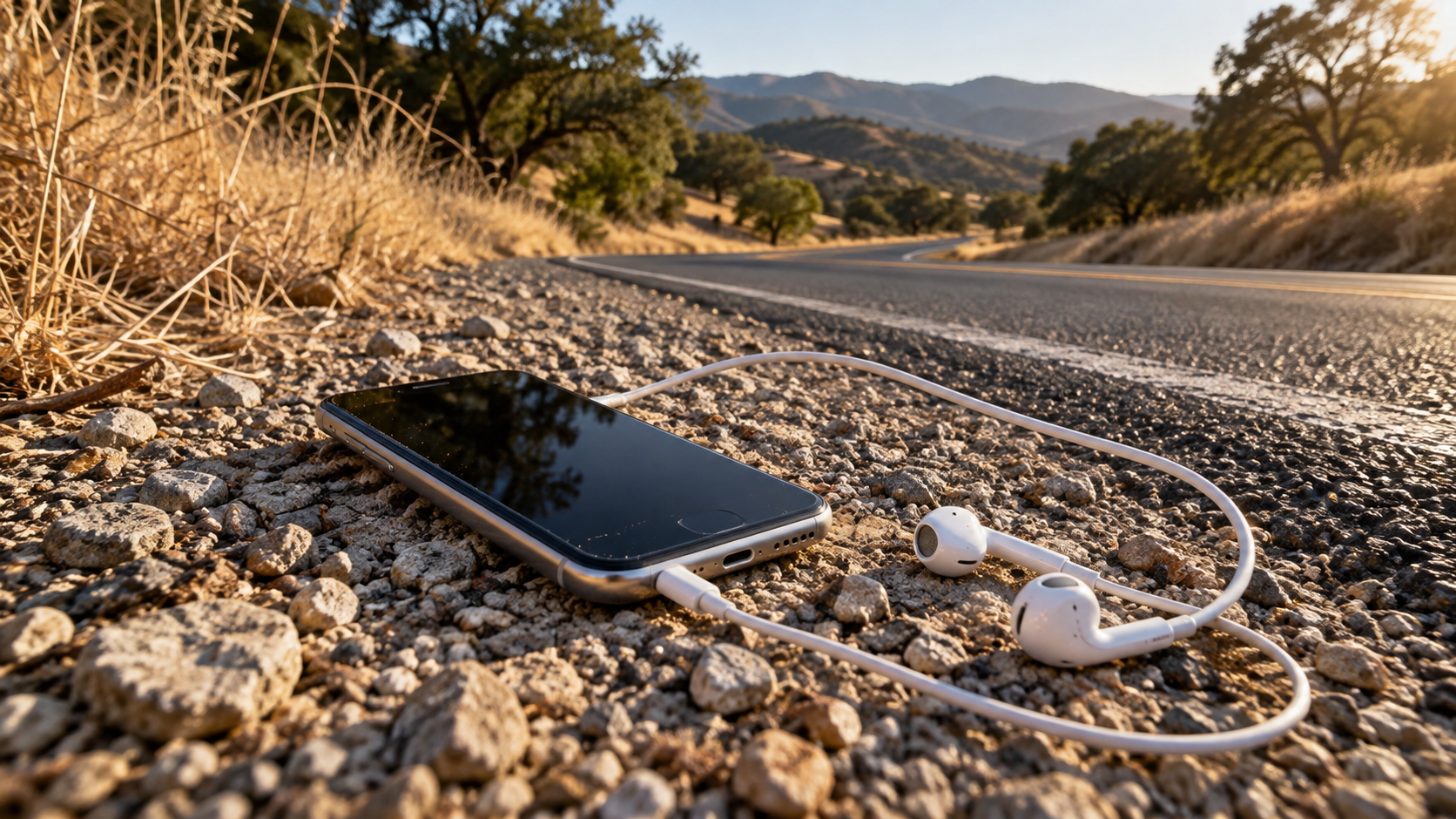
Why Was Sherri Papini’s Phone Beside The Road When She Was Nowhere To Be Found?
Keith Papini returned home from work on 2 November 2016 expecting to find his family. Instead, his wife was absent and their two young children had not been collected from daycare. When he checked the location of Sherri’s iPhone, the signal led him towards a road near their home in northern California.
He found the phone and earbuds near Sunrise Drive and Old Oregon Trail, about two feet from the roadway. Blond hairs were tangled in the earbuds. According to the FBI’s later affidavit, Keith thought the phone looked as though it had been placed there, an arrangement he found strange.
That observation did not explain where Sherri had gone. It could not establish whether somebody had attacked her, whether the phone had fallen during a struggle, or whether it had been left deliberately. The object gave investigators a location. The person who could explain it was missing.
At approximately 5.50pm, Keith reported her disappearance. Sherri was 34, a mother of two living in the Mountain Gate area of Shasta County, near Redding. She had last been seen running on Sunrise Drive and was believed to have disappeared between 10am and midday.
The distance between those two moments mattered. Several hours had passed between her last reported sighting and the missing-person report. Investigators needed to reconstruct an ordinary morning without knowing which part of it had ceased to be ordinary.
Her purse and jewellery were accounted for at home. A walkthrough of the residence revealed nothing obviously out of place. There was no immediate answer waiting inside the house, and the roadside discovery did not identify a vehicle, a destination or another person.
The Shasta County Sheriff’s Office requested FBI assistance. A local absence became a much wider investigation, with searches across the county and beyond California. Hundreds of tips arrived. Potential evidence was collected, but none of it led searchers to Sherri.
The Search Extended Beyond The Roadside
Investigators also examined Sherri’s relationships and communications. This was necessary work in a disappearance: a missing person’s movements may be explained by an acquaintance, an appointment, a journey or a conversation that those closest to them know nothing about.
Her phone contained two numbers stored under women’s names that belonged to men. One exchange, on the day before she disappeared, concerned a possible meeting in Redding. Travel records showed that the man involved had visited California and returned to Michigan on 2 November.
Investigators travelled out of state to interview him. He said that he and Sherri had known each other for years and exchanged flirtatious messages, but that the proposed meeting had not happened. They did not find Sherri with him.
The lead illustrates why a striking discovery is not necessarily an explanation. A concealed contact could justify further enquiries without proving involvement in a disappearance. Investigators had to check the encounter against travel records and testimony rather than turn an intimate secret into a criminal conclusion.
Meanwhile, a friend helped establish a fundraising campaign to support the search. Its appeal depended on an urgent, understandable premise: a family needed help bringing a missing woman home. People outside the investigation could contribute money, circulate information and watch for sightings, but they could not independently verify what had happened.
The search therefore developed on two tracks. Publicly, the priority was finding Sherri. Privately, investigators were assembling a fuller picture of her life, checking relationships and testing possible explanations. Neither task could safely wait for the other to finish.
Twenty-two days passed without her being located. Then, early on Thanksgiving morning, emergency calls began arriving from another part of California.
A Woman On Interstate 5
At approximately 4.30am on 24 November, the California Highway Patrol responded to reports of a woman standing or running in the roadway near Woodland. A truck driver stopped and called for assistance. The woman was Sherri Papini, roughly 146 miles south of where she had disappeared.
Her condition required medical attention. A chain encircled her waist, with one arm bound to it; additional bindings were around her other wrist and her ankles. Her long hair had been cut substantially shorter, and she appeared to have lost considerable weight.
At Woodland Hospital, examinations documented a swollen nose, facial bruising, rashes, marks around the wrists and ankles, burns on the left forearm, and bruising around the pelvis and the fronts of both legs. A brand was visible on her right shoulder, although the affidavit described its exact content as indistinguishable.
These were physical findings, not simply details in an account. They established that her body had sustained injury. They did not, by themselves, identify who had caused those injuries, the circumstances in which they occurred, or whether every mark belonged to the same event.
That distinction would become central. A burn can establish contact with heat without identifying the person holding the object. A ligature mark can indicate pressure from a binding without establishing who applied it. The medical evidence needed an accompanying reconstruction that could survive independent checks.
Hospital staff collected her clothing for forensic examination, including her sweatshirt, sweatpants, socks and underwear. Sherri told investigators that the underwear was the same pair she had worn when she disappeared. Preserving those garments created an evidential record that would remain available long after bruises faded.
For her family, the immediate fact was that she was alive. For detectives, finding her changed the investigation’s purpose. They now needed to determine where she had spent those weeks, how she had reached Woodland, and whether anybody remained a danger to others.
The Account She Gave Investigators
Sherri said that two Hispanic women had abducted her at gunpoint. In her account, a dark SUV had passed her while she was jogging and then returned. She described being taken away and held captive, with an older woman behaving more violently than a younger one.
She said the women spoke Spanish and concealed their faces. Those were allegations from her account, not independently established descriptions of identified offenders. The distinction matters because their apparent specificity gave investigators something to pursue while leaving the existence and identities of the alleged abductors unverified.
Sherri was initially reluctant to speak directly with officers. According to the affidavit, she said her captors had suggested that law enforcement was involved. At the hospital and during an ambulance journey, Keith asked questions while investigators remained present and recorded the exchange.
Her account supplied more than descriptions of people. Over subsequent interviews, she described rooms, furniture, a closet, a bathroom and the circumstances in which she said she had been injured. Such details could potentially help locate a property or test whether a witness had encountered the same surroundings.
The investigation required patience as well as scepticism. An injured person’s incomplete recollection cannot fairly be treated as automatic evidence of dishonesty. Equally, an explanation does not become independently corroborated merely because it includes distressing or unusual details.
Detectives needed evidence outside the interview room: a location consistent with her descriptions, a vehicle connected to her movements, witnesses who had seen her, or forensic material identifying somebody who had been in contact with her clothing.
There was also a public consequence to the account. Police resources were directed towards identifying women matching the descriptions she supplied. Once circulated, an allegation can shape what members of the public notice and report, even before investigators establish whether its central premise is accurate.
At this stage, the injuries and her account appeared to concern the same experience. Whether they actually supported the same explanation remained a question for the investigation.
The Unidentified Man In The Forensic Results
Laboratory examination found mixtures of DNA consistent with Sherri and an unidentified male contributor on portions of her underwear and sweatpants. The male profile was not Keith’s. Investigators now had a biological lead that did not depend upon Sherri remembering a face or recognising a photograph.
The result did not establish that a man had abducted her. DNA identifies a possible source of biological material; interpreting how and when that material reached an item requires additional evidence. It does not provide a complete account of the encounter that produced it.
The affidavit also recorded a separate finding of sperm or partial sperm on clothing. It expressly cautioned that the male DNA material analysed could have come from sperm or another source. Treating the profile as conclusive proof of a sexual relationship would go beyond that record.
The unidentified profile was entered into the Combined DNA Index System, known as CODIS, and checked against other profiles. Initially, it did not supply investigators with the direct identification they needed. A potentially important trace remained attached to an unknown person.
In September 2019, detectives requested a familial DNA search through the California Department of Justice. Instead of seeking only a direct match to the unknown contributor, this approach could identify a possible biological relative and give investigators a family connection to examine.
In March 2020, the search produced a potential relative with two living biological sons. One was a former boyfriend of Sherri’s. Investigators established historical connections between them, including a shared email account and financial transactions.
This was a lead requiring confirmation, not a genetic verdict. A possible relative in a database could narrow the search, but investigators still needed to determine whether the particular man they were examining was the source of the material recovered from Sherri’s clothes.
In June, agents collected discarded items from outside his Costa Mesa residence. Among them was a drinks bottle. The laboratory subsequently reported that DNA recovered from its mouth area matched the previously unidentified male profile.
The investigation had moved from an unknown biological trace to a specific person and address. It still needed to establish what that connection meant.
An Address That Could Be Checked
On 10 August 2020, investigators interviewed the former boyfriend, later publicly identified as James Reyes. His account placed Sherri at his home during the period when others were searching for her. It gave detectives a concrete alternative location to examine.
Reyes was not an independent observer with no personal stake. He knew Sherri, had been involved with her previously, and described conduct that required careful investigation. His account needed corroboration rather than acceptance simply because it contradicted hers.
Investigators compared the property with details Sherri had previously supplied. A closet with a pole passing through shelving, the arrangement of a bathroom and features of a window offered points of comparison. A table visible in social-media material also resembled one she had described.
An ordinary item of furniture is rarely unique. Nor does a similar bathroom layout identify a house on its own. The evidential value lay in the accumulation of correspondences alongside the DNA connection, rather than any single resemblance being treated as decisive.
Phone records provided another way to test the account. Investigators documented communications between Sherri and Reyes before the disappearance. They also examined prepaid phones that, according to the affidavit, had been used to communicate between their respective areas.
Historical cell-site analysis indicated that the relevant phones travelled south from the Redding area along Interstate 5 on the day she disappeared. The records also showed a text exchange that morning. These findings gave detectives a sequence against which to compare what they had been told.
Cell-site data does not ordinarily place a handset at an exact point with the precision of a continuously recorded GPS route. A device’s movement also requires evidence connecting it to its user. The significance here was the alignment of communications, broad travel patterns and other records.
Investigators checked rental vehicles and work schedules as well. Reyes’s time off coincided with the relevant journey, while rental documentation supplied independently recorded dates. Records surrounding Thanksgiving included a vehicle driven approximately 927 miles, a distance consistent with the described round trip towards Woodland.
No odometer reading can identify a passenger or establish consent. But records made by unrelated businesses are useful precisely because they were not created to answer a detective’s later questions. They can support or undermine a witness’s chronology without relying on that person’s memory.
What Other People Had Seen
Reyes’s cousin supplied another account. According to the affidavit, the cousin had seen Sherri at the residence twice during the period of her disappearance. On one occasion she was at a window; on another she was in the living room before moving into a bedroom.
Investigators described those sightings as showing her without restraints. That observation was relevant, but its limits also mattered. Seeing somebody unbound during a brief encounter does not, in isolation, establish that they are free from coercion or able to leave safely.
What the sightings could support was narrower and still significant: another person placed Sherri inside the property during the relevant weeks. That was independent support for her presence there, separate from the laboratory result and Reyes’s own description.
Other parts of the cousin’s account concerned things Reyes had said. Those statements had a different evidential character. Repeating somebody else’s explanation is not the same as witnessing the event, even when both appear in the same police interview.
This separation helps explain why the case could not responsibly be reduced to one man contradicting one woman. Investigators were combining different kinds of material: physical traces, personal testimony, business records, telephone analysis and details Sherri herself had provided before the address was identified.
The strongest comparisons involved information already on record. If an earlier description matched a subsequently located feature, investigators could examine that correspondence without relying entirely on a new recollection offered after the discovery.
By August 2020, they had enough material to put specific questions to Sherri. The next interview would test her account against an address, photographs and records she had not previously been asked to explain together.
The Photographs In The Interview Room
On 13 August, an FBI agent and a sheriff’s detective interviewed Sherri with Keith present. At the outset, investigators warned her that lying to federal officers was a crime. The interview was recorded and later described extensively in the criminal affidavit.
They first asked about the women she had reported. Sherri continued to distinguish the younger woman from the older one. Investigators then introduced photographs and asked her to compare them with the surroundings she had described.
When shown the closet, she acknowledged similarities but said it was different. She recognised aspects of the bathroom’s arrangement while disputing its appearance. When she mentioned a crack in the tiling, investigators showed a photograph of cracked tile at the property.
Those exchanges were more useful than an attempt to read guilt from her expression. A person’s discomfort during questioning can have several explanations. The investigators had something more concrete to examine: whether her descriptions and denials were consistent with independently documented features.
They told her they had identified the house and spoken with people who knew she had been there. Sherri asked to speak with Keith, and the investigators temporarily left them together. When questioning resumed, the discussion returned to the DNA and her contact with Reyes.
She denied that he had collected her at her request. She also denied communications that investigators said were established by telephone records. Later in the interview, she acknowledged some earlier contact, but she did not withdraw her account of abduction by two women.
The interview created a fresh evidential issue. Investigators were no longer examining only statements made immediately after her return, when injury and distress might complicate recall. They were testing specific assertions made years later, after warnings and direct presentation of contrary evidence.
Her account also had an administrative life beyond the investigation. The California Victim Compensation Board had made payments for services connected to the reported abduction, including therapy and ambulance costs. The affidavit recorded payments totalling $30,694.15 between 2017 and 2021.
Those payments were not all cash handed to Sherri for unrestricted spending. Some were payments for treatment or reimbursement of expenses. Their importance was that public money had been disbursed on the basis of the reported crime, creating a separate question about the representations supporting those claims.
More than a year passed after the August interview before the federal case reached its next public stage. On 3 March 2022, Sherri was arrested. The supporting affidavit brought the investigative record into public view, but an arrest and a prosecutor’s allegations were not themselves the final legal answer.
What The Evidence Ultimately Established
On 18 April 2022, Sherri Papini pleaded guilty to one count of mail fraud and one count of making false statements to federal agents. The resolution established that the kidnapping account she had maintained was a hoax: she had voluntarily stayed with her former boyfriend while her family and investigators searched for her.
The evidence explained why genuine injuries had accompanied a false account. According to Reyes’s statement in the affidavit, Sherri deliberately injured herself, cut her hair and asked him to help create injuries, including the brand. He described using a wood-burning tool at her request.
That account should not be flattened into a claim that she personally inflicted every mark without assistance. Investigators considered his knowledge of details not publicly disclosed, then tested his broader account against the telephone, vehicle and physical evidence. The prosecution’s reconstruction rested on that combined record.
Reyes said Sherri eventually wanted to return because she missed her children. He described driving her north before she reappeared near Woodland. Her disappearance had generated a real emergency, but the two women she accused were not the explanation for it.
On 19 September 2022, US District Judge William B. Shubb sentenced Papini to 18 months in prison, followed by 36 months of supervised release. She was ordered to pay approximately $309,902 in restitution to agencies including the victim compensation board, Social Security Administration, sheriff’s office and FBI.
The offences were specifically mail fraud and false statements, rather than a conviction for an offence simply called “faking a kidnapping”. That legal distinction explains why the later interview and the payments mattered alongside the original disappearance.
Her prison confinement ended in 2023 with a transfer to community confinement. Her marriage also ended, and subsequent reporting described continuing disputes over contact with her children. Those family proceedings concerned separate decisions about the children’s welfare, not a retrial of the federal charges.
In 2025, Papini publicly advanced a different account through interviews, a documentary and her book. She alleged that Reyes had actually abducted her and that she had lied about the identity of her captors. She also alleged abuse by Keith, who vehemently denied it.
Reyes had previously denied her allegations and was not charged with a crime. Her later account conflicts with the account underlying her guilty plea; it is not an established replacement for it. No verified reversal of her federal convictions was located in the records reviewed for this article.
Financial enforcement was still producing court activity in 2026. A public docket records a government application for a continuing writ of garnishment on 2 September, linked to her criminal case. The entry establishes that an application was filed, not the eventual ruling, the amount recovered or her current outstanding balance.
The record does not justify diagnosing Papini from a distance or claiming complete knowledge of her motives. It does establish repeated deception sustained through interviews and claims for assistance. The persistence of that conduct is observable; a definitive explanation of her inner life is not.
Nor should this case become a shortcut for disbelieving another person who reports violence. Its resolution depended on evidence particular to Sherri Papini, not on an assumption that an unusual account must be false. The false identification of Hispanic women made careful verification more necessary, not less.
The phone beside the road had provided a place to begin, but it could never explain the missing weeks by itself. That explanation emerged from records created elsewhere: a laboratory profile, communications between phones, vehicle paperwork and the features of a house hundreds of miles away. For the family who had waited for her, finding Sherri and learning what had happened were separated by years.
Sources
FBI Criminal Complaint And Supporting Affidavit, 3 March 2022 — US Department Of Justice. Primary investigative record supporting the chronology, medical findings, laboratory work, witness accounts, telephone analysis and interview details.
Arrest Announcement, 3 March 2022 — US Attorney’s Office, Eastern District Of California. Documents the arrest, allegations and agencies involved.
Sentencing Announcement, 19 September 2022 — US Attorney’s Office, Eastern District Of California. Confirms the plea dates, offences, sentence and restitution.
Sherri Papini Sentenced To 18 Months In Prison, 19 September 2022 — ABC News. Independent reporting on the sentencing hearing.
Sherri Papini Claims Ex-Boyfriend Abducted Her, 20 June 2025 — ABC News. Reports her later allegations alongside relevant denials and legal context.
Where Is Sherri Papini Now?, 14 May 2026 — Biography. Supports the post-prison chronology and subsequent family proceedings.
Why Sherri Papini Faked Her Disappearance, Updated 16 July 2026 — A&E. Provides additional reporting on the divorce and continuing custody dispute.
United States Of America v. Papini, Filed 2 September 2026 — Justia Dockets. Records the subsequent garnishment application; the public entry does not establish its eventual outcome.
Next Reads
Natalee Holloway: The Missed Flight And The Investigation Across Three Countries — Another disappearance in which competing accounts required years of investigation.
Sydney Loofe’s Disappearance: The Phone Records That Led Into Rural Nebraska — Follow how digital records helped investigators examine movements and relationships.
Clown Panic: What Happened During The 2016 Killer Clown Scare? — Explore the difficulty of separating reported threats, public fear and independently verified events.
