The Jigsaw Puzzle Murder
How Could Detectives Identify A Man Whose Family Had No Reason To Report Him Missing?
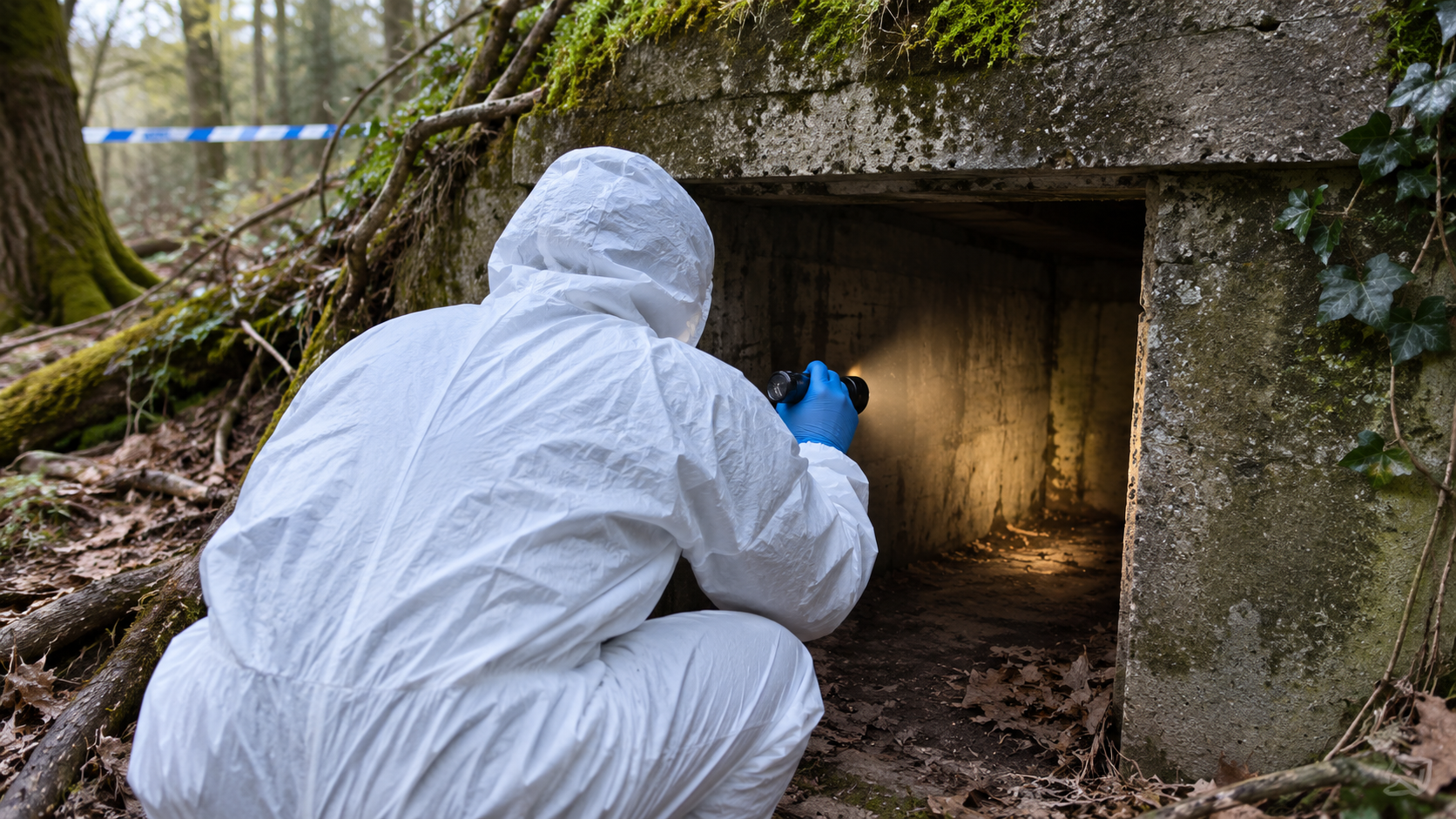
On 4 April 2024, a member of the public discovered human remains at Kersal Dale in Salford. They had been wrapped in clear plastic and left in a secluded concrete bunker. The recovered section included part of a man's lower torso. There was no face through which an appeal photograph could immediately put a name to him.
The discovery created several investigations at once. Detectives needed to establish whose remains they had found, where the person had died, how the remains had reached the nature reserve and whether other locations held evidence. A place where a body is discovered is not necessarily the place where a life was taken.
Nor could investigators assume that someone had already reported this man missing. A missing-person inquiry can supply photographs, medical information, names of friends and a last confirmed sighting. Here, officers began with the physical evidence in front of them and an unknown life beyond it. They needed to work backwards from a location that might represent only one brief stop.
That investigation is the subject of The Jigsaw Puzzle Murder, the two-part Minnow Films documentary announced for Paramount+ on 12 November 2026. Behind its title lies a case built from separate kinds of evidence: surveillance recordings, journeys, household objects, electronic communications and material recovered from water. None could be understood properly without the others.
The first question was not simply who had done something to this man. It was why nobody who loved him appeared to know that he needed finding.
A Heavy Bag On A Familiar Path
Police began examining CCTV around the discovery site. Footage from 2 April showed a man approaching the area with a substantial blue shopping bag. Later footage showed him leaving with the bag apparently empty and folded. The difference between those two appearances gave investigators a specific journey to examine.
In ITV's account of the investigation, Detective Sergeant Heidi Cullum described why the man attracted attention. He appeared to struggle with the load, moved it between his hands and paused. The recovered remains had considerable weight. His movements therefore fitted something investigators were actively looking for, although the pictures did not show what the bag contained.
That limitation mattered. Carrying a heavy bag into woodland is not proof of murder. Even a return journey with an empty bag leaves unanswered questions about its contents, the purpose of the visit and the identity of the person carrying it. The recording offered a lead to test, rather than a complete explanation to accept.
The useful next step was to connect that short sequence to a longer route. Investigators traced bus travel and examined further footage. A bus journey could link one camera location with another, while ticket information could help identify additional movements. The inquiry began to extend beyond the paths surrounding Kersal Dale.
This was painstaking work with a practical deadline. Recordings could be overwritten before police obtained them. An image which seemed unimportant on the day it was made might become vital only after another camera supplied a connection. Retrieving footage and understanding it were separate tasks, and both had to continue while the identity of the man remained uncertain.
The case also illustrates the difference between seeing something and recognising its significance. Cameras had already recorded the journey. What they could not do was identify the moment investigators should pay attention to, explain the burden being carried or connect it to the discovery two days later. Those links depended on people comparing evidence.
Recognition On A Salford Street
On 25 April, the search for a face in recorded footage became an encounter with a man in the street. An investigator working on the inquiry recognised someone who resembled the person the team had been tracing. Police were alerted, and the man was arrested while travelling on a bus.
His name was Marcin Majerkiewicz. He lived in a shared house on Worsley Road in Winton. According to the Crown Prosecution Service, officers found him carrying a mobile phone and bank cards belonging to another man: Stuart Everett. Enquiries then turned towards that man's whereabouts and his connection with the address.
An arrest did not settle the case. The identification from footage had to be supported, the property in Majerkiewicz's possession had to be explained, and the house needed examination. But investigators now had something they had lacked at the beginning: a named person whose recent movements and domestic circumstances could be checked against the unidentified remains.
Police established that Stuart had not been seen for weeks. Forensic DNA testing subsequently identified him as the man whose remains had been recovered. The inquiry had crossed an essential threshold. A discovery that had first been described through anatomy and location could now be connected to a person's history, relationships and home.
The route to that identification is worth noticing. Investigators had not simply started with Stuart's name and located the remains through his known contacts. Their enquiries into an unidentified man's death had led through surveillance to a suspect, then to a shared address and an absent resident. The direction of the investigation shaped everything they could ask next.
It also changed the meaning of the communications still associated with Stuart. Before identification, a message from his phone could look like ordinary contact. Afterwards, investigators had to establish who had actually been using it, when and for what purpose.
The Life Behind The Name
Stuart Everett was 67. Born Roman Ziemacki to Polish parents and originally from Derby, he was known within his family as Benny. He had worked for the NHS and the Department for Work and Pensions. His interests included gardening, cricket, horse racing and the music of Frank Sinatra and Dean Martin.
These details place him outside the language of the investigation. A victim's name can become attached so firmly to a crime that the person seems to have existed only in the circumstances of their death. Stuart had a working life, particular tastes, family habits and friendships that preceded anything detectives were now trying to reconstruct.
He had lived at the Worsley Road property since 2013 and sublet its other bedrooms. Majerkiewicz moved in during 2017. This was therefore an established household, rather than an encounter between strangers. Understanding its arrangements mattered because access to rooms, possessions and everyday information could have innocent explanations as well as potentially significant ones.
A third resident, Michal Polchowski, was initially charged in the investigation. The case against him was discontinued in February 2025. That outcome must remain clear whenever his earlier arrest is discussed: living at the address and coming under suspicion did not establish participation in Stuart's death.
His presence also makes the evidential task more demanding than a simple association between one suspect and one property. Investigators had to distinguish individual actions within shared surroundings. Who controlled a particular phone? Whose room contained a particular item? What could be established about a person's movements, rather than assumed from their address?
In their early tribute, Stuart's family described someone who placed relatives and friends first. They thanked people for the support they had received. Their account supplied a necessary counterweight to the expanding map of search locations: every discovery concerned a man whose absence would permanently change an existing circle of lives.
Messages That Made An Absence Look Ordinary
Stuart's family had not reported him missing. Police later explained that communications appearing to come from him had continued, including WhatsApp messages and birthday correspondence. The prosecution described accounts suggesting that he had suffered a stroke and was in hospital. His relatives were being given reasons for altered contact, rather than silence without explanation.
The distinction helps explain why the absence of a missing-person report was not evidence of indifference. Families normally interpret messages within a history of trust. They do not approach every familiar number as a possible impersonation. A plausible explanation for someone being unavailable can postpone concern, particularly when other signs of ordinary contact continue.
For investigators, however, receipt of a message and proof of its authorship are different things. A handset can send words while its owner is elsewhere. A familiar account can remain active without the person associated with it controlling the conversation. The important question was no longer whether Stuart's phone had been used, but whether Stuart had used it.
The birthday card added a physical object to that problem. Unlike a text, it could be held, kept and revisited. It appeared to belong to the familiar routine of remembering a relative's birthday. Its significance depended on who had sent it and when, not merely on the name presented to its recipient.
This was a form of evidence that reached in two directions. Communications could help reconstruct what others had been led to believe, while device examination could help establish the activity behind that impression. The emotional meaning to the family and the investigative meaning to detectives were different, but both came from the same exchanges.
There is no need to turn that observation into a general warning to distrust loved ones. The point is narrower: apparently continuing contact cannot independently confirm a person's safety when investigators have evidence that somebody else may possess their phone. Here, the account of Stuart's whereabouts had to be tested against material evidence.
What The House Concealed Beneath Its Surface
At Worsley Road, police encountered a house that had been partly cleared, with a skip outside. Its surface appearance did not immediately present an obvious crime scene. Examination beneath the carpet in Majerkiewicz's bedroom, however, revealed blood staining extending into the underlay and floorboards. Investigators also identified a replaced section of carpet.
Other enquiries followed furniture removed from the property to a lock-up in Bury. Police reported finding Stuart's blood on a sofa bed associated with the bedroom and his DNA in a fridge-freezer. These findings connected the missing man to items which had been moved away from the house.
Blood evidence requires context. Its presence can associate an injured person with an object or place, but a stain does not narrate an assault by itself. Investigators have to consider its distribution, surrounding marks, the condition of the item and other evidence. The significance here lay in the relationship between several findings, rather than a single positive test.
The replacement carpet was important for a related reason. A room's current appearance and its previous condition need not be the same. A surface can look ordinary while material beneath it retains evidence. Examining separate layers allowed investigators to compare what was visible with what had survived beyond casual view.
Removed furniture created another route through the inquiry. Disposal or relocation does not necessarily end an object's evidential history. If investigators can trace an item and establish where it previously stood, examination elsewhere can still contribute to understanding the original room. That makes the record of movement important alongside the laboratory finding.
None of this meant that household familiarity alone proved responsibility. Shared homes contain legitimate contact, overlapping routines and possessions moved for ordinary reasons. The task was to identify a combination that ordinary cohabitation could not adequately explain. The developing case brought the property evidence into conversation with the journeys, the recovered remains and the phones.
A Search Extending Across Land And Water
The investigation expanded to locations including Boggart Hole Clough, Linnyshaw Colliery Wood and Blackleach Reservoir. Police compared phone information with recorded journeys to guide searches. At the reservoir, underwater examination recovered a hacksaw with Stuart's blood on its blade and separate pieces of his skull.
Those were different kinds of discoveries. A tool could connect an object with the victim; skeletal remains could carry evidence of injury. Neither should be treated simply as another item added to a dramatic inventory. Each required examination to establish what it could contribute and what remained uncertain.
Location evidence likewise needed careful handling. Information associated with a phone does not automatically supply an exact position for its owner at every moment. Its value increases when it can be checked against other records. In this inquiry, the interaction between movement data, CCTV and physical searches helped investigators decide where to concentrate their efforts.
The searches continued beyond the initial arrests. In June 2024, police announced further methodical work around Worsley Woods and the Roe Green Loopline. Residents were asked to avoid the area while specialist teams worked. The investigation was still dealing with places that needed careful examination long after the first discovery had generated headlines.
That continuing work served more than the preparation of a prosecution. Finding a sufficient evidential basis for a charge does not answer every question about a person's remains. Recovery can matter to a family even when an additional discovery makes little difference to the legal case. The two purposes overlap, but neither makes the other unnecessary.
Police eventually described nineteen search areas and crime scenes. Evidence or remains were recovered from fifteen of them, but only about a third of Stuart's body was found. Those figures should not be confused: a location yielding evidence was not necessarily a location yielding human remains. A map of the inquiry was larger than a map of the recoveries.
What The Separate Pieces Could Establish
By the time the case reached court, the prosecution could draw on more than 2,000 hours of CCTV, approximately 3,000 exhibits and over 450 witness statements. The scale was substantial, but quantity alone was not the point. The question was whether the material formed a reliable account of what had happened and who was responsible.
The case involved evidence of movement, identity, injury and concealment. Those categories answered different questions. Footage could place a person on a route without showing the contents of a bag. DNA could associate remains with Stuart without independently identifying an assailant. Communications could show an account being used without proving that its named owner was speaking.
The strength of a combined case depends on those limitations being respected. If investigators treat every clue as proof of everything, the argument becomes circular. If they identify what each piece actually establishes, they can test whether the pieces independently support the same explanation. Here, the prosecution relied on their connection rather than claiming that one recording captured the whole crime.
Majerkiewicz denied responsibility and did not give evidence in his defence. That did not relieve the prosecution of its burden. A defendant's failure to provide a public explanation cannot substitute for proof of the offence charged. The court still had to evaluate the affirmative case presented against him.
The discontinued case against Polchowski also prevents the household from being treated as a single guilty unit. A prosecution must establish responsibility individually. The same address can connect people to an investigation while the evidence supports very different conclusions about their involvement. Preserving that distinction is essential to an accurate account of this case.
Another distinction concerned what happened before death and what happened afterwards. Evidence of dismemberment can establish treatment of a body, but it does not by itself establish the fatal injury. The recovered skull therefore had a significance beyond identification. Its examination could address a question that footage of later journeys could never answer: what physical violence had caused Stuart's death?
What The Evidence Finally Revealed
On 21 March 2025, a jury at Manchester Crown Court found Marcin Majerkiewicz guilty of murdering Stuart Everett. The evidence established that Stuart had been subjected to repeated blows to the head with a heavy blunt implement. Examination of the recovered skull showed severe fractures consistent with that sustained assault.
In his sentencing remarks, Mr Justice Cavanagh placed the attack in Majerkiewicz's bedroom on the night of 27 March 2024. He found at least four blows to the top and back of Stuart's head, probably inflicted with a hammer. The judge also stated that there was no evidence that dismemberment occurred while Stuart was alive.
That qualification matters. The condition of recovered remains can invite speculation about suffering that the medical evidence does not support. The documented killing was already extremely violent; its seriousness does not depend on adding an imagined sequence. The assault and the subsequent destruction of the body were distinct parts of the established events.
The court's findings also resolve a discrepancy in some coverage. News reports described the motive as unclear, but the sentencing judge expressly found a planned murder for financial gain. Sky's sentencing report records debts of £60,000 in loans and about £14,000 on credit cards, alongside the judge's conclusion that Majerkiewicz intended to exploit Stuart's money.
It would therefore be misleading to present the motive as something no court had addressed. Equally, the finding should be attributed to the judge rather than presented as a confession. A judicial conclusion drawn from evidence and a perpetrator's personal explanation are different forms of knowledge. This case supplied the former without the latter.
The communications after Stuart's death were part of an impersonation. Majerkiewicz used the appearance of continuing contact to delay recognition of the loss. The family had not failed to notice an unexplained disappearance; they had been deliberately supplied with a false account. That answers the question with which the investigation began, without placing responsibility on those who trusted the messages.
On 28 March 2025, Majerkiewicz received a life sentence with a minimum term of 34 years, subject to credit for time on remand. The minimum is the point before which release cannot be considered, not a promise of freedom afterwards. The sentencing remarks explain that any eventual release depends on the Parole Board and would remain subject to a life licence.
The physical recovery could not restore everything that had been lost. Stuart's brother Richard described how family photographs and documents had been thrown away during the clearance of the house. Stuart had kept records of their parents, who survived a concentration camp during the Second World War before coming to Britain. Their destruction removed irreplaceable parts of the family's history.
That loss sits outside the usual measurements of a criminal investigation. An exhibit can be recorded, an offence proved and a sentence imposed. None of those processes recreates a photograph which no longer exists or returns a family member to the gathering where he is missing. The damage extended beyond the evidence the court needed.
As of 3 November 2026, the forthcoming documentary offers another public account of the investigation; its announcement is not a new judicial finding. The established legal outcome remains the murder conviction and life sentence. The programme also promises Polchowski's account, making it particularly important that his discontinued prosecution is not repackaged as unresolved suspicion.
For Richard, the continuing relationship with his brother has a quieter expression. In the family's published tribute, he described Stuart's ashes on the fireplace and the way he touches the urn each morning to say good morning. After months in which investigators worked to identify, recover and explain, that ordinary greeting belongs to the family again.
Sources
R v Marcin Majerkiewicz: Sentencing Remarks, 28 March 2025 — Courts And Tribunals Judiciary: Primary record for the judge's findings, medical qualifications and sentence.
Building The Case Against Marcin Majerkiewicz — Crown Prosecution Service: Prosecution account of identification, communications, arrest and the discontinued second case.
Investigation And Verdict Report, 21 March 2025 — Greater Manchester Police: Property examinations, reservoir discoveries and investigative totals.
Sentencing And Recovery Report, 28 March 2025 — Greater Manchester Police: Search scale, recovery limits and identification work.
How Thousands Of Hours Of CCTV Helped Police — ITV News: Investigator interview about footage, the shopping bag and bus enquiries.
Court And Biographical Reporting, 28 March 2025 — ITV News: Stuart's background and household history.
Trial Reporting, 21 March 2025 — ITV News: Trial position, forensic reporting and contemporary descriptions of motive.
Sentencing Report, 29 March 2025 — Sky News: Financial evidence and the judge's finding concerning gain.
Further Searches, 14 June 2024 — PA/The Standard: Continuing examination of Worsley Woods and the Roe Green Loopline.
Family Tribute, 3 May 2024 — Greater Manchester Police: The family's early account of Stuart's character and interests.
Family Tribute, 28 March 2025 — Greater Manchester Police: Family history, destroyed records and Richard's remembrance of his brother.
The Jigsaw Puzzle Murder Announcement, 29 October 2026 — Royal Television Society: Documentary identity, production and announced release date.
Next Reads
Sherri Papini: The Missing 22 Days And The Evidence Left Behind — Another investigation in which accounts had to be tested against independent evidence.
Ross MacGillivray: What Happened Inside The Inverness House? — Follow enquiries connecting a domestic scene with movements beyond it.
Sydney Loofe’s Disappearance: The Phone Records That Led Into Rural Nebraska — Explore how digital records helped direct a physical search.
