True Crime: American Nightmare — The Bedroom, The Ransom, And The Wrong First Theory
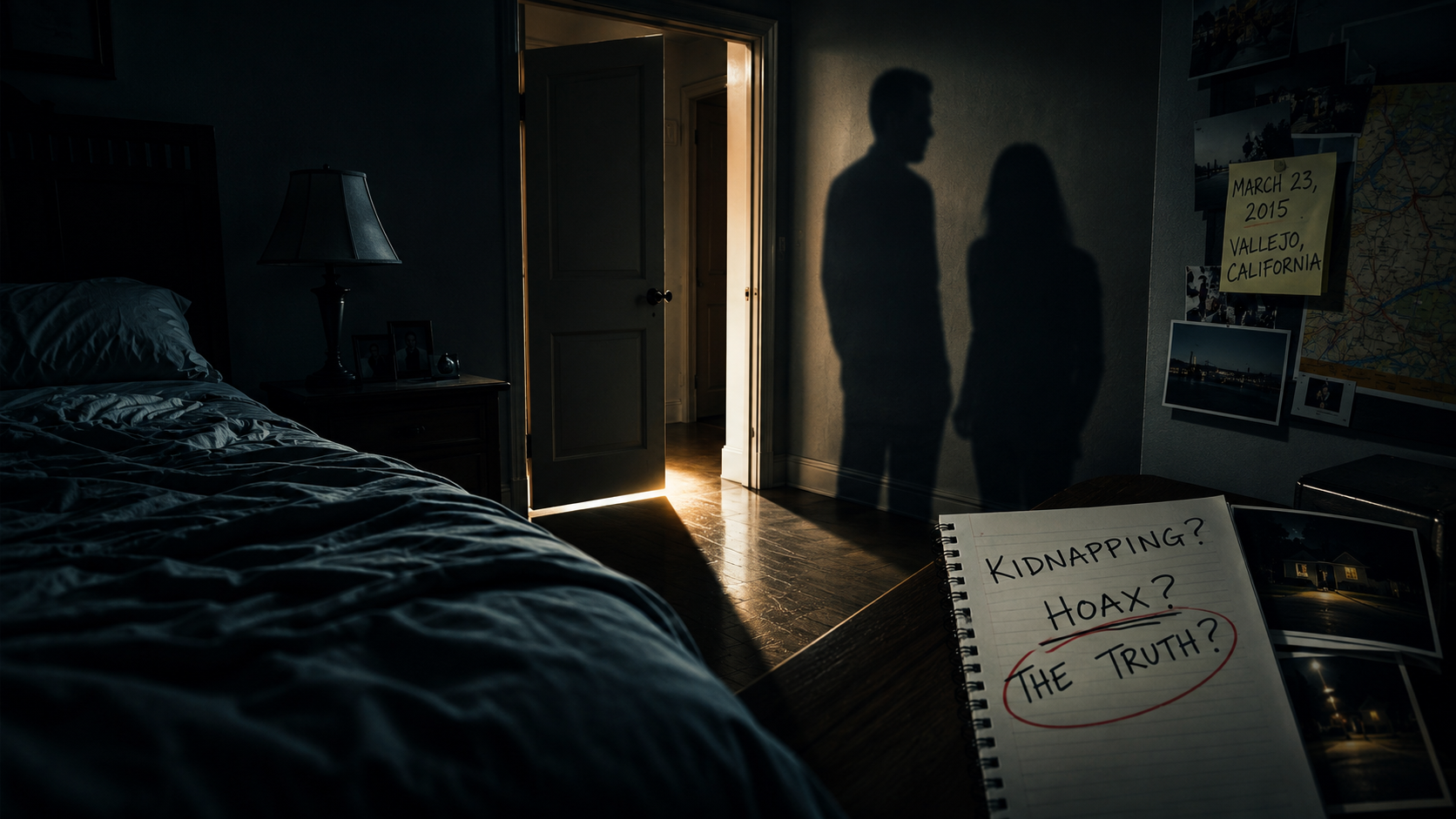
The Mare Island Bedroom And The Case That Changed Meaning
The Case Behind The Real-Life Gone Girl Label
The room did not look like the beginning of a national accusation.
It was a home on Mare Island in Vallejo, California, in the early hours of March 23, 2015. A couple were asleep. Then came light, instructions, restraint, and a story so strange that the people who most needed to be believed soon found themselves treated as suspects.
At first, the case seemed to turn on one impossible question: could an abduction really have happened in the way Aaron Quinn described it?
This is the case behind American Nightmare: a story about a kidnapping, a police assumption, a public label, and the long distance between being alive and being believed.
The Life Before The Case
Denise Huskins and Aaron Quinn were not public figures before March 2015. They were physical therapists, dating for less than a year, building an ordinary relationship around work, routine, and the private complications that come with real life.
That matters because the public version later flattened them into roles. Aaron became “the boyfriend.” Denise became the woman whose story was doubted. Their relationship became an investigative theory before it was allowed to be a human relationship under stress.
The case did not begin with an online mystery or a documentary camera. It began with two people in a house, asleep, unaware that their private lives were about to be pulled into police interviews, headlines, legal filings, and public suspicion.
The first damage was physical and immediate. The second damage was reputational. The third was slower: the knowledge that even after surviving the event, they would still have to prove they were victims.
The People Around Them
The supporting cast in the Vallejo case became important because the investigation moved quickly from emergency to suspicion. Police looked at Aaron. Public attention moved toward Denise. A past relationship detail entered the conversation. Family members became part of the practical search for help.
That is how many investigations work: detectives test the closest relationships first. The problem in this case was not that police asked hard questions. The problem was how quickly one theory appeared to harden around the people reporting the crime.
Aaron had waited hours before calling police. That delay became one of the central reasons investigators said they struggled to believe him. But the delay could not be understood without the threat environment he described: he said he had been drugged, restrained, warned that Denise would be harmed, and told he was being watched.
Inside the house, the intruder had not created a simple crime scene. He created a controlled performance. Recorded instructions, restraints, blacked-out goggles, staged authority, and threats all made the first report sound elaborate. The more elaborate it sounded, the easier it became for investigators to treat strangeness as evidence of fabrication.
The First Cracks
The first crack was the story itself.
Aaron said intruders had entered the house, drugged him and Denise, restrained them, and taken Denise away. Police did not yet have the later evidence that would explain the structure of the crime. What they had was a boyfriend reporting an abduction under circumstances that sounded, on the surface, almost scripted.
Suspicion in a case like that is not automatically unreasonable. Investigators are trained to test accounts, especially when a person disappears from a home and the closest witness survives. But suspicion becomes dangerous when it narrows too early.
Aaron was interrogated for hours. The police focus moved toward whether he was involved, whether the relationship held clues, and whether the report was a cover story. The question was no longer only “Where is Denise?” It was also “Is Aaron telling the truth?”
That shift mattered. Every hour spent inside the wrong frame changes what investigators look for, what they overlook, and how the public later understands the person who came forward.
The Last Ordinary Movements
The timeline began in the early morning.
Court documents later placed the break-in between 3:00 a.m. and 5:00 a.m. on March 23, 2015. The intruder entered the Mare Island home, used a stun gun and a simulated firearm, ordered Aaron and Denise to lie still, bound and blindfolded them, and forced them to drink a sleep-inducing liquid. A prerecorded message threatened punishment for noncompliance.
That detail is essential because it explains why the scene sounded unreal. The crime was designed to feel bigger than one person. It was staged to create the impression of surveillance, planning, and multiple actors.
Denise was then placed in the trunk of a car and taken from Vallejo to South Lake Tahoe. Aaron remained behind with instructions and fear. Emails later demanded ransom amounts totaling $17,000. No ransom was paid.
The final ordinary movement was not a walk out of a door or a missed appointment. It was the moment an ordinary bedroom stopped being private and became the first controlled space in a crime built around confusion.
The First Alarm
When Aaron eventually contacted authorities, the case entered the official record as an emergency and almost immediately became a credibility test.
Police questioned the delay. They questioned the relationship. They questioned whether the abduction had happened at all. The absence of Denise was real, but the explanation for that absence was already under attack.
Two days later, Denise appeared in Huntington Beach, hundreds of miles from Vallejo, near her father’s home. Her return should have widened the investigation. Instead, it intensified the public doubt. Police announced that they had found no evidence of a kidnapping and accused the couple of staging the event.
That was the moment the case changed shape. A woman who had reported being abducted returned alive, but instead of the official story moving toward rescue and evidence collection, it moved toward accusation.
The public heard a simple version: an unbelievable story, a returning woman, and police saying it was not real. Simple versions travel faster than careful ones.
The Search For An Explanation
The early theory was powerful because it was neat.
If the kidnapping was a hoax, the odd details made sense. The recordings, the ransom, the delayed call, the lack of immediate physical proof, and the comparison to a fictional disappearance could all be folded into one public explanation.
But neat explanations are not the same as accurate ones.
Denise’s account remained consistent with key features Aaron had described: restraint, sedation, controlled movement, and release far from Vallejo. The problem was that the official narrative had already placed both of them under suspicion.
The public label did additional harm. Once the case was compared to Gone Girl, the story was no longer received as a report of violence and coercion. It was received as a possible performance. That cultural shortcut made doubt feel clever.
The search for an explanation should have moved through evidence. Instead, for a critical period, it moved through disbelief.
The Evidence That Did Not Fit
The first major rupture came from another case.
In June 2015, investigators in Alameda County were looking into a home-invasion burglary in Dublin. That inquiry led to Matthew Muller’s South Lake Tahoe residence. Officers found evidence connected to the Vallejo kidnapping, and the case that had been dismissed publicly as a hoax began to shift toward a very different explanation.
The evidence was not a single cinematic object. It was accumulation. A laptop resembling one taken from Aaron. A vehicle search that produced items consistent with the victims’ accounts. Goggles. A simulated weapon. Navigation history. Later FBI analysis found recordings consistent with the instructions given to Aaron and Denise.
The official case eventually showed why the original account had sounded strange. It sounded strange because the crime itself had been staged to sound strange.
That distinction is the heart of the case. A fabricated story can sound elaborate. So can a real crime committed by someone deliberately using theatrical control, false complexity, and fear.
The Event At The Center Of The Case
The central event was not only an abduction. It was a controlled home invasion followed by captivity.
Court documents said Muller entered the Vallejo home armed with a stun gun and simulated firearm. He restrained Aaron and Denise, blindfolded them, forced them to ingest a sedative, and played a recording that threatened violence if they did not comply. Denise was then taken in a car trunk to South Lake Tahoe, where she was held under his control for two days.
Federal prosecutors later said FBI analysts found recordings on Muller’s computers consistent with instructions given to the victims. They also found video recordings of Muller with Denise at his residence while she was blindfolded and under his control. Prosecutors said further video evidence showed sexual assaults during captivity.
The violence matters legally because it shows why the case was not just about movement from one place to another. The evidence went to restraint, coercion, sexual assault, ransom, interstate instrumentalities, and control over the victim. It also explained why the victims’ early descriptions included details that sounded engineered rather than spontaneous.
Muller released Denise in Huntington Beach on March 25, 2015. No ransom had been paid.
The evidence answered one question and sharpened another. Denise and Aaron had been telling the truth. Why had the official story moved so hard in the opposite direction?
When The Story Broke Open
The case broke open in public twice.
The first time was when police called the case a hoax. That turned Denise and Aaron from reported victims into targets of suspicion. The second time was when Muller’s connection to the crime forced a public reversal.
By then, the damage was no longer limited to the original crime. The public accusation had created a second ordeal. Denise and Aaron were not only processing an attack, abduction, and captivity. They were also dealing with the reputational effect of being portrayed as liars.
The documentary series later made that institutional failure the central public memory of the case. Its three episodes trace the movement from Aaron as suspect, to Denise’s return and disbelief, to the later evidence that widened the frame. The official episode summaries describe the same broad structure: attack, suspicion, reappearance, doubt, and the later turn toward “the others.”
What made the case resonate was not only that police were wrong. It was that the wrongness had been announced with confidence.
The Case Built From Fragments
The legal case against Muller did not depend on vibes, suspicion, or internet outrage.
It depended on documents, physical evidence, digital material, admissions, and the relationship between separate events. The official federal record said Muller pleaded guilty to one count of kidnapping in September 2016. The plea agreement stated that the government would have to prove he kidnapped, seized, or confined Denise Huskins; held her for ransom, reward, or other benefit; and used an instrumentality of interstate commerce in furtherance of the kidnapping.
The court process also translated the case into a legal standard. Public belief was not enough. Denise and Aaron being vindicated in public was not the same thing as proving a federal kidnapping charge. Prosecutors needed evidence that met the legal elements.
That evidence included the ransom emails, the movement across distance, the digital and physical material recovered after the Dublin investigation, and FBI analysis of Muller’s computers. The strongest point was the alignment. Separate details from the victims’ accounts matched items and recordings later recovered from Muller’s world.
What the evidence could not do was give the public access to every private thought or every unanswered detail. It could not fully repair the delay. It could not erase the public accusation. It could not make the first official theory harmless.
The Outcome That Did Not End The Story
Matthew Muller pleaded guilty to one count of kidnapping in 2016. In March 2017, a federal judge sentenced him to 40 years in prison for the Vallejo kidnapping.
The legal meaning was clear: the federal case accepted the kidnapping as real, criminal, and serious. The official account described restraint, sedation, ransom demands, transport, captivity, release, and evidence recovered through later investigation.
But the outcome did not close the larger story. Denise and Aaron had been publicly disbelieved before the evidence caught up. That created a civil and institutional question separate from Muller’s guilt: what happens when law enforcement tells the public a reported victim is lying and later events show the accusation was wrong?
Denise and Aaron sued the City of Vallejo and members of its police department. A federal court order in 2017 allowed several claims to proceed, including state law defamation against certain defendants and emotional distress claims.
They later reached a $2.5 million settlement with Vallejo. The city and police department eventually apologized for how the case was publicly handled.
The Aftermath People Still Argue About
The aftermath is why American Nightmare works as more than a crime reconstruction.
The case is often remembered through the “real-life Gone Girl” label. That label is catchy, but it is also the public misunderstanding. It made the case easier to discuss and harder to see clearly.
The better frame is not fiction imitating life. It is institutional disbelief meeting a real crime that happened to have theatrical features. The intruder’s methods were elaborate. Police treated that elaborateness as evidence against the victims. Later evidence showed it was evidence of the offender’s planning and control.
Denise and Aaron later married and had children. They also became public advocates for survivors and people wrongly accused after reporting crimes. Their lives after the case matter because survival did not return them to the moment before the bedroom, the police interview, or the press conference.
The public story changed again in 2025, when prosecutors in other counties linked Muller to additional crimes. Santa Clara County prosecutors announced that he pleaded guilty to two felony counts of committing sexual assault during home invasions in Mountain View and Palo Alto in 2009.
That later development widened the meaning of the Vallejo case. It suggested the official disbelief in 2015 had not simply misread one bizarre report. It had missed the possibility of a broader pattern.
The Review, Appeal, Or Unanswered Question
The unanswered question is not whether the Vallejo kidnapping happened. The court record answered that.
The deeper question is how a real kidnapping became publicly framed as a hoax before the investigation had earned that certainty. That question still matters because it sits at the intersection of policing, sexual violence, media shorthand, and public appetite for a clean twist.
Later official developments made the pattern more disturbing. In January 2025, Santa Clara County prosecutors said Muller had been convicted in two 2009 North County home-invasion sexual assault cases after pleading guilty. Prosecutors described break-ins in Mountain View and Palo Alto involving women attacked in their homes and forced to drink medication mixtures.
In June 2025, Sacramento County prosecutors announced that Muller pleaded guilty to charges relating to a 1993 kidnapping and sexual assault near Folsom Lake. The district attorney said he used a gun, ordered two young campers out of a tent, tied up the male victim, and carried the female victim away to sexually assault her. The sentence was 11 years to life, consecutive to other sentences.
Those later convictions do not change what Denise and Aaron endured in 2015. They change the public understanding of what may have been missed before and after it.
Why This Case Matters
The case still matters because it shows how quickly disbelief can become its own evidence.
A strange report should be tested. It should not be swallowed whole. But it should also not be dismissed because it resembles a story the public already knows. In Vallejo, the fictional comparison became a trap. Once the “hoax” label attached, every odd detail seemed to confirm it.
The ordinary object at the center of the case was not the fake weapon, the goggles, the laptop, or the ransom email. It was the bedroom. That room was first a private place, then a crime scene, then a disputed story, then part of a federal record.
By the end, the case had proved something colder than the headline version. The truth did not fail because it was unsupported forever. It failed at first because the people holding power decided the story sounded wrong.
The bedroom did not look like evidence until investigators finally followed the facts back into it.
