True Crime: Brian Low in Aberfeld—The Walk That Does Not Add Up
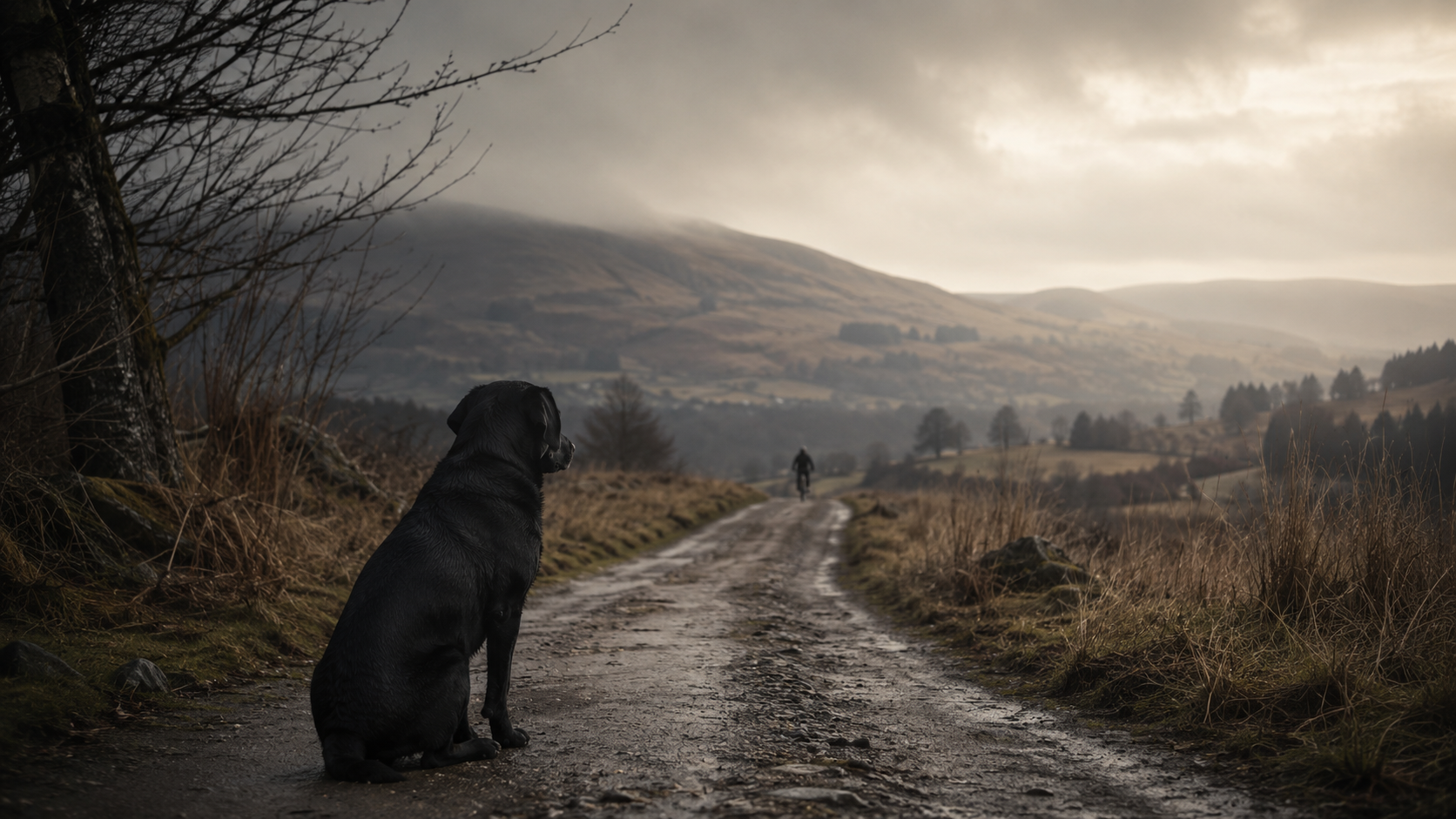
A Familiar Route With No Clear Answer
The Dog Walk, The Road, And The Unexplained Gap
A Country Path, A Familiar Dog, And One Unexplained Interval
The first detail is the dog.
Brian Low is sixty-five and recently retired. Around Aberfeldy, he is known through ordinary things: years of physical work, familiar conversations, a long relationship, family contact, and walks with his black Labrador, Millie. Nothing about the routine appears unusual. The country path belongs to the same life as the estate work, the Sunday calls, and Millie’s lead.
The route near Pitilie is not a stage. It is a rural track outside a Perthshire town, the kind of place where walkers meet, dogs recognize one another, and a few minutes can pass without anyone recording them. That ordinariness matters. The story begins not with a dramatic public confrontation, but with a man, his dog, and a landscape where routine movement is easy to overlook.
At first, there is no obvious public question. There is only Brian’s life as it stands in February two thousand and twenty-four, and the network of people who expect him to remain part of it.
Then one ordinary interval stops making sense. How can a familiar walk create a gap in which almost every detail begins to carry a different weight?
The Life Around Brian Low
Records from early two thousand and twenty-four describe James Brian Low, known as Brian, as a sixty-five-year-old retiree whose working life is closely tied to Edradynate Estate near Aberfeldy. He joined the estate as a groundsman in August two thousand and remained there until February two thousand and twenty-three. Retirement changes his timetable, but not his connection to the countryside. Walking Millie remains part of the everyday pattern around him.
The available record does not offer a complete biography, and it should not be padded with invented warmth. What it does show is a man repeatedly described as gentle, hardworking, decent, honest, and quietly humorous. The estate owner regards him as a highly capable employee. A local farmer who knows Brian and another long-serving estate worker describes him as gentle. Family accounts emphasize an old-fashioned honesty and a sense of humor that make regular Sunday contact important.
Brian’s private life is anchored by his partner, Pamela Curran. They have been together for more than two decades. His family relationships extend beyond the couple, including a granddaughter and the recurring bond with his brother, Douglas. These are not decorative details. They establish the people who know his habits well enough to notice when a day no longer follows its expected shape.
His retirement from the estate is also described as amicable. Its owner marks Brian’s departure with a car and money as gifts. The gesture places his exit in a different emotional category from the bitterness associated with another former employee’s departure years earlier. The two men come from the same working world, but they do not leave it carrying the same history.
For now, Brian is simply a retired groundsman whose life still fits the landscape around him. He has a partner, a family, a dog, and a route that feels familiar enough not to require explanation.
The People Closest To His Routine
Pamela Curran knows the rhythms of Brian’s days more intimately than any public record can. Their relationship spans twenty-two years, and retirement is meant to open a quieter period rather than close one. Routine creates its own map: a voice in the house, a dog being addressed, a walk beginning, a partner returning, and a day continuing in its expected order.
Douglas Low occupies another stable place in Brian’s life. The brothers’ Sunday contact gives the week a recurring point of connection. Family descriptions emphasize Brian’s kindness, honesty, humor, and the value of those regular conversations. The portrait is modest. It does not turn him into a symbol. It shows how ordinary contact becomes part of the structure by which another person is known.
Millie, the black Labrador, belongs in this human map as more than an image. She is part of Brian’s daily movement and of the way others recognize him on local paths. A person walking alone can blend into a rural landscape. A familiar man with a familiar dog is easier to place, especially among other walkers whose own routines cross the same ground.
The wider circle around Brian includes people from Aberfeldy and Edradynate Estate. Some know him through years of work. Others encounter him while walking dogs. In a small rural setting, those overlapping connections can be both helpful and misleading. Familiarity produces knowledge, but it also produces assumptions about who gets along, which disagreements matter, and whether old hostility has truly faded.
The people closest to Brian understand his habits. They do not yet know which part of his history will matter most when one routine no longer follows its normal course.
The Estate Where Old Tensions Stayed Quiet
Edradynate Estate connects Brian to a long professional history. He works there as a groundsman from August two thousand until February two thousand and twenty-three. For much of that period, the estate’s head gamekeeper has occupied his own role since May nineteen eighty-four. Both men are regarded as capable workers, and accounts of their early years suggest a relationship that is workable rather than close.
Over time, the atmosphere cools. A written warning sent to Brian in May two thousand and eleven records that he has spoken unpleasantly about the head gamekeeper and his wife to people outside the estate. Brian apologizes and is told that further conduct of that kind could threaten his employment. The document matters because it shows friction moving beyond private dislike into workplace management. It also shows that the hostility cannot be reduced to one man resenting another without any provocation.
Rural estate work can create unusually durable professional relationships. People share land, equipment, responsibilities, local contacts, and knowledge accumulated across years. Disagreements do not always end when a shift ends. They can pass through gossip, perceived slights, criticism, questions of loyalty, and competing views about who can be trusted.
Brian remains at Edradynate until retirement and leaves with gifts from the owner. The head gamekeeper leaves several years earlier under circumstances he describes differently, carrying a sense that his departure was not voluntary. That contrast does not establish what either man thinks day by day. It does place them on separate paths after years inside the same small working world.
From outside, the history looks dormant. Employment has ended. Time has passed. Brian’s days now belong to retirement rather than estate business. Yet the first visible detail that does not fit is already present: two men can stop speaking long before the reasons for the silence have truly disappeared.
The Ordinary Movements That Friday
Friday, February sixteenth, two thousand and twenty-four, begins without a publicly documented confrontation. The open record does not establish the exact moment Brian leaves home, the words spoken before he goes out, or every step he takes. It establishes only the ordinary purpose: he is walking Millie in the Pitilie area outside Aberfeldy, using a route familiar enough for other local dog walkers to recognize him.
That lack of detail is normal. Most people do not create a formal record before taking a dog along a country track. A departure time may be remembered approximately. A route may vary. A conversation at home may be too routine to preserve word for word. The day is lived, not documented.
The landscape creates its own gaps. Trees, bends, fields, and stretches beyond nearby houses allow someone to move without being continuously visible. Other walkers may pass at intervals rather than remain on the route. A familiar path can therefore hold long periods in which nothing appears unusual simply because nobody is looking at the same point.
By evening, Brian’s movements are no longer clear to the people expecting him. That uncertainty does not yet supply an explanation. A walk can run long. A person can change direction. A phone can be missed. Human expectation often preserves the normal shape of a day for as long as possible.
What changes the story is not a dramatic message or an announced threat. It is the failure of an ordinary routine to complete itself in a way anyone can confidently explain.
The First Concern
The next morning, Kevin Timoney was walking his dogs near Leafy Lane. He often encountered Brian and would stop to talk. On this occasion, Millie approached him first. A short distance away, Timoney saw a person lying on the ground. He called out, moved closer, and recognized Brian. Brian was unresponsive, cold, and stiff. There was blood on him.
Timoney placed his jacket over Brian and ran toward nearby houses for help. After asking a woman to contact the emergency services, he returned home, left his dog, collected a blanket and his car, and picked up another local man on the way back. Two emergency calls were made. The men covered Brian and waited.
A paramedic arrived shortly after eight thirty a.m. and pronounced Brian dead at about nine. The first suspected explanation was a sudden medical event, possibly cardiac arrest, followed by a fall. A police officer who attended visually examined the scene and also concluded that Brian’s injuries were consistent with falling while out walking. The death was therefore treated as non-suspicious.
That decision changed the entire early response. The track was not immediately preserved as a potential crime scene. No full forensic examination began. Walkers, animals, and weather continued to affect the area. Brian’s family was told that the death appeared non-suspicious, and communication itself caused further pain: evidence later heard described how a teenage granddaughter learned of the death before Pamela was formally notified.
At this point, death had been confirmed, but its cause had not. The official explanation was simple enough to close the first question. Yet Brian’s visible injuries had not been fully understood, and the simplicity of the answer depended on a mistake.
The Explanation That Looked Too Simple
Detective Constable Mark Chance had spent years in criminal investigation but had never dealt with a firearm homicide. He later accepted that he had made a serious error. Brian had about thirty pellet injuries to his face, with further wounds affecting his chest, neck, and arms. Blood was visible, yet the possibility of a shooting did not enter the officer’s decision-making.
The first assessment shaped everything that followed. Without a suspicious-death protocol, the scene remained open for days. No immediate cordon protected trace evidence. Rain fell. People and animals moved through the area. The gap did not make a later investigation impossible, but it removed the certainty that comes from examining an undisturbed scene. Police later acknowledged that evidence could have been lost.
The mistake also affected the family’s experience. Pamela was initially told that Brian had suffered a medical episode and fallen. Several days passed before that account began to collapse. The later discovery did not merely add a new technical detail. It transformed what the family had been asked to believe about the final hours of his life.
Police criticism must still be precise. The early conclusion was wrong, and the force has admitted it fell below the expected standard. That does not mean every attending professional acted in bad faith, or that hindsight makes every sign equally obvious. It means the process for an unexplained outdoor death failed to force a sufficiently careful examination before the scene was released.
The case now contained two separate problems. One was the unexplained cause of Brian’s injuries. The other was the institutional delay that had allowed the most important location in the story to change before specialists treated it as evidence.
The Pellets In The Body Bag
The official account began to change when Brian’s body reached the mortuary. Shotgun pellets were seen in or falling from the body bag, prompting a forensic pathologist to escalate the examination. A two-doctor post-mortem established that Brian had suffered gunshot wounds to the neck and chest. The injuries were no longer compatible with an accidental fall after a medical collapse.
Medical evidence later described a face-on discharge from a shotgun. A forensic scientist estimated that the weapon’s muzzle had been between roughly nineteen and forty-five meters away. Pellets had penetrated the lungs, and the overall pattern showed that Brian had been struck across the face, neck, chest, and upper body. The blast caused death within a very short period.
The language matters. The medical findings established how Brian died, but not who fired the weapon. Cause of death and identification are separate questions. A shotgun pattern can indicate direction, range, and mechanism. It cannot, by itself, name the person who pulled the trigger.
Once the injuries were recognized, the inquiry became a murder investigation. The scene was eventually secured, but several days had passed. Detectives now had to reconstruct an event that had initially been treated as natural or accidental, while accounting for the possibility that rain and traffic had erased or contaminated evidence.
The investigation expanded sharply. Thirty-one officers from major investigation, local policing, and specialist search teams became involved. Detectives examined about two thousand four hundred hours of camera footage, gathered around one thousand statements, and visited nearly five hundred properties. Experts in ballistics, biology, chemistry, cybercrime, and soil science helped turn scattered fragments into a testable sequence.
The first official theory had failed. The next task was harder: identify who had motive, means, opportunity, and a route through the missing minutes.
The Grudge That Changed The Inquiry
Attention returned to Edradynate Estate and to David Campbell, the former head gamekeeper who had worked alongside Brian for years. Campbell had left the estate in February two thousand and eighteen, while Brian remained until retirement in two thousand and twenty-three. Witnesses described Campbell as dedicated and skilled, but also as a man who could react badly to criticism.
The prosecution’s motive theory rested on a grievance connected to an earlier wildlife investigation. Campbell believed Brian had planted incriminating material during a raid on his home. Witnesses said he repeatedly expressed that suspicion. Local farmer Sally Crystal recalled language of intense hatred, including a statement that he loathed Brian. Campbell denied making the remark and later claimed that his former employer had instructed him to spread false allegations about Brian planting poison.
This was powerful narrative material, but motive evidence has limits. People can harbor resentment without committing violence. A grudge can explain why one person might target another, but it cannot establish that the targeting occurred. The prosecution still needed evidence connecting Campbell to the route, the time, and the act.
Campbell’s own position was that he and Brian simply did not get on. He said they had not spoken since about two thousand and seventeen and denied threatening him. He accepted that he disliked Brian but rejected the idea that a years-old dispute had turned into murder. The defense later asked why a man with a comfortable life and a loving partner would suddenly act after so much time had passed.
Investigators therefore could not stop at hostile words. They examined Campbell’s movements, his cameras, the bicycles at his home, his access to weapons, his behavior after Brian’s death, and the physical material that survived the delayed scene response.
The grudge gave the inquiry direction. The evidence had to decide whether that direction was justified.
The Camera That Went Dark
The camera evidence began early on the morning of Friday, February sixteenth. Campbell’s vehicle was recorded leaving home at about seven eleven a.m. He drove to a property in Dunkeld Street, walked toward it, and returned carrying what appeared to be a long, narrow bag. His car was back at home by about seven thirty-five. He then placed duct tape over his video doorbell.
At about ten nine a.m., the home CCTV system was manually shut down. The tape had been removed by approximately ten thirteen, then replaced at about eleven ten. The doorbell produced no further footage until around seven thirty-two that evening, when the rear door appeared to close from inside. Minutes later, Campbell was seen outside in a boiler suit.
Campbell gave an alternative explanation. He said he mistakenly believed a second doorbell camera had been stolen and covered the remaining camera as part of an attempt to identify the supposed thief. He described himself as poor with technology and said he had not intended to disable the main system. Under questioning, however, he accepted that his earlier suggestion that police were responsible for the lost recording was wrong.
The prosecution treated the dark cameras as preparation. On its account, Campbell created an artificial gap around his home before using his wife’s electric bicycle to leave Aberfeldy. Footage showed a hooded cyclist with a bag traveling toward Leafy Lane shortly after four p.m., disappearing from view between four eighteen and five one, then returning toward town. The timing overlapped the point at which Brian’s phone stopped moving.
The images did not provide facial identification. Their force came from comparison: the bike appeared to share features with the one owned by Campbell’s wife, including its mirror, bottle, lights, and tires, while the journey appeared to begin and end near Campbell’s home. The defense stressed that similar bikes and accessories were not unique.
The cameras did not record the central act. They narrowed where a rider could have been while Brian’s phone became still.
The Bike, The Soil, And The Missing Weapon
The electric bike became one of the most important physical objects in the case. The morning after Brian was found, a man took a bike to a shop in Blairgowrie and asked for its tires to be changed. The shop owner considered the existing tires serviceable and suitable for forest riding, but the customer insisted on wider replacements, explaining that his wife planned to use the bike the following weekend.
The old tires were returned to him. Changing them could have removed mud or track material from the parts most likely to contact the ground. Yet soil remained elsewhere on the bicycle. Specialist analysis found material consistent with the area around Leafy Lane, supporting the prosecution claim that the bike had traveled to the scene. Campbell’s wife said she had ridden in the surrounding area during earlier months, offering an innocent route by which local soil could have reached it.
That distinction is central to circumstantial evidence. Soil can associate an object with a location or type of terrain. It may not establish the precise date of transfer, the rider’s identity, or the purpose of the journey. Its meaning grows when aligned with the camera gap, the recorded cyclist, the phone timeline, and the rapid tire replacement.
The shotgun was never recovered. Nor were several other items the prosecution alleged had been discarded. The absence of the weapon denied investigators the most direct possible comparison between a firearm and the pellets or cartridges. It also meant the case could not rely on a conventional chain from gun to owner to scene.
A cartridge shipping box was visible inside Campbell’s home on doorbell footage the following day. Evidence about firearm access, his experience as a gamekeeper, and the long narrow bag seen that morning added further pressure, but none was individually conclusive. The Crown’s argument was accumulation: each fragment addressed a different part of the same journey.
The bike did not answer the case alone. It made the alternative explanations harder to separate from one another.
The Event On Leafy Lane
By the prosecution reconstruction, Campbell had disabled the cameras at home, covered the doorbell, prepared a shotgun in a bag, and left Aberfeldy on his wife’s electric bicycle. The hooded rider moved toward Leafy Lane while Brian was walking Millie. Around four fifty-two p.m., the time Brian’s phone stopped recording movement, the rider was outside the camera network.
Medical and ballistic evidence indicated that Brian was facing the shotgun when it was discharged from a distance estimated between nineteen and forty-five meters. Pellets struck his face, neck, chest, and upper body. The injuries to his chest and neck caused death within seconds or minutes. There was no evidence that Brian was armed or posed a threat.
The exact words, if any, exchanged on the track remain unknown. No camera captured the encounter. No witness described the firing. The prosecution inferred planning and ambush from the route, the concealed cameras, Campbell’s expertise with guns, the long hostility, and the absence of any sign of a chance quarrel. The judge later concluded that the meeting was not accidental and that the shotgun was not carried there by coincidence.
After the shooting, the cyclist appeared on cameras traveling back toward Aberfeldy. The prosecution said Campbell then disposed of the shotgun and other incriminating items, before changing the bicycle tires. The weapon’s disappearance and the early failure to secure Leafy Lane created permanent gaps. What remained was a pattern rather than a single decisive exhibit.
The defense challenged the timing itself. Expert evidence about dual-pattern lividity was used to argue that Brian might have died later, possibly between ten p.m. and eight a.m. Pamela had initially described hearing Brian speaking to Millie early the next morning, and another witness had first said she saw him after the prosecution’s proposed time. Those accounts changed in later statements, which the defense said reflected a police theory that had shifted.
This was the legal hinge. If the time of death could not be placed near four fifty-two, the cyclist timeline weakened. If the later-sighting evidence was unreliable and the phone data reflected the moment Brian stopped moving, the fragments aligned.
What The Jury Had To Decide
David Campbell was arrested and charged three months after the investigation began. He entered a not-guilty plea and lodged a special defense of alibi, maintaining that he had remained at home. His trial took place at the High Court in Glasgow before Lord Scott. He originally faced eight charges, including murder, attempting to defeat the ends of justice, firearm matters, and historic breaches of the peace. By the close of the evidence, the prosecution withdrew all but the murder charge.
The jury’s task was narrower than the wider story. It was not disputed by the end that Brian had been murdered. The question was identification: had the Crown proved beyond reasonable doubt that Campbell was the person who fired the shotgun?
The prosecution relied on the claimed motive, the disabled home surveillance, the doorbell tape, the cyclist’s route, the similarities between the recorded bicycle and Campbell’s wife’s e-bike, the phone stopping at four fifty-two, the soil evidence, the tire change, Campbell’s firearm experience, the missing weapon, and alleged inconsistencies in his explanations. It described the case as one in which separate facts formed a coherent plan.
The defense attacked the same structure at its joints. The camera footage was grainy and did not identify a face. Similar bicycles existed. Soil could have been transferred during legitimate rides. The time of death was disputed. The long interval since the workplace conflict made motive less compelling. Campbell’s behavior with the cameras could be explained by confusion, and the tire change could be seen as a gesture for his wife rather than concealment.
What the evidence could not prove directly was private intent or the precise unseen sequence on Leafy Lane. No murder weapon, eyewitness, facial image, or confession supplied a cinematic answer. Circumstantial cases instead ask whether innocent explanations remain reasonably possible when all strands are considered together.
The jury deliberated for three days and asked to see the cyclist footage again. The repeated viewing showed where the case’s pressure lay: not in one perfect image, but in whether the rider, the bike, the timing, and the preparations could reasonably belong to anyone else.
The Verdict, Sentence, And Refused Appeal
On February twenty-fifth, two thousand and twenty-six, the jury returned a majority guilty verdict. Lord Scott imposed the mandatory life sentence and fixed the punishment part at nineteen years, meaning Campbell must serve at least that period before he can apply for parole. Eligibility does not guarantee release.
The judge described the murder as carefully premeditated. He found that Campbell had disabled the cameras to conceal his movements, carried a shotgun to the lane, killed an unarmed and defenseless man, disposed of the weapon and other items, and adjusted his explanations as evidence exposed earlier claims. He also linked the act to years of bitterness and blame connected with Campbell’s departure from the estate.
The sentence could not answer the family’s central question of why. Pamela’s victim impact statement described daily sadness, fear of going out after dark, difficulty concentrating, and the loss of the retirement she and Brian expected to share. Douglas described the missing Sunday contact and the qualities that had made his brother’s presence dependable. The legal outcome established responsibility; it did not make motive emotionally intelligible.
Campbell lodged an intimation of appeal against conviction in March. On June nineteenth, two thousand and twenty-six, court officials confirmed that leave to appeal had been refused. The conviction and life sentence therefore remain in force. The available public record through July thirteenth does not establish a successful further appeal step.
The verdict also confirmed something broader about the evidence. The police had lost the advantages of an immediately protected scene, and the weapon was never found. Even so, the jury accepted that the surviving circumstantial strands proved identification beyond reasonable doubt.
The case was legally resolved through accumulation. Its institutional consequences were not.
Why The Dog Walk Still Matters
Police Scotland has acknowledged that its initial response fell below the standard the public should expect. The force reviewed its policies and procedures for attendance at unexplained deaths, while the independent police watchdog completed an investigation and submitted findings to prosecutors. As of the latest confirmed public position, the Crown Office was still considering that material as part of its investigation into the handling of Brian’s death.
The scale of the later investigation cannot erase the early failure, but it explains why the case did not collapse. Officers reconstructed thousands of hours of footage, gathered around one thousand statements, visited hundreds of properties, and used several scientific disciplines to compensate for what could no longer be recovered cleanly from Leafy Lane. The lesson is not that procedure became unnecessary. It is that extraordinary later effort was required because basic early safeguards were missed.
The story is now set to reach a wider audience through a two-part installment of the documentary series Murder Trial, currently carrying the working title Death Of A Dog Walker. The production was filmed over several years and is expected later in two thousand and twenty-six, with access to the investigation, the Scottish courts, legal teams, and Brian’s family. A companion podcast series has also been commissioned.
That attention should not turn Brian into the opening mechanism for someone else’s notoriety. The most revealing fact about him is still the simplest: he was going about an ordinary part of his life. Millie was with him. A local walker knew them well enough to notice the dog and approach.
At the beginning, the dog is merely part of the routine. By the end, she represents the continuity Campbell could not erase and the first thread that led another person toward Brian on Leafy Lane.
The country path matters because the case teaches two opposite truths at once. Ordinary places can conceal deliberate acts, and ordinary details can survive them long enough to rebuild the truth.
