True Crime: Caleb Flynn And The Case That Unfolded In Tipp City
The Night Police Were Called To The Flynn Hom
Messages, Devices And An Ohio Home
On the morning of February sixteenth, twenty twenty-six, police were called to a house in Tipp City, Ohio, a small community north of Dayton. Inside the home was thirty-seven-year-old Ashley Flynn. She had suffered gunshot wounds. Her husband, Caleb Flynn, told investigators that someone had entered the house and attacked her while he was elsewhere inside.
Two children were also home.
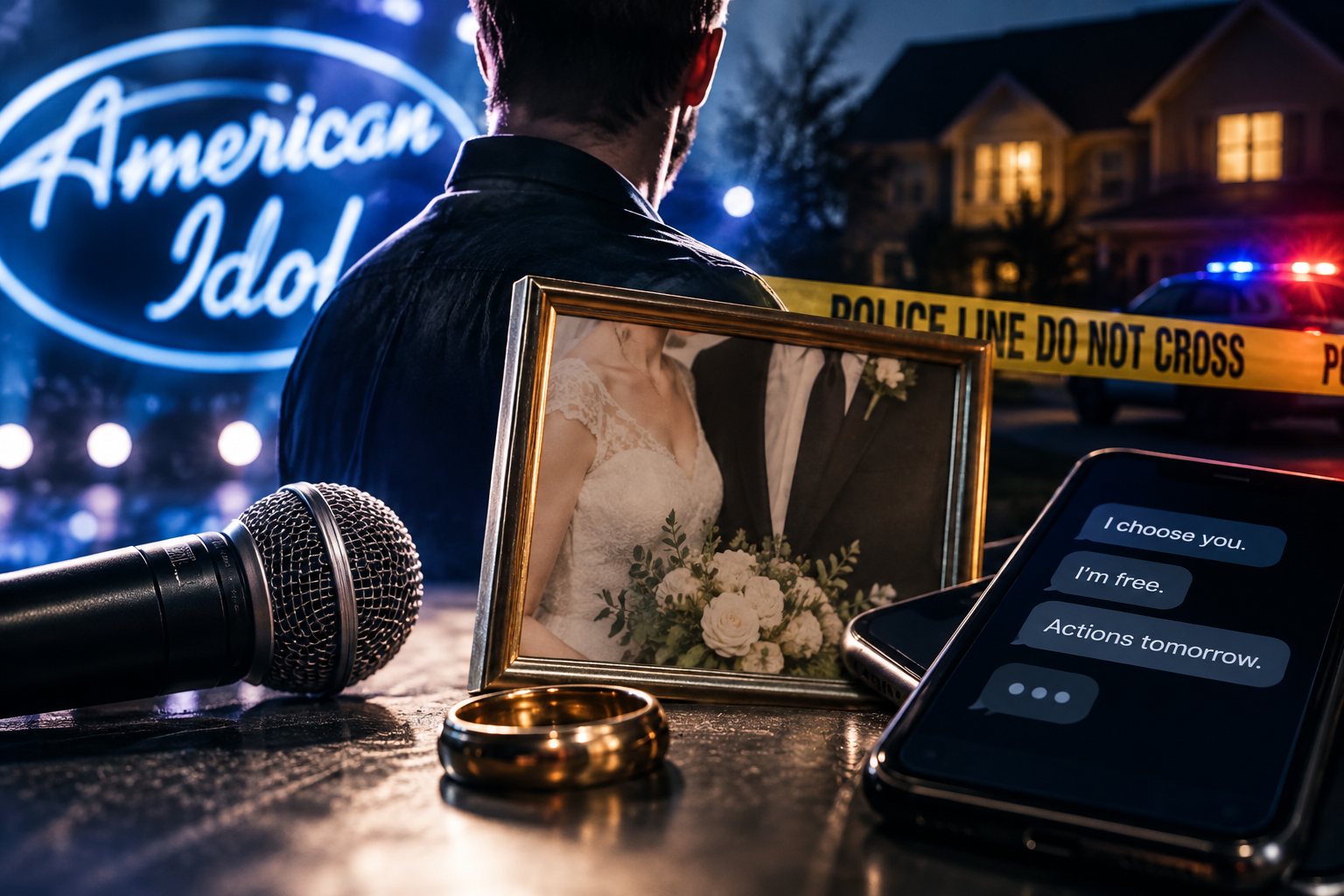
Caleb was forty years old. He had worked as a music pastor and worship leader. More than a decade earlier, millions of television viewers could have caught a glimpse of him on American Idol. His appearance was brief, but one detail from it would acquire a very different significance years later: Caleb had spoken warmly about Ashley and said she had encouraged him to audition.
By twenty twenty-six, they had built a life far removed from a television singing competition. Ashley was a teacher and volleyball coach. She was also a mother. After her death, the school community where she worked described her as warm, kind and devoted to the people around her.
What happened inside the Flynn home initially appeared to have an obvious explanation.
Caleb said there had been an intruder.
Within three days, however, police had arrested him.
What followed was an investigation built not around a recovered murder weapon or an eyewitness to the shooting, but around the physical scene, digital activity, tens of thousands of messages, an affair and the increasingly difficult question of whether the story Caleb gave police could be reconciled with the evidence around him.
The Call From The House
According to the account Caleb gave investigators, he had been sleeping on a couch when an intruder entered the family home.
He later told police that he discovered Ashley in the bedroom after noticing that a side garage door was open. Investigators searched for evidence that another person had approached the property, entered it and then escaped.
Prosecutors would eventually argue that they found nothing convincing to support that sequence of events.
Instead, their reconstruction was stark: Ashley had been sleeping when she was shot twice in the back of the head. Prosecutors said Caleb then manipulated the scene so it would resemble a burglary or home invasion.
The couple's daughters, reported as being around ten and twelve years old, were also inside the home. They did not testify at the eventual trial.
One piece of the physical puzzle was missing.
Caleb owned a gun that he normally kept in the centre console of his truck.
That gun was gone.
Investigators never recovered the weapon prosecutors said was used to kill Ashley.
That absence would become central to Caleb's defence.
But investigators were also looking at something less tangible than a weapon: the digital trail created by phones, devices and messages.
A Story Tested Against Digital Evidence
Caleb had told police he was asleep on the couch around the period when Ashley was shot.
Prosecutors said his electronic devices told a different story.
During closing arguments, Assistant Prosecuting Attorney Matthew Joseph told jurors that the devices documented movement and activity inside the house during the hours surrounding Ashley's death. Prosecutors argued that this activity was inconsistent with Caleb's account of sleeping through the critical period.
Reporting from the trial described hundreds of recorded steps inside the property.
No single step proved who fired a weapon. Digital activity has limits: a device record can show movement or use, but its significance depends upon context and the wider evidential picture.
For prosecutors, though, those records mattered because they did not stand alone.
The physical scene was one strand.
Caleb's changing or disputed account was another.
Then detectives began examining his private communications.
That opened an entirely different part of the Flynn marriage.
Alleigha Botner
Alleigha Botner was twenty-four when she appeared in court.
She had first met Caleb through the church where he worked. Botner testified that she had been an intern there and that the two eventually began an affair. Accounts presented during the trial placed their relationship across an extended period before Ashley's death.
Investigators obtained an extraordinary volume of communication between them.
More than one hundred thousand messages were introduced or discussed as part of the prosecution case, according to trial reporting.
Many were ordinary evidence of the affair.
Some were far more significant.
Botner testified that Caleb had repeatedly spoken about wanting his marriage to end. She said he discussed leaving Ashley several times beginning around August twenty twenty-five, while Botner imposed a succession of deadlines by which she wanted him to make a decision.
Then there were messages about Ashley herself.
Around six months before the shooting, Caleb sent Botner a message describing having stayed awake thinking about ways of killing his wife without going to prison, according to evidence reported from the trial.
Another exchange became uncomfortable for Botner on the witness stand.
She had written that she wanted to kill Ashley.
Caleb responded that there were two of them.
Botner told jurors she had not meant her statement literally. In another message, she explicitly said she was not asking Caleb to take Ashley's life and believed he would not actually do so.
That qualification was important.
People can write cruel, exaggerated or reckless things without acting upon them. A hostile message is not, by itself, proof of homicide.
Caleb's lawyers would make essentially that point.
The prosecution's argument was that the messages became more significant when considered alongside their timing and the evidence surrounding February sixteenth.
The Break Between Caleb And Botner
By early twenty twenty-six, Botner was demanding a resolution.
According to her testimony, she gave Caleb a final deadline of January eleventh to separate from Ashley.
When that did not happen, communication between the pair largely stopped.
Caleb continued attempting to reach her.
Among the material discussed at trial was a song he had written after their separation. Investigators found several songs connected with Botner, some apparently created using artificial-intelligence-powered music software and lyrics stored elsewhere on Caleb's phone.
The songs became an unusual feature of the trial.
They were not evidence that Ashley had been killed. But prosecutors used them to demonstrate the depth of Caleb's fixation on his relationship with Botner and his desire for a different life.
Then, on February fourteenth — Valentine's Day and two days before Ashley's death — Caleb and Botner resumed communicating.
What Caleb wrote next would become some of the most closely examined evidence in the case.
The Night Before
During the evening before Ashley was shot, Caleb sent a sequence of messages to Botner.
Among them was the declaration:
“I choose you. I'm free.”
He also wrote that actions would come the next day and described February sixteenth as a significant day.
What did that mean?
Botner told the court that she understood the reference to “actions” as meaning Caleb was finally going to begin a divorce.
That interpretation mattered because prosecutors were asking jurors to view those words through knowledge of what happened only hours later.
The defence could point to a less incriminating meaning available at the time: Caleb had repeatedly been under pressure from Botner to leave his wife. A promise that action would happen tomorrow could therefore mean separation rather than violence.
The jury ultimately had to decide not whether one ambiguous message proved murder, but whether all of the evidence fitted together.
Prosecutors argued that it did.
The Home-Invasion Account
Shortly after Ashley was shot, Caleb presented himself as another person caught inside an invaded home.
During police interviews later shown to jurors, he maintained that he and Ashley were an ordinary married couple who loved each other despite disagreements.
Investigators challenged that picture as they learned about the affair and recovered the messages with Botner.
Caleb also described an unusual encounter before the killing.
In one interview, he said a man had appeared at the door the previous day, given Ashley an American flag and delivered what Caleb described as a strange sales pitch about America.
The detail provided an apparent possibility of an unfamiliar person having recently approached the Flynn home.
But prosecutors argued that the alleged home invasion itself lacked the supporting physical trail they would have expected.
They said investigators found no persuasive evidence of an outsider approaching, breaking into or escaping from the property.
The state's case was that the open garage area was not evidence of an intruder.
It was staging.
On February nineteenth, three days after Ashley's death, Caleb Flynn was arrested.
Ashley Flynn
The trial inevitably focused on Caleb: what he said, what he searched, where his devices moved, whom he was seeing and what he wrote.
Ashley risked becoming the person around whom everyone else's evidence revolved.
Outside court, a different picture emerged.
She was thirty-seven years old and the mother of two daughters. She worked in education and coached volleyball. Her school district remembered her for the relationships she built with students and athletes and for what it described as her warmth and kindness.
She had also been beside Caleb long before the investigation and the courtroom.
When Caleb appeared on season twelve of American Idol in twenty thirteen, he spoke about Ashley during his television segment and credited her with encouraging him to pursue his singing ambition.
He auditioned during the season featuring judges Mariah Carey, Randy Jackson and Nicki Minaj.
His run on the programme did not develop into a lasting television career. Contemporary reports differ slightly in describing how far he progressed, but he did not reach the main competitive stages that would have made him a prominent American Idol finalist.
Thirteen years later, that brief appearance became news again for reasons no one watching it could have anticipated.
The Trial
Caleb's case was heard in the Miami County Court of Common Pleas in Troy, Ohio.
The prosecution presented a large circumstantial case.
It called forty witnesses over eight days of testimony.
There was no witness who told jurors they had watched Caleb shoot Ashley.
There was no recovered murder weapon.
And Caleb did not confess.
Those facts gave the defence a clear argument: prosecutors were attempting to bridge gaps in their case with evidence of infidelity and ugly private conversations.
Defence lawyer Emily Smith told jurors that Caleb was not being tried simply for being a bad husband or for having an affair.
That distinction was legally essential.
Cheating on a spouse does not prove murder. Neither does writing cruel things about somebody. The state still had to prove the charged offences beyond a reasonable doubt.
Caleb's attorneys chose not to call defence witnesses after the prosecution rested. Caleb himself did not testify.
Instead, his lawyers attacked the prosecution's interpretation of its evidence.
They highlighted the missing firearm.
They argued there was no direct evidence establishing that Caleb fired the fatal shots.
And they warned jurors against allowing moral condemnation of the affair to substitute for proof of homicide.
Prosecutors answered by asking the jury to consider the evidence collectively.
What Prosecutors Said The Evidence Showed
The prosecution's reconstruction contained several connected pieces.
First was the alleged staging of the home.
Investigators had not found evidence supporting Caleb's account of an unknown intruder entering and escaping.
Second was Caleb's own timeline.
Digital evidence, prosecutors said, recorded activity inconsistent with his claim that he had been sleeping.
Third was his relationship with Botner.
The prosecution presented evidence that Caleb wanted to end his marriage while avoiding consequences that a conventional separation might bring.
Assistant prosecutor Matthew Joseph argued during closing submissions that Caleb potentially had several interests to protect: his relationship with Botner, his connection to his daughters, his church reputation and financial considerations including his work and Ashley's life insurance.
Those were prosecution arguments about motive, not separate findings that any one factor caused the crime.
Then came the messages.
Months before Ashley's death, Caleb had explicitly discussed killing her.
Hours beforehand, he told Botner he was choosing her, said he was about to be free and promised action the next day.
Finally came the shooting itself and what prosecutors characterised as efforts to conceal what had happened.
The state argued that each piece reinforced the others.
The defence argued that none closed the evidential gaps.
The decision went to twelve jurors.
A Little Over Two Hours
On Tuesday, September twenty-ninth, twenty twenty-six, the jury began deliberating.
It took only a little over two hours to reach a decision.
Caleb Flynn was found guilty on all nine counts against him.
Those counts included aggravated murder, multiple murder charges, felonious assault and tampering with evidence. Jurors also returned firearm specifications connected to several offences.
In other words, the jury rejected the defence argument that reasonable doubt remained over who had killed Ashley.
As the verdicts were read, Caleb closed his eyes and shook his head. Reporting from inside the courtroom described him becoming visibly emotional and eventually crying.
His bond was revoked.
He was taken from the courtroom in handcuffs.
For Ashley's family, the verdict brought the criminal trial to its first major conclusion.
In a statement released after proceedings, her family said the result represented “justice and accountability”.
For Caleb, the legal process was not necessarily finished.
His attorney said the verdict was disappointing and indicated that an appeal was expected.
Why There Were Multiple Murder Counts
Reports that Caleb was convicted on nine separate charges can make the result sound as though prosecutors alleged nine separate criminal events.
That is not what happened.
All of the homicide counts concerned Ashley's death, but prosecutors charged different statutory theories and accompanying offences.
CBS reported that the verdict covered one aggravated-murder count, three murder counts, two felonious-assault counts and three evidence-tampering counts, together with firearm specifications on seven counts.
This kind of charging structure allows jurors to determine whether the prosecution has established different legal elements arising from the same underlying conduct.
Sentencing does not necessarily mean every nominal maximum for every count is simply added together. Courts must determine how convictions and specifications operate under Ohio law when imposing the final sentence.
That stage had not yet happened when the verdict was returned.
What Happens Next
As of September thirtieth, twenty twenty-six, Caleb Flynn has been convicted but not yet sentenced.
Judge Jeannine Pratt scheduled sentencing for Monday, October fifth.
He faces the possibility of life imprisonment without parole.
That potential sentence has been widely reported, but the court has not yet imposed his final punishment.
An appeal is also expected.
An appeal would not amount to another jury simply deciding whether it agrees with the original verdict. Appellate proceedings ordinarily focus on alleged legal or procedural errors and whether those errors justify disturbing a conviction.
Caleb's defence has already signalled its disagreement with the outcome and its position that the evidence did not directly establish that he fired the weapon.
For now, however, the legal position is clear.
An Ohio jury considered eight days of testimony, approximately forty prosecution witnesses, extensive digital evidence, communications with Botner, Caleb's police interviews and the defence's arguments about the missing weapon and absence of direct eyewitness evidence.
It convicted him on every count submitted to it.
The Strange Return Of American Idol
Caleb's television history occupies only a tiny part of the criminal case.
It did not prove motive.
It did not establish opportunity.
And it had nothing to do with the forensic evidence.
Yet it has become one of the reasons the case has drawn attention far beyond Ohio.
In twenty thirteen, television viewers saw Caleb as a hopeful singer talking affectionately about the woman who had encouraged him to audition.
Thirteen years later, jurors in an Ohio courtroom concluded beyond a reasonable doubt that he had murdered that same woman.
The prosecution did not reach that result with a recovered gun or a witness who saw the shooting.
It reached it through accumulation: the scene prosecutors said had been staged, electronic activity that contradicted Caleb's account, a secret relationship, months of messages, statements about killing Ashley, communications sent hours before her death and Caleb's explanation of what happened inside the house.
The defence asked jurors not to confuse a terrible husband with a murderer.
The jury accepted that distinction — and still convicted him.
Sentencing on October fifth will determine what Caleb Flynn's punishment will be.
Ashley Flynn's life cannot be reduced to the circumstances presented at that hearing. She was a mother, teacher and coach whose death left two children without their mother and a school community mourning someone it described as a positive presence in classrooms and on the volleyball court.
The last major event in the case, as of September thirtieth, is therefore not yet a prison sentence or an appellate ruling.
It is the verdict returned in Troy, Ohio.
Nine counts.
Nine guilty verdicts.
And a sentencing hearing still to come.
