

True Crime: Colin Pitchfork - How DNA Fingerprinting Changed A Murder Investigation
The Leicestershire Murder Inquiry
The DNA Investigation
The investigation into the murders of Lynda Mann and Dawn Ashworth showed that DNA could challenge a confession as well as identify an offender.
Two schoolgirls were killed in neighbouring Leicestershire communities, three years apart. Police had biological evidence, a suspected connection between the crimes and, eventually, a young man who confessed to one of them. What they did not yet possess was a reliable identification of the killer.
The scientific test they introduced changed the direction of the investigation. It also established a principle that remains more important than the familiar phrase “the first murderer caught by DNA”: a powerful forensic method must be allowed to contradict the investigators who request it.
Colin Pitchfork was convicted in 1988 of the rapes and murders of Lynda Mann and Dawn Ashworth, both aged 15. The route to that outcome involved laboratory research, preserved evidence, a large screening programme and information about someone evading the process. None of those elements would have been sufficient on its own.
Case Status And Scope
This is a resolved historical case. Pitchfork received life sentences on 22 January 1988. The Parole Board’s decision published on 13 November 2025 refused release and did not recommend transfer to open conditions. It is the latest official decision identified in the research for this account, checked in September 2026.
Richard Buckland, the initial suspect who confessed to one murder, was excluded by the DNA evidence. His exclusion is essential context and should never be concealed to create a surprise. The story concerns how an investigation moved away from a mistaken suspect and towards the man ultimately convicted.
Two Girls And Two Investigations
Lynda Mann was murdered in November 1983 near Narborough. Dawn Ashworth was murdered in July 1986 near Enderby. Their names belong at the centre of the account, before the offender, the technology or the later arguments about release.
The locations and similarities gave investigators reason to consider a connection. But similarity is an investigative starting point, not proof that two crimes share an offender. Police needed evidence capable of testing that proposition.
Biological samples offered one route. Before modern DNA profiling, forensic examination could classify some material using blood groups and other biological characteristics. Such results could exclude people or narrow a field without uniquely identifying a person.
This difference is easy to miss from the perspective of a world accustomed to database searches. Knowing that an offender belongs to a broad biological category is not the same as having an identifying profile. A clue may be genuine and still leave thousands of possible people.
The original investigation also depended on keeping material that could later be examined by a new method. Evidence has a future value that may not be obvious when it is collected. A technique not yet ready for forensic use can become relevant before an unresolved case has reached its end.
A Discovery Outside The Murder Inquiry
Alec Jeffreys’s work at the University of Leicester did not begin as a project to catch this particular killer. His research concerned variation in DNA, the molecule carrying inherited biological information. The university dates his recognition of genetic fingerprinting to 10 September 1984.
The breakthrough involved highly variable repeated sequences. Patterns revealed by the laboratory method differed between people while showing relationships within families. That made them potentially useful for questions of identity and kinship.
The discovery was not a machine producing a person’s name from an anonymous sample. It made comparison possible. Investigators still needed a biological trace, a method suited to the material and something against which to compare the result.
The first practical applications included an immigration dispute and paternity questions. These uses matter because they show that genetic identification was capable of challenging an official assumption before it became widely associated with criminal prosecution.
The scientific achievement lay in finding informative variation and making it measurable. Most human DNA is shared. Identification does not require every part of the genome to be different; it requires sufficiently informative markers and a sound account of how likely particular combinations are under competing explanations.
What The Test Could Actually Compare
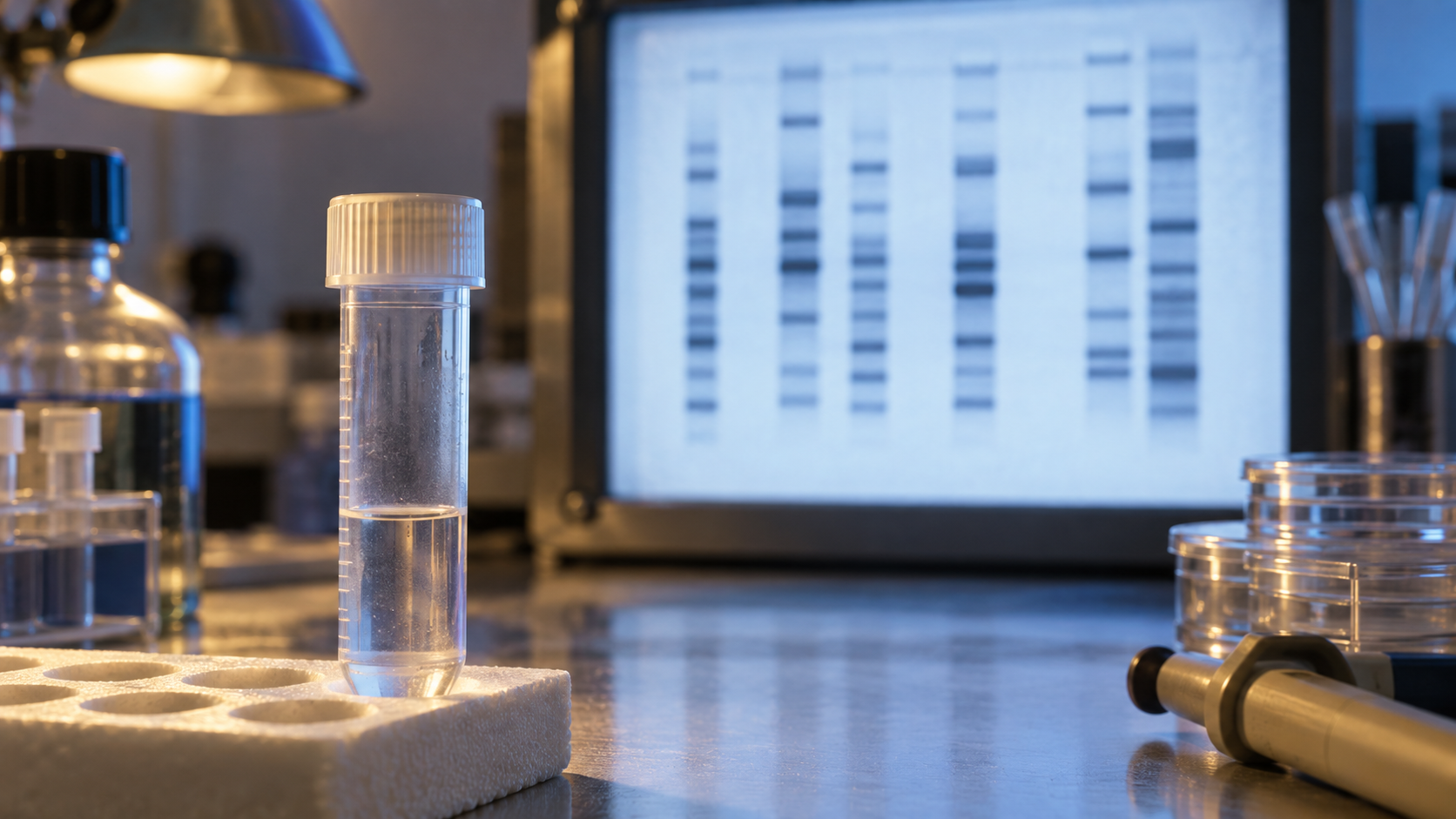
The early fingerprinting methods used patterns that could be visualised as bands. Later forensic profiling developed into different laboratory procedures, including methods based on short tandem repeats. Those changes should not be projected backwards onto the 1980s investigation.
At the centre of either approach is a comparison between a questioned sample and reference material. The questioned sample might come from a crime scene. The reference sample comes from a known person. Laboratory findings address whether the observed genetic information is consistent with that person being the source.
There are several distinct questions here. Is the sample suitable? Can an interpretable profile be obtained? Do the relevant characteristics agree? How informative is that agreement? Finally, what does the source of the material establish about the alleged crime?
The last question belongs to the wider evidence. A genetic match does not normally contain a timestamp or an explanation of how material arrived somewhere. Its meaning depends on location, sample type, circumstances and the competing accounts being considered.
In these murders, the biological material was closely connected to the sexual offences. That gave the comparison a significance different from an unexplained trace on an object many people might legitimately have handled. Describing both simply as “DNA at a scene” erases the distinction.
The Confession That Did Not Fit
After Dawn’s murder, police arrested Buckland, then 17. He confessed to killing her while denying responsibility for Lynda’s death. Investigators sought a scientific comparison that could examine the relationship between the two crimes and the suspect.
The results did not support the expected story. According to the University of Leicester’s history, the biological profiles from the offences were consistent with the same source, but that source was not the arrested young man. DNA excluded Buckland from the offences for which he had become the focus.
This was not a marginal detail to be placed alongside the confession and forgotten. It directly challenged the identification on which the investigation was proceeding. The correct response was to change course.
A confession feels unusually powerful because it seems to originate inside the event. Readers understandably ask why anyone would admit to a murder they did not commit. But that intuitive question cannot replace testing the account against independent evidence.
Taylor Tailored’s examination of why false confessions happen explains the broader problem. Applying it responsibly means avoiding an invented psychological explanation for Buckland. His exclusion is established; assigning a particular internal motive or diagnosis without adequate evidence would add speculation.
Why Exclusion Was A Breakthrough
A forensic success is often imagined as a match that produces an arrest. Here, one of the method’s most consequential early achievements was a mismatch. It prevented the inquiry from treating an unreliable account as a complete answer.
Exclusion and identification have different practical effects. Excluding a suspect can return an investigation to uncertainty, which may feel like losing progress. In fact, eliminating a wrong explanation is progress if it redirects attention towards evidence that can identify the right one.
The result also gave investigators stronger grounds to treat the two murders as connected. They could move beyond similarities in circumstances to a biological relationship between the traces. That narrowed the problem even as it widened the search for the person responsible.
The episode is a warning against measuring an investigation only by how quickly it settles on a suspect. A fast answer can become a costly obstacle if later evidence is forced to accommodate it. The more useful measure is whether the working theory survives meaningful attempts to disprove it.
That is not a demand for endless indecision. It is a demand to identify which findings should change a conclusion. In the Pitchfork inquiry, the DNA exclusion was precisely that kind of finding.
A Search Through The Local Population
Investigators then undertook a large screening programme among local men. Around 5,000 men are commonly associated with the exercise, although accounts describe different stages of invitation, sample collection and testing. Those stages should not be treated as identical counts.
The programme was a logistical operation as well as a scientific one. People had to be contacted, samples collected, identities recorded and laboratory comparisons completed. The reliability of the result depended on the entire chain.
A screening exercise tests a defined group. It does not automatically include every person who could have committed a crime. Eligibility rules, residence, age, participation and administrative accuracy affect its coverage. A failure to find a match can therefore mean several things besides failure of the genetic method.
The offender might lie outside the screened population. Suitable material might not have been obtained. A record might be wrong. Or someone might have defeated the process by presenting another person’s sample under a false identity.
That last possibility became central. A laboratory can correctly analyse the contents of a tube while the paperwork falsely identifies the person from whom those contents came. Scientific accuracy inside the laboratory cannot repair an identity substitution that is never detected outside it.
The Sample Given Under Another Name
The decisive lead concerned a man who had supplied a sample on Pitchfork’s behalf. Accounts of the investigation describe information reaching police after the substitution was discussed publicly. The later official parole record confirms the deliberate impersonation behind the screening evasion.
When investigators obtained Pitchfork’s own sample, the profile matched the material from the offences. The sequence matters: information about evasion identified a person to examine, and the biological comparison then supplied direct support. It was neither a lucky database result nor a laboratory working independently of ordinary police inquiries.
The substitution exposed a weakness in the screening process without disproving DNA profiling. Two different systems were involved. One was the ability to compare genetic material; the other was the ability to authenticate the source of the reference sample. The second had been deceived.
This distinction applies well beyond this case. A valid analytical method can be undermined by incorrect labels, contaminated samples or broken handling procedures. Quality assurance must cover collection and identity as well as the final instrument reading.
It also explains why the tip mattered. Human information did not become obsolete because a scientific technique existed. It directed the technique towards the right comparison and explained why the earlier exercise had failed to identify its target.
Conviction And The Meaning Of A Life Sentence
Pitchfork pleaded guilty and was sentenced in January 1988. His convictions established responsibility for the murders of Lynda and Dawn, alongside other offences. The historical case is therefore not an unresolved contest between Buckland and Pitchfork.
The Parole Board’s published record distinguishes the life sentences from the minimum term. It records that a 30-year tariff was later reduced to 28 years. The expiry of a minimum term does not itself order release; it changes eligibility for consideration under the applicable process.
That distinction is crucial to understanding the later headlines. A life sentence, a tariff, release on licence, recall and a subsequent parole decision describe different legal events. Compressing them into “he served his sentence” would misrepresent the continuing sentence and supervision arrangements.
The same record lists release in September 2021 and recall in November that year. The subsequent published refusal of release concerns an assessment of risk, rather than a new trial of the original murders.
Readers may have strong views about those decisions. An accurate account begins by identifying what question the decision-maker was addressing and which evidence was considered. It should not invent a fresh release date or turn an eligibility milestone into a promise that release will occur.
What Modern DNA Evidence Adds—And Complicates
Modern methods can recover information from much smaller quantities of biological material than early techniques could. That increased sensitivity has helped investigations, but it has also made interpretation more demanding in some circumstances.
NIST’s explanation of DNA mixtures describes samples containing material from several contributors, sometimes in small or degraded amounts. Interpreting such evidence can require modelling rather than a simple visual comparison. Some mixtures are straightforward; others are too complex to support a confident conclusion.
A reader should therefore resist treating the clarity of one historical case as proof that every later DNA result is equally clear. The relevant questions include sample quality, number of contributors, laboratory method, assumptions and the relationship between the material and the alleged activity.
Consider an ordinary shared doorway. Identifying someone’s DNA on it may be unsurprising if that person regularly uses the building. The same identification in a sample intimately connected with an offence may have a very different evidential meaning. The strength of the source comparison does not erase the need to examine context.
Nor does a large likelihood ratio mean a laboratory has calculated the probability that the accused is guilty. Such a ratio compares how expected the genetic findings are under specified propositions. Guilt requires assessment of the whole case, including propositions the laboratory test does not address.
The Wider Question Of Genetic Privacy
The Pitchfork case helped demonstrate why societies would want forensic DNA systems. It also raises questions about the conditions under which samples should be collected and retained. The effectiveness of a method does not settle every question about its governance.
A local screening programme, a criminal justice database and a consumer genealogy service serve different purposes. They may use different kinds of genetic information, different access arrangements and different consent processes. A history of DNA investigation should make those differences visible.
The central policy trade-off is not simply between solving crime and refusing science. It concerns how useful searches can be carried out with appropriate limits, accountability and protection against misuse. People excluded from a case have interests in what happens to their information afterwards.
Public confidence depends on both effectiveness and discipline. A system that identifies offenders but handles unrelated people’s data carelessly can undermine support for the very technique it relies on. Conversely, clear limits can help maintain the legitimacy of investigations that ask a community to cooperate.
These are questions for contemporary policy and law, which can change. The historical case establishes the importance of the technology; it should not be used as a shortcut around examining the rules governing a different present-day system.
A Sample Is Only As Useful As Its Identity
The substitution at the screening exposed a weakness that had little to do with the chemistry of DNA. A laboratory could analyse the material correctly while the investigation attached that result to the wrong person.
This is the distinction between analytical accuracy and the integrity of the wider process. The laboratory asks what the sample contains. The collection procedure must establish whose sample it is. A correct answer to the first question cannot repair a failure in the second.
The principle applies to every stage through which evidence travels. Labelling, documentation and the relationship between an item and its recorded source are part of the evidence, not merely administration surrounding it.
Imagine two perfectly performed tests on samples whose labels have been exchanged. The technical results may be reproducible while the conclusions about the people remain wrong. This hypothetical example explains why identity controls are a scientific necessity as well as a procedural one.
In the Pitchfork investigation, the human route around the screening created a problem that a more sensitive test would not automatically solve. Investigators needed information about the substitution itself before the genetic comparison could reach the correct person.
That interaction is central to the case’s significance. Technology changed what could be established, but people still determined which samples entered the process and what names were attached to them.
The same point explains why a mass screening should not be described as a machine sorting a community into innocent and guilty people. It is an investigative operation involving eligibility, consent or legal authority, collection, interpretation and follow-up. Each stage can introduce a different kind of uncertainty.
A negative comparison may exclude a person as the source of a particular sample without answering every conceivable question about a crime. A positive association may justify further investigation while still requiring the surrounding facts. The meaning comes from the question the evidence can actually address.
The lasting achievement was therefore a combination: a new method capable of making highly informative comparisons and an investigation that eventually supplied the right material for those comparisons. Neither part should erase the other.
What The Case Leaves Us With
The popular version ends when the killer’s profile matches. The fuller explanation includes the samples preserved years earlier, research undertaken for broader scientific reasons, the willingness to accept an exclusion, the effort of screening and the information that exposed impersonation.
It also includes the limits of confidence. The first suspect’s confession seemed to offer an answer, but independent evidence showed otherwise. As the broader research on memory and confidence reminds us, an account’s forcefulness and its accuracy are separate questions; neither certainty nor vividness removes the need for corroboration.
Lynda Mann and Dawn Ashworth were children whose lives were taken. Their importance cannot be reduced to a milestone in a laboratory history. The scientific legacy matters because it helped establish who was responsible and prevented the case from ending with the wrong person.
The enduring lesson is practical. Evidence should be powerful enough to change an investigation, and investigators must be willing to let it do so. DNA transformed this case because it was used first to test the story, then to identify the man who had tried to stay outside the test.
