True Crime: Inside the Zodiac Killer’s Unfinished Reign of Fear
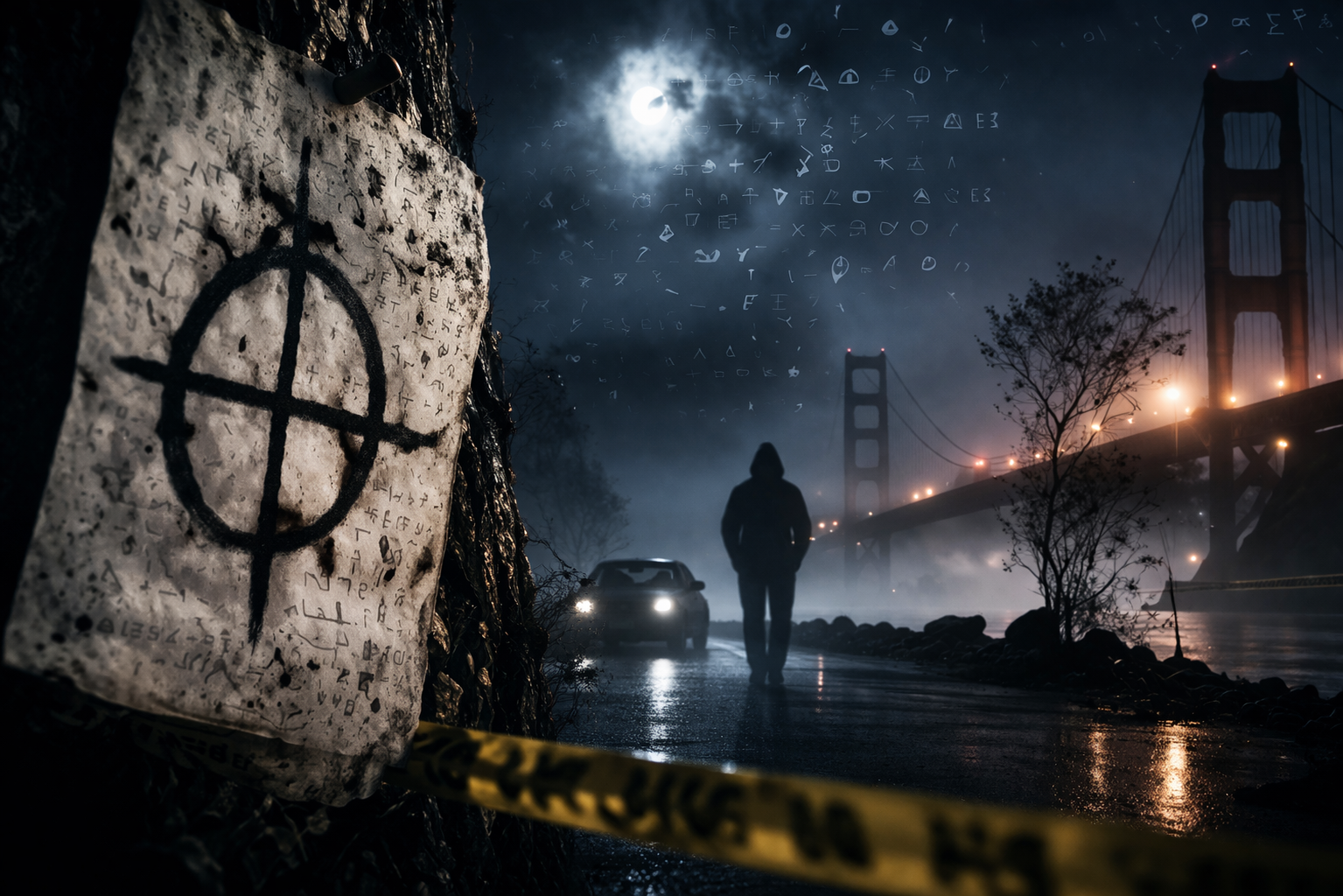
The Zodiac Killer, the Ciphers, and the Perfect Vanishing Act
The Voice That Turned Murder Into Theater
The cab had stopped in Presidio Heights by then. A driver sat dying in the front seat. Across the street, three teenagers watched a man lean into the car, move with purpose, and then walk away into a San Francisco night that should have trapped him. It did not.
Within days, a letter arrived claiming the killing. It carried something police could not dismiss: a bloodstained piece of the driver’s shirt. The man behind the note said he had slipped past officers because the radio description had pointed them toward a Black suspect, not the white man witnesses had actually seen. Whether every boast in that correspondence was true or not, the larger fact was. He had turned one more murder into authorship.
That was the Zodiac’s gift, if that word can be used at all. Not only violence. Narrative control. Northern California had already seen unexplained killings before the name was fixed in public memory. But once the letters began, the crimes were no longer only crime scenes. They were episodes. Ciphers. Threats. A symbol. A voice that kept inserting itself between the dead and the people trying to understand them.
Before the Crosshair, there were teenagers.
The first confirmed victims were not symbols. They were David Faraday and Betty Lou Jensen, teenagers in Benicia out on a date five nights before Christmas 1968. Accounts from later reporting place them at a holiday concert before they drove to a secluded turnout on Lake Herman Road. David had promised to get Betty Lou home by 11 p.m. It was the kind of small promise that only becomes unbearable after the fact.
At that stage, there was no Zodiac. No signature. No mythology. There were just two young people in a parked car on a rural road and a community trying to force the crime into a shape it could understand. Drugs, maybe. Personal grievance, maybe. The possibility that a stranger had come out into the dark simply to kill is anything but plausible. That refusal matters because it shows how cases like these begin: not as legend, but as confusion.
The Bay Area that framed the first murders felt the tremors of late-1960s upheaval, but many towns around the water still saw themselves as quieter, smaller, and safer places. That gap between self-image and reality would help give the Zodiac case its force. The killer was not just attacking people. He was attacking assumptions about where random violence belonged.
Lake Herman Road
The physical reconstruction of the first confirmed attack remains stark because it is so spare. Sometime after 11 p.m. on December 20, 1968, motorists saw the Rambler parked at the lovers’ lane turnout. Soon after, another driver saw what looked like bodies near the car. When police arrived, Betty Lou Jensen had been shot multiple times in the back, and David Faraday had a gunshot wound to the head. He was still alive when found but died before he could be saved.
Investigators recovered .22-caliber ammunition and noted bullet holes in the car, evidence that suggested the shooter may have fired at or around the vehicle to force the pair out before finishing the attack. That detail matters because it points to control rather than frenzy. This was not a panicked discharge of a weapon. It appears to have been a short sequence: approach, compel movement, isolate, kill, leave. Yet even there, the case began with a void. No clear motive. No witness is good enough to give police a man. No obvious suspect who could absorb the fear.
What survived, then, was pattern. A young couple. A parked car. A road dark enough to belong to whoever chose it. But pattern alone is not proof, and for months the killings sat there without the connective tissue that would later make them infamous. The road kept its silence until July.
Blue Rock Springs
The second confirmed attack gave the first one its shape. On the night of July 4, 1969, Darlene Ferrin, a 22-year-old wife, mother, and restaurant worker, drove with Michael Mageau to Blue Rock Springs Park in Vallejo. They were sitting in her Corvair around midnight when another car entered the lot, left, and then returned. The driver got out, shined a bright light into the car, and opened fire with a 9 mm handgun.
Mageau survived with wounds to the jaw, shoulder, and leg. Ferrin was hit several times and died after being taken to the hospital. The attack had some of the same architecture as Lake Herman Road: a couple in a parked car, nighttime, abrupt gunfire, a man arriving and leaving fast. But it added something more corrosive. About 40 minutes later, a caller rang Vallejo police and calmly claimed responsibility not only for the Blue Rock Springs shooting but for the Lake Herman Road murders as well.
That call is one of the essential turning points in the case. It did not solve anything. It did worse. It linked the killings and announced that the killer wanted to be heard. From there on, every police move would have a second audience: the man narrating himself from pay phones and envelopes.
“This Is the Zodiac Speaking”
On July 31, 1969, three Bay Area newspapers received near-identical letters, each containing one piece of a larger cipher. The writer claimed responsibility for the Benicia and Vallejo attacks and included details designed to prove he was the killer. He threatened more murders if the cipher was not published. A few days later, in a follow-up note, he used the name that would eclipse every victim he touched: Zodiac.
The first solved cipher did not reveal a name. It revealed appetite. The decoded text was essentially a boast that killing people was pleasurable and that victims would become his slaves in the afterlife. That was the first real glimpse of motive the public got, and even that may be too neat a word. What the cipher offered was less explanation than self-dramatization: a killer writing himself as something larger, stranger, and more powerful than an ordinary murderer.
The federal role in the case also becomes important here. The murders themselves did not fall under federal jurisdiction, so there was no standalone FBI murder investigation to take over the case. But local agencies leaned on federal expertise in handwriting, fingerprints, and cryptanalysis. That arrangement helps explain the case’s strange texture for the next half century: intensely local crimes, but a national afterlife built out of laboratory work, media circulation, and unresolved code.
Lake Berryessa: The Fatal Encounter, Second by Second
The clearest surviving reconstruction of a Zodiac attack comes from the shoreline at Lake Berryessa on September 27, 1969, because one victim lived and the scene itself was made to speak. Bryan Hartnell and Cecelia Shepard were sitting near the lake in daylight when a man approached wearing a hooded executioner-style costume marked with a crossed-circle on the chest. He carried a gun. He said he was an escaped prisoner who needed money and a car to get to Mexico. Whether that story was meant only to calm them or to entertain him remains unknowable. What is established is that he came prepared, with pre-cut lengths of plastic clothesline.
The sequence, as reliably supported, is brutal and controlled. He had the pair bound. Hartnell later survived to describe the encounter, and the physical scene backed the essential outline: a prolonged interaction rather than a sudden burst of gunfire. Then the attacker switched from the deception of robbery to the mechanics of murder. He stabbed Hartnell six times in the back. He then turned to Shepard and stabbed her ten times. The evidence gives clarity on wounds and order, but not perfect clarity on every second: exactly how long the pause was between binding and stabbing, exactly what he said to himself or to them as he moved from one victim to the other, and exactly how much of the attack was rehearsed versus improvised. Those gaps matter because they are the difference between a scene that feels visible and one that is actually provable.
What came next is one of the strongest pieces of case linkage in the entire file. The attacker walked to Hartnell’s car and wrote on the door the dates and locations of the previous attacks, added the current date and time, and ended with two words that mattered enormously: “by knife.” Later that evening, a caller reported a “double murder” from a pay phone in Napa and said he was the one who did it. Shepard died two days later. Hartnell survived. Legally and investigatively, Lake Berryessa showed something new and chilling: the same offender, if police were right, could change weapons, change scenery, change performance, and still keep enough of his signature intact to claim the act as his own.
Presidio Heights
Two weeks later, the killer changed the setting again. No lovers’ lane. No lakeside isolation. No hood. On October 11, 1969, cab driver Paul Stine picked up a fare in San Francisco and drove toward Presidio Heights. At Washington and Cherry, the passenger shot him in the head. He then took Stine’s wallet and keys and cut away a piece of the victim’s shirt.
This time, witnesses saw more. Three teenagers across the street watched the man at the cab. They saw him moving around the vehicle, and police later used their account to build the case’s most famous composite sketch. But the near-break became one more wound in the file. A radio dispatch described the suspect as Black. Officers who soon passed a white man near the scene did not stop him. The mistake has become part of Zodiac lore because it feels like the whole case in miniature: proximity without resolution, evidence without capture, confidence undone by one bad line moving through the system.
Stine’s murder was also the last confirmed Zodiac killing. That does not mean the man stopped writing, only that the hard evidentiary trail of confirmed murders ends here. Some later investigators and writers have argued he may have continued in other crimes. Officially, police have held the line at five dead and two survivors. The distinction is important. Zodiac claimed expansiveness. The record, by comparison, remains conservative and hard-edged.
The Mail Became a Second Crime Scene
After Presidio Heights, the letters did not merely continue. They evolved. The writer mailed more of Stine’s shirts, threatened schoolchildren, boasted about bombs, played games with body counts, and addressed attorney Melvin Belli in a note pleading for help while also sustaining the performance. He was building a second theater of operations in which paper, not ballistics, kept the case alive.
That is why the ciphers matter, even when they fail to identify him. The 408 cipher exposed the killer’s grandiose fantasy life. The 340 cipher, finally cracked in 2020 by private codebreakers and confirmed by the FBI, did not hand over a name either. It largely delivered more taunting, more talk of death, and more self-regard. In one sense that was disappointing. In another, it was clarifying. The codes were never a clean route to identity. They were extensions of personality.
The numbers he claimed kept rising anyway. Seven. Ten. Seventeen. Thirty-seven. Police did not follow him there. Officially, the confirmed Zodiac attacks remain the four incidents between December 1968 and October 1969. Everything beyond that sits on a spectrum of possibility, contamination, imitation, and desire.
The Victims He Claimed and the Ones Police Rejected
Part of what keeps the Zodiac case unstable is its halo of maybe. In March 1970, Kathleen Johns said a man manipulated her car trouble, drove her and her child around for hours near Modesto, and she later identified him from a Zodiac poster. Months later, the Zodiac claimed that episode in a letter. Police never officially counted it as his crime.
The same pattern appears around the 1966 murder of Cheri Jo Bates in Riverside. Similarities in letters and timing have kept the case orbiting Zodiac discussions for decades. But the attribution has never settled cleanly, and later investigators in Riverside moved toward other explanations. That tension matters because the Zodiac case has always been pulled between two instincts: narrow proof and expansive myth. One is slower and duller. The other is more seductive. Only one deserves trust.
So when people say the Zodiac killed dozens, they are usually repeating the killer’s own propaganda or later speculative frameworks, not the narrow official record. That distinction is not a technicality. It is the difference between evidence and atmosphere. This case generates atmosphere in industrial quantities. Evidence is rarer.
Suspects, Dead Ends, and Arthur Leigh Allen
Over the decades, thousands of names have drifted through the Zodiac file. Only one man was ever publicly identified by police as a suspect in the traditional sense: Arthur Leigh Allen, a former elementary school teacher from Vallejo. Allen denied being the Zodiac. He was investigated repeatedly, and his name became deeply embedded in public imagination, helped along by books, documentaries, and the basic human need for a face.
But the case against Allen never hardened into chargeable proof. A partial DNA sample developed from envelopes in 2002 did not match him, yet investigators and later reporting emphasized that the sample was thin and inconclusive, not the kind of clean biological key that closes a case. Other lines of evidence that fascinated the public also remained frustratingly ambiguous. That is the Allen problem in one sentence: enough to keep him in the conversation, not enough to end it.
That pattern repeats across later suspect waves. Every few years someone announces a solution. And every few years the official position stays where it was: no one charged, no definitive identification, no proof strong enough to survive the weight of the case. In a file this famous, suspicion is cheap. Proof is ruinously expensive.
Why the Case Never Closed
The easiest explanation is still the best one: the evidence was never good enough. Modern cold-case breakthroughs usually depend on biological abundance or digital traces. Zodiac left neither in a form investigators could confidently convert into an identity. The best-known possible DNA profile is partial and may not even come from the killer at all. At Lake Berryessa, where he had the most physical contact with victims, the crime happened in an era that did not preserve evidence with later forensic possibilities in mind.
The visual evidence is weak too. The composite sketch is famous, but fame is not the same as usefulness. The only face witnesses saw clearly were the teenagers in Presidio Heights, and even that sighting was brief, nighttime, and filtered through stress and distance. The two surviving attack victims did not get the kind of unobstructed view that solves a case. Hartnell saw a costume. Mageau got a blinding light.
Then there is the possibility that the killer recognized his own vulnerability and stopped. Stine’s murder was his closest brush with capture. If notoriety was part of the motive, he may have learned he no longer needed fresh murders to keep power over the case. The letters could do some of that work for him. That is speculative, but grounded speculation. The confirmed record shows the killings ending while the self-created legend kept breathing by mail.
The Zodiac in American Memory
Some unsolved killers remain files. Zodiac became culture. The case inspired Dirty Harry in 1971 and later David Fincher’s Zodiac in 2007. It also fed shelves of books, countless documentaries, and a permanent ecosystem of amateur inquiry. Part of that is the cipher element. Part is the sketch. Part is the near-capture. But mostly it is the unnerving completeness of the package: random victims, ritualized letters, official failure, and a vanishing act.
There is a danger in that afterlife. The killer wanted spectacle and seems to have understood, earlier than many police agencies did, how media could magnify violence. Every retelling risks finishing the work for him. That is why the victims have to stay in frame: David Faraday, Betty Lou Jensen, Darlene Ferrin, Cecelia Shepard, Paul Stine, and the two men who survived, Michael Mageau and Bryan Hartnell. Without them, the case collapses into brand management for a murderer.
And yet the case endures because it also exposes something real about public memory. People do not just want to know who did it. They want retroactive order. They want the file to prove that a man who could terrorize a region and then dissolve back into ordinary life was never actually that free. The Zodiac case still refuses to offer that comfort.
Why This Case Still Matters
The Zodiac case matters because it sits at the exact point where homicide investigation, media amplification, and uncertainty collide. It is not only a story about a serial killer in Northern California. It is also a story about what happens when a perpetrator successfully inserts himself into the public meaning of his own crimes, then leaves just enough evidence to keep the state chasing him without ever catching up.
It matters because the official record remains narrow while the public imagination remains vast. Five dead. Two survivors. Dozens of theories. Four major crime scenes. Letters through 1974. A famous sketch. Solved and unsolved ciphers. No conviction. No courtroom. No final answer. For victims’ families, that is not a mystery. It is deprivation stretched across generations.
And it matters because even now, with all the mythology attached, the case still teaches a hard lesson: forensic possibility is not the same as forensic certainty, publicity is not the same as understanding, and a famous unsolved case can be saturated with information while still lacking the one thing that counts. A name that can be proved. Until that exists, the Zodiac remains what he always was beneath the symbol and the spectacle: a murderer who escaped the final sentence.
