True Crime: Jack the Ripper and the Streets That Hid Him
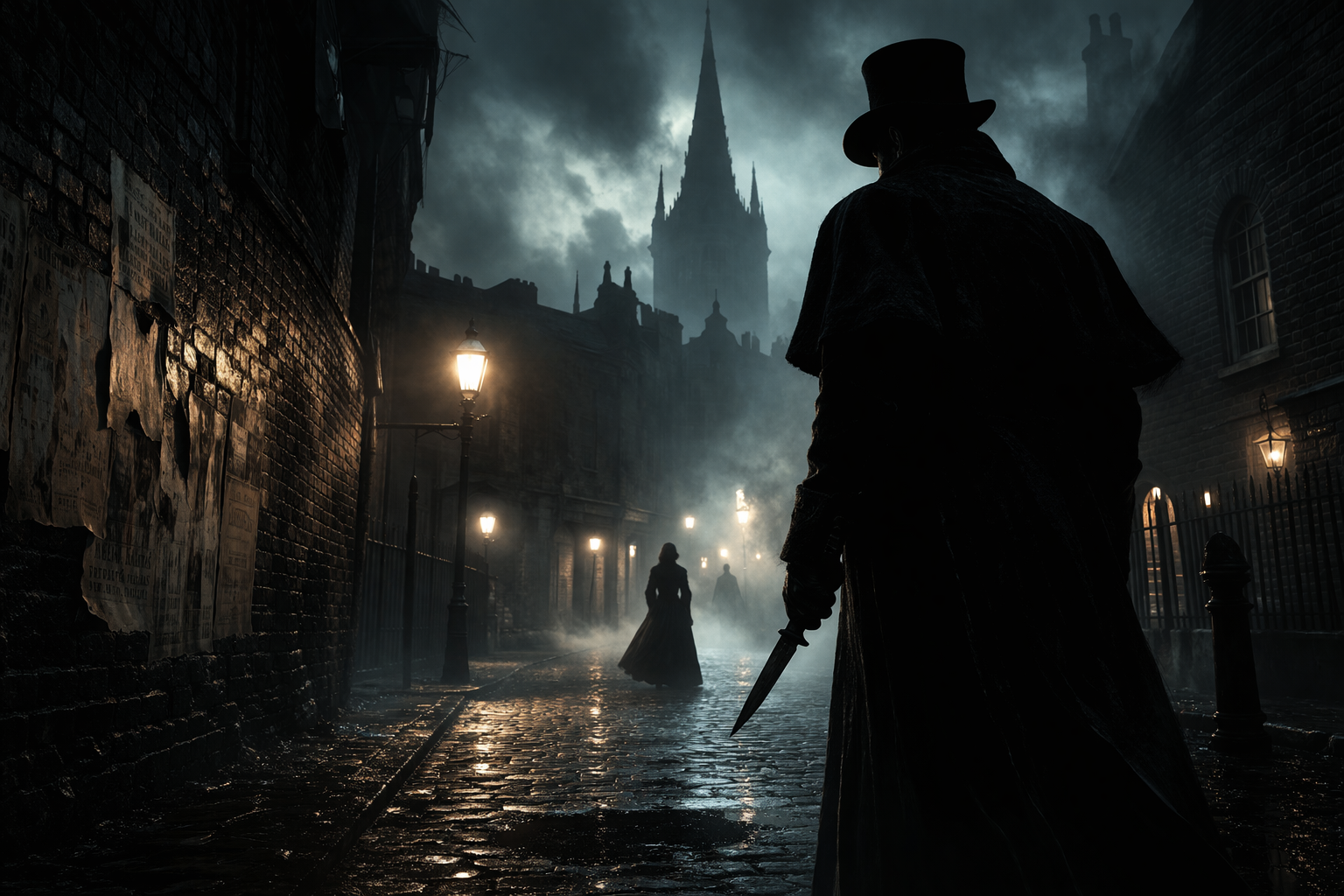
The Night Whitechapel Learned His Name
How Jack the Ripper Became a Legend Before He Had a Face
The room was so small that the bed seemed to swallow it.
On the morning of November 9, 1888, a rent collector named Thomas Bowyer went to Room 13 in Miller’s Court, off Dorset Street. He knocked. No answer. He reached through a broken windowpane, lifted the curtain, and saw flesh on the table, blood on the floor, and a body on the bed. When police finally forced the door, they found what would become the most infamous crime scene in Victorian London.
That is where the legend usually starts: with horror, with mutilation, with a name that still sells books and tours. But the truth is harder and more human than the myth. There was no arrest, no trial, no verdict, and not even certainty about where the series truly began or ended. What survives is a cluster of murders in the East End, a panicked city, and five women whose lives were flattened into a single monstrous brand.
The killer became famous. The women were made secondary. That imbalance is part of the case too.
Whitechapel Before the Name
In 1888, Whitechapel sat inside the richest imperial capital on earth and yet remained one of its poorest districts. London was modernizing, but not evenly. Whitechapel was overcrowded, damp, and unstable. Some families shared a single room. Unskilled labor was badly paid and unreliable. The district also held a large Jewish community, a transient population, common lodging houses, and streets where poverty pressed right up against commerce. Charles Booth’s poverty maps marked much of the area in black and dark blue: “destitute” and “semi-criminal.”
That context matters because Jack the Ripper did not emerge from fog and fiction. He emerged from a place where women were exposed to public danger, where privacy was scarce, where the police were distrusted, and where a killer could move through dark courts and narrow passages without attracting immediate attention. The setting helped make the crimes possible, and the city’s inequality helped make them legible to the public as both local horror and national scandal.
Five Women, Not Just “Ripper Victims”
Police eventually linked five murders to a single unknown offender: Mary Ann Nichols, Annie Chapman, Elizabeth Stride, Catherine Eddowes, and Mary Jane Kelly, all killed between August 31 and November 9, 1888. The "canonical five" refers to these murders, but the broader Whitechapel killings encompassed additional deaths, and the series' boundaries have always sparked debate.
For years, popular accounts treated all five women as interchangeable street prostitutes, as if that explained everything. It did not. London Museum notes that they were not born in Whitechapel, that some were mothers, and that most came from working-class backgrounds and unstable relationships shaped by death, poverty, illness, and separation. Britannica also notes that the old blanket claim that all five were prostitutes has been challenged by more recent historians, who argue that at least some of those labels were products of Victorian class and gender prejudice rather than clean evidence.
That does not soften the case. It sharpens it. The victims were not symbols of vice wandering into legend. They were poor women living brittle lives in a brutal city. The mystery matters, but the loss matters first.
The First Two Murders
Mary Ann Nichols was found in Buck’s Row in the early hours of August 31. A constable saw blood oozing from her throat. Later examination found deep cuts that severed the major vessels of the neck and a series of abdominal wounds. The injuries were violent, quick, and already different in character from earlier Whitechapel killings that police had considered.
Just eight days later, Annie Chapman was found in the yard of 29 Hanbury Street. Her throat had been cut, her abdomen opened, and her uterus removed. Contemporary medical testimony described the cuts as deliberate enough to trigger immediate debate about whether the killer possessed anatomical knowledge. That debate would become one of the central habits of the case: every wound becoming an argument, every argument becoming a theory, every theory becoming a suspect.
By then, the pattern was no longer deniable. The throat came first. The mutilation followed. The attacks were swift, intimate, and concentrated in poor, exposed places. Whitechapel had begun to understand that it was not facing a run of unrelated murders. It was against someone who could kill quickly and vanish.
The Night of the Double Event
The case changed again on September 30. Around 1:00 a.m., Louis Diemschutz entered Dutfield’s Yard in Berner Street with his pony cart. The pony shied. His whip struck what turned out to be Elizabeth Stride’s body. She had suffered a deep slash wound to the throat, but not the extensive mutilation seen on Nichols and Chapman. That absence has always mattered. It raised a question that has never fully gone away: was Stride killed by the same man, or did the killer get interrupted before he could continue?
Less than an hour later, at about 1:44 a.m., Police Constable Edward Watkins re-entered Mitre Square and found Catherine Eddowes murdered in a dark corner. Her throat had been cut. Her face had been mutilated. Her abdomen had been opened, and her left kidney and part of her uterus were missing. The timing of these injuries, inflicted within the gap between patrols, added a new level of dread to the case. Whoever did the deed could work at astonishing speed.
That night hardened the public mood. One woman was dead in Metropolitan Police territory. Another death in the City of London. Two police forces, one killer, growing panic, and a press already feeding on every new detail. The murders were no longer just East End crimes. They were now a public failure.
Miller’s Court
Then came Mary Jane Kelly.
At a quarter to eleven on the morning of November 9, Bowyer went to collect overdue rent. Through the broken pane he saw the room first. McCarthy looked next. Police were called. Witnesses later described seeing Kelly alive late the previous night, drunk, with a stout, shabby man carrying a pot of ale. One witness heard Kelly singing. Another later described hearing a single faint cry of “Oh — murde” around the half-hour before four, but that kind of cry was common enough in the district that it did not trigger alarm. Still another witness, Caroline Maxwell, claimed to have seen Kelly alive the next morning, evidence that has long complicated estimates of the time of death.
When officials entered the room, the differences from the earlier murders were unmistakable. Kelly was indoors, on a bed, in private space. Medical evidence later concluded that the severance of the right carotid artery was the immediate cause of death and that the fatal injury was likely inflicted while she lay on the right side of the bed, her head near the upper-right corner. After death, the body appears to have been repositioned. Blood saturation on the bedding and splashes on the wall supported that reconstruction.
The mutilation was by far the worst in the series. That was not necessarily because the killer had changed. It was because, for once, he had time.
The Fatal Pattern, Reconstructed
Because the case is a murder series rather than a single homicide, there is no one fatal encounter to reconstruct. But the evidence across the canonical five does allow a responsible reconstruction of the killer’s method.
Outdoors, the attacks seem to have been built on speed and control. The women were approached in places where short private transactions would not have looked unusual. Nearby residents often heard little or nothing. On Nichols, Chapman, Stride, and Eddowes, the throat wound was the decisive injury. On Nichols, the neck vessels were severed, and the abdominal injuries followed. On Chapman, the throat cut was followed by abdominal opening and organ removal. On Stride, the throat alone may represent either interruption or a different killer. On Eddowes, the throat cut was followed by facial cuts, abdominal opening, and removal of the kidney and uterus, all in the narrow interval between patrols.
That timing is one of the strongest facts in the whole case. In Mitre Square, only about 14 minutes passed between Watkins’s rounds. In that space, the killer appears to have subdued Eddowes, cut her throat, opened the abdomen, removed organs, made additional facial cuts, and escaped before the constable returned. That is not proof of surgical training. It is proof of confidence, physical force, knife familiarity, and the ability to act under pressure in darkness.
Kelly’s murder, by contrast, shows what happened when the same pattern moved indoors. The inquest and postmortem suggest the throat was cut first while she was on the bed. The room then became a contained worksite. The body was repositioned. Organs were removed and placed around the bed. The wall bore blood splashes. The killer no longer needed to work between footsteps and patrols. He could stay. That is why Kelly’s murder feels qualitatively different even if it belongs to the same series.
What remains uncertain is equally important. We do not know whether Stride was interrupted or unrelated. We do not know exactly how the killer first immobilized each victim. We do not know whether the same hand committed every “canonical” murder. And we do not know whether the person who called himself Jack the Ripper ever wrote a single letter at all.
What the Doctors Thought the Wounds Meant
Victorian investigators quickly attached meaning to the mutilations. Some took the removal of organs as evidence that the killer had medical or anatomical knowledge. Others were less impressed. Modern analysis tends to preserve that tension rather than resolve it. The injuries suggested familiarity with bodies and blades, but not necessarily the neat method of a trained surgeon.
A modern medical review of the Eddowes injuries argues that the killer likely knew enough anatomy to locate desired organs quickly, yet the roughness and placement of the cuts argue against formal surgical precision. Contemporary doctors were similarly split: some thought a butcher, hunter, slaughterman, or someone used to cutting animals could have done it; others suspected stronger anatomical training. That disagreement survives because the wounds support competence without proving profession.
That matters because “the doctor theory” became part of the myth very early. It gave the murders a perverse elegance they may not deserve. The evidence does not compel the image of a gentleman surgeon moving through Whitechapel by night. It more safely suggests a killer who knew how to cut, how to move fast, and how to exploit vulnerable women in vulnerable streets.
The Letters That Built the Legend
The name “Jack the Ripper” likely did not come from the killer at all. It came from correspondence. The “Dear Boss” letter, dated September 25, 1888, popularized the name after being sent to the press and forwarded to Scotland Yard. The British Library notes that the nickname appears to have come from a letter “almost certainly” written by a hoaxer, and the National Archives identifies one famous surviving example as a hoax letter among hundreds sent during the panic.
That distinction is not trivial. If the letters were hoaxes, then the most famous serial-killer brand in modern history was partly manufactured by media circulation. Police received waves of useless correspondence. The public consumed a theatrical villain. The killer, if he followed the papers, may have realized that London was building a character for him in real time.
The case therefore sits at the beginning of something modern: a murder investigation transformed by publicity, rumor, copycats, and a market for dread. The women were real. The name may have been a piece of Victorian performance.
The Hunt That Never Ended
Police connected five murders to one offender, but the wider Whitechapel file ran beyond those five. That ambiguity guaranteed a permanent afterlife. If you cannot be sure where a series begins or ends, you can go on suspecting almost anyone. Even in 1888, the investigation produced public uproar, criticism of police leadership, and organized local action such as the Whitechapel Vigilance Committee. Commissioner Charles Warren came under mounting attack and soon resigned.
The case never produced what true crime usually depends on: closure. No arrest. No confession. No jury verdict. Just suspects. Britannica still lists the standard names most often floated in serious discussions: Montague Druitt, Michael Ostrog, and Aaron Kosminski. None was ever proved.
That vacuum is why the case remains so exploitable. Every generation inherits not just the murders but the empty space around them. People rush to fill it.
Why So Many “Solutions” Collapse
Modern claims of a solved case usually revolve around Aaron Kosminski and a shawl allegedly linked to Catherine Eddowes. But even scholars open to revisiting the evidence keep returning to the same problem: provenance. Smithsonian reported in 2019 that the key issue is whether the shawl can be reliably tied to the crime scene at all. In 2025, crime historian Drew Gray made the same point more bluntly: police records describing Eddowes’s scene do not clearly establish such a shawl there, and a textile handled across generations is a poor foundation for courtroom certainty.
That does not prove Kosminski innocent. It proves something narrower and more frustrating: extraordinary historical claims need a chain of evidence they rarely have. The Ripper case is full of romantic objects, missing documents, memoirs written long after the fact, and evidence contaminated by time, tourism, obsession, and mythmaking.
So the mystery survives not because nobody has tried hard enough, but because the evidentiary structure is rotten in exactly the places where certainty would need to stand.
Why This Case Still Matters
Jack the Ripper still matters for two opposite reasons at once. First, the crimes became one of the foundational myths of modern serial murder: the anonymous predator, the taunting letters, the panicked press, the failed police hunt, and the endless suspect list. Second, recent historical work has pushed attention back where it should have been all along: onto the women, onto Whitechapel, and onto the violence of a city that made them disposable long before the killer found them.
The case also exposes a deeper truth. London could project imperial power across the world and still fail to protect women in one of its own poorest districts. That contradiction has never really gone away. The details change. The pattern does not. Poverty, misogyny, sensational media, public fear, and institutional inadequacy still make fertile ground for predators and myths.
That is why the story endures. Not because the killer is fascinating, but because the city that produced him still feels recognizable. And because five women walked through Whitechapel in 1888 and never got to leave it.
