True Crime: Jason Mosely - The Fulton Street Mystery Explained
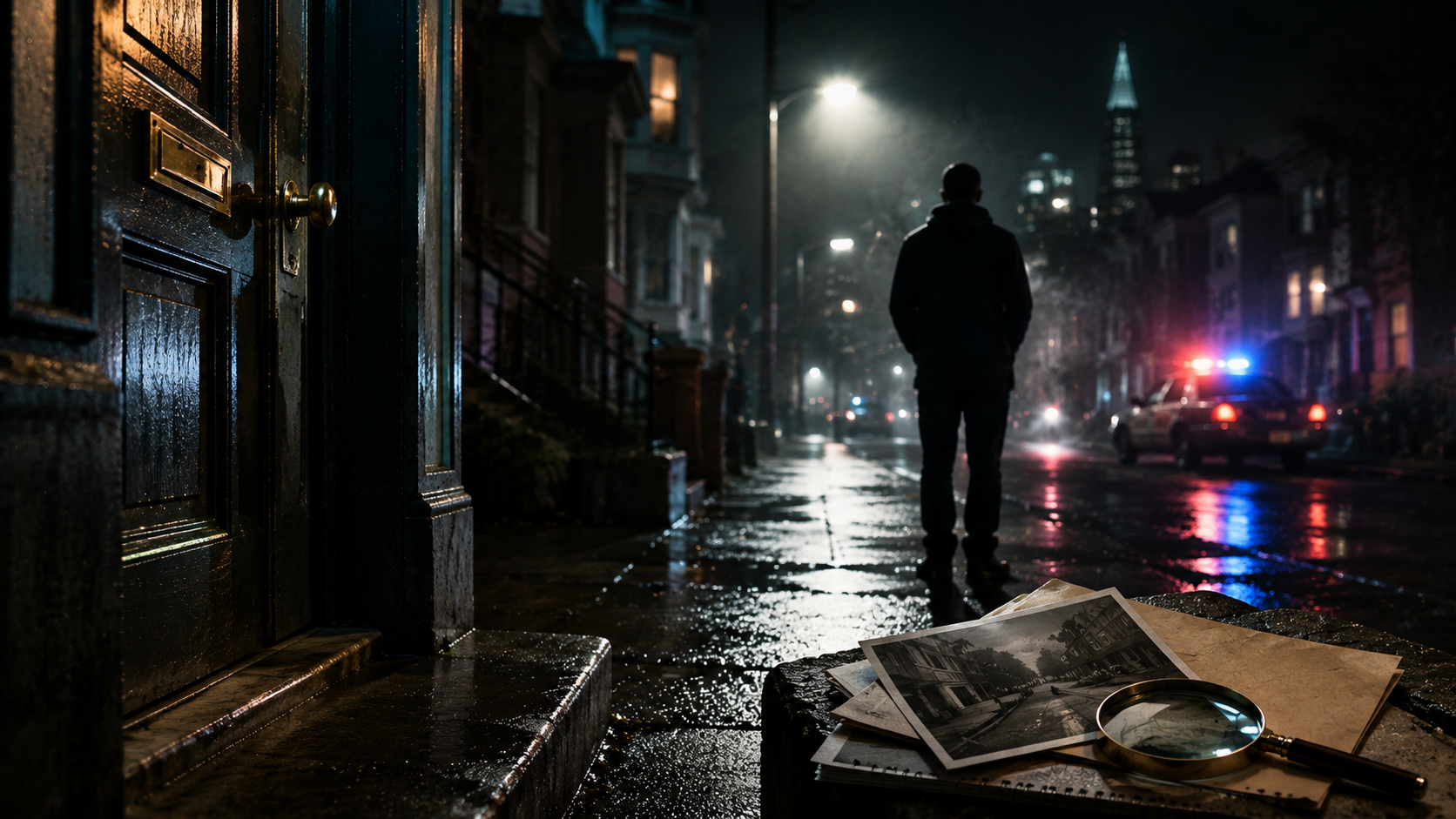
Was The Shooting Mistaken Identity?
Timeline: From Fulton Street To A Cold-Case Breakthrough
On a Sunday evening in April two thousand and eight, Jason Mosely is inside a home on Fulton Street in San Francisco. He is twenty-eight years old. His life is moving towards something immediate and ordinary: the following day, he plans to go to City Hall and marry his pregnant fiancée. There is no elaborate ceremony planned. The important part is making the commitment official.
Jason has work, family responsibilities and people around him who know his routines. He works as a desk attendant for a community housing organisation. He is also helping care for his grandmother. His mother, Selina Arceneaux, is nearby. Around the neighbourhood, Jason is familiar enough that children know him. His mother says that earlier that afternoon he has been giving sweets to local children.
Then someone rings the doorbell.
Jason goes outside.
Almost immediately, his mother hears gunfire.
For a family preparing for a wedding, the evening has suddenly become something entirely different. At first, there is no eighteen-year mystery, no cold-case unit and no suspect living hundreds of miles away. There is only Fulton Street, a series of gunshots and an urgent question: what has just happened outside the house?
Jason Mosely Before The Case
The surviving public record of Jason's life is considerably smaller than the record of what happened around him. That imbalance is common in long-running homicide investigations. Police documents accumulate, anniversaries generate headlines and investigative breakthroughs eventually become searchable. Ordinary life leaves fewer records.
What is known matters.
Jason is twenty-eight and living in San Francisco. He works in community housing, with contemporary accounts identifying his job as a desk-attendant position. His mother portrays him as someone without gang connections and describes him as close enough to children in the area that handing out sweets shortly before the shooting is not treated as unusual behaviour.
His immediate future also appears unusually clear.
His fiancée is pregnant. The couple intends to marry the next day at San Francisco City Hall. According to his mother, the ceremony is intended to be small. Jason wants to marry his partner before their child is born.
That detail has become one of the defining features of the case, but in the chronology it is not yet tragic symbolism. On the afternoon of Sunday, April twenty-seventh, it is simply Monday's plan.
Jason is also connected closely enough to his extended family to be helping care for his grandmother at the Fulton Street residence. The home lies close to San Francisco's civic centre and around the boundary between the Western Addition and Hayes Valley, an urban area that in two thousand and eight is living through both redevelopment and serious concerns about gun violence.
At this point there is no publicly documented feud attached to Jason, no established criminal conflict and no known reason in the surviving record why anyone should be arriving at the door intending violence.
That absence will become important.
Sunday Evening On Fulton Street
The date is April twenty-seventh, two thousand and eight.
Police later place the shooting at approximately six-ten in the evening on the five-hundred block of Fulton Street. Family accounts put Jason inside the residence shortly beforehand. His mother is there. Someone comes to the door.
Jason responds.
Selina Arceneaux's account is stark because of how little time appears to separate the ordinary sound of a doorbell from the sound that follows. Jason goes outside. His mother hears shots.
Emergency services and police now have a violent incident to respond to.
Jason has been shot.
The injuries are fatal. Twenty-eight-year-old Jason Mosely dies less than twenty-four hours before the City Hall wedding he and his fiancée have planned.
Only now does the vocabulary of the story change.
What had been a family preparing for a marriage is now a family facing a homicide investigation.
The sequence appears brutally short: doorbell, Jason stepping outside, gunfire. What is missing is everything that investigators most need. Who came to the residence? Was Jason deliberately summoned outside? Was somebody waiting nearby? Was he the intended target? What happened in the seconds immediately before the shots?
The surviving public account does not answer those questions.
Police begin investigating.
The First Theory Comes From Jason's Family
Jason's mother publicly rejects one explanation almost immediately: that her son has become entangled in gang violence.
She says he is not in a gang.
The family instead develops another possibility. They wonder whether the shooter has mistaken Jason for somebody else.
At this stage, that is a family theory rather than an established police conclusion.
The distinction matters enormously.
There is an intuitive logic to mistaken identity when somebody apparently unconnected with gangs is shot close to home without an obvious public motive. But absence of a known motive is not evidence of a particular alternative motive. The early investigation has to leave open possibilities that the family cannot see.
Police need witnesses.
They need to identify who was present.
They need information about anyone who approached the Fulton Street residence.
They need to determine whether Jason was expected outside or whether the doorbell was simply a way of drawing whoever answered into view.
And they need to understand whether the shooting is connected to Jason personally, to the property, to somebody else associated with the location or to a broader pattern of violence.
The public record from those first days does not disclose a breakthrough.
Instead, the case enters a much larger problem confronting San Francisco.
A City Struggling With Homicides
Jason's shooting does not happen during a quiet year for San Francisco.
By April twenty-ninth, only two days after his death, contemporary officials are already discussing a rising homicide count. Thirty-six homicides have been recorded in the city by that point in the year. Police officials publicly complain that witnesses are often unwilling to come forward, even in cases where investigators believe people have information capable of identifying killers.
The problem is not simply investigative technique.
It is cooperation.
Officials describe communities in which fear can outweigh substantial financial rewards. At the time, the city is offering rewards in numerous unsolved homicide investigations, yet authorities say money is not necessarily persuading witnesses to speak.
For Jason's family, this broader problem becomes personal.
His aunt speaks publicly about a generation of young people facing limited opportunity and violence. His mother continues to insist that Jason is not part of a gang. A local political debate about policing and foot patrols is unfolding at almost the same time.
Jason's death is the first homicide recorded in that part of the Western Addition in approximately eleven months.
By the end of two thousand and eight, San Francisco records ninety-seven homicides, according to later police annual-report statistics.
That number helps explain the environment in which detectives are working. It does not explain Jason's shooting.
And for investigators, the difference between those two questions is everything.
The Information That Does Not Arrive
A homicide case can move rapidly when one of several things happens.
A witness identifies the shooter. Surveillance footage captures a vehicle or face. A weapon is recovered and linked through ballistics. Phone records expose communication between people who claimed not to know each other. A suspect makes an admission. DNA produces an association. Somebody involved tells another person what happened.
None of those breakthroughs is publicly documented in Jason's case during the period immediately after the shooting.
That does not mean police possess no evidence.
It means the open record does not show enough evidence to identify and arrest somebody.
The distinction is crucial in any cold case. "Unsolved" does not necessarily mean empty. A case file can contain names, interviews, photographs, forensic material, partial leads and suspicions while still falling short of probable cause. It can contain evidence whose significance is not recognised until years later. It can also contain information that simply cannot be corroborated.
In Jason's case, the public-facing story gradually becomes quieter.
There is no announced arrest.
There is no publicly established motive.
There is no court case.
The family theory of mistaken identity remains exactly that: a possibility.
And the distance between the shooting and an answer begins to grow.
When An Investigation Becomes A Cold Case
The phrase "cold case" can create a misleading image of a file being shut inside a cabinet and forgotten.
That is not necessarily what happens.
A homicide may become cold because leads stop producing actionable evidence, because witnesses refuse to cooperate, because forensic technology cannot yet extract useful information or because investigators cannot bridge the gap between suspicion and proof.
Time creates disadvantages.
Memories become weaker. Witnesses move. People die. Physical locations are redeveloped. Relationships change. Records can become harder to retrieve.
But time can also create opportunities.
Loyalties shift. People who once feared retaliation may become willing to talk. Digital databases expand. Forensic technology improves. Investigators can compare old evidence against people or information unavailable during the original inquiry.
Most importantly, a new detective can look at a familiar file without carrying the assumptions developed during the earliest days.
For Jason's family, however, those advantages are theoretical for a very long time.
Years pass.
Then more years.
The wedding that was supposed to take place the day after Jason's death becomes part of the permanent description of the case. His child grows up in a world where the shooting remains unresolved. The neighbourhood changes. San Francisco changes.
The case remains.
Eighteen Years Without A Public Answer
The sheer length of the gap is one of the most important facts in the Jason Mosely case.
April two thousand and eight becomes April two thousand and nine.
Then two thousand and ten.
Five years become ten.
Ten become fifteen.
There is no publicly announced identification of Jason's killer during those years.
The absence of an arrest does not establish that investigators have no theory. It establishes something narrower: whatever police know has not yet resulted in a public homicide arrest.
That distinction becomes important when the case eventually reaches the San Francisco Police Department's Cold Case Unit.
The unit's purpose is not simply to reread old paperwork. Modern cold-case reviews can involve re-interviewing witnesses, reconsidering old statements, resubmitting physical evidence for forensic examination and comparing information against databases that did not exist when the crime occurred.
San Francisco has demonstrated the value of that approach in other cases. In one separate homicide from nineteen ninety-two, investigators reopened the file decades later, submitted preserved biological evidence through modern databases and obtained a DNA association.
That does not establish what happened in Jason's case.
It illustrates why an old homicide file can suddenly become active again.
The Cold Case Unit Takes Over
Eventually, Jason's homicide is assigned to investigators working within the San Francisco Police Department's Cold Case Unit.
This is the first major documented shift in years.
The current public record does not provide a precise date on which the renewed review begins. Nor has the department publicly described every investigative step that follows.
That leaves a substantial gap.
But something inside the investigation changes.
Police say investigators locate evidence.
They do not publicly describe what that evidence is.
They do not say whether it is forensic, testimonial, documentary, digital or a combination of several categories. A police spokesperson says only that evidence located by investigators is sufficient to help establish probable cause for an arrest warrant.
That restraint is important.
A cold-case arrest often triggers an understandable demand to know the breakthrough. Was it DNA? A witness? Ballistics? A confession? A reopened relationship? Genetic genealogy?
In this case, none of those answers has been officially established in the information released so far.
Speculation cannot fill that vacuum responsibly.
All that can safely be said is that investigators now believe the evidence points towards a specific person strongly enough to seek judicial authorisation for an arrest.
The case has entered a new stage.
A Name Enters The Investigation
Police identify forty-year-old Derreyl Goode as the suspect.
Goode is reported to be living in Las Vegas, Nevada. Investigators develop probable cause and obtain an arrest warrant.
The age difference creates an obvious timeline point.
If Goode is forty in two thousand and twenty-six, he would have been roughly twenty-two around the time Jason was shot. That arithmetic alone proves nothing. It simply places him as a young adult during the original investigation.
There is also evidence in the broader public record that a man of the same name described himself years later as having grown up in San Francisco's Western Addition while participating in a city construction-training programme.
That geographical connection may attract attention because Jason was shot in or beside the same broader neighbourhood.
It must not be overstated.
Growing up in an area does not establish involvement in a crime committed there. Police have not publicly said that neighbourhood familiarity is part of the probable-cause case. The significance, if any, of that background remains unknown.
What matters legally at this point is much narrower.
Investigators say they have developed probable cause.
They have a warrant.
And they now have to find Goode.
The Search Moves Beyond San Francisco
Investigators believe Goode is residing in Las Vegas.
Yet the arrest does not happen there.
On August seventeenth, two thousand and twenty-six, San Francisco cold-case investigators coordinate with the United States Marshals Pacific Southwest Regional Fugitive Task Force.
They locate Goode in Los Angeles.
He is arrested.
Eighteen years after Jason Mosely walks outside following a knock or ring at the door, police have finally taken somebody into custody in connection with the homicide.
The moment is significant.
It is not a verdict.
It is not proof beyond reasonable doubt.
It is not a judicial determination that Goode killed Jason.
Goode is a suspect who has been arrested on a homicide warrant. The investigation remains open, and the underlying evidence has not yet been publicly tested in a criminal trial.
That distinction has to remain central to everything that follows.
What The Arrest Warrant Means
Police obtained what has been described as a Ramey arrest warrant.
In California, such a warrant allows law enforcement officers to seek judicial authorisation to arrest a suspect before prosecutors necessarily file a formal criminal complaint.
The legal threshold is probable cause.
That threshold is meaningful but much lower than the standard required for a criminal conviction.
Probable cause asks whether sufficient facts exist to reasonably believe that a person committed an offence. A conviction requires guilt to be established beyond a reasonable doubt after the evidence is tested through the legal process.
Those are not interchangeable standards.
The existence of the warrant therefore tells us something important: investigators have presented enough evidence to justify arresting Goode.
It does not tell the public what that evidence is.
It does not establish whether prosecutors will file precisely the charge police anticipate.
It does not establish whether the evidence will survive defence challenges.
And it does not establish what a future jury might conclude if the case reaches trial.
As of the latest confirmed information, those stages still lie ahead.
What Investigators Have Not Revealed
The most striking feature of the modern breakthrough is how much remains hidden.
Police have not publicly explained the evidence that caused the case to move.
No confirmed DNA breakthrough has been announced.
No newly cooperative witness has been identified.
No firearm comparison has been disclosed.
No confession has been reported.
No newly discovered surveillance footage has been announced.
No motive has been formally established in the material made public.
Police have also not publicly explained whether Goode was known to investigators in two thousand and eight or became relevant only during the recent cold-case review.
That question is particularly important.
If his name appeared in the original investigation, the story becomes one about old information acquiring new evidential value.
If his name emerged only recently, the story becomes one about a genuinely new lead.
If forensic testing generated the connection, it becomes a technological story.
If a witness changed the case, it becomes a story about time, fear and cooperation.
At present, the record does not justify choosing between those possibilities.
The Mistaken-Identity Theory Remains Unproven
Jason's family has believed from the beginning that he may have been mistaken for someone else.
There are reasons that theory has survived.
His mother says Jason was not involved in gangs. There is no publicly established criminal dispute attached to him. The shooting appears sudden. Someone apparently comes to the residence before Jason goes outside.
But the theory still requires evidence.
Was someone else expected to answer the door?
Did Jason resemble another person associated with the property?
Was the shooter targeting the location rather than Jason?
Did the person who arrived know Jason personally?
Was there a dispute investigators never made public?
Those are separate possibilities.
The family belief should be treated with respect, but it cannot become factual narration until evidence supports it.
The arrest of Goode does not, by itself, resolve the motive question.
Police have not publicly explained why they believe the shooting happened.
That makes motive one of the largest remaining holes in the case.
Why Cold Cases Can Suddenly Move
To understand why an eighteen-year-old homicide can suddenly produce an arrest, it helps to understand what changes around a case even when the facts of the original crime never change.
Technology is one factor.
Modern DNA processing can sometimes obtain profiles from samples considered insufficient years earlier. National and state databases can produce matches that were impossible when evidence was first collected. Ballistic evidence can be compared across shootings. Historical phone and location data may have been preserved in case files even when investigators lacked today's analytical tools.
Witnesses are another factor.
People who refuse to speak at twenty may cooperate at forty. Gang relationships can dissolve. Fear can weaken. A person serving a sentence may decide to disclose information. A witness who once protected a friend may no longer feel that loyalty.
Investigative perspective also matters.
Cold-case detectives are able to challenge the assumptions of the original team. An early witness who seemed peripheral may become central. A contradiction buried inside hundreds of pages can suddenly matter when compared with another record.
But Jason's case currently demonstrates the danger of assuming too much about cold-case science.
Police have not said which mechanism produced the breakthrough.
Until they do, the breakthrough should be described simply as new or newly developed evidence sufficient to establish probable cause.
Anything more dramatic risks becoming fiction.
The Investigation Is Still Open
Even after Goode's arrest, police continue to describe the investigation as active.
That matters for two reasons.
First, investigators may believe there are witnesses who have still not spoken.
Second, identifying one suspect does not necessarily answer every question surrounding a homicide.
Police continue to ask anyone with information to contact the department.
That request suggests the case file is not considered finished.
In a prosecution involving an eighteen-year gap, additional corroboration could be especially valuable. Memories will be challenged. Physical evidence may be disputed. The defence may question why a particular person was not arrested earlier. Prosecutors, if they file charges, will need to present evidence that remains persuasive after almost two decades.
The passage of time cuts both ways.
It may help investigators obtain evidence that once seemed unreachable.
It also creates obvious problems for proving a criminal case.
The Legal Position Now
As of August twentieth, two thousand and twenty-six, Goode has been arrested on the outstanding homicide warrant.
The most recent confirmed reporting places him in Los Angeles County custody without bail while arrangements are made for the case to proceed in San Francisco.
No criminal conviction exists in this case.
The evidence supporting the arrest has not yet been publicly tested at trial.
The public therefore needs to resist the understandable temptation to convert an arrest into an ending.
For Jason's family, the arrest may represent the first major movement in nearly eighteen years. For investigators, it represents sufficient evidence to take a suspect into custody. For the legal system, however, it is the beginning of a new process.
Goode is entitled to the presumption of innocence.
If prosecutors file a murder charge, they must prove the case.
The defence will have the opportunity to examine how Goode was identified, challenge evidence, test witnesses and attack weaknesses in the chronology.
Only after that process can legal guilt be determined.
What The Record Cannot Yet Prove
Several questions remain unanswered.
The first is motive.
The second is the nature of the evidence that produced the arrest.
The third is whether Goode was known to the original investigators.
The fourth is whether police believe anyone else played a role.
The fifth is whether Jason was intentionally targeted.
The sixth is whether his family's mistaken-identity theory will ultimately be supported or rejected.
The seventh is what witnesses, physical evidence or forensic testing remain available after eighteen years.
Those uncertainties are not weaknesses in responsible reporting.
They are the current reality of the case.
The public record supports a clear sequence: Jason was shot outside a Fulton Street residence in April two thousand and eight; the homicide went unresolved for years; cold-case investigators eventually developed evidence and identified Goode as a suspect; police obtained an arrest warrant; and Goode was arrested in Los Angeles in August two thousand and twenty-six.
Everything beyond that must wait for evidence.
The Larger Meaning Of The Eighteen-Year Gap
Jason's case exposes one of the most painful characteristics of unsolved homicide.
Time does not freeze for the people left behind.
Children grow up.
Parents age.
Relationships change.
Detectives retire.
Neighbourhoods transform.
The location where something happened can become almost unrecognisable while the unanswered question remains exactly the same.
There is also an institutional lesson.
San Francisco recorded ninety-seven homicides in two thousand and eight. In two thousand and twenty-five, the city recorded twenty-eight, the lowest annual total since nineteen fifty-four. The police homicide unit reported clearing more cases than the number of new homicides recorded that year because investigators were also resolving older cases.
A clearance rate above one hundred per cent can sound impossible until the accounting is understood. It means detectives are solving not only current-year crimes but cases inherited from previous years.
Jason Mosely's file is exactly the kind of case that makes that work matter.
An old homicide is not simply a statistic waiting to be moved from one column to another.
It is a family waiting for a credible answer.
The Doorbell Again
The detail that remains hardest to escape is still the simplest.
Someone rings the doorbell.
Jason responds.
That ordinary action is where the public timeline narrows from a twenty-eight-year-old man preparing for marriage into a homicide investigation that remains unresolved for almost eighteen years.
The doorbell matters because it raises the question police have never publicly answered: who expected Jason to come outside, and why?
Perhaps the forthcoming legal process will answer it.
Perhaps evidence will establish that the person at the door knew exactly whom they were summoning.
Perhaps Jason's family was right about mistaken identity.
Perhaps the motive will turn out to be something that has never appeared publicly.
At present, none of those possibilities can be treated as fact.
What has changed is that, after almost eighteen years, investigators no longer say they have only an unsolved shooting.
They say they have identified a suspect.
Derreyl Goode has been arrested.
The evidence that transformed an old case into an active one remains largely concealed from public view.
And that means the Jason Mosely case has finally moved forward without yet reaching its answer.
