True Crime: Ted Bundy - The Volkswagen, The Disguises, And The Truth Still Emerging
How Ordinary Trust Became A Dangerous Weapon
The Car That Kept Appearing And The Pattern Police Almost Missed
The Disguises, The Fragmented Evidence, And The Record Still Changing
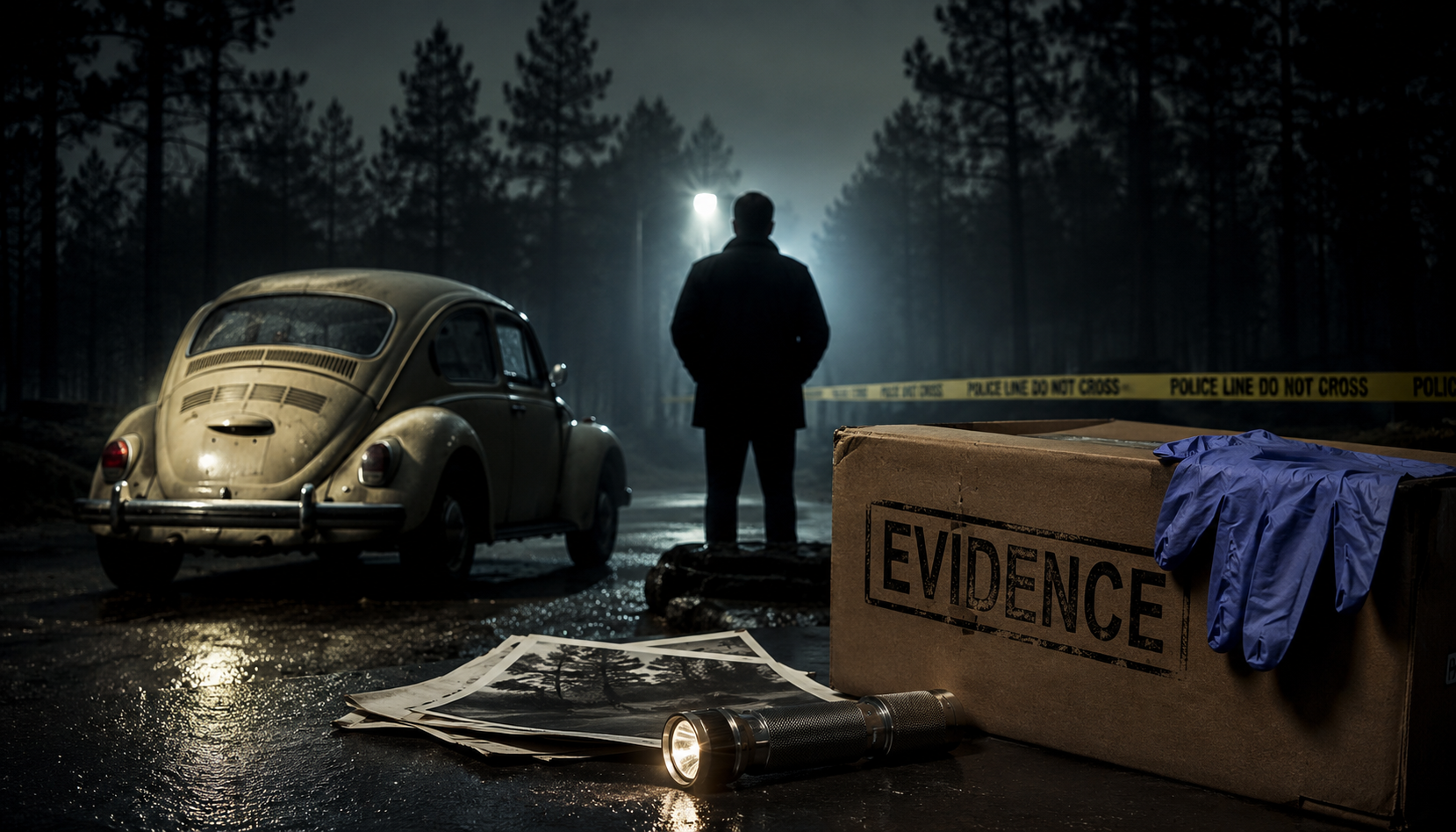
The Volkswagen will keep returning. It will appear in witness descriptions, police reports, survivor testimony, searches, photographs, and the growing suspicion that disappearances separated by state lines may not be separate at all.
The Life Before The Case
Theodore Robert Cowell enters the public record in Burlington, Vermont, on November twenty-fourth, nineteen forty-six. He spends his earliest years within a family arrangement that obscures the identity of his father and presents his mother, Louise, as his older sister. Louise later moves with him to Washington, marries Johnnie Bundy, and gives her son the surname by which the world will know him.
By the early nineteen seventies, Bundy has constructed a life that does not resemble the public stereotype of a dangerous offender. He studies psychology at the University of Washington, becomes involved in Republican politics, works on public campaigns, and later enters law school. He can appear articulate, helpful, ambitious, and socially conventional.
That presentation becomes central to the mythology surrounding him. The shorthand says that Bundy is unusually charming, handsome, and brilliant. Repetition turns those descriptions into explanations, as though appearance itself enabled every crime.
The record is less flattering and more useful. His academic path is uneven. His finances are unstable. His relationships contain deception and infidelity. People who know him encounter different versions: attentive partner, political volunteer, insecure student, petty thief, compulsive liar, and man who can become cold when challenged.
Elizabeth Kloepfer, his long-term girlfriend, lives with the private version of that uncertainty. She is raising a young daughter and wants stability. Bundy moves between affection and withdrawal, commitment and secrecy. When women begin disappearing around Seattle, details she has tried to dismiss begin to look different: unexplained absences, possessions she does not recognize, a Volkswagen matching witness descriptions, and behavior that feels increasingly difficult to reconcile with the man she believes she knows.
The women whose names will become connected to Bundy’s movements are also living ordinary, distinct lives. They are students, workers, daughters, sisters, friends, and young women planning futures that have nothing to do with the man who will dominate accounts of them.
Lynda Ann Healy studies psychology and reports weather conditions for a local radio station. Donna Gail Manson is interested in music and the arts. Susan Rancourt studies at Central Washington State College. Roberta Kathleen Parks attends Oregon State University. Brenda Carol Ball spends time with friends at a tavern near Seattle-Tacoma International Airport. Georgann Hawkins belongs to a sorority at the University of Washington.
The differences matter. Bundy does not select one identical type of woman. Popular accounts often reduce his targets to young white women with long dark hair parted in the middle. Some victims broadly fit that image; others do not. The more consistent pattern concerns vulnerability, access, opportunity, isolation, and Bundy’s ability to create a brief reason for someone to lower her guard.
Long before the investigations converge, ordinary life is being interrupted one person at a time.
The People Around Him
Bundy’s public identity depends on other people accepting a carefully managed surface. He cultivates relationships with professors, campaign workers, friends, romantic partners, and members of respectable institutions. Each group sees only part of him.
Kloepfer sees more than most, but even she lacks a complete picture. Suspicion inside an intimate relationship rarely arrives as a clean revelation. It accumulates through contradictions. A partner says he was in one place, but a receipt or conversation suggests another. An object appears without a credible explanation. A car is cleaned, altered, or used at odd hours. Concern competes with affection and with the fear of making an accusation that sounds impossible.
After the Lake Sammamish disappearances, authorities circulate a description of a man calling himself Ted and using a Volkswagen Beetle. Kloepfer contacts police. Other people who know Bundy also recognize elements of the description.
The name alone is common. Volkswagen Beetles are common. An arm sling can be discarded. A person with no serious adult record, political connections, and the appearance of social stability does not fit the assumptions guiding many investigators.
Police receive a flood of names. Bundy becomes one entry among many rather than the obvious answer hindsight makes him appear to be. The gap between suspicion and proof remains wide.
This is where the popular “charming killer” narrative becomes misleading. Bundy does not need to mesmerize every person he meets. He needs to appear legitimate for a few minutes. He uses social expectations: help an injured man, listen to someone claiming to be a police officer, assist with a boat, follow a person who speaks with confidence.
Some women refuse him. At Lake Sammamish, witnesses describe declining his request or walking toward the Volkswagen before noticing there is no sailboat and leaving. Their decisions show that the approach is neither supernatural nor infallible. It is a calculated test repeated until someone is isolated.
The supporting cast also includes the investigators working in different jurisdictions. Detectives in Washington see missing university students and remains discovered in wooded areas. Officers in Utah encounter disappearances, an attempted abduction, and a suspicious Volkswagen. Colorado authorities investigate a woman who vanishes from a ski resort. Each department holds fragments that become more powerful when placed beside fragments held elsewhere.
In the nineteen seventies, that exchange is slow. Databases are primitive or nonexistent. Records travel by telephone, teletype, meeting, mail, and personal relationships between investigators. A suspect can cross a state line faster than a case file.
Bundy’s strongest protection is therefore not charisma alone. It is fragmentation.
The First Cracks
The known Washington sequence begins not with a disappearance but with a survivor.
In January nineteen seventy-four, a young woman sleeping in a basement bedroom near the University of Washington is attacked. She survives severe head injuries and permanent effects. The intruder leaves without creating a clear public pattern that can be connected to the disappearances that follow.
The next month, Lynda Ann Healy does not arrive for work. Evidence in her room suggests that the explanation is not a voluntary absence, yet there is no obvious suspect. Her disappearance becomes one of several surrounding college campuses in Washington and Oregon.
Donna Manson disappears from the Evergreen State College campus in March. Susan Rancourt vanishes from Central Washington State College in April. Roberta Parks disappears from Oregon State University in May. Brenda Ball is last seen after leaving a tavern in June. Georgann Hawkins disappears while walking a short distance between university residences later that month.
The distances are manageable by car. The settings offer young women moving between dormitories, libraries, parking areas, social events, and nearby roads. Some witnesses recall a man using crutches, wearing a sling, or asking for assistance. Others remember a Volkswagen.
At the time, the clues are suggestive rather than conclusive. No single witness sees the entire event. A vehicle description can narrow a search without identifying a driver. A first name can generate tips without establishing who used it. A similar age range among missing women can indicate a pattern or simply reflect the population around campuses.
Kloepfer’s concern grows. She reports Bundy’s name, but the reports do not produce immediate action. Investigators are weighing large numbers of tips, and the evidence required to search, arrest, and prosecute someone is more demanding than the evidence required to feel uneasy.
Bundy, meanwhile, remains socially mobile. He travels, studies, maintains relationships, and prepares to move to Utah for law school. Nothing in his official life publicly announces the danger investigators are trying to define.
The first major public break comes at Lake Sammamish because the approach occurs in daylight before numerous witnesses. The man does not conceal his chosen first name. He repeatedly walks through a populated park. He allows women to see the Volkswagen.
That confidence supplies investigators with their clearest description so far. It also exposes the central weakness of the inquiry: they can describe the approach, but they cannot yet prove what happens after a woman reaches the car.
The Last Ordinary Movements
Janice Ott arrives at Lake Sammamish on a summer Sunday. Witnesses later describe her leaving with the man who says he needs help with his sailboat.
Denise Naslund is at the park with friends and her boyfriend. She walks toward the restroom area during the afternoon. When she does not return, the first possibilities remain ordinary: she has met someone, taken a different path, or become separated in the crowd.
Those explanations weaken as time passes.
Witnesses place both women near the same man. Several remember his sling. Others remember the Volkswagen. The car becomes the fixed object around which uncertain recollections can be compared.
Investigators produce a composite sketch and ask for information about a man named Ted. They receive hundreds of tips. Bundy’s name is among them, but he is not immediately elevated above numerous other men who share some feature of the description.
The sequence also shows the limits of witness evidence. A crowded park creates many observers, but each sees only a few seconds. One notices the clothing. Another hears the name. Another sees a woman walking beside him. Another sees the Beetle.
No witness sees the central act. Their accounts become powerful only through accumulation.
The same principle will later define the cases against Bundy. One strand alone may be weak. A Volkswagen is not proof. A sling is not proof. A false name is not proof. Travel near a disappearance is not proof. A relationship conflict is not proof. Unusual behavior is not proof.
When independent strands repeatedly align, however, the pattern becomes harder to dismiss.
In late summer, Bundy relocates to Salt Lake City and enters the University of Utah law school. The geographic center of concern shifts with him, although investigators do not yet know that they are following the same sequence.
In Utah, young women continue their routines. Melissa Smith leaves a pizza restaurant in Midvale. Laura Ann Aime attends a Halloween gathering and later sets out alone. Debra Kent goes to a school play in Bountiful. Carol DaRonch visits a shopping mall.
The settings are again ordinary. A restaurant. A party. A school. A shopping center.
The danger does not announce itself as danger. It arrives through a request, a claim of authority, a short walk, or an offer of transport.
The First Alarm
In September nineteen seventy-four, searchers discover human remains near Issaquah, not far from Lake Sammamish. The recovered remains include Janice Ott and Denise Naslund. The uncertainty surrounding their absences becomes a homicide investigation.
Months later, additional remains are found on Taylor Mountain. The names attached to the disappearances are no longer isolated missing-person files. Lynda Healy, Susan Rancourt, Roberta Parks, and Brenda Ball are among those identified. The wooded locations show that someone has been using remote terrain to conceal victims taken from public or semi-public places.
The change in tense is unavoidable. These women had lives before the case, but the investigation now confirms that those lives have ended.
The discoveries provide connection without immediate identification. Investigators can compare geography, victim circumstances, witness descriptions, and the suspected vehicle. They still lack the kind of direct physical evidence that modern audiences associate with homicide investigations.
There is no usable offender DNA profile. No nationwide digital system can instantly compare evidence across jurisdictions. The absence of a fingerprint or biological match does not mean the crimes are unrelated; it means investigators must build through pattern, witness accounts, travel, property, and admissions.
Utah produces its own alarms. Melissa Smith, seventeen, is reported missing in October nineteen seventy-four and is found dead nine days later. The state’s current cold-case record continues to classify her homicide as active while identifying Bundy as the believed perpetrator.
Laura Ann Aime, also seventeen, disappears after Halloween. Her body is found near American Fork Canyon later that month. The physical circumstances resemble aspects of other suspected Bundy crimes, but resemblance is not a forensic identification.
Debra Kent disappears after leaving a school production in November. Near the school, investigators recover a small handcuff key. Her remains are not identified at the time, and the missing-person case continues without the certainty that a recovered body can provide.
That same day, Carol DaRonch enters Fashion Place Mall in Murray, Utah. A man approaches her and says someone has attempted to break into her car. He presents himself as a police officer and persuades her to follow him.
The first explanation sounds official. Her car may have been targeted. A suspect may be waiting at a station. She may need to file a complaint.
Then the route stops making sense.
The Search For An Explanation
Carol DaRonch spends roughly ten to fifteen minutes observing the man at close range. She notices his face, walk, clothing, shoes, mustache, and the interior of his light-colored Volkswagen. She becomes suspicious when the supposed officer cannot show convincing identification and does not drive toward a police station.
The man stops near a school and places a handcuff on one of her wrists. DaRonch fights. He threatens her with what she believes is a gun and strikes or attempts to control her with a metal object. She escapes the car, continues struggling outside, and reaches passing assistance.
Her survival changes the investigation because she can describe not only an approach but the attempted abduction from inside the vehicle. She remembers a torn rear seat, rust spots, the Volkswagen’s color, and the man’s physical mannerisms.
The handcuffs remain locked around the same wrist. The recovered key near the place where Debra Kent disappeared fits the same kind of restraint. That does not prove one man committed both crimes, but it strengthens the emerging connection.
Kloepfer again communicates her suspicions. Detectives in Utah and Washington compare what they know. A suspect who once seemed too ordinary begins to fit more of the details.
In August nineteen seventy-five, a Utah patrol officer notices Bundy driving through a residential area before dawn. When the officer follows, Bundy attempts to get away. A search of the Volkswagen uncovers handcuffs, rope, masks, a crowbar, and other objects that can have innocent uses separately but acquire a different meaning beside DaRonch’s account. The passenger seat has been removed or repositioned, creating additional space inside the car.
Suspicious property is not automatic proof of kidnapping or murder. Bundy supplies explanations. He says items have ordinary purposes. Investigators must connect him to a specific offense, not merely demonstrate that his car contains troubling objects.
DaRonch identifies him. Details of his Volkswagen correspond with what she saw. Blood-type evidence, shoes, the car’s interior, and her prolonged opportunity to observe him become part of a cumulative case.
Bundy is arrested and charged in connection with her abduction. The legal process has begun, but the wider homicide investigations remain unresolved.
Investigators from Washington, Utah, and Colorado meet to compare cases. The exchange creates a clearer picture of Bundy’s travels and the disappearances surrounding them. Yet the difference between believing one man is responsible and proving individual murders remains severe.
DaRonch has given authorities something the homicide files do not have: a living witness who encountered the method, resisted it, and can identify the man behind the invented authority.
The Evidence That Did Not Fit
In nineteen seventy-six, a Utah judge finds Bundy guilty of aggravated kidnapping after a trial without a jury. The conviction is later upheld. The state’s highest court concludes that DaRonch had repeated opportunities to observe her attacker and that numerous circumstances, considered together, supported the judgment beyond a reasonable doubt.
The ruling demonstrates a principle that will recur throughout Bundy’s legal history. Circumstantial evidence is not necessarily weak evidence. Its force depends on how independently verified details connect.
The Utah conviction does not resolve the deaths and disappearances across the West. Colorado authorities focus on Caryn Campbell, a twenty-three-year-old nurse who disappears from a hotel corridor at a ski resort in January nineteen seventy-five. Her body is later found near a rural road.
Travel records, witness accounts, and Bundy’s presence in the area place pressure on his denials. He is charged and moved to Colorado to face the case.
The proceedings expose another part of his public persona. Bundy insists on participating closely in his defense, studies legal materials, and takes advantage of privileges given to a defendant assisting counsel. During a courthouse appearance in Aspen in June nineteen seventy-seven, he is left in a room with access to a window.
He climbs out.
The escape produces a mountain search and federal involvement. Authorities capture him after several days, but the failure does not end there. Returned to custody in Glenwood Springs, Bundy loses weight, studies the jail’s structure, and prepares a second route.
At the end of December, he climbs into the ceiling above his cell, moves through the building, enters living or office space, changes clothes, and walks away. A nationwide search follows. Federal agents distribute identification material, process fingerprints, provide behavioral assistance, and eventually place him on the Ten Most Wanted Fugitives list.
The escapes are more than dramatic episodes. They create a direct institutional consequence. A convicted kidnapper and accused murderer, already suspected across several states, is again able to move without supervision.
He travels east and south under stolen identities. He obtains vehicles, rooms, food, and money through theft. The controlled presentation that once operated through ordinary respectability becomes more unstable.
The Volkswagen motif also changes. The familiar tan Beetle has helped investigators connect the Western cases, but Bundy can abandon one vehicle and steal another. A car is useful evidence only while investigators know which car to seek.
By January nineteen seventy-eight, he is in Tallahassee, Florida, living under an assumed name near a university campus.
The investigation has crossed the country. The immediate danger has crossed with it.
The Event At The Center Of The Case
During the early hours of January fifteenth, nineteen seventy-eight, an intruder enters the Chi Omega sorority house near Florida State University.
Nita Neary returns and hears someone moving rapidly down the stairs. She sees a man near the front entrance carrying a club-like object. Her view is brief, but she notices his profile, clothing, and the object in his hand.
Upstairs, the extent of the attack becomes clear. Margaret Bowman and Lisa Levy have been killed. Kathy Kleiner and Karen Chandler have sustained serious injuries but survive. The women were attacked in their rooms with a heavy length of wood. Medical evidence establishes blunt-force trauma, and the two women who died were also strangled. A patterned injury on Levy’s body is interpreted as a human bite.
Within roughly an hour, Cheryl Thomas is attacked in a nearby residence. Neighbors hear noise and call police after receiving no answer from her. She survives severe injuries.
The sequence matters because of its speed and concentration. Earlier suspected crimes rely on isolation, deception, transport, and disposal in remote areas. The Tallahassee attacks occur inside occupied residences, near witnesses, during a compressed period. The offender leaves survivors, hair evidence, a witness description, and a patterned injury that investigators believe can be compared with a suspect’s teeth.
Bundy is not yet in custody. In the following weeks, he continues using stolen property and false names.
On February ninth, twelve-year-old Kimberly Leach disappears from her junior high school in Lake City. Witness accounts later place a man and a white van near the school. Evidence links Bundy to a nearby hotel under another name and to movements involving a stolen vehicle, although portions of the physical case are less conclusive than popular retellings suggest.
The van produces no fingerprint or hair match to Bundy or Kimberly. Soil from the vehicle differs from soil at the recovery site. Blood found in the van matches Kimberly’s blood group, but that group is shared by a significant part of the population. Fiber and contact evidence supports an association but does not record the abduction itself.
In April, searchers find Kimberly’s body in a wooded area near the Suwannee River. The case now involves the disappearance and death of a child, a fugitive already connected to kidnapping, and a largely circumstantial trail across stolen vehicles and false identities.
On February fifteenth, before Kimberly is found, a Pensacola police officer notices a stolen orange Volkswagen. The driver resists arrest and gives a false name.
Fingerprints and fugitive material establish that the driver is Ted Bundy.
The man associated with a tan Volkswagen in the West has been caught inside another Volkswagen in Florida.
When The Story Broke Open
Bundy’s arrest joins several narratives that had developed separately: the Washington disappearances, the Utah kidnapping, the Colorado charge and escapes, the national fugitive search, the Tallahassee attacks, and Kimberly Leach’s disappearance.
Public attention expands rapidly. Bundy’s appearance and education become part of almost every account. The implication is that dangerous offenders are expected to look visibly dangerous, and that Bundy represents an exception.
That idea grants him too much originality. Violence has never belonged to one face, class, profession, or level of education. Bundy’s usefulness as a public lesson lies not in the claim that he is uniquely charming but in the evidence that people and institutions often use irrelevant social signals to assess risk.
His legal behavior intensifies the fascination. He participates in his defense, speaks in court, challenges witnesses, and appears to enjoy the attention. Cameras turn the proceedings into public spectacle.
The spectacle can distort the actual stakes. The women are not supporting characters in a courtroom performance. Margaret Bowman and Lisa Levy were university students killed in their residence. Kathy Kleiner, Karen Chandler, and Cheryl Thomas survived attacks that would continue shaping their lives. Kimberly Leach was a twelve-year-old child taken during a school day.
The public version often compresses these people into “Bundy victims,” while expanding every detail of his appearance, speech, relationships, and supposed intelligence. That imbalance survives for decades.
The investigation itself also becomes simplified. Popular retellings suggest that one brilliant clue exposed him. The real progression is slower: survivors, witnesses, a vehicle, a handcuff key, travel records, receipts, false names, stolen vehicles, hair comparisons, blood grouping, fiber evidence, courtroom identification, and an offender whose own movements repeatedly intersect with the cases.
Some strands are strong. Others are limited. Some methods accepted at trial will later face serious scientific criticism.
The case is built not from one perfect answer but from fragments of unequal quality.
That distinction becomes vital when Bundy enters two major Florida trials. The question is no longer whether the public suspects him. The question is whether prosecutors can establish the charged crimes beyond a reasonable doubt using admissible evidence.
The Case Built From Fragments
In the Chi Omega proceedings, prosecutors rely on Nita Neary’s identification, testimony placing Bundy near the sorority house, evidence of his movements, hair comparison, incriminating statements, flight from police, similarities between the attacks, and expert testimony concerning the patterned injury on Lisa Levy.
The Florida Supreme Court later describes Neary’s identification and the dental comparison as principal evidence, supported by a larger collection of circumstantial facts. The court concludes that the combined evidence is legally sufficient to support two murder convictions, three attempted-murder convictions, and two burglary convictions.
At the time, the bite-mark presentation appears visually compelling. Experts compare casts of Bundy’s teeth with photographs of the injury and tell jurors that distinctive features correspond.
Modern forensic science treats that claimed precision very differently.
A major scientific review has found that bite-mark analysis on human skin lacks adequate foundational support. Research has not established that front-tooth patterns are individually unique, that skin reliably records those patterns, or that examiners can consistently interpret the resulting injuries. Skin stretches, swells, moves, heals, and distorts. Qualified examiners may disagree over whether an injury is even a bite.
This does not produce a credible factual claim that Bundy was innocent of the Chi Omega crimes. The trial record contained multiple strands beyond the dental evidence, his later admissions connected him to a much broader series, and modern DNA has confirmed his responsibility in at least one case that was previously supported mainly by suspicion and confession.
It does change the forensic lesson. Bundy’s famous trial helped popularize a method that modern review considers scientifically unsupported for identifying a specific person. A correct verdict cannot validate an unreliable technique. Reliability must be tested independently of whether a defendant is widely believed to be guilty.
The Kimberly Leach case is also circumstantial. One witness places a man with a girl near the school. Other witnesses and records connect Bundy to a white van, stolen tags, false registration details, and the surrounding route. Blood grouping and fiber evidence offer support, while fingerprints, hair, and soil fail to create direct identification.
The Florida Supreme Court upholds Bundy’s conviction and death sentence. Its opinion shows why evidence must be read in layers: one item can be inconclusive while the total pattern still meets the legal standard.
What the evidence cannot do is reproduce every private moment. It cannot establish every word spoken, every route taken, or one complete motive. It cannot determine the full number of victims.
The trials answer specific legal charges. They do not answer the whole historical case.
The Outcome That Did Not End The Story
Bundy is convicted in Florida of killing Margaret Bowman and Lisa Levy and of attempting to kill three other women. He receives two death sentences. He is later convicted of kidnapping and killing Kimberly Leach and receives another death sentence. The Florida Supreme Court affirms the judgments in separate appellate decisions.
Appeals and post-conviction proceedings continue for years. These challenges address legal representation, venue, evidence, procedure, witness identification, and constitutional issues. An appeal does not operate as a second trial, and its existence does not itself establish innocence or legal error. The courts repeatedly leave the convictions and sentences in force.
As execution becomes imminent, Bundy begins giving more detailed accounts of killings across several states. He admits responsibility for thirty homicides, although his disclosures remain incomplete and sometimes difficult to verify. Some statements provide information consistent with known evidence. Others are vague, self-serving, incorrect, or delivered too late for investigators to test fully.
The timing matters. Information has value to him. By offering fragments, he can seek delays, attention, control, and renewed negotiation. Families and investigators need answers, while Bundy controls which details he releases.
Confession is therefore not the same as proof. A confession may be true, false, exaggerated, minimized, strategically timed, or mixed with misinformation. Investigators still need corroboration.
On January twenty-fourth, nineteen eighty-nine, Bundy is executed in Florida’s electric chair. He is forty-two years old.
His death ends the criminal proceedings against him. It does not identify every victim, locate every missing person, or transform all his statements into reliable history.
That unfinished record is one reason the case remains active in a practical sense. Evidence remains in storage. Cold-case investigators continue comparing old files with improved scientific methods. Families still wait for information that the original investigations, trials, confessions, and execution did not provide.
The law reaches a formal ending.
The evidence does not.
The Aftermath People Still Argue About
Bundy’s confirmed and admitted crimes extend across Washington, Oregon, Utah, Idaho, Colorado, and Florida. The exact total remains unknown.
The uncertainty has encouraged two opposite mistakes. One treats every unresolved disappearance near a place Bundy visited as another Bundy case. The other treats his admitted total as a complete boundary.
Neither position is justified.
Bundy lied frequently. He minimized his conduct for years, then disclosed killings under the pressure of execution. He may have withheld cases involving very young victims, crimes close to his family, or events he believed would damage the version of himself he still wanted to control. He may also have enjoyed encouraging the belief that his total was unknowably high.
Without corroborating evidence, speculation can absorb unrelated victims into Bundy’s mythology and divert attention from other offenders.
Ann Marie Burr, an eight-year-old who disappears from Tacoma in nineteen sixty-one, is often discussed as a possible early victim. Bundy is fourteen at the time and lives in the wider area. Later suspicions focus on proximity and perceived behavioral similarities. Testing conducted decades later does not yield sufficient intact DNA for comparison, leaving the theory unproven.
Susan Curtis remains listed by Utah authorities as a kidnapping and homicide case in which Bundy is the prime suspect after admitting responsibility. Her body has never been recovered.
Melissa Smith’s homicide remains active in Utah’s cold-case system, with Bundy identified as the believed perpetrator. Nancy Baird’s disappearance and other cases continue to generate discussion, but suspicion, admission, and forensic proof are separate categories.
In two thousand and eleven, an investigator discovered that Bundy’s DNA profile was not available in the national Combined DNA Index System. Working with Florida authorities, investigators located an existing biological sample, developed a profile, and uploaded it. That step made it possible for crime-scene profiles from elsewhere to be compared against him.
For years, the database entry did not produce the dramatic public resolution many expected. Old evidence may contain no biological material. It may have degraded, been consumed during earlier testing, been contaminated, lost, discarded, or stored under conditions that make modern analysis difficult.
The existence of a reference profile is only half the problem. Investigators also need preserved evidence from a crime scene capable of producing a meaningful comparison.
That is why the most important recent development begins not with Bundy’s notoriety but with an evidence box kept for more than half a century.
The DNA That Changed The Record
Laura Ann Aime grows up on a family farm in Utah. Her younger sister later remembers sharing a bedroom, riding horses together, and watching Laura feed red licorice to her horse.
On Halloween night in nineteen seventy-four, Laura leaves a gathering alone. Her body is discovered near American Fork Canyon later that month. Investigators suspect Bundy, and he later claims responsibility, but he does not provide sufficient detail to close the case.
The evidence is preserved.
Utah’s forensic laboratory introduces new genotyping technology in two thousand and twenty-three. The system allows analysts to recover information from samples that are small, aged, degraded, or mixed with DNA from more than one person. Analysts reviewing Laura’s case identify material capable of producing a single male profile.
That profile is submitted for comparison.
It matches Bundy.
On April first, two thousand and twenty-six, Utah County authorities announce that the evidence definitively establishes Bundy’s responsibility and officially close Laura Ann Aime’s homicide. The result supplies the physical corroboration that his death-row admission never provided.
The breakthrough is important for more than one case. Utah now possesses a profile developed through evidence associated with Laura’s homicide, while Bundy’s reference profile is already held in the national system. Authorities can compare suitable biological material from other unresolved cases against that profile.
Officials have indicated that another suspected Bundy case may be approaching resolution, although no additional public closure had been confirmed by July tenth, two thousand and twenty-six. Several Utah cases remain active or unresolved, including Melissa Smith’s homicide and Susan Curtis’s disappearance.
Modern DNA has also narrowed the Bundy story by excluding him from cases attached to his name through rumor.
Ann Woodward was killed inside her Moab bar in nineteen seventy-three. Bundy speculation became associated with the case, but preserved clothing and other evidence were eventually retested. Utah’s cold-case record now identifies Douglas K. Chudomelka through DNA and lists the case as closed.
That outcome is as instructive as the Laura Aime match.
Science does not exist to increase a notorious offender’s total. It exists to test the evidence. In one file, DNA confirms Bundy. In another, DNA points elsewhere.
The new evidence therefore changes the record in both directions. It strengthens one attribution that had remained unproven and removes a famous name from a different case where the evidence identifies another man.
The mythology expands through speculation.
The record improves through exclusion as well as confirmation.
Why The Volkswagen Still Matters
The tan Volkswagen at Lake Sammamish begins as an ordinary car attached to an ordinary request. A man with an injured arm needs help with a sailboat.
The women who refuse him never become central names in the case. Their decisions still matter. They show that Bundy’s method depends on repetition, opportunity, and a momentary imbalance of information. He knows the request is false. The person hearing it does not.
For Janice Ott and Denise Naslund, the car becomes the boundary between a crowded public space and an event no witness can fully reconstruct.
For Carol DaRonch, the Volkswagen becomes the place where deception fails. She notices the route, the damaged seat, the false authority, and the sudden restraint. She fights her way out and gives investigators the detail needed to connect a person, a vehicle, and a method.
For police, the Beetle becomes a searchable object: photographed, described, compared, and filled with items whose significance emerges only beside witness testimony.
For the wider case, it becomes a warning against letting symbols replace people. Bundy’s car, face, courtroom performance, and escapes are memorable. Lynda Healy’s work, Laura Aime’s horse, Kimberly Leach’s school day, and the lives of the surviving women are less frequently repeated.
That imbalance gives the perpetrator the cultural permanence he sought.
The strongest modern answer is not another dramatic theory about how many people he may have killed. It is the patient examination of evidence he could no longer manipulate: a survivor’s observations, an old garment, a preserved biological sample, a court record, a DNA profile, and a result capable of excluding as well as identifying.
More than fifty years after the Volkswagen appeared beside a crowded lake, the case is still being corrected one fragment at a time.
The car remains recognizable.
The task now is to keep the people from disappearing behind it.
