True Crime: The Delphi Murders - The Evidence Under New Scrutiny
What The Evidence Really Shows
Two Girls And An Ordinary February Afternoon
Abigail "Abby" Williams and Liberty "Libby" German were thirteen and fourteen years old when they went to the Monon High Bridge Trail outside Delphi, Indiana, on February thirteenth, two thousand and seventeen.
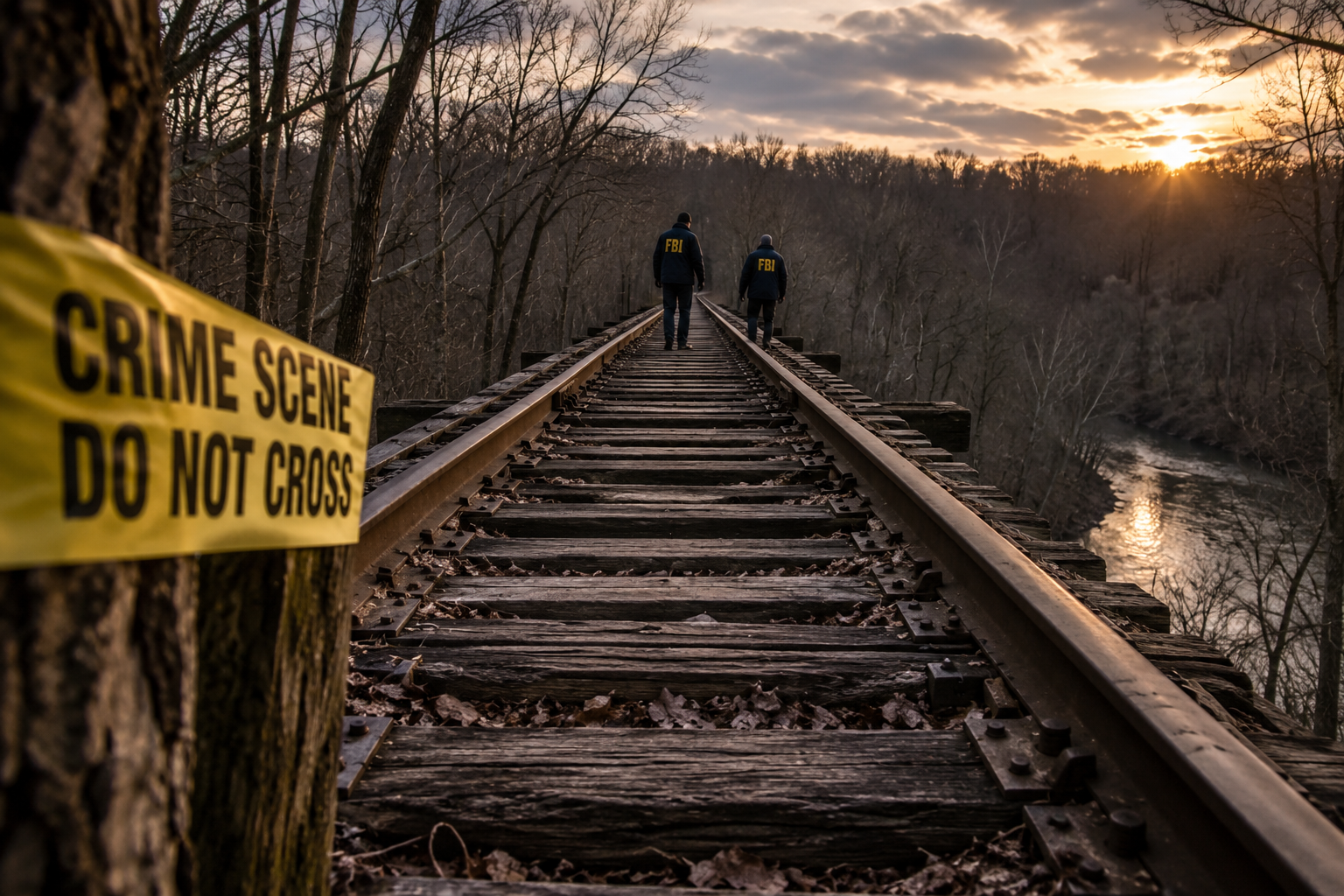
The trail and the abandoned railway bridge were familiar parts of the local landscape. At some point during the afternoon, Libby's phone captured video and audio of a man approaching the girls. A male voice could be heard directing them "down the hill." That recording became one of the most recognizable pieces of the investigation and produced the image widely known as "Bridge Guy."
When Abby and Libby failed to return as expected, relatives began searching and authorities became involved. The following day, searchers found them in a wooded area near Deer Creek. Police publicly confirmed their identities and began investigating their deaths as homicides.
The investigation generated enormous attention but did not produce an immediate arrest. Investigators released images, audio and different composite sketches while seeking information about the unidentified man recorded on Libby's phone.
Years passed.
One of the enduring questions became how someone could have appeared on the investigative radar early, yet not become the central suspect until much later.
The Man Who Said He Was On The Trail
Richard Allen lived in Delphi and worked locally. During the original investigation, he told an investigator that he had been on the trail on February thirteenth.
That fact became enormously important when investigators revisited the case years later.
Allen said he had been in the area during the afternoon. Investigators ultimately came to believe that his account, witness information, clothing descriptions and the timing of the Bridge Guy recording placed him within the relevant investigative window. The State has continued to emphasize that Allen himself acknowledged being on the trail.
In October two thousand and twenty-two, investigators searched Allen's home.
Among the items seized was a handgun. The investigation also focused on an unspent .40-caliber cartridge recovered near Abby and Libby. Firearms examination became one of the important evidentiary disputes in the case because the State maintained that markings on the cartridge were consistent with it having been cycled through Allen's weapon.
The defense has challenged how much that comparison can scientifically prove.
That distinction matters. The cartridge was not a fired bullet recovered after being shot from the handgun. The evidentiary theory concerned toolmarks allegedly produced when the cartridge moved through the firearm's mechanism.
Allen was arrested and charged.
From that point, the case entered a legal process almost as contentious as the investigation itself.
The Pretrial Fight Became Part Of The Case
Allen's detention conditions are now central to his appeal.
While awaiting trial, he was transferred into the Indiana Department of Correction rather than remaining under more conventional county-jail conditions. Authorities argued that extraordinary security was necessary because of the notoriety of the case and concerns for his safety.
His attorneys saw something very different.
They argued that Allen spent prolonged periods under conditions resembling solitary confinement and deteriorated severely. Records and testimony later described bizarre behavior including smearing feces, drinking toilet water, harming himself, speaking nonsensically, asking whether he was dead and demonstrating symptoms that medical professionals regarded as psychotic. His appellate brief describes numerous statements about the killings occurring during this period of extreme behavioral deterioration.
The significance is not merely that Allen became mentally unwell.
It is what happened while he was unwell.
He began confessing.
The Confessions That Changed The Case
Allen made incriminating statements repeatedly. Some were made to correctional staff and mental-health personnel. Others involved members of his family.
One particularly detailed statement described using a box cutter and included a claimed reason the encounter escalated. Prosecutors later argued that aspects of Allen's statements were corroborated by evidence presented at trial. The defense argues that many statements emerged from a mind experiencing profound psychosis and contained unreliable or inconsistent material.
That created an unusually difficult evidentiary problem.
A confession can be enormously persuasive to a jury. But the law also recognizes that statements must be voluntary, and reliability becomes especially important when the speaker's mental condition is severely impaired.
Allen's appellate lawyers argue that his confinement was not simply background to his breakdown. Their position is that state-imposed conditions contributed to his deterioration and that incriminating statements obtained in that environment should not have been admitted against him.
The State rejects that connection.
At the September appeal hearing, the Attorney General's office argued that Allen had been placed under restrictive conditions for protection rather than interrogation, that correctional officials were not using confinement to extract a confession and that he made numerous admissions under different circumstances. The State also argued that some incriminating statements occurred outside periods of acute psychosis.
That is why Judge Brown's remark attracted such attention.
If confinement imposed by the State materially helped create the psychiatric condition in which incriminating statements emerged, the appellate court must consider whether the conventional distinction between mental illness and governmental coercion is sufficient to resolve the issue.
What The Jury Saw And What It Did Not
Allen's appeal is not based on a single alleged error.
His opening appellate brief runs to more than one hundred pages and challenges multiple decisions concerning what the jury was permitted to hear. Written briefing identifies disputes involving the home search, Allen's statements, excluded defense evidence and other evidentiary rulings.
The appellate argument therefore raises a broader question: even if each ruling can be defended individually, did their combined effect prevent Allen from presenting his case adequately?
The defense argues yes.
The State says no.
One of the most visible examples involves the police sketches released during the investigation. Over time, authorities circulated markedly different depictions while searching for the person seen near the bridge.
Allen's lawyers wanted jurors to see and consider evidence concerning those sketches. They argue that the discrepancy mattered when testing the quality and direction of the investigation.
The State's position is that police sketches are investigative tools rather than reliable identifications and therefore should not be treated as substantive evidence proving who committed a crime.
At oral argument, the appellate judges questioned the issue directly.
That does not mean the sketches prove Allen was wrongly convicted. It means the appellate panel is considering whether preventing the defense from using them deprived the jury of relevant context when evaluating the investigation.
The Search Warrant Question
Another major appellate challenge begins with the October two thousand and twenty-two search of Allen's home.
The Fourth Amendment requires searches of private homes to rest on constitutionally sufficient probable cause. Allen's lawyers argue that investigators obtained the warrant using an affidavit containing misleading statements and material omissions.
Their brief specifically attacks the handling of witness descriptions, accounts of the vehicle investigators associated with the trail area and the way different witness observations were presented when probable cause was sought. Allen's attorneys argue that the omitted or altered information weakened the basis for the warrant and that the trial court should have granted fuller consideration under the legal procedure associated with Franks v. Delaware.
The State disputes that characterization.
Its appellate position is that probable cause remained supported by other evidence, including Allen's own acknowledgement that he had been on the trails, witness timing and clothing information. Even if individual pieces of the warrant application were imperfect, the State argues that the search was lawful or that the challenged issues do not justify overturning the convictions.
The stakes are obvious.
The search produced Allen's handgun, linking the warrant challenge directly to the disputed cartridge evidence.
If an appellate court concluded that the search was unconstitutional and that evidence derived from it should have been excluded, it would then have to consider what remained of the prosecution case and whether any error was harmless.
The Cartridge And The Firearms Evidence
The unspent cartridge found near Abby and Libby became one of the State's important physical evidence strands.
The State presented firearms examination supporting its argument that the cartridge had been cycled through Allen's handgun.
The defense wanted to challenge that conclusion more aggressively.
Allen's appellate arguments include the exclusion of proposed expert testimony questioning the reliability of identifying a particular firearm from markings on an unfired cartridge. During the September hearing, the appellate judges specifically asked about the exclusion of defense firearms testimony.
This dispute is easy to oversimplify.
The cartridge does not operate like a fingerprint bearing a person's identity. Toolmark comparison involves examining physical markings and assessing whether their characteristics support association with a particular weapon. The appellate question is not simply whether firearms comparison evidence exists as a recognized forensic discipline. It is whether Allen was given an adequate opportunity to challenge the specific evidence offered against him.
The State argues the trial court's evidentiary decisions were proper and that the defense was able to contest the cartridge evidence.
Allen's lawyers argue jurors were prevented from hearing important expert criticism.
Those positions are now for the appellate panel to resolve.
The Alternative-Perpetrator Theory
Few aspects of the Delphi case have generated more online speculation than theories involving other possible perpetrators.
The appellate issue is narrower.
Before trial, Allen's defense sought to introduce evidence supporting a theory that the crime scene contained features that could be interpreted as ritualistic and that investigators had previously examined people connected with Norse-pagan or Odinist beliefs.
The trial judge restricted significant portions of that defense theory.
Allen's lawyers argue that this prevented him from presenting a complete defense. They wanted expert testimony concerning the alleged ritual characteristics and evidence relating to alternative suspects and investigative leads.
The State argues that the proposed third-party evidence lacked the required direct connection to the murders. Its appellate briefing also points to alibi evidence and contends that the alternative theory remained speculative rather than establishing admissible evidence tying another person to the crime.
This distinction is crucial.
A defendant does not automatically have the right to place every alternative theory before a jury simply because somebody else was once investigated. Courts can exclude speculation that lacks sufficient connection to the charged offense.
But the constitutional right to present a defense also prevents evidentiary rules from being applied so rigidly that a defendant cannot meaningfully challenge the State's theory.
The appellate judges must decide where this case falls on that line.
The Prison Videos And Missing Context
Allen's lawyers also challenge restrictions placed on evidence concerning his mental deterioration.
Their appellate brief says jurors heard incriminating statements from the prison period without being allowed to hear or fully consider other material that the defense believed demonstrated his psychiatric condition.
That included disputes over audio associated with prison video recordings, telephone calls and foundational material connected to expert testimony about solitary confinement and psychosis.
The defense argument is fundamentally about context.
If jurors hear a defendant confess, the confession can appear direct and rational when isolated from the circumstances around it. Allen's lawyers argue that material excluded from trial would have allowed jurors to evaluate whether those statements came from someone capable of reliably describing reality.
The State answers that jurors were not kept ignorant of Allen's condition. Evidence of bizarre behavior and psychiatric deterioration was presented, and prosecutors maintain that his confessions cannot all be dismissed as products of psychosis.
That makes the appellate issue more precise than "was Allen mentally ill?"
The question is whether the jury received enough admissible evidence to assess what his condition meant for the reliability and voluntariness of the statements used against him.
What The State Says Still Points To Allen
The State's defense of the convictions does not depend solely on arguing that every trial ruling was perfect.
Appellate courts frequently ask a second question after identifying an error: did it actually affect the outcome?
That is the doctrine of harmless error.
Indiana argues that even if particular rulings are questioned, substantial evidence still supported the verdict. Prosecutors emphasize Allen's acknowledged presence on the trail, circumstantial evidence concerning his movements and clothing, the cartridge evidence and numerous incriminating statements. The State also relies on aspects of Allen's statements that prosecutors say corresponded with evidence known about the crime.
Allen's lawyers answer that this approach underestimates how interconnected the disputed evidence is.
Remove or weaken the home search, and the handgun evidence changes.
Question the confinement and confession evidence, and one of the most powerful categories of evidence changes.
Permit more aggressive expert criticism of the cartridge, and another strand changes.
Allow the defense to present excluded investigative and third-party material, and jurors receive a different account of reasonable doubt.
That is why the appeal cannot be understood by counting disputed rulings one at a time. Allen's attorneys argue that the structure of the trial itself became unfair.
What The Evidence Cannot Prove By Itself
The Delphi case demonstrates why evidence has to be considered according to what each strand can actually establish.
Allen's presence on the trail establishes opportunity and proximity. It does not independently prove he was Bridge Guy or that he killed Abby and Libby.
The cartridge, assuming the State's firearms interpretation is accepted, can support an association between a cartridge at the scene and Allen's weapon. It does not independently establish when the cartridge arrived there or who possessed the firearm at a particular moment.
The confessions are potentially powerful because they came from Allen himself. Their weight depends partly on voluntariness, psychiatric condition, consistency and corroboration — all matters now under appellate scrutiny.
The absence of Allen's DNA or fingerprints at the crime scene does not prove innocence either. Many criminal cases are established through circumstantial evidence. But the absence becomes relevant when assessing the overall strength of a case built substantially from other categories of proof.
An appeal does not ask judges to substitute their own instinct for the jury's.
It asks whether the jury received a legally fair version of the evidence.
The Moment The Appeal Became Much More Significant
Allen's formal appeal had been developing for months before the September hearing.
His opening brief was filed on December seventeenth, two thousand and twenty-five. Indiana filed its response on March twenty-fifth, two thousand and twenty-six. Allen filed his reply on April twenty-seventh, and the Court of Appeals granted oral argument in May.
The September hearing mattered because appellate judges finally questioned the lawyers directly.
Questions reportedly focused on Allen's confinement and psychiatric deterioration, the police sketches, the excluded firearms testimony, the alternative-perpetrator evidence and whether the jury received enough context to evaluate the confessions.
One judge's sharp question does not equal a decision.
Neither does aggressive questioning of the State mean reversal is inevitable. Appellate judges frequently stress-test whichever lawyer is speaking, sometimes because they are considering that side's argument seriously and sometimes because they want a clean record explaining why it fails.
The hearing therefore generated meaningful signals but no result.
As of September twenty-third, two thousand and twenty-six, the panel has taken the matter under consideration and has not issued its written decision.
What The Court Can Do Next
The Indiana Court of Appeals has several possible paths.
It can affirm Allen's convictions, concluding that the trial was legally sufficient and that any errors were either nonexistent, waived or harmless.
It can reverse and order further proceedings if it finds one or more errors undermined Allen's constitutional rights or the reliability of the verdict.
Depending on the particular ground accepted, the remedy could involve a new trial or another form of remand.
Whatever the decision, the appellate process may not necessarily finish there. Further review can potentially be sought from the Indiana Supreme Court after the Court of Appeals issues its opinion.
That history has particular resonance in this case. Before Allen ever went to trial, the Indiana Supreme Court intervened after the trial judge removed his original appointed lawyers. The state's highest court ordered attorneys Andrew Baldwin and Brad Rozzi reinstated, while rejecting Allen's separate requests concerning the judge and trial timing.
The Delphi prosecution has therefore encountered unusual appellate litigation before.
This time, however, the convictions themselves are at stake.
Why The Delphi Appeal Matters Beyond Richard Allen
For Abby Williams and Libby German's families, the legal arguments exist alongside something much more permanent: two girls went onto a trail in February two thousand and seventeen and did not return home.
No appellate ruling changes that.
But the legitimacy of a criminal conviction depends on more than the seriousness of the crime. The more consequential the accusation, the more important it becomes that constitutional protections are applied faithfully.
The appeal tests several difficult boundaries at once: how courts should treat confessions made during severe psychiatric deterioration; when restrictive pretrial detention becomes constitutionally relevant; how far defendants may go in presenting alternative-perpetrator evidence; how juries should evaluate contested forensic disciplines; and when the cumulative exclusion of defense evidence becomes more important than any individual ruling.
Those questions do not require anyone to decide emotionally whether Allen "seems guilty" or "seems innocent."
They require the appellate court to examine what happened before and during the trial.
That is why the September hearing matters.
The famous image from the Delphi investigation has always been a figure walking across an abandoned railway bridge. Nine years later, the legal argument has reached a different kind of bridge: the distance between a jury's verdict and the constitutional rules that determine whether that verdict can stand.
For now, the court has not crossed it.
