True Crime: Lin And Megan Russell—The Secrets Hidden On A Woodland Path
What Really Happened In Chillenden?
The Path Into Darkness
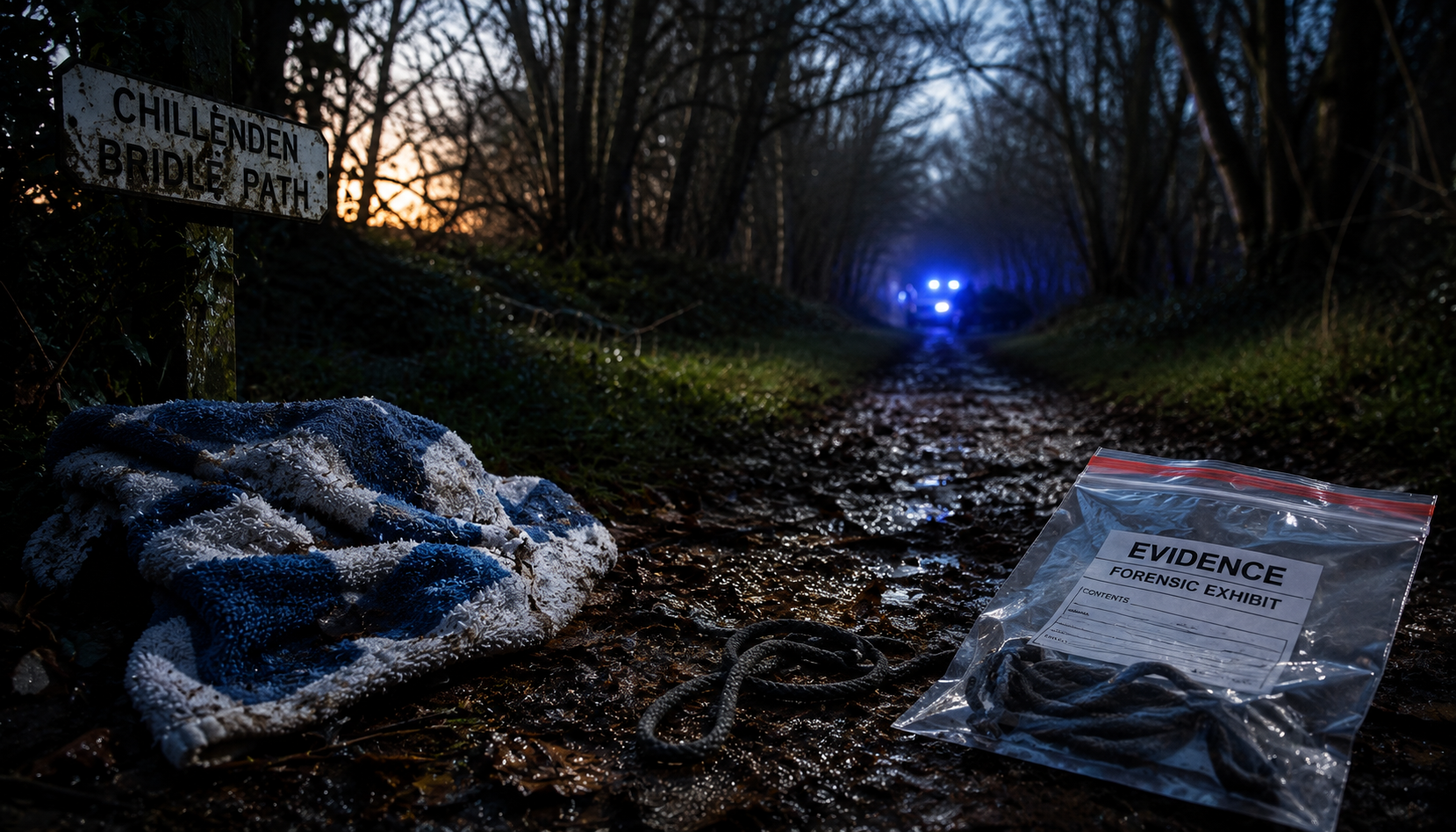
The path runs through the Kent countryside toward the small village of Chillenden. It is not a place built for traffic or crowds. It is a route used for walking home, carrying school bags and swimming equipment, with the family dog moving beside you.
On July ninth, nineteen ninety-six, Lin Russell and her daughters, nine-year-old Josie and six-year-old Megan, take that route after a school swimming gala. Their home is less than half a mile away. The journey should require no explanation.
Instead, the path becomes the center of a case that will be examined by detectives.
The Life Before The Case
Lin Russell is forty-five years old. Her husband, Shaun, works as a botanist, and their daughters are still in primary school. The family has lived in Wales and moved to the countryside near Chillenden only months before the attack. The household includes Lucy, their small white terrier, who accompanies Lin and the girls on their walk home.
Megan is six. Josie is nine. The available record preserves fragments rather than a complete portrait: school, swimming, a rural home, a family adjusting to a new place. Those details matter because the case is often remembered through evidence—the lace, the hammer, the lunchbox and the alleged confession—rather than through the ordinary lives interrupted on the path.
The People Around Them
The immediate family world is small. Shaun is not on the path that afternoon. Lin is walking with both daughters and Lucy after collecting the children from the school event.
There is no documented connection between the family and the man who confronts them. The account reconstructed in court presents the encounter as an attempted robbery rather than a planned attack on specific victims. The stranger demands money. Lin does not have any and offers to retrieve some from home. The offer does not end the confrontation.
That apparent randomness becomes one of the case’s defining difficulties. There is no obvious relationship to investigate, no established personal dispute and no clear reason the family should have been selected.
The absence of a known connection leaves detectives facing a vast field of possibilities: a passing offender, someone committing another crime nearby, a person familiar with the area, or a man whose presence on the lane would be difficult to reconstruct afterward.
The First Cracks
The earliest pressure point is physical rather than social. A vehicle is positioned on or near the route, restricting the family’s movement. Josie later describes a male attacker and associates him with a red car. Other witnesses report seeing a beige vehicle near the area, creating an early discrepancy that never becomes entirely simple.
The attacker carries a claw hammer. After demanding money, he forces Lin, Megan and Josie away from the open path and into a wooded area. The family’s swimming items become part of the scene. Strips of towel and a lace are used as restraints or bindings.
Each detail appears capable of narrowing the search: the car, the weapon, the demand for money, the attacker’s appearance and the materials he handles. Yet none immediately produces a name.
The first version of the event sounds like a robbery committed by a stranger. The difficulty is explaining why a demand for money becomes something far more extreme.
The Last Ordinary Movements
The confirmed sequence begins after the swimming gala. Lin collects the girls, and the three walk with Lucy toward home. School bags, lunch containers and swimming equipment travel with them.
At approximately late afternoon, they encounter the man near Cherry Garden Lane. The confrontation moves from the track into a wooded clearing. Josie’s subsequent account indicates that Lin tells her to run, but the attacker catches her. The victims are blindfolded and restrained.
No camera records the route. No reliable clock fixes every stage. The reconstruction depends on the family’s expected journey, later witness evidence, the condition of the scene and what Josie is eventually able to communicate.
The gap is relatively short in distance but profound in evidentiary terms. A routine walk ends within sight of familiar countryside. What occurs inside the clearing is known through injuries, objects and the memory of a seriously wounded child.
The First Alarm
When the family fails to arrive home, concern develops into a search. They are found that evening in woodland near the route. Lin and Megan have sustained catastrophic head injuries and are pronounced dead. Lucy has also been killed.
Josie initially appears lifeless. An officer notices movement, and she is taken for emergency treatment. She has severe head injuries but survives.
The scene shows repeated blunt-force violence. The attack is not an accidental fall, a brief struggle or an unexplained medical emergency. It is treated as a double murder and an attempted murder.
The attacker has left objects behind and handled items belonging to the family. That creates an expectation that science may provide the answer. Blood, hairs, fibers, bindings and fingerprints all appear capable of turning an unknown man into an identifiable suspect.
Instead, the first examinations produce fragments, exclusions and material whose significance cannot yet be fixed.
The Search For An Explanation
The investigation becomes one of the largest undertaken by Kent Police. Officers examine vehicles, local offenders, witness descriptions, thefts and people who may know the countryside around Chillenden.
An appeal later produces an e-fit of the man described by Josie. Michael Stone emerges as a suspect approximately one year after the attack. He has a serious criminal history, a heroin addiction, experience using bootlaces as tourniquets and familiarity with hammers and property crime. He also has connections to the wider area.
Those facts make him a plausible investigative target. They do not place him on the path.
Stone cannot provide a meaningful alibi for the relevant afternoon. A receipt places him in Chatham around lunchtime, but there is sufficient time for him to travel to Chillenden. Witnesses also give disputed accounts about blood on his clothing and his disposal of clothes after the attack.
Suspicion is building. Proof remains more difficult.
The Evidence That Did Not Fit
The scene contains material that does not produce a forensic connection to Stone. A blood-marked fingerprint on a lunchbox is not his. Hairs and fibers are recovered without being reliably tied to him. Testing of the lace and other items does not establish that Stone deposited biological material at the scene.
Josie does not identify Stone in the formal identification process. The descriptions of the vehicle are not uniform. No weapon is conclusively linked to him, and forensic examination of a vehicle associated with him does not connect it to the Russells.
None of those points automatically excludes Stone. A person can commit an offense without leaving recoverable DNA. A witness who has suffered catastrophic injuries may be unable to identify an attacker. Unidentified hair or DNA can arrive through innocent contact.
Yet the missing forensic link matters because the prosecution needs another bridge between Stone and the clearing. That bridge arrives through men who say Stone spoke to them in prison.
The Event At The Center Of The Case
The physical reconstruction is stark. The attacker diverts Lin, Megan and Josie into the wooded area, restrains and blindfolds them, and strikes them repeatedly with a hammer. The medical evidence attributes the deaths to severe head injuries. Josie survives despite similar violence.
The sequence supports several inferences. The attacker has time to control three people, improvise restraints and search or handle their belongings. The violence continues beyond what would be necessary to obtain money or escape. He then leaves without being reliably identified by another witness.
What the scene cannot establish by itself is his name.
The lace may have been handled by the attacker, but it may also contain DNA from earlier contact. The lunchbox fingerprint may be connected to the confrontation, or it may belong to someone with an innocent reason to have touched it. Hairs on clothing may come from the gala or another ordinary environment.
The scene produces a profile of conduct: control, repeated violence, rapid movement and an apparent willingness to attack children. It does not produce an uncontested genetic or fingerprint identification.
When The Story Broke Open
Stone is arrested and tried at Maidstone Crown Court in nineteen ninety-eight. Three prisoners give evidence suggesting that he made admissions while in custody.
The jury returns majority guilty verdicts on two counts of murder and one count of attempted murder. Stone receives life sentences and continues to deny involvement.
The apparent resolution quickly weakens. One prison witness retracts his account. Concerns also emerge about another witness and money associated with media involvement. In February two thousand and one, the Court of Appeal quashes the convictions and orders a retrial.
That decision does not declare Stone innocent. It determines that the first trial cannot safely stand. The prosecution may try the case again, but the second jury will hear a narrower version of the prison-confession evidence.
The Case Built From Fragments
At the retrial, the central witness is Damien Daley, who says Stone confessed while the men occupied neighboring cells and communicated through the space around a heating pipe.
Daley acknowledges his own dishonesty and criminal background. The defense argues that his account is unsafe and that the alleged confession contains no decisive information unavailable through published coverage. The jury visits the cells to assess whether communication through the pipe is possible.
The prosecution does not rely on Daley in complete isolation. It presents the description of the attacker, Stone’s knowledge of the area, his drug use, the bootlace comparison, his lack of an alibi and disputed evidence about his behavior after the attack.
The legal question is not whether each fragment proves guilt alone. It is whether the fragments, combined with Daley’s account, establish guilt beyond reasonable doubt.
In October two thousand and one, the second jury returns majority guilty verdicts. Stone is convicted again.
The Outcome That Did Not End The Story
Stone appeals again, attacking Daley’s reliability, the disclosure of information about his drug use and mental condition, and the warnings given to jurors about prison-informer evidence.
In two thousand and five, the Court of Appeal dismisses the appeal. The judges conclude that the jury understood Daley was a dishonest and deeply flawed witness. They decide that the trial judge’s repeated warnings were sufficient and that the additional material would not have made the convictions unsafe.
That judgment is legally important. It means the case cannot be reduced to the assertion that judges overlooked Daley’s character. The appeal court considered the problem and decided the jury had been equipped to assess it.
The result also does not convert Daley’s account into scientific evidence. Stone remains convicted because the jury accepted the prosecution case and the appeal court found no legal basis to disturb the verdicts.
The distinction between a standing conviction and independent proof of innocence becomes the center of everything that follows.
The Aftermath People Still Argue About
Stone continues to deny the crimes. His minimum term is fixed at twenty-five years, but completing a minimum term does not itself require release. His convictions remain in force unless quashed by the Court of Appeal.
Josie rebuilds her life after extensive treatment and later becomes a textile artist. In two thousand and twenty-six, she publicly supports efforts to preserve the Welsh primary school connected to her childhood and recovery. Her survival is more than evidence in another person’s trial; it is a life continuing beyond the clearing.
Public debate focuses increasingly on two weaknesses: the lack of a forensic link to Stone and the dependence placed on a prison confession.
A third issue enters the case when convicted serial murderer Levi Bellfield claims responsibility. His accounts change over time. He confesses, retracts and later renews the claim. Investigators and people familiar with his known offenses question whether his account is genuine. A confession from Bellfield is therefore not a solution. It is another disputed claim requiring independent testing.
The Review, Appeal, Or Unanswered Question
The Criminal Cases Review Commission declines to refer Stone’s convictions in July two thousand and twenty-three. It says its review found no credible new material creating a real possibility that the Court of Appeal would quash the convictions. In October, however, it agrees to conduct a further review following a new request from Stone’s representatives.
The renewed work now includes forensic examination. A review commissioned by Stone’s legal team identifies possible opportunities involving preserved bindings, part of a blood-marked lace, material associated with the victims and fingernail scrapings said not to have received modern testing. The commission has instructed its own forensic specialist.
On July ninth, two thousand and twenty-six, an investigator obtains a new DNA sample from Stone. Two days later, the commission confirms that it intends to obtain a sample from Bellfield, although no date has been fixed. Stone’s representatives say earlier analysis identified male DNA that could not all be attributed to Shaun Russell. That claim and the relevance of each profile still require expert assessment.
Modern autosomal testing may recover more information from small or mixed samples. Y-chromosome testing can help isolate male DNA when female DNA dominates a sample, although it generally identifies paternal-line patterns rather than one uniquely identifiable man. DNA can establish biological consistency or exclusion; it cannot automatically explain when, why or through whose actions the material arrived.
A strong Bellfield match on material reliably associated with the attacker could transform the case. A profile excluding Stone but identifying another man across several attacker-contact items could provide genuinely new evidence. A weak mixed profile, an unidentified trace or DNA on an item with innocent transfer possibilities may resolve very little.
The question is therefore not simply whether new DNA exists. It is whether the testing can produce an interpretable profile whose location, quality and context connect it to the person who carried out the attack.
Why The Bridle Path Still Matters
New DNA cannot declare Michael Stone innocent by itself. The commission is not conducting a new trial, and its task is not to certify factual innocence. It must decide whether new evidence or argument creates a real possibility that the Court of Appeal would find the convictions unsafe.
Several outcomes remain possible. The tests could strengthen the existing case. They could identify Bellfield. They could point toward a different unknown man. They could produce results too limited or contaminated to carry meaningful weight.
The most significant result would not merely be an exclusion. It would be a repeatable, well-supported profile on material clearly handled during the attack, combined with evidence showing that the DNA arrived through the crime rather than earlier contact or later contamination.
Until that work is complete, Stone remains lawfully convicted. Bellfield remains an unproven alternative suspect in this case. The renewed testing is important precisely because it may challenge either side’s certainty.
The path near Chillenden has already carried witness memory, disputed confession evidence and thirty years of legal argument. Now its surviving objects are being asked a narrower question: not who appears capable of the crime, but whose biological trace can still be shown to belong there.
