True Crime: The Unabomber Files - How America Hunted An Invisible Bomber
Inside The Hunt For The Unabomber
Investigation: Bombs, Clues And A Nationwide Search
In late May nineteen seventy-eight, a package appeared in a parking lot at the University of Illinois at Chicago Circle.
It had an address. It had postage. It appeared to have been sent by a professor at Northwestern University named Buckley Crist.
There was one problem. Crist had not sent it.
The package was returned to him. Suspicious, he contacted campus security. When a security officer opened it, the device inside exploded. The officer survived with injuries.
At the time, there was little reason for anyone outside the investigation to see the incident as the beginning of something larger.
There was no public identity to attach to the bomber. No obvious organisation claimed responsibility. No coherent list of demands had appeared. Investigators had pieces of a device and a crime that could have remained an isolated event.
It did not.
Over the next seventeen years, explosive devices appeared at universities, inside businesses, in the mail and even aboard a commercial passenger aircraft. Some failed. Some injured their intended recipients or people who happened to encounter them first.
Three people were eventually killed.
Twenty-three others were injured in the series according to the Federal Bureau of Investigation's principal history of the case. Sixteen devices were attributed to the campaign.
The investigation grew into one of the longest and most unusual manhunts in FBI history.
And for years, the person investigators were searching for remained almost invisible.
A Bomber Without A Name
The second known device appeared the following year.
In May nineteen seventy-nine, a graduate student at Northwestern University opened what appeared to be a present that had been left in an area used by students. It exploded and injured him.
Then came an attack that changed the scale of the investigation.
On November fifteenth, nineteen seventy-nine, American Airlines Flight four hundred and forty-four was travelling from Chicago to Washington when a device detonated in the aircraft's luggage compartment.
Smoke filled the cabin.
The bomb did not function as intended, and the aircraft landed safely. Several passengers suffered smoke inhalation.
The implications were obvious. An unknown bomber had placed an explosive device aboard a commercial airliner.
The FBI's investigation increasingly connected attacks involving universities and airlines. Its case designation became UNABOM, drawn from the words university and airline bombing.
The abbreviation would eventually produce the name by which the case became famous: the Unabomber.
But the name gave investigators something they did not yet possess in reality.
An identity.
The Devices Keep Appearing
In June nineteen eighty, United Airlines president Percy Wood received a package at his home.
Inside was what appeared to be a book. When Wood opened it, a device concealed within exploded and injured him.
Another bomb was discovered at the University of Utah in October nineteen eighty-one. It was safely detonated.
In May nineteen eighty-two, a package sent to Vanderbilt University's computer science department injured a secretary when she opened it.
Two months later, an engineering professor at the University of California, Berkeley, was injured by a bomb left in Cory Hall.
Another device appeared in the same building in May nineteen eighty-five. An engineering student was injured.
The targets could seem different when considered separately: academics, airline executives, computer scientists, engineers.
Together, however, patterns began to emerge.
Universities appeared repeatedly. So did technology. Aviation and computing featured in the attacks. The bomber seemed interested in people or institutions associated with scientific and technological development.
Even that pattern was not enough to identify him.
In June nineteen eighty-five, a suspicious package arrived at Boeing's fabrication division in Washington state. Authorities safely detonated it, although much of the potential forensic evidence was destroyed.
Later that year, a package containing an explosive device reached University of Michigan psychology professor James McConnell. His assistant opened it. Both were injured.
Then, in December nineteen eighty-five, the campaign became fatal.
A device had been left in the parking area of a computer store in Sacramento, California.
The store's owner, Hugh Scrutton, encountered it.
The explosion killed him.
The investigation was no longer attempting only to stop a serial bomber.
It was searching for a killer.
The First Good Look
For investigators trying to identify a bomber, the devices themselves presented a frustrating problem.
They could reveal habits and construction techniques, but the person making them took pains to obscure their origins.
The FBI later said the devices were constructed from materials that were difficult to trace. Scrap metal, wood and other ordinary components could be obtained without leaving a useful commercial trail.
Some components were deliberately misleading.
Investigators studied fragments from one scene and compared them with fragments from another. They examined wiring, fasteners, wood and metal. They looked for fingerprints and manufacturing clues.
Then, in February nineteen eighty-seven, chance offered something different.
Another device was left outside a computer store, this time in Salt Lake City.
A woman nearby saw a man around the area before the explosion.
The device later seriously injured the son of the store's owner.
For the first time, investigators had an eyewitness description connected to the bomber.
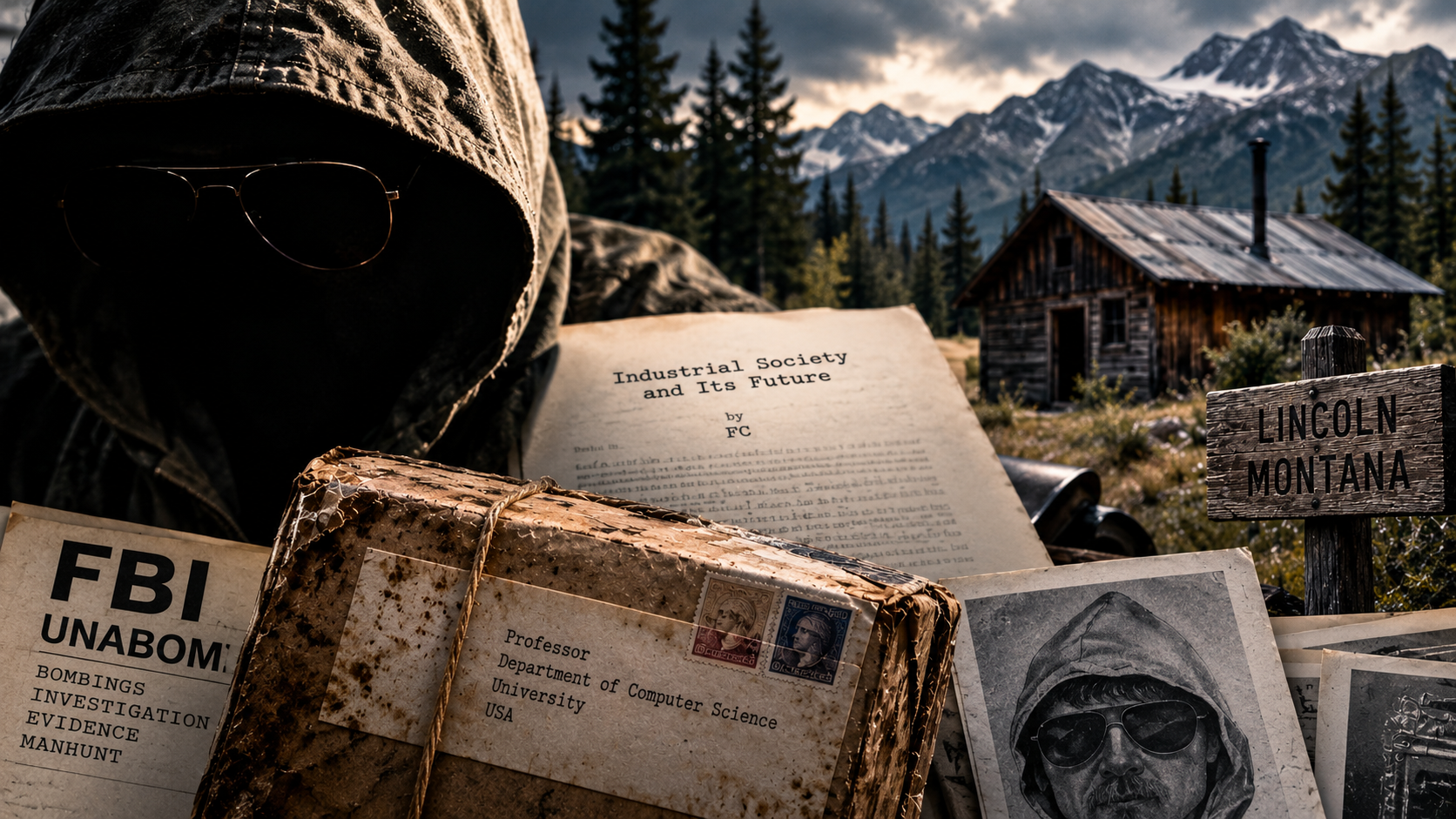
The resulting composite drawing became one of the most recognisable images in American criminal history: a man in a hooded sweatshirt wearing aviator-style sunglasses.
The FBI also recovered pieces bearing the letters "FC", a marking connected to several communications and devices.
The sketch was valuable.
It was not enough.
After the Salt Lake City attack, the bombings stopped.
One year passed.
Then another.
By the early nineteen nineties, investigators faced an uncomfortable possibility. The bomber could have died. He could have been imprisoned for another crime. He could have moved abroad. He could simply have stopped.
The case remained open.
The trail did not.
Six Years Of Silence
The gap lasted roughly six years.
Then the devices returned.
On June twenty-second, nineteen ninety-three, a package exploded after it was opened by University of California geneticist Charles Epstein at his home.
He suffered serious injuries.
Two days later, another package reached Yale University computer scientist David Gelernter.
That device also exploded.
Gelernter was badly injured.
The sudden return forced investigators to reconsider everything they knew.
This was not a copycat emerging years later. The construction and characteristics linked the attacks to the earlier series.
The bomber had survived.
He had not abandoned his campaign.
And the attacks were becoming increasingly dangerous.
A specialised task force pursued the case with resources from the FBI, the United States Postal Service and other agencies.
Agents revisited old evidence.
They reconsidered geographic links.
They analysed the targets.
They studied language from communications attributed to the bomber.
Yet the central problem remained: investigators had accumulated enormous amounts of information about what the bomber did without establishing who he was.
The Campaign Turns Deadlier
On December tenth, nineteen ninety-four, a package arrived at the New Jersey home of advertising executive Thomas Mosser.
When it exploded, Mosser was killed.
Months later, on April twenty-fourth, nineteen ninety-five, another package bomb exploded in the Sacramento office of Gilbert Murray, president of the California Forestry Association.
Murray was killed.
The attacks had now claimed three lives.
At around the same period, investigators and journalists began receiving something they had previously possessed only in fragments.
The bomber's words.
Letters were sent to newspapers and other recipients.
The author used the designation "FC", presented as the initials of something called the Freedom Club.
For investigators, the communications presented both a danger and an opportunity.
The bomber was communicating publicly.
That meant threats.
It also meant language.
Every sentence created potential evidence.
Vocabulary, spelling, punctuation, phrasing and ideas could reveal something about the person who had written them.
And in nineteen ninety-five, the writer made an extraordinary demand.
The Manuscript
In June nineteen ninety-five, The Washington Post and The New York Times received a lengthy manuscript titled Industrial Society and Its Future.
It ran to approximately thirty-five thousand words.
The document attacked what its author called the industrial-technological system and argued that technological society had progressively reduced human autonomy.
The writer demanded publication.
If the manuscript appeared publicly under the specified conditions, the author offered to stop intentionally killing people. If it did not, another lethal attack was threatened.
The demand placed newspaper executives and federal authorities in an extraordinary position.
Publishing it could be viewed as surrendering editorial space to someone using murder and threats to obtain publicity.
Refusing carried another risk.
If another bomb killed someone, there would always be the question of whether publication might have prevented it.
Federal authorities came to believe publication could serve another purpose.
Someone might recognise the writing.
The newspapers deliberated for months.
Attorney General Janet Reno and FBI Director Louis Freeh supported publication on public-safety grounds.
On September nineteenth, nineteen ninety-five, The Washington Post printed the manuscript in a special section, with The New York Times sharing the cost.
Millions of people now had access to the bomber's argument.
Some read it for its political ideas.
Investigators hoped someone would read it for something more personal.
A Familiar Voice
In New York state, David Kaczynski confronted a possibility he did not want to believe.
David's wife, Linda Patrik, had already noticed similarities between the unidentified bomber's ideas and those of David's older brother, Ted.
Theodore John Kaczynski had once been a mathematician of exceptional ability.
He had entered Harvard University when he was sixteen.
After Harvard, he continued his studies at the University of Michigan, earning a doctorate in mathematics. He then joined the University of California, Berkeley, where he taught mathematics while still in his twenties.
His academic career was short.
In nineteen sixty-nine, Kaczynski resigned.
Within a few years, he had moved towards an entirely different existence.
Near Lincoln, Montana, he built a small cabin.
There was no electricity.
There was no indoor plumbing.
He sought independence from modern society and spent increasing amounts of time living there.
David knew his brother had intense views about technology and modern civilisation.
That alone proved little.
Many people criticised industrial society. The ideas expressed in the manifesto were not so unique that ideology itself could identify the author. Contemporary scholars consulted about the manuscript told reporters that several of its themes were already familiar within political and philosophical writing.
But David was not merely comparing political arguments.
He knew how his brother wrote.
Words and phrases began to feel familiar.
One phrase in particular attracted attention: "coolheaded logicians."
David remembered Ted using remarkably similar language in earlier correspondence.
The resemblance became difficult to ignore.
David and Linda faced a brutal decision.
If their suspicions were wrong, they risked exposing an isolated family member to the most intensive criminal investigation in the United States.
If they were right and said nothing, another person could die.
Through an attorney, information eventually reached federal investigators.
They began examining Theodore Kaczynski.
The Man In Montana
Investigators compared documents supplied by the family with the manifesto and other communications attributed to the Unabomber.
Language became increasingly important.
So did biography.
Kaczynski had connections to locations and periods relevant to the attacks. His education and intellectual background could fit characteristics investigators had considered. His hostility towards technological development resembled themes expressed by the anonymous writer.
None of that alone justified breaking into his home.
Federal agents needed evidence sufficient for a search warrant.
The linguistic comparisons became part of a much larger affidavit establishing probable cause.
A federal judge approved the warrant.
On April third, nineteen ninety-six, agents approached the small cabin outside Lincoln, Montana.
Ted Kaczynski came to the door.
Agents arrested him.
Then they entered the cabin.
What they found transformed the case.
According to the FBI, the search produced bomb components, approximately forty thousand pages of handwritten journals, material documenting experiments with explosives and accounts describing attacks attributed to the Unabomber.
There was also a completed bomb.
It was ready to be mailed.
Investigators also recovered material they believed connected Kaczynski directly to the manuscript that had been published months earlier.
After seventeen years, the anonymous bomber had a name.
Before The Cabin
Ted Kaczynski's life before the bombings has produced decades of argument over how much it explains.
Some facts are straightforward.
He was born in Chicago in nineteen forty-two.
He showed unusual academic ability early in life and skipped a school grade.
At sixteen, he entered Harvard.
He later studied mathematics at the University of Michigan, where professors recognised the strength of his work.
In nineteen sixty-seven, he joined Berkeley's mathematics faculty.
He resigned two years later.
By the early nineteen seventies, he had withdrawn towards life in rural Montana.
The contrast is striking: a young academic working at one of America's leading universities became a man living in a small cabin with few modern conveniences.
It is tempting to turn that change into a simple psychological story.
The evidence does not support such simplicity.
One episode in particular has received sustained attention.
While at Harvard, Kaczynski participated in psychological research overseen by professor Henry Murray. The research subjected participants to stressful confrontational sessions while recording their responses.
Later accounts have criticised the methods and ethics of those experiments.
Because Kaczynski later became a terrorist, the study has sometimes been presented as a possible explanation for what followed.
That connection has never been established as a cause.
Kaczynski's participation is historically relevant. Treating the experiment as the event that created the Unabomber goes beyond what the evidence can prove.
His own writings provide far stronger evidence of what he came to believe.
Kaczynski argued that industrial technology was not simply a collection of useful machines.
He believed it had become a system that progressively restricted human independence and could not be permanently controlled through ordinary political reform.
His opposition became radical.
And eventually violent.
Understanding those ideas helps explain how he justified his campaign to himself.
It does not justify the campaign.
The People Behind The Case
The scale of the investigation can obscure what the bombs actually did.
Hugh Scrutton went to work at his computer store in Sacramento and was killed in nineteen eighty-five.
Thomas Mosser was at home in New Jersey when a mailed package exploded in nineteen ninety-four.
Gilbert Murray was working in his Sacramento office when a package bomb exploded in nineteen ninety-five.
Others lived with damaged hands, burns, shrapnel wounds, hearing injuries and lasting physical effects.
Some victims had direct links to fields Kaczynski opposed.
Others encountered devices because of where they worked or because they opened a package intended for somebody else.
That distinction matters.
Kaczynski was not conducting an abstract argument with "technology."
Explosive devices cannot distinguish philosophical symbols from human beings.
They injure whoever is close enough when they detonate.
The FBI's historical account lists sixteen devices over the course of the campaign. Three people were killed and twenty-three injured. Other FBI material has at times used a figure of twenty-four injured, reflecting differences in how injuries from the airline incident and other attacks have been counted. The bureau's main UNABOM chronology uses twenty-three.
The Courtroom Fight
Kaczynski's arrest did not end the complexity of the case.
Federal prosecutors prepared for trial in Sacramento.
The death penalty was possible.
That created a bitter conflict between Kaczynski and his defence lawyers.
His attorneys believed evidence concerning his mental condition could be crucial to saving his life.
Kaczynski strongly opposed being portrayed as mentally ill.
The conflict became so serious that the question of who controlled his defence nearly overwhelmed the trial itself.
A court-ordered psychiatric evaluation found him competent to stand trial while diagnosing paranoid schizophrenia. Kaczynski rejected the diagnosis and resisted a defence strategy that he believed would reduce his political beliefs to symptoms of mental illness.
This distinction remains important.
A psychiatric diagnosis made during litigation can help explain clinical findings relevant to legal proceedings. It does not prove why someone committed years of deliberate violence, and it should not be used as shorthand for dangerousness.
The procedural struggle intensified as opening statements approached.
Kaczynski attempted to dismiss his lawyers and sought greater control over how his case would be presented.
The judge rejected an effort that would effectively have allowed him to change course at the last moment and represent himself under the circumstances then before the court.
The case appeared headed toward an extraordinary capital trial.
Instead, on January twenty-second, nineteen ninety-eight, it ended with an agreement.
The Plea
Ted Kaczynski pleaded guilty to federal bombing offences.
The plea removed the possibility of a trial in which prosecutors would have presented the government's evidence and witnesses before a jury.
It also removed the possibility of a death sentence.
By pleading guilty, Kaczynski accepted responsibility in federal court for the bombing campaign and the deaths it caused.
On May fourth, nineteen ninety-eight, United States District Judge Garland Burrell sentenced him.
The judgment included multiple life sentences with no possibility of release, together with additional imprisonment on other counts.
The federal docket records life sentences on several counts, additional twenty-year terms, a consecutive thirty-year term and restitution of more than fifteen million dollars.
The seventeen-year bombing campaign was over.
The argument surrounding the man behind it was not.
A Manifesto With An Afterlife
Industrial Society and Its Future continued circulating long after Kaczynski's arrest.
Parts of its criticism of technological dependence have periodically been rediscovered whenever public anxiety rises around automation, artificial intelligence, environmental degradation, surveillance or the power of large technology companies.
That creates a difficult distinction.
Some questions raised in the essay can be discussed independently of its author. Concerns about environmental damage, technological dependence or the concentration of institutional power existed before Kaczynski and continue to exist without him.
But the historical record also resists attempts to turn him into a misunderstood philosopher whose violence can be separated neatly from his ideology.
Kaczynski himself connected the campaign to his political objectives.
The manifesto acknowledged violence as part of gaining attention for its message.
The bombs were not an unrelated secret life discovered beside a philosophical manuscript.
They were part of the method through which he attempted to force that manuscript into public view.
That is one reason the decision to publish it remains such a remarkable episode in journalism.
The newspapers were criticised for responding to coercion.
Yet the publication also produced precisely the possibility law enforcement had hoped for.
Someone recognised the writer.
Not an academic specialist.
Not a computer system.
Not a forensic laboratory.
His family.
Why The Investigation Took So Long
The UNABOM investigation demonstrates why certain crimes can remain unresolved even when enormous resources are devoted to them.
The bomber often acted at a distance.
Mail separated the sender from the explosion.
Ordinary materials reduced traceability.
Targets were geographically dispersed.
The long gaps between attacks weakened assumptions about where the offender might be living.
Some devices were planted rather than mailed.
Others travelled through postal systems.
The intended victims did not form a single obvious social circle whose members could be investigated until a common enemy appeared.
Even the bomber's intelligence could be misleading.
Investigators generated profiles based on the devices, targets and writings. Some assessments came close to aspects of the man eventually arrested. Others did not.
A criminal profile can organise possibilities.
It cannot substitute for evidence.
The decisive shift occurred when the offender changed his own behaviour.
For years, the physical devices had revealed relatively little about the person constructing them.
Then he began communicating.
Eventually he produced tens of thousands of words.
Language gave investigators something explosives had not.
A personal pattern.
Publication expanded the pool of people capable of recognising it from hundreds of investigators to millions of readers.
One of those readers knew the author.
The Cabin Becomes Evidence
The Montana cabin became one of the central physical objects in the history of the case.
It was small enough to reinforce the public image of Kaczynski as an isolated hermit.
But investigators were interested in what was inside rather than what the building symbolised.
The search linked the physical world of the bombings to the written world of the manifesto.
Bomb-making materials were recovered.
A completed device was found.
Thousands of pages of journals and notes were seized.
Investigators found writings describing experiments and crimes.
Material connected to the manifesto was also recovered.
The cabin itself was eventually removed from Montana and preserved as evidence.
It later became part of the Smithsonian collections.
There is something almost misleading about seeing it as a museum object.
Empty, it is simply a rough wooden structure.
Its significance comes from what investigators found there and from the years during which they had no idea where to look for it.
Life After The Manhunt
Kaczynski was eventually imprisoned at the federal supermax facility in Florence, Colorado.
The institution was designed for inmates requiring extreme levels of security and control.
He spent many years there.
In prison, Kaczynski continued writing and corresponding with people outside the institution. His writings developed their own following in some anti-technology and extremist subcultures, while historians, journalists and academics continued debating his life, ideology and crimes.
None of that changed his legal position.
He had pleaded guilty.
His sentences ensured he would never be released.
Later in life, declining health led to his transfer from Colorado to a federal medical centre in North Carolina.
On June tenth, two thousand and twenty-three, Theodore John Kaczynski died in federal custody at the age of eighty-one.
Authorities subsequently reported his death as suicide.
His death closed the life of the man at the centre of the case.
It did not close the historical questions surrounding it.
What The Unabomber Case Left Behind
The case survives partly because so many different stories sit inside it.
It is the story of an extraordinarily long criminal investigation.
It is a study in forensic limitations.
It is a story about language as evidence.
It is a debate about journalism under coercion.
It is also a family story.
David Kaczynski could have dismissed his suspicions.
Instead, he helped investigators examine whether the anonymous writer terrorising the country might be his brother.
The decision carried consequences he understood could be permanent.
Without it, investigators might eventually have identified Kaczynski through another route.
There is no way to know.
What is known is what happened after the manifesto became public.
David recognised similarities.
Information reached authorities.
Investigators compared the writings and built their case.
A judge authorised a search.
Agents reached a cabin outside Lincoln, Montana.
Inside were the materials that turned suspicion into overwhelming evidence.
The case had begun with a package whose supposed sender knew he had never mailed it.
Seventeen years later, it ended because the bomber finally sent investigators something more revealing than another device.
He sent them his voice.
