True Crime: The Yorkshire Ripper - The Hunt That Terrified Northern England
The Evidence, Errors And Missed Clues
How The Police Hunt Went Wrong
A Cassette Tape, A False Voice, And The Investigation That Lost Its Way
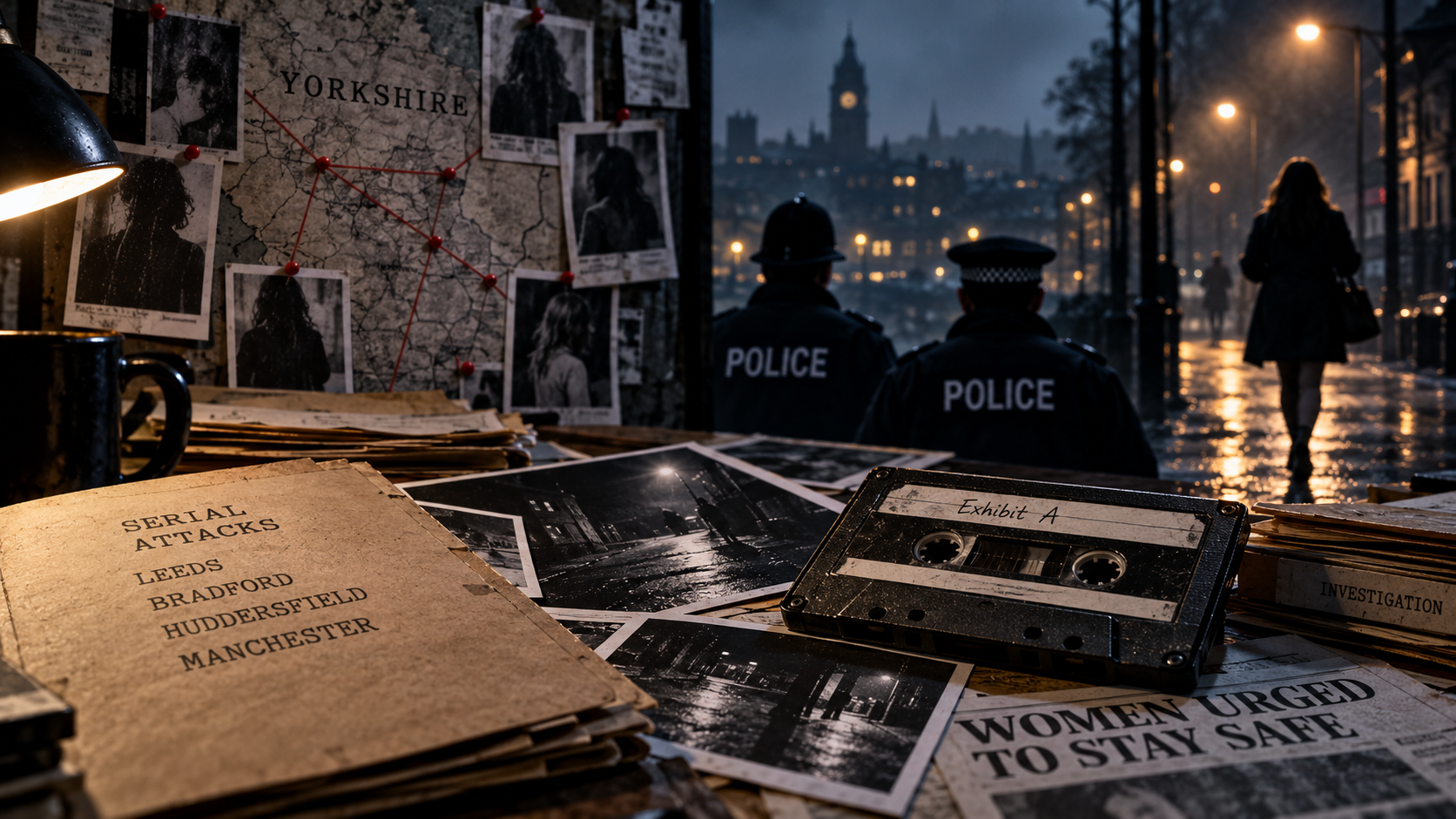
In the summer of nineteen seventy-nine, detectives investigating a series of violent attacks across northern England had something that seemed extraordinary: a voice. A cassette sent to police contained a man speaking in a distinctive north-east accent, claiming responsibility and taunting the officers trying to find him. For an investigation drowning in paper, sightings, interviews and theories, the recording appeared to offer direction.
The voice pointed towards Wearside. Detectives listened, analysed, publicised and searched. Thousands of men could be eliminated because they sounded wrong. Somewhere inside the enormous investigation, however, sat information about another man whose accent did not match the tape at all.
The question at the centre of the Yorkshire Ripper case is therefore larger than the identity of the man responsible. It is how a killer could operate across Yorkshire and Greater Manchester for years while repeatedly coming into contact with the very investigation hunting him.
This article reflects information confirmed through September fourth, two thousand twenty-six.
A Pattern Begins To Form
Northern England in the mid-nineteen-seventies offered a difficult environment for investigators trying to recognise a serial offender. Police records were overwhelmingly paper-based. Information was divided between forces, districts and individual enquiries. There was no searchable national digital system capable of instantly connecting a vehicle, interview, description, workplace, previous offence and geographic movement.
In July nineteen seventy-five, Anna Rogulskyj was attacked in Keighley. She survived. Other women also survived attacks during the period before investigators understood the scale of what they were confronting. The significance of those early incidents was not immediately apparent, and the question of which additional offences can confidently be attributed to the same offender has remained complicated ever since.
On October thirtieth, nineteen seventy-five, twenty-eight-year-old Wilma McCann was attacked in Leeds. She was a mother of four. Her death began the sequence that came to define the investigation.
Emily Jackson, aged forty-two and a mother of three, was killed in Leeds in January nineteen seventy-six. In February nineteen seventy-seven, twenty-eight-year-old Irene Richardson was killed. Patricia Atkinson, aged thirty-two, was killed in Bradford that April.
The repetition was becoming impossible to dismiss. Women were being attacked after dark, often in areas connected with nightlife or sex work, and the violence contained enough similarities for detectives to recognise that they could be dealing with the same offender.
But the developing narrative contained a dangerous assumption.
Some of the women were sex workers. Others were not. Treating the attacks primarily as crimes against women involved in sex work encouraged investigators and public discussion to build a narrower picture of risk than the evidence justified.
That became devastatingly clear in June nineteen seventy-seven.
Jayne MacDonald Changes The Public Understanding
Jayne MacDonald was sixteen years old and worked as a shop assistant. On June twenty-sixth, nineteen seventy-seven, she was killed in Leeds after a night out.
Her death altered the way many people understood the threat. The idea that the offender was targeting only women involved in sex work could no longer comfortably contain what was happening.
That distinction should never have determined how seriously any attack was treated. Yet the language surrounding the investigation repeatedly separated supposedly “respectable” women from women involved in sex work, creating a hierarchy that modern policing has since acknowledged was damaging.
The consequences went beyond language. A profile built too rigidly around a particular category of woman risked distorting how investigators interpreted attacks that did not fit it.
The offender was not operating inside the neat boundary the investigation wanted.
The next stages of the case made that increasingly clear.
Jean Jordan, aged twenty-one, was killed in Manchester in the autumn of nineteen seventy-seven. Yvonne Pearson, aged twenty-two, was killed in Bradford in early nineteen seventy-eight. Eighteen-year-old Helen Rytka was killed in Huddersfield at the end of January.
Vera Millward, forty, was killed in Manchester in May.
By then fear extended far beyond individual neighbourhoods. Women across Yorkshire were altering ordinary routines. Walking home, waiting for buses and crossing poorly lit streets acquired a new calculation of risk.
Parliament subsequently recorded that hundreds of thousands of women in the affected areas experienced fear about going outside alone at night.
The Five-Pound Note
One of the investigation’s most promising leads emerged from the killing of Jean Jordan.
A new five-pound note was recovered in connection with the case. Investigators were able to trace it to a relatively small group of employers whose workers might have received it through wages.
This should have been powerful because it narrowed an apparently anonymous offender through something mundane: money circulating through an employer.
Among the firms examined was T. And W. H. Clark, the Bradford haulage company where Peter Sutcliffe worked as a lorry driver.
Sutcliffe was interviewed.
He was not identified as the offender.
This became one of the defining characteristics of the case. Sutcliffe was not an invisible figure existing outside police records. His name entered the investigation repeatedly. Officers spoke to him more than once. Pieces of information accumulated around him without being successfully assembled into a single picture.
The problem was partly scale.
A later police review described the Yorkshire Ripper enquiry as one of the largest and most complex investigations in British policing. Around one hundred and fifty-one thousand investigative actions were raised, approximately one hundred and fifty-eight thousand vehicle enquiries were conducted and about thirty-one thousand witness statements were collected. All of this had to be managed largely through paper systems.
Volume created its own form of blindness.
Information existed, but finding the right relationship between pieces of information became increasingly difficult.
The Investigation Drowns In Information
Large investigations do not necessarily fail because detectives have too little information. They can fail because they have too much.
The Yorkshire Ripper enquiry produced mountains of index cards, statements, vehicle checks, interviews and sightings. Every new attack generated another wave of information. Every public appeal created additional names to investigate.
A modern database can search millions of records in seconds. Detectives in the nineteen-seventies depended heavily on clerical systems, memory, manually maintained indexes and the ability of individual officers to recognise a significant name among thousands.
Sutcliffe repeatedly survived this environment.
He lived in Bradford, worked as a lorry driver and travelled widely. His employment gave him legitimate reasons to move around northern England. He could appear in areas relevant to the investigation without the movement automatically looking extraordinary.
Police questioned him on several occasions.
Yet no single encounter generated sufficient evidence to transform him from one name among many into the central suspect.
Sir Lawrence Byford’s subsequent official review examined the investigation in extraordinary detail. Byford described it as the largest-scale police investigation conducted in Britain at that point and considered criticism from surviving women, victims’ relatives, police officers and others involved in the case.
The review exposed something more important than one missed clue.
The investigation had developed structural weaknesses.
And then a man who had nothing to do with the attacks gave those weaknesses a direction.
The Letters And The Voice
Three anonymous letters and a cassette recording arrived between March nineteen seventy-eight and June nineteen seventy-nine. The sender claimed to be the Yorkshire Ripper.
One letter went directly to senior investigator George Oldfield. Another was sent to a newspaper. Further communication followed. Then came the tape.
The speaker had a north-east accent.
The recording was compelling precisely because it appeared personal. Here, seemingly, was the offender himself addressing police.
Investigators began devoting enormous resources to finding the man behind the voice.
The official Byford review later identified the consequences clearly: major police resources were redirected towards tracing the sender, while both officers and the public became conditioned to believe the Yorkshire Ripper came from Sunderland.
This mattered because an accent became a gatekeeper.
Potential suspects could effectively appear less important because their voices did not fit the recording.
Sutcliffe had a Bradford accent.
The tape therefore did not merely waste police time. It reinforced a false model of the person they were searching for.
That model became increasingly difficult to dislodge.
Josephine Whitaker And Barbara Leach
In April nineteen seventy-nine, nineteen-year-old Josephine Whitaker was killed in Halifax.
Five months later, twenty-year-old university student Barbara Leach was killed in Bradford.
The geographical spread, victim backgrounds and growing number of attacks should have placed increasing pressure on assumptions about the offender.
Instead, the Wearside theory remained deeply influential.
Women were meanwhile being given increasingly restrictive safety advice. Much of the public response placed responsibility on women to change their behaviour: avoid walking alone, avoid dark streets, travel in groups, stay inside.
The underlying reality was harsher.
Women were being told to reorganise ordinary life because one unidentified man had not been stopped.
That imbalance became one of the lasting social legacies of the case.
The policing language made matters worse. Women involved in sex work were frequently spoken about in terms that implied their deaths belonged to a different category of tragedy. Decades afterward, senior police leadership publicly apologised for language used during the original investigation.
The distinction had never reflected the offender’s actual behaviour.
His targets included mothers, students, workers, teenagers and women involved in sex work.
The common factor was that they were women.
The Final Year Of The Hunt
Marguerite Walls, aged forty-seven, was killed in Leeds in August nineteen eighty.
Three months later, twenty-year-old Jacqueline Hill, a student at Leeds University, was killed in Headingley.
By this point the investigation had consumed years of police work.
Officers had interviewed enormous numbers of people. Vehicles had been checked. Information had been indexed. Public appeals had been broadcast. The Wearside recording had been played repeatedly.
Still, the person responsible had not been identified.
Fear had become embedded in daily life.
The longer the investigation continued, the more extraordinary the central contradiction became: the police did not lack contact with the offender. They lacked the mechanism to recognise what their own information was telling them.
Peter Sutcliffe had already been interviewed.
More than once.
His name was in the system.
Yet the investigation remained fixed on other possibilities.
Sheffield And The False Number Plates
On January second, nineteen eighty-one, two South Yorkshire police officers encountered a brown Rover in Sheffield.
The circumstances initially looked routine.
A woman was with the driver. Officers checked the vehicle.
The registration plates did not correspond with the vehicle’s tax information.
The driver gave his name.
Peter Sutcliffe.
He was arrested over the false plates.
Nothing about that initial offence explained the enormous investigation unfolding across northern England. But when his details were checked, his previous contact with the Yorkshire Ripper enquiry became significant.
Sutcliffe had also been allowed to move away from the officers briefly while claiming he needed to urinate. After his connection to the Ripper enquiry attracted attention, an officer returned to the location.
A hammer and knife were recovered nearby.
Another knife was found after Sutcliffe had been taken into custody.
The routine stop had changed completely.
Police now had a man whose name had previously appeared in their investigation, driving on false number plates, with weapons located around the circumstances of his arrest.
The investigation finally narrowed.
Sutcliffe admitted responsibility.
After years of national attention, huge numbers of interviews and one of the largest police operations Britain had seen, the decisive encounter began with officers checking a registration plate in Sheffield.
The Man Behind The Name
Peter William Sutcliffe was born in Bingley, West Yorkshire, in June nineteen forty-six.
He worked in several occupations before becoming a lorry driver. He married Sonia Szurma in nineteen seventy-four and lived in Bradford.
Nothing about an ordinary employment record or marriage explains serial violence. Retrospective biographies often tempt readers into searching childhood, relationships or personality for a single clue that makes later crimes inevitable.
There is no such reliable shortcut.
What matters more is documented behaviour.
Sutcliffe travelled extensively, approached women in circumstances where he could isolate them and carried tools capable of being used as weapons. He repeatedly escaped detection after police contact and gave accounts that diverted suspicion.
His offending also demonstrated adaptation.
The attacks did not follow one perfectly rigid script. Locations changed. Victims differed. Methods varied. That variability made narrow profiling especially dangerous.
After his arrest, the question was no longer simply whether police had the right man.
The legal system had to determine his criminal responsibility.
What His Behaviour Can And Cannot Explain
Documented Behaviour
Sutcliffe’s behaviour across the established offences shows repetition, preparation and concealment. He approached women, moved through different locations and carried or obtained implements capable of inflicting severe injuries. When confronted by police in Sheffield, he discarded weapons and attempted to conceal another knife after entering custody.
His actions during the years of offending also demonstrate awareness of detection risk. He answered police questions, provided explanations and continued functioning in employment and family life while the investigation was active.
Those behaviours matter because they show that the offending cannot responsibly be reduced to one impulsive episode or one isolated loss of control.
What Qualified Experts Said
Sutcliffe’s mental condition became a major issue after his arrest.
Three psychiatrists called for the defence diagnosed paranoid schizophrenia. They relied in part on Sutcliffe’s claim that he had experienced a divine command connected with killing women involved in sex work.
The proposed legal consequence was diminished responsibility, which could have reduced murder charges to manslaughter.
The judge declined simply to accept that conclusion and required a jury to determine the issue.
The jury rejected the diminished-responsibility case and convicted Sutcliffe of murder.
His psychiatric history did not end there. He was subsequently diagnosed with paranoid schizophrenia in custody and transferred to Broadmoor high-security psychiatric hospital in nineteen eighty-four.
That creates an important distinction. A later clinical diagnosis does not retrospectively alter the jury’s legal decision about his responsibility for the murders.
Clinical diagnosis and criminal responsibility answer different questions.
What Can Reasonably Be Inferred
The documented pattern is consistent with purposeful victim selection, concealment and efforts to avoid detection.
It also suggests flexibility rather than dependence on one exact ritual. That helps explain why an investigation based too heavily on a single offender profile struggled when actual behaviour did not conform to it.
Sutcliffe’s concealment behaviour can reasonably be interpreted as evidence that he understood police detection posed a threat to him.
It cannot, by itself, resolve the extent to which psychiatric illness influenced his motivations.
What Cannot Be Known
No responsible psychological analysis can reconstruct Sutcliffe’s internal experience with certainty.
His descriptions of divine instructions may have reflected genuine psychotic experiences, self-serving explanations, or some combination of mental illness and retrospective rationalisation. Psychiatric professionals accepted significant mental illness, while the jury rejected the claim that it substantially reduced his responsibility for the murders.
Both facts belong in the record.
Explanation is not exoneration, and diagnosis is not a complete theory of why a person commits serial violence.
What The Jury Had To Decide
Sutcliffe appeared at the Old Bailey in nineteen eighty-one.
He admitted the killings but pleaded not guilty to murder, offering guilty pleas to manslaughter on the ground of diminished responsibility.
The psychiatric evidence created an unusual legal conflict.
Several doctors believed he suffered from paranoid schizophrenia. The prosecution was initially prepared to accept manslaughter pleas.
Mr Justice Boreham refused to resolve thirteen killings that way without a jury examining the question.
The issue was therefore not whether Sutcliffe had carried out the attacks.
The question was whether his responsibility had been substantially diminished by abnormality of mind to the extent required by law.
The jury heard evidence and rejected that argument.
On May twenty-second, nineteen eighty-one, Peter Sutcliffe was convicted of murdering thirteen women and of seven attempted murders.
He received twenty concurrent life sentences.
The judge recommended that he serve at least thirty years and described him as exceptionally dangerous.
The Yorkshire Ripper finally had a legal identity.
Peter Sutcliffe was a convicted murderer.
The Thirteen Women
The scale of the case is easy to compress into a number.
Thirteen murders.
Doing so risks repeating one of the original investigation’s failures: allowing the offender to dominate the identity of everyone else.
The women Sutcliffe was convicted of murdering were Wilma McCann, Emily Jackson, Irene Richardson, Patricia Atkinson, Jayne MacDonald, Jean Jordan, Yvonne Pearson, Helen Rytka, Vera Millward, Josephine Whitaker, Barbara Leach, Marguerite Walls and Jacqueline Hill. Their ages ranged from sixteen to forty-seven, and their lives extended far beyond the circumstances in which they encountered him.
Some were mothers.
Some were students.
Some worked in shops or offices.
Some sold sex.
That final fact was treated during the original investigation as if it separated certain women from the others.
It did not.
Twenty-three children were reported to have lost their mothers through the thirteen murders.
The number reveals something the nickname “Yorkshire Ripper” tends to obscure.
This was never simply a story about a serial killer.
It was a story about families.
The Byford Review And The Missed Opportunities
Sutcliffe’s conviction did not answer the most uncomfortable question.
Why had it taken so long?
Home Secretary William Whitelaw appointed Sir Lawrence Byford to conduct an extensive review of the investigation.
Byford examined original case material, interviewed officers, contacted surviving women and relatives of those killed, and assessed criticisms of the enquiry. His report became one of the most important examinations of investigative failure in modern British policing.
The problems were not reducible to one incompetent detective or one unfortunate decision.
There was too much information and inadequate information management.
There was excessive reliance on the Wearside letters and tape.
There was insufficient flexibility when facts conflicted with the working profile.
There were repeated occasions on which Sutcliffe came to police attention without the accumulated information around him being recognised for what it represented.
Investigative assumptions reinforced each other.
Once officers accepted that the tape contained the offender’s real voice, a Sunderland accent became evidence.
Once the accent became evidence, men with other accents became easier to discount.
Once suspects were discounted, subsequent information about them could receive less attention.
The system began protecting its theory.
The Wearside Hoax Exposed
The voice on the cassette belonged to neither Peter Sutcliffe nor any accomplice.
It belonged to John Humble.
Advances in forensic science eventually allowed investigators to identify him decades after the original investigation.
Humble had sent the communications as a hoax.
The cassette that had consumed police attention, reshaped the suspect profile and contributed to the exclusion of men who did not speak with the expected accent had been created by someone entirely separate from the murders.
That does not mean the hoax alone explains the investigative failure.
It made an already overloaded enquiry worse.
Byford’s report found that the letters and tape conditioned both police and the public to believe the sender was the killer and that he came from Sunderland.
The cassette therefore became more than a false clue.
It became a lesson in confirmation bias.
Investigators had evidence suggesting one conclusion and gradually interpreted other evidence through it.
The voice sounded certain.
The certainty was false.
Were There More Victims?
Sutcliffe’s twenty convictions do not necessarily represent the complete extent of his offending.
Questions about additional attacks existed almost immediately after his arrest.
The Byford review considered whether he could have been responsible for further offences, including attacks predating the first murder for which he was convicted.
Decades later, West Yorkshire Police established Operation Painthall to examine offences in which Sutcliffe had been suggested as a suspect or person of interest.
The scale of that review is frequently misunderstood.
Operation Painthall examined one hundred and eighty-three crimes and non-crime incidents. Police have explicitly cautioned that inclusion did not mean Sutcliffe was considered the offender in all of them. The purpose was to test allegations and available information, not to attribute another one hundred and eighty-three crimes to him.
That distinction matters.
Serial killers attract retrospective attribution. Unsolved cases are sometimes linked to famous offenders because geography, timing or method appears superficially similar.
Similarity is not proof.
Sutcliffe made admissions to additional violence, and police have reviewed unresolved offences connected with his name. Some cases remain undetected.
The responsible conclusion is therefore narrower than sensational claims suggest.
His proven offending may not represent everything he did.
But the public record does not justify treating every suspected connection as another Sutcliffe crime.
Broadmoor, Prison And The Whole-Life Order
Sutcliffe initially served his sentence in prison.
In nineteen eighty-four, after clinicians diagnosed paranoid schizophrenia, he was transferred to Broadmoor high-security psychiatric hospital.
He remained there for decades.
His mental-health treatment became intertwined with continuing legal questions about punishment and detention.
In two thousand ten, the High Court imposed a whole-life order, meaning Sutcliffe should never be released.
His lawyers challenged that decision, arguing that his mental illness should be considered when determining the appropriate minimum term.
The appeal did not secure his release.
By two thousand sixteen, clinicians concluded that he no longer required treatment in a high-security psychiatric hospital, and he was transferred from Broadmoor back into the prison system.
He was held at HMP Frankland in County Durham.
Peter Sutcliffe died in November two thousand twenty at the age of seventy-four after becoming seriously ill during the coronavirus pandemic.
The legal case against him was over.
The consequences were not.
What The Record Cannot Prove
The Yorkshire Ripper case has generated decades of books, programmes, speculation and retrospective theories.
Some claims go far beyond established evidence.
It is not possible to state precisely how many additional crimes Sutcliffe committed.
It is not possible to reconstruct every occasion on which police could hypothetically have identified him sooner.
It is not possible to reduce the investigative failure to one decision, one detective or one hoax.
Nor does the record justify treating every unusual aspect of Sutcliffe’s behaviour as evidence of one psychological explanation.
What can be established is substantial enough.
He was convicted of thirteen murders and seven attempted murders.
Police had encountered him repeatedly before his arrest.
The investigation became overwhelmed by information.
The Wearside hoax distorted the search.
Rigid assumptions about geography, accent and victims contributed to opportunities being missed.
The official response after his conviction recognised that lessons had to be learned nationally.
Those conclusions do not require embellishment.
How The Case Changed British Policing
The Yorkshire Ripper investigation sits at the boundary between two eras of murder investigation.
The original enquiry depended upon vast paper indexes and human retrieval.
Modern major-incident systems are designed specifically to reduce that weakness.
Information can now be indexed, cross-referenced, prioritised and searched electronically. A suspect interviewed by several teams can be linked rapidly to vehicle information, movements, previous incidents and other intelligence.
Technology does not eliminate investigative failure.
It changes where failure can occur.
Modern investigators can still develop tunnel vision. Data can still be misunderstood. Algorithms can reinforce assumptions. Poor-quality information entered into a sophisticated system remains poor-quality information.
The lesson from the Ripper investigation is therefore not merely that computers would have caught Sutcliffe.
It is that information has to remain challengeable.
A theory that cannot survive contradictory evidence is not a useful theory.
The Women The Investigation Failed To See Clearly
One of the deepest reassessments of the case concerns the way the women themselves were described.
The historic distinction between “innocent” women and those engaged in sex work was not simply offensive.
It affected the mental framework surrounding the investigation.
If one group is implicitly treated as an expected target while another is treated as an exceptional one, investigators can begin looking for distinctions that exist more strongly in their assumptions than in the offender’s behaviour.
Sutcliffe’s convictions demonstrated that the supposed boundary was false.
The women differed in age, employment, family circumstances and location.
Their killer was the common factor.
Modern discussions of the case increasingly restore names that the nickname once pushed aside.
Wilma McCann.
Emily Jackson.
Irene Richardson.
Patricia Atkinson.
Jayne MacDonald.
Jean Jordan.
Yvonne Pearson.
Helen Rytka.
Vera Millward.
Josephine Whitaker.
Barbara Leach.
Marguerite Walls.
Jacqueline Hill.
Their identities should not require Peter Sutcliffe’s biography to make them matter.
Why The Yorkshire Ripper Case Still Matters
The Yorkshire Ripper investigation remains relevant because nearly every central problem it exposed still exists in a modern form.
Investigators can still drown in data.
They can still mistake confidence for reliability.
They can still build profiles that exclude the correct suspect.
Institutions can still become invested in their own theories.
Women who live outside socially approved categories can still receive unequal sympathy.
Public pressure can still push investigators towards certainty before the evidence deserves it.
And one compelling piece of evidence can still dominate thousands of quieter facts.
Today that evidence might be an algorithmic match, phone-location record, viral video or AI-generated image rather than an anonymous cassette.
The technology changes.
The cognitive danger does not.
The Meaning Of The Cassette
Return to the tape that arrived during the investigation.
A voice speaks confidently.
It sounds specific.
It offers geography.
It provides personality.
It appears to solve a problem.
Detectives had spent years searching through an expanding mass of information, and suddenly the offender seemed to have spoken directly to them.
But the voice belonged to someone else.
Meanwhile, the real offender had already entered police records.
That is why the cassette remains such a powerful object in the history of the Yorkshire Ripper investigation.
It represents the difference between information and truth.
The investigation possessed extraordinary quantities of the first.
For too long, it could not reliably identify the second.
Peter Sutcliffe was eventually stopped not through the grand theory that consumed the enquiry, but after two officers noticed something mundane about a car in Sheffield.
False number plates.
A routine check.
A name already sitting inside the investigation.
The case is remembered because of the man called the Yorkshire Ripper.
Its more important lesson lies elsewhere.
The most dangerous clue in an investigation is sometimes the one everyone has become certain must be right.
