True Crime: Tupac Shakur Murder Timeline - What Happened And How The Case Was Finally Solved
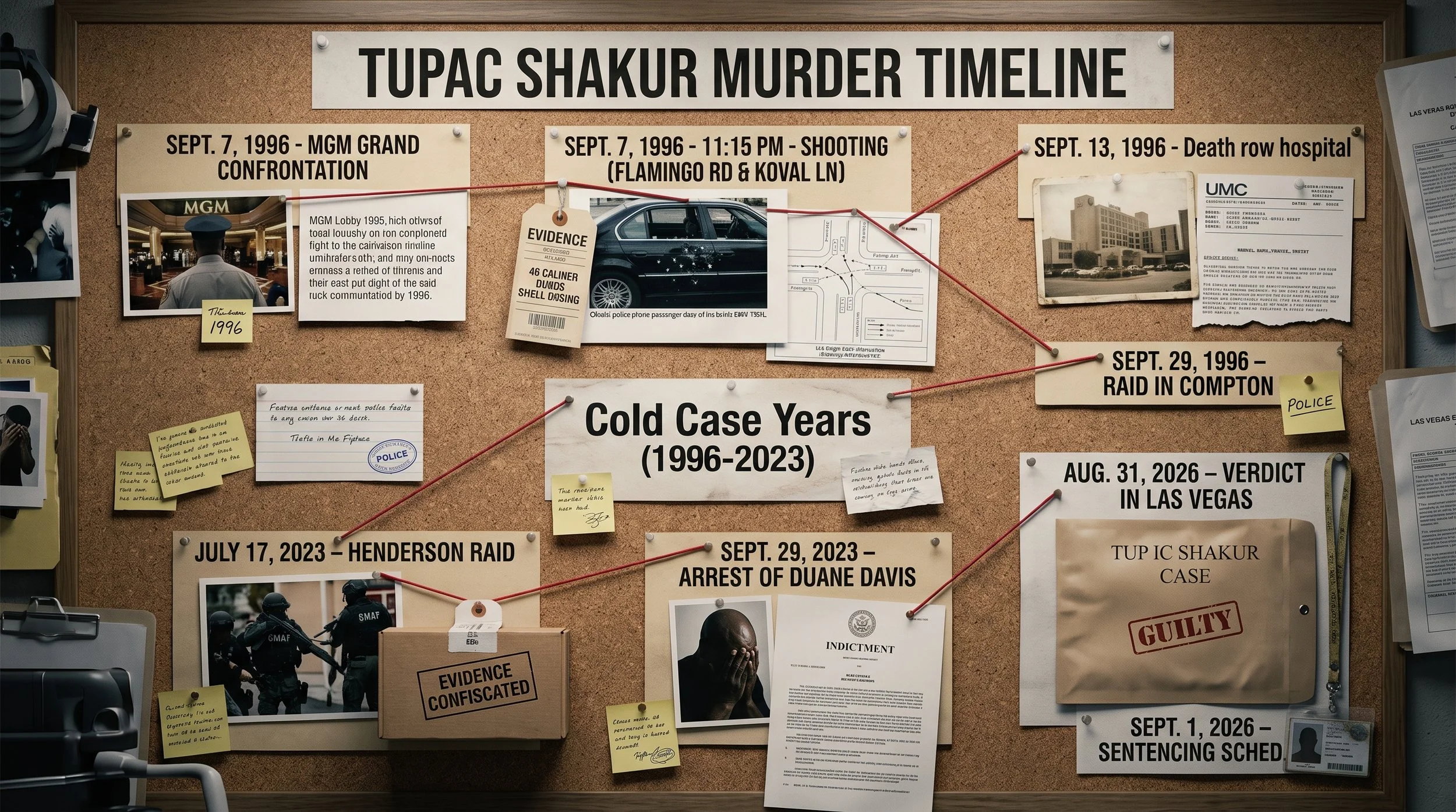
The Full Story Of The 1996 Las Vegas Murder
Who Shot Tupac?
On the night of 7 September 1996, Las Vegas is packed for one of boxing’s biggest events. Mike Tyson is fighting Bruce Seldon at the MGM Grand Garden Arena. Among the celebrities sitting ringside is twenty-five-year-old Tupac Shakur, already one of the biggest rappers in America.
The fight itself barely lasts. Tyson wins in the first round. Within minutes, the crowd begins spilling back into the casino.
Tupac is travelling with Marion “Suge” Knight, the formidable co-founder of Death Row Records. Their group is supposed to continue the night at Club 662, where Tupac is expected to perform.
Instead, an apparently brief confrontation inside the MGM Grand sets another sequence of events in motion.
Roughly two hours later, Tupac is sitting beside Knight in a black BMW near the Las Vegas Strip. The car stops at a red light.
A white Cadillac pulls alongside.
Gunfire erupts.
What follows becomes one of the longest, most controversial and most mythologised murder investigations in modern American history — a case that takes almost exactly thirty years to produce its first murder conviction.
This is the complete timeline.
Before Las Vegas: Tupac, Death Row And A Rap Rivalry Turning Dangerous
By 1996, Tupac Amaru Shakur is much more than a successful rapper.
Born in New York in 1971, he has become an actor, poet, political voice and cultural phenomenon. His records combine social commentary about poverty, racism and police violence with extraordinarily aggressive material about enemies, street life and retaliation.
His personal life has become equally turbulent.
One of the most consequential events takes place in Manhattan on 30 November 1994, when Tupac is robbed and shot multiple times at Quad Recording Studios.
Tupac survives.
But he becomes convinced that figures associated with New York's rap scene knew more about what happened than they admitted. His relationship with Christopher Wallace — The Notorious B.I.G., or Biggie Smalls — deteriorates badly.
There has never been proof that Biggie or Sean “Puffy” Combs organised the Quad Studios shooting. Nevertheless, Tupac increasingly treats them as enemies.
While Tupac is imprisoned on an unrelated sexual-abuse conviction, Suge Knight helps arrange his release on an appellate bond reportedly worth around $1.4 million.
Tupac signs with Death Row Records.
It places one of the most volatile and charismatic figures in hip-hop alongside a record label whose image is inseparable from Los Angeles street culture.
At the 1995 Source Awards, Knight publicly taunts Combs. The increasingly hostile atmosphere becomes popularly characterised as an East Coast-West Coast rap war, although that description can obscure the more complicated mixture of personal grudges, record-label rivalry and genuine gang affiliations surrounding some of the people involved.
By February 1996, Tupac releases All Eyez on Me.
It is enormously successful.
He also attacks Biggie, Bad Boy Records and others explicitly through his music, most notoriously on “Hit ’Em Up”.
Whatever began as a musical rivalry now exists alongside genuine violence and connections with rival Los Angeles gangs.
One particular conflict will matter enormously on the night Tupac travels to Las Vegas.
7 September 1996: Mike Tyson Versus Bruce Seldon
Tupac arrives in Las Vegas with Suge Knight and associates to watch his friend Mike Tyson challenge Bruce Seldon for the WBA heavyweight championship.
The MGM Grand is packed.
At around 8:30 p.m., Tupac and Knight take their seats close to the ring.
The contest lasts less than two minutes.
Tyson overwhelms Seldon and wins by first-round technical knockout.
Afterwards, Tupac congratulates Tyson.
The night appears to be moving towards its next stage. Tupac and members of the Death Row entourage intend to travel to Club 662, Knight's Las Vegas nightclub, where Tupac is expected to appear.
But before everyone leaves the MGM Grand, somebody is spotted in the casino.
His name is Orlando “Baby Lane” Anderson.
The MGM Grand Fight
Anderson is associated with the South Side Compton Crips.
He also has an existing conflict with members of the Mob Piru Bloods, whose members are associated with Knight and Death Row.
According to evidence that emerges around the case, Anderson has previously been accused of involvement in an incident in which a Death Row-associated man had his medallion or chain taken.
Inside the MGM Grand, one of Knight's associates apparently recognises Anderson.
Security footage captures what happens next.
Tupac approaches Anderson and throws a punch.
Members of Tupac and Knight's group then join the assault, knocking Anderson to the floor and repeatedly hitting and kicking him.
The confrontation is brief.
The participants disperse.
At this point, there is no public reason to view it as anything more than another episode of violence surrounding Death Row's increasingly combustible environment.
Anderson leaves.
Tupac and Knight prepare to continue to Club 662.
It is approximately 8:50 p.m.
The gap between that casino fight and the events several hours later becomes the central question of the investigation.
Tupac Leaves The MGM Grand
Later that evening, Tupac changes clothes at the Luxor Hotel.
He joins Knight again.
Knight is driving a black BMW 750iL.
Tupac sits in the front passenger seat.
Other members of the entourage travel in separate vehicles.
The group begins moving towards Club 662.
At one point, Las Vegas bicycle officers stop the BMW because of excessively loud music and an issue involving the vehicle's licence plate. Knight is not detained and the journey continues.
Shortly afterwards, photographer Leonard Jefferson photographs Tupac sitting in the passenger seat beside Knight.
It becomes one of the last photographs taken of him before the shooting.
Nothing about the picture itself explains what is coming.
Tupac simply appears to be another celebrity travelling through an exceptionally busy Las Vegas night.
Around 11:15 P.M.: Flamingo Road And Koval Lane
The BMW eventually stops at a red traffic signal close to the intersection of East Flamingo Road and Koval Lane.
Knight is driving.
Tupac is beside him.
A white Cadillac approaches the BMW.
It pulls alongside the passenger side — Tupac's side.
Then somebody inside the Cadillac opens fire.
Multiple rounds are discharged into the BMW.
Tupac is struck several times.
Knight is wounded but remains conscious.
The Cadillac speeds away.
The attack lasts seconds.
The mystery surrounding it will last decades.
The Immediate Aftermath
Despite being wounded, Knight initially drives away.
Police and emergency services converge on the area.
Tupac's condition is extremely serious.
He is transported to the University Medical Center of Southern Nevada and eventually placed in intensive care.
Doctors operate.
Among the injuries are devastating wounds to his chest. Part of his treatment involves removing his right lung.
For several days, people close to Tupac remain concerned about security around the hospital. Members of his Outlawz group and associates keep watch.
Fans gather outside.
Rumours spread almost immediately.
Few reliable answers exist.
There is still a crucial difference between what witnesses have seen and what investigators can prove.
Police know that somebody in a white Cadillac fired into Knight's BMW.
They know about the MGM Grand fight.
They know the shooting happened only hours afterwards.
But they do not yet possess a prosecutable reconstruction identifying everyone in the Cadillac and their respective roles.
13 September 1996: Tupac Dies
Six days after the shooting, Tupac's condition deteriorates.
He suffers respiratory failure followed by cardiopulmonary arrest.
Attempts to revive him are unsuccessful.
His mother, Afeni Shakur, ultimately agrees that further resuscitation should cease.
At 4:03 p.m. on 13 September 1996, Tupac Shakur is pronounced dead.
He is twenty-five years old.
The Las Vegas shooting is now a homicide investigation.
And almost immediately, the case becomes entangled with an enormous amount of misinformation.
The First Theory: Was The MGM Grand Fight The Motive?
For investigators, one possible sequence is obvious.
Tupac and others beat Orlando Anderson inside the MGM Grand.
Approximately two hours later, somebody in a Cadillac shoots Tupac.
Police begin examining whether the two events are connected.
On 3 October 1996, Anderson is detained during a large gang-related operation in California and questioned.
His lawyer publicly confirms that Anderson is the same man attacked by Tupac inside the MGM Grand.
Anderson denies involvement in Tupac's shooting.
He is not charged.
This distinction becomes critical.
Over subsequent years, Anderson is frequently described in books, documentaries and popular discussion as the likely gunman.
But suspicion is not the same thing as a conviction.
Anderson was never prosecuted for Tupac's murder.
For decades, the identity of the person who actually pulled the trigger remains legally unresolved.
November 1996: A Potential Witness Is Killed
Another complication arrives remarkably quickly.
Yafeu Fula — better known as Yaki Kadafi, a member of Tupac's Outlawz group — was travelling in the entourage on the night of the shooting and was considered a potentially important witness.
On 10 November 1996, less than two months after Tupac's death, Kadafi is shot and killed in New Jersey.
His death is not officially treated as part of the Tupac conspiracy.
Nevertheless, investigators have now lost somebody who may have been able to provide useful eyewitness information about the Cadillac and the shooting.
The homicide investigation begins slowing.
1997: The Investigation Starts Looking Like A Cold Case
By the first anniversary of Tupac's death, investigators have still made no arrest.
Las Vegas homicide investigators acknowledge publicly that the murder may never be solved.
This is the period during which the mythology of the case begins overtaking the known evidence.
Every possible theory circulates.
Some focus on Orlando Anderson and the South Side Compton Crips.
Others focus on Death Row Records.
Others attempt to connect Tupac's death to the East Coast-West Coast rivalry.
Still others claim law enforcement, corrupt police officers or organised criminal figures were involved.
The fact that The Notorious B.I.G. is murdered in Los Angeles on 9 March 1997, only six months after Tupac, intensifies almost every conspiracy theory.
The two murders become culturally inseparable.
But cultural association is not evidence that the same people ordered both killings.
Tupac's case remains open.
1998: Orlando Anderson Dies
On 29 May 1998, Orlando Anderson is killed in an unrelated gang shooting in Compton.
He is twenty-three.
Anderson dies without ever being charged in Tupac's homicide.
That has major consequences.
If investigators believed Anderson had significant information, he can no longer be interrogated.
If Anderson was involved, he can no longer be prosecuted.
And if investigators were wrong about him, he can no longer meaningfully defend himself beyond the denials he made while alive.
For years afterwards, the case remains largely frozen.
Then one of Anderson's relatives begins talking.
Duane “Keffe D” Davis
Duane Keith Davis is Orlando Anderson's uncle.
Known as Keffe D, Davis had been a significant figure within the South Side Compton Crips.
More importantly, Davis possesses something extraordinarily unusual in an unsolved murder investigation.
He claims firsthand knowledge of the Cadillac.
Eventually, he says he was actually inside it.
The significance of that admission is difficult to overstate.
For years, police had struggled to place surviving witnesses inside the vehicle from which Tupac was shot.
Davis progressively begins supplying precisely that account himself.
2009: Davis Talks To Investigators
A major breakthrough occurs in 2009, although its consequences are not immediately visible to the public.
Davis participates in a recorded interview with investigators during a broader law-enforcement investigation.
The interview is conducted under a form of proffer arrangement, an issue that later becomes enormously important when Davis is prosecuted.
Davis gives investigators a detailed account of the night of Tupac's shooting.
He describes being inside the Cadillac.
He discusses obtaining a firearm.
He describes the vehicle searching for Tupac and Knight after the MGM Grand fight.
He describes the gun being passed towards the rear of the car.
And in the version Davis gave investigators, his nephew Orlando Anderson ultimately fired the shots.
Years later, Davis's defence would argue that statements made within these law-enforcement arrangements were protected and should not be used to prosecute him.
Nevada prosecutors eventually disagreed.
The legal battle over precisely what immunity Davis possessed becomes one of the central pre-trial issues.
For the moment, however, none of this produces an arrest.
The Four Men Alleged To Have Been In The Cadillac
Over time, investigators and Davis's own accounts identify four men allegedly travelling in the white Cadillac:
Duane “Keffe D” Davis.
Orlando “Baby Lane” Anderson.
DeAndre “Dre” or “Freaky” Smith.
Terrence “T-Brown” Brown.
Eventually, Davis becomes the only one still alive.
That fact fundamentally changes the future case.
There will never be a conventional prosecution in which four occupants give competing accounts of what happened inside the Cadillac.
There will never be a trial of Orlando Anderson.
And prosecutors will ultimately conclude that identifying the precise person who physically fired the weapon is not necessary to prove Davis guilty of murder.
Under Nevada law, somebody who knowingly aids, encourages or orchestrates a murder can be criminally liable even if another person pulls the trigger.
2018: Davis Goes Public
Something highly unusual happens next.
A man possessing potentially incriminating knowledge about an unsolved murder starts discussing that knowledge publicly.
Davis appears in documentary interviews and openly acknowledges being inside the Cadillac.
In a 2018 broadcast interview, he says the shots came from the rear seat but declines to identify the shooter, invoking the “code of the streets”.
Las Vegas police publicly confirm that they are reviewing the case again.
There is still no immediate arrest.
But Davis has now created a new evidentiary problem for himself.
Whatever protections may have applied to statements made during confidential law-enforcement discussions do not automatically protect things somebody later chooses to repeat publicly.
Davis keeps talking.
2019: Compton Street Legend
In 2019, Davis publishes a memoir, Compton Street Legend.
Again, he describes his connection to the events surrounding Tupac's shooting.
The prosecution that eventually emerges will rely heavily upon a simple proposition:
Davis repeatedly told versions of substantially the same story.
He spoke to investigators.
He spoke to documentary makers.
He participated in interviews.
He published a book.
Those statements do not always perfectly match one another.
That inconsistency will ultimately become a major defence argument.
But prosecutors will contend that one core element remains remarkably persistent: Davis repeatedly places himself inside the Cadillac involved in the attack.
A murder case that once struggled for witnesses is slowly being reconstructed from the words of one alleged participant.
17–18 July 2023: Police Search A Henderson Home
Twenty-seven years after Tupac's death, the investigation suddenly becomes visibly active again.
Las Vegas police execute a search warrant at a home in Henderson, Nevada, connected to Davis.
Investigators seize various items, including electronic devices, photographs, documents and material connected with Tupac.
The search causes immediate international attention.
Police confirm it relates to the Shakur homicide investigation but initially reveal relatively little else.
For the first time in years, an arrest appears genuinely possible.
29 September 2023: Duane Davis Is Arrested
On 29 September 2023, a Clark County grand jury indictment is unsealed.
Duane “Keffe D” Davis is arrested.
Prosecutors accuse him of murder.
Las Vegas police describe Davis as a central organiser of the group they say carried out the attack.
According to their reconstruction, the MGM Grand beating of Orlando Anderson triggered a retaliatory search for Tupac and Knight.
Davis, prosecutors allege, helped obtain the weapon and organised the group travelling in the Cadillac.
More than twenty-seven years after the shooting, the Tupac Shakur murder case finally has its first criminal defendant.
Davis denies the charge.
November 2023: Davis Pleads Not Guilty
On 2 November 2023, Davis enters a not-guilty plea.
His legal strategy increasingly centres on several arguments.
First, his lawyers challenge whether prosecutors possess independent evidence corroborating his statements.
Second, they argue Davis exaggerated or fabricated stories about Tupac for money, notoriety and entertainment.
Third, they challenge whether his earlier law-enforcement cooperation granted him immunity.
And fourth, they attack the reliability of an investigation being reconstructed decades after the event.
Those are substantial issues.
Many physical and eyewitness opportunities that might have existed in 1996 are gone.
Witnesses have died.
Memories have deteriorated.
Records have disappeared or were never collected.
The alleged murder weapon has never become the simple forensic centrepiece of the case.
The prosecution therefore possesses an unusual murder case: extraordinarily old, heavily dependent upon historical reconstruction, yet containing numerous recorded statements from the defendant himself.
2024–2025: The Case Is Delayed
The trial does not proceed quickly.
Davis remains in custody despite earlier discussions surrounding bail.
His lawyers seek additional investigative time.
The trial date moves repeatedly.
In January 2025, Davis attempts to have the murder charge dismissed, arguing among other things that previous proffer agreements protected him from prosecution.
Judge Carli Kierny rejects the argument that he has immunity from prosecution in Nevada.
The defence continues investigating potential witnesses whom it says can challenge Davis's placement in Las Vegas or inside the Cadillac.
On 18 February 2025, the court postpones the trial again, eventually moving it into 2026 because the defence says additional work is necessary to provide effective representation.
The case is approaching its thirtieth anniversary.
August 2026: The Trial Finally Begins
Jury selection begins on 10 August 2026.
Opening statements follow on 17 August.
For the first time, evidence surrounding Tupac's September 1996 shooting is being tested in a murder trial.
Davis is sixty-three years old.
He pleads not guilty.
The prosecution does not have to prove Davis personally fired the bullets that hit Tupac.
Its case is that Davis deliberately participated in and helped organise the retaliatory attack.
The state's most important witness against Davis is, in many respects, Davis himself.
The Prosecution's Case
Jurors hear recordings of Davis discussing the killing.
They hear his 2009 account to investigators.
They hear about subsequent interviews.
They hear material connected with his memoir.
Prosecutors argue that Davis's accounts change in peripheral ways but remain consistent on crucial elements.
He repeatedly places himself in the Cadillac.
He repeatedly describes the confrontation following the MGM Grand fight.
He describes obtaining or facilitating access to the gun.
And he describes the group locating Tupac and Knight before somebody in the vehicle opens fire.
Chief Deputy District Attorney Binu Palal argues that discrepancies do not erase those central admissions.
The prosecution ultimately does not need to establish which back-seat passenger actually fired the weapon.
The legal question is Davis's participation in the murder.
Twenty-five prosecution witnesses are called before the state rests its case.
The Defence: Davis Was Selling A Story
Davis's lawyers attack the prosecution's case at its weakest point.
Where, they ask, is the independent evidence proving Davis was inside the Cadillac?
Retired detective Dan Long acknowledges during testimony that investigators could not independently confirm Davis's presence in the vehicle.
There is no surviving conventional forensic exhibit that simply establishes Davis's position in the Cadillac.
The defence argues that Davis told sensational stories because those stories made him interesting.
His memoir was entertainment, they contend.
His interviews created publicity.
His statements evolved.
Davis, according to the defence, had converted himself into a character in one of hip-hop's greatest mysteries and prosecutors were now treating his boasts as reliable confession evidence.
Defence lawyer Michael Sanft argues that the state cannot transform repeated storytelling into proof beyond reasonable doubt simply because Davis repeated it often.
It is the fundamental choice facing the jury.
Either Davis repeatedly lied by falsely inserting himself into a notorious murder for years — including during conversations with investigators — or those statements contain the core truth about his participation.
What The Trial Still Could Not Establish
Even after thirty years of investigation and a murder trial, several points remain less certain than popular retellings often suggest.
The murder weapon has not produced the sort of decisive forensic chain familiar from modern homicide cases.
No surviving occupant of the Cadillac appears in court to give an independent eyewitness account contradicting or confirming Davis's version.
And prosecutors do not ultimately need the jury to decide whether Orlando Anderson or another rear-seat occupant physically fired the shots.
That last distinction matters enormously.
A verdict against Davis cannot automatically be rewritten as a judicial determination resolving every conspiracy theory surrounding Tupac's death.
The jury is determining Davis's criminal responsibility.
It is not conducting a referendum on three decades of speculation about every possible person associated with Tupac, Death Row, Bad Boy or the wider rap rivalry.
31 August 2026: The Jury Deliberates
Closing arguments take place on 31 August 2026.
Prosecutors return repeatedly to Davis's own words.
The defence returns repeatedly to the absence of independent evidence.
The case goes to the jury.
Despite thirty years of mystery, the final deliberations are surprisingly short.
Less than three hours later, the jurors return.
They have reached a unanimous decision.
Duane “Keffe D” Davis Is Found Guilty
The jury finds Duane Keith Davis guilty of first-degree murder with a deadly weapon in the killing of Tupac Shakur.
Davis stands as the verdict is announced.
Members of Tupac's family react emotionally. His sister Sekyiwa Shakur cries and embraces people around her.
Davis remains composed.
He tells the judge that he intends to appeal.
Nearly thirty years after the Cadillac pulled alongside Tupac's BMW, the murder has produced its first conviction.
The verdict is significant for another reason.
Davis has not been convicted because prosecutors persuaded jurors that he personally squeezed the trigger.
He has been convicted because the jury accepted that he intentionally participated in the killing sufficiently to incur murder liability.
The distinction finally explains how somebody who was never identified by prosecutors as the gunman could nevertheless be convicted of Tupac's murder.
What Happens Next
Davis's sentencing is scheduled for 13 October 2026.
He faces a potentially life-long prison sentence.
He has already indicated that he intends to appeal his conviction.
That means the legal story is not completely finished.
An appeal may revisit some of the issues fought over before and during the trial, potentially including the admissibility and significance of Davis's historical statements.
Unless and until an appellate court overturns the verdict, however, Davis is now a convicted murderer.
For almost thirty years, no person held that legal status in connection with Tupac Shakur's death.
So Who Actually Shot Tupac?
This is where the answer needs to remain precise.
The 2026 verdict establishes Duane Davis's criminal responsibility for Tupac Shakur's murder. It does not definitively establish in court who physically fired the fatal shots.
Davis had previously claimed Orlando Anderson fired from the rear of the Cadillac.
Anderson had long been a major focus of suspicion.
Other testimony and theories over the years have suggested another occupant could have been the shooter.
The prosecution in Davis's trial did not need to settle that dispute.
Its position was effectively that the identity of the trigger-man did not determine Davis's guilt.
The other three alleged occupants of the Cadillac are now dead.
Consequently, one of the most famous questions in music history now has a much clearer answer without having an entirely complete one.
The legal system has determined who bears criminal responsibility among the only alleged participant still available to prosecute.
It has not produced an uncontested forensic identification of the person whose finger pulled the trigger.
Why Did It Take Thirty Years?
There is no single answer.
The original investigation suffered from an exceptionally difficult combination of gang culture, reluctant witnesses, rapidly disappearing evidence and witnesses who themselves died.
The MGM Grand confrontation supplied an obvious potential motive but did not itself prove who entered the Cadillac or what each person did afterwards.
The alleged participants did not immediately cooperate.
Potential witnesses were lost.
Physical evidence did not produce a rapid suspect identification.
And when Davis eventually supplied investigators with a detailed account, questions surrounding his cooperation agreements complicated how that information could be used.
Then Davis did something prosecutors could scarcely have forced him to do.
He began talking publicly.
Again.
And again.
The 2026 prosecution turned those statements into the centre of its case.
In a sense, the breakthrough did not arrive as a fingerprint, DNA match or newly discovered murder weapon.
It arrived because a man prosecutors believed had participated in the killing repeatedly described his own involvement.
Tupac, Biggie And The Conspiracy Theories
Tupac's murder became almost uniquely vulnerable to conspiracy theories because several enormous stories collided around it.
He had been shot before.
He had publicly accused rivals.
He belonged to a record label surrounded by gang associations.
He had openly feuded with Biggie.
Biggie himself was murdered six months later.
And Tupac died young enough, famous enough and suddenly enough to become an almost mythological figure.
That created an information vacuum.
Into it came theories involving Death Row Records, Bad Boy Records, corrupt police, organised crime, federal agencies and even the claim that Tupac had somehow staged his death.
None of those theories should be treated as equivalent to evidence.
The Davis prosecution ultimately offered a considerably more immediate explanation.
A gang-related confrontation occurs inside the MGM Grand.
One of the men beaten is Davis's nephew.
According to prosecutors and the accounts Davis himself repeatedly gave, Davis and associates seek retaliation.
They locate Tupac and Knight.
A gun is fired from their Cadillac.
Tupac dies six days later.
Thirty years afterwards, a jury accepts that reconstruction sufficiently to convict Davis of first-degree murder.
What The Verdict Does — And Does Not — Prove
The conviction substantially changes how the Tupac Shakur case should now be described.
For decades it was accurately called an unsolved murder.
That description is no longer sufficient.
A jury has now convicted Duane Davis of first-degree murder.
But history should not be rewritten more broadly than the verdict permits.
The jury did not determine every factual dispute surrounding the case.
It did not establish every claim Davis made throughout his life as truthful.
It did not judicially resolve every allegation about the identities or motives of every Cadillac occupant.
It certainly did not validate the sprawling conspiracy industry that developed around Tupac's death.
The verdict answered one central legal question:
Was Duane Davis criminally responsible for the murder?
Twelve jurors unanimously concluded that he was.
Thirty Years From A Casino Corridor To A Courtroom
The entire case can ultimately be reduced to a remarkably compressed original timeline.
Mike Tyson defeats Bruce Seldon.
Tupac leaves the arena.
Orlando Anderson is spotted.
A fight erupts.
Tupac and Suge Knight leave the MGM Grand.
A white Cadillac begins moving through Las Vegas.
The two vehicles meet at a traffic light.
Shots are fired.
Tupac is rushed to hospital.
Six days later, he dies.
Everything after that — the suspects, deaths of witnesses, interviews, documentaries, memoir, search warrant, indictment, immunity arguments, trial and verdict — takes another three decades.
For years, the most famous photograph from that night showed Tupac sitting beside Knight in the BMW, apparently just another moment in the Las Vegas traffic.
After the shooting, the car becomes evidence.
After the investigation stalls, it becomes an image attached to an unsolved mystery.
After Davis begins speaking publicly, the focus slowly shifts from the BMW to the Cadillac travelling somewhere nearby.
And on 31 August 2026, almost thirty years after the two cars came together at a Las Vegas intersection, a jury finally assigns criminal responsibility for what happened there.
Tupac Shakur was twenty-five.
His murder outlived virtually everyone accused of travelling in the other vehicle.
The case became larger than the evidence, spawning books, documentaries, accusations and theories that sometimes made the basic sequence difficult to see.
But the eventual prosecution returned repeatedly to that sequence: an altercation, retaliation, a Cadillac, a gun and the words of the only alleged participant still alive.
Those words had followed Duane Davis for years.
In 2026, a jury decided they were enough — alongside the surrounding evidence — to convict him of murder.
The appeal process may continue.
Questions about the identity of the actual gunman may remain.
But the legal status of the Tupac Shakur murder changed fundamentally on the final day of August 2026.
After thirty years, it is no longer a murder for which nobody has ever been convicted.
