True Crime: Uvalde And The Hallway That Became The Question
The 77 Minutes That Still Matter
The Response, The Trial, And The Gap
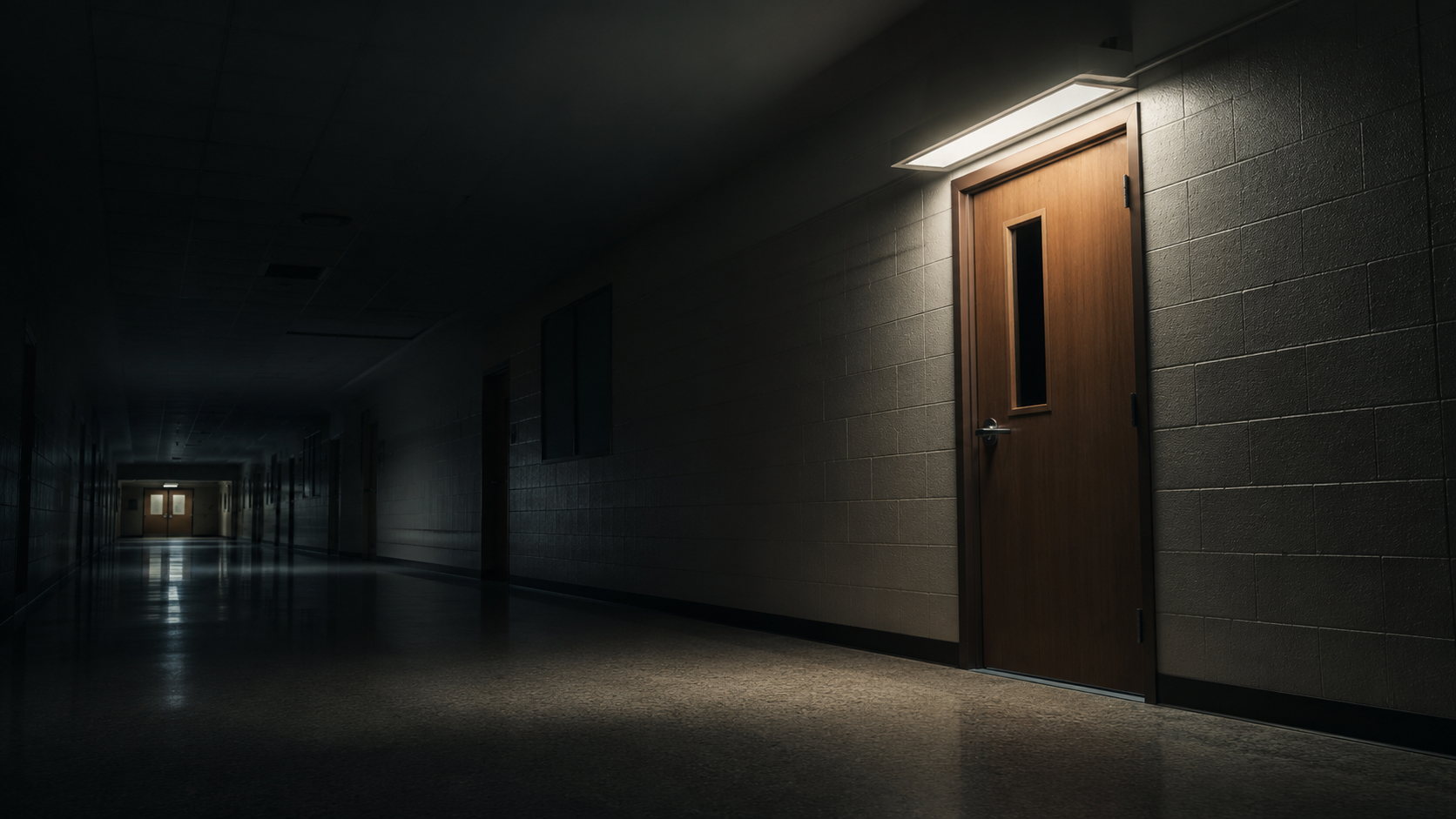
The hallway mattered because it was not empty.
Outside classrooms 111 and 112 at Robb Elementary School, officers stood with weapons, radios, body cameras, shields, keys, conflicting orders, and incomplete information. Inside the rooms were children and teachers. Outside were adults trained to move toward gunfire.
For a long time, the public question sounded simple: why did they wait? But the accountability case that followed was never simple. It became a harder question about command, training, fear, law, institutional failure, and the narrow difference between a catastrophic mistake and a criminal offense.
The Life Before the Case
Robb Elementary was near the end of its school year on May 24, 2022. The ordinary rhythm of the day mattered: awards, classrooms, children close to summer, teachers moving through the last routines of the term. Official accounts later recorded that 19 students and two teachers died, while at least 17 others were physically injured.
The two teachers, Eva Mireles and Irma Garcia, became part of the public memory of Uvalde not as symbols first, but as educators responsible for fourth graders in a school that should have been protected. The children were not a statistic inside a report. They were students with families, habits, voices, schoolwork, birthdays, games, and private futures that the public record can only partially hold.
That limit matters in true crime. When a case becomes about systems, agencies, lawsuits, reports, and courtroom procedure, the people at the center can disappear into institutional language. The Robb Elementary accountability case is really the opposite. Every later document exists because a school day became a test of whether adults, agencies, and laws could protect children when protection mattered most.
The first human fact was not the failure. It was the ordinary life interrupted by it.
The People Around Them
The supporting cast in the accountability case was unusually large. Local police, school district police, state officers, federal agents, emergency responders, school staff, dispatchers, public officials, prosecutors, civil lawyers, grieving families, and surviving children all became part of the record.
That scale created one of the case’s most difficult problems. Nearly 400 law enforcement officers were eventually connected to the response, yet only two former Uvalde school district officers were criminally charged: former school district police chief Pete Arredondo and former officer Adrian Gonzales. Gonzales was later found not guilty on all 29 counts against him; Arredondo’s case remains pending.
The public story often focused on Arredondo because state officials and later reviews identified him as a central leadership figure. Arredondo has disputed the framing that he alone controlled the response. That distinction is not a technicality. It is one of the reasons the accountability case became harder than public anger expected.
Families wanted responsibility to match the scale of the failure. The legal system asked a narrower question: which individual, if any, could be proven criminally liable under Texas law for what happened during those minutes?
The First Cracks
The first official explanation after Uvalde did not hold.
In the hours and days after the shooting, the public received shifting accounts of what officers had done and when. Later reviews criticized not only the tactical response but also communications after the attack, including inaccurate early narratives. The Justice Department review said the response involved failures in leadership, decision-making, tactics, policy, training, and communication.
That mattered because accountability depends on a reliable timeline. Families were not only grieving; they were trying to understand whether children waited for help while help waited outside. The answer that emerged from later records was devastating: the incident was not treated throughout as an active shooter situation, and officers did not continuously push forward to eliminate the threat.
The first crack was therefore not only tactical. It was informational. The public could not assess responsibility because the story kept changing.
In Uvalde, the demand for accountability began with a demand for an accurate clock.
The Last Ordinary Movements
The accountability case turns on time.
The Justice Department review reconstructed the response minute by minute and examined what happened before, during, and immediately after the shooting. It found a 77-minute gap between when officers first arrived and when the gunman was confronted and killed.
Within that gap, the central legal and moral questions formed. Officers were not dealing with a distant threat. They were inside or near a school where children and teachers had been shot, where calls for help were part of the record, and where active-shooter doctrine demanded movement toward the threat rather than containment.
But the legal system does not punish failure simply because failure is obvious in hindsight. Prosecutors had to connect specific conduct to specific legal duties. The state later alleged that Gonzales and Arredondo failed to act in ways that endangered children. The defense position, especially in Gonzales’s case, was that the scene was chaotic, responsibility was diffuse, and one officer could not be made the legal vessel for a system-wide collapse.
The last ordinary movements of that school day ended quickly. The movements that followed were slower, more contested, and harder to judge.
The First Alarm
The alarm became official almost immediately, but official response did not become effective immediately.
The Justice Department said some first officers initially acted consistently with generally accepted practices by trying to engage the subject. The failure deepened after officers retreated under gunfire and the response shifted toward treating the situation like a barricaded-subject event rather than an active-shooter event.
That distinction became the legal and institutional heart of Uvalde. A barricaded-subject response can involve slowing down, containing, communicating, and waiting. An active-shooter response is built around stopping the killing as quickly as possible. The difference is not academic. It determines whether waiting is a tactic or a failure.
The record later showed enough resources and equipment were present to push forward, according to the Justice Department’s assessment. The problem was not simply that no one arrived. It was that arrival did not become decisive action.
That is why the first alarm did not end the danger. It exposed the gap between response and rescue.
The Search for an Explanation
At first, the explanation centered on command.
Who was in charge? Who had authority? Who knew children were still alive? Who heard gunfire? Who understood the rooms? Who had the keys? Who had the equipment? Who should have ordered entry?
The Justice Department review collected more than 14,000 pieces of data and documentation, spent 54 days on site, and conducted more than 260 interviews. Its work covered timeline reconstruction, tactics, leadership, communications, trauma services, school safety, and pre-incident preparation.
That breadth showed why the case could not be reduced to one hallway decision. The failure was layered: command confusion, poor communication, training gaps, delayed urgency, and a public information breakdown. Yet criminal law does not usually prosecute “a system.” It prosecutes named people for defined offenses.
This is the public version versus the legal record. The public version said officers failed. The legal record had to ask which officer, under which duty, caused which legally recognizable danger.
That gap became the center of the accountability case.
The Evidence That Did Not Fit
The evidence did not fit the first public expectation that accountability would be broad and swift.
The first major official reviews were damning, but criminal charges did not arrive until June 2024, more than two years after the attack. A Uvalde County grand jury indicted Arredondo and Gonzales on abandoning or endangering a child charges. Gonzales faced 29 counts; Arredondo faced 10. Both pleaded not guilty.
The count structure mattered. Gonzales’s indictment was tied to 29 children. Arredondo’s was tied to 10 counts. These were not murder charges. They were child abandonment or endangerment allegations, a state-law route prosecutors used to test whether failure to act during an active-shooter response could become criminal liability.
The evidence prosecutors relied on was not a single hidden recording. It was accumulation: training expectations, timeline evidence, officer actions, what was heard, what was known, what was not done, and how long children and teachers remained inside the rooms before breach.
The defense pressure was equally clear. If nearly 400 officers were part of the wider response, why should only two carry criminal blame?
The Event at the Center of the Case
The event at the center of the accountability case is not only the shooting. It is the delay.
The Justice Department’s review described the most significant failure as not treating the incident throughout as an active-shooter situation and not using available resources and equipment to move forward immediately and continuously. It said 33 students and three teachers, many of whom had been shot, were trapped in rooms with an active shooter for more than an hour while law enforcement remained outside.
That finding is stark, but legal responsibility required more than moral clarity. Prosecutors had to show that the accused officers’ actions or inaction met the elements of abandoning or endangering a child. In Gonzales’s trial, the state argued he failed to confront, delay, distract, or impede the gunman. The defense argued that he did not see the shooter before the shooter entered the school, operated in chaos, helped evacuate students, and was being singled out for a collective failure.
That is what the jury had to weigh. It was not asked whether the Uvalde response was a failure. Multiple reviews had already answered that. It was asked whether one former officer’s conduct satisfied the criminal charge beyond the legal threshold required.
The verdict showed the distance between public accountability and criminal proof.
When the Story Broke Open
Uvalde became larger than a local tragedy because the response contradicted what many Americans had been told about active-shooter policing.
For years, the public message had been that officers are trained to move toward gunfire. Robb Elementary tested that doctrine in real time. The records later showed that doctrine existed, that officers were present, and that the final breach did not happen for 77 minutes.
The story also broke open because families refused to let procedure bury the question. They attended meetings, challenged officials, sued, pushed for records, and demanded explanations from agencies that had issued incomplete or inaccurate public accounts.
Civil action became another accountability track. Families reached a $2 million settlement with the city of Uvalde, later approved by city leaders, with reform-related terms including improved police training, mental health support, remembrance, and memorial commitments. Other lawsuits remained directed at public agencies and private companies connected to the broader chain of responsibility.
The criminal case asked whether individuals could be punished. The civil and legislative tracks asked whether institutions could be changed.
The Case Built from Fragments
The Gonzales trial became the first courtroom test of the accountability theory.
Jurors heard evidence about the opening minutes, active-shooter training, what Gonzales did, what he allegedly failed to do, and what other officers did around him. Prosecutors framed inaction as legally dangerous. The defense framed the case as scapegoating inside a response failure involving many agencies and many armed responders.
On January 21, 2026, Gonzales was acquitted on all 29 counts. Jurors deliberated for more than seven hours before returning not guilty verdicts.
That verdict did not erase the failure. It clarified the legal problem. A jury can believe a response failed and still decide that the state did not prove the defendant committed the charged offense. In the United States, that distinction is not a loophole. It is the burden of criminal law.
The remaining Arredondo case is different because his alleged role was tied more directly to command. But it carries the same central difficulty: proving individual criminal liability inside a mass institutional failure.
The Outcome That Did Not End the Story
The Gonzales acquittal moved the accountability case into a new phase rather than closing it.
Arredondo still faces 10 counts of abandoning or endangering a child. He has pleaded not guilty. His trial has been tentatively set for February 22, 2027, and his defense has also pursued testimony from U.S. Customs and Border Protection personnel who responded that day.
That pending case matters because it may be the last criminal courtroom test of the Uvalde response. It also matters because it will likely focus more intensely on command, delay, authority, and whether other officers acted independently or because of Arredondo’s decisions.
But even if Arredondo is tried, the result will not answer every accountability question. A conviction would not punish every failure. An acquittal would not mean the response was acceptable. Either way, the criminal court can decide only the charges in front of it.
The larger story remains bigger than one verdict.
The Aftermath People Still Argue About
The aftermath has split into several tracks: criminal law, civil litigation, public records, school rebuilding, police reform, and community memory.
Texas lawmakers passed House Bill 33, the Uvalde Strong Act, to address active-shooter incidents and school emergency response. The enrolled bill requires training and response-related changes for law enforcement and emergency medical personnel and ties future training to final reports on school active-shooter responses.
The new school, Legacy Elementary, became another kind of response. It was built to replace Robb Elementary and to give children and educators a campus designed with safety, trauma, and memory in mind. Its opening did not undo what happened, but it changed the physical landscape of Uvalde’s recovery.
Still, rebuilding is not the same as closure. Families continued to press for records, explanations, and accountability. Public anger remained strongest where institutional language seemed to soften a simple moral fact: children waited while officers waited too.
The argument after Uvalde is not only about what happened. It is about what a society is willing to call failure when failure is shared.
The Review, Appeal, or Unanswered Question
The unanswered question is not whether the response failed. Official reviews answered that.
The harder question is what kind of accountability fits the failure. Administrative discipline can remove officers. Civil lawsuits can produce settlements, reforms, disclosures, or damages. Legislation can change future duties. Criminal prosecution can punish individual conduct, but only when proof fits a charge.
That is why Uvalde remains so uncomfortable. The moral scale of the event is enormous. The legal tools available afterward are narrow. Families may see a corridor, a delay, and a failure to move. A jury must see statutory elements, admissible evidence, causation, duty, and proof beyond the required threshold.
Arredondo’s pending case may sharpen that distinction. His defense says testimony from federal responders is important to rebut the claim that he personally delayed others. Prosecutors and families see the delay through a different lens: one in which leadership failure had consequences no later explanation can make acceptable.
The law can test that conflict. It cannot make the corridor disappear.
Why This Case Still Matters
The Robb Elementary accountability case matters because it exposes a gap most emergency systems prefer not to discuss.
Training can be mandatory. Protocols can be written. Officers can be armed. Agencies can arrive. But if command fails, if communication breaks, if urgency collapses, and if no one takes responsibility in the moment, the existence of a response does not guarantee rescue.
That is the lesson official reviews, lawsuits, legislation, and trials keep circling. Uvalde was not a case where no one came. It was a case where many came, and the central question became why arrival did not become action.
The hallway is still the image that holds the case. Not because it explains everything, but because it refuses to let the explanation become abstract.
At Robb Elementary, accountability began in the space between a classroom door and the adults outside it.
