
Rust Cohle Character Analysis: Why True Detective’s Broken Philosopher Still Hits So Hard
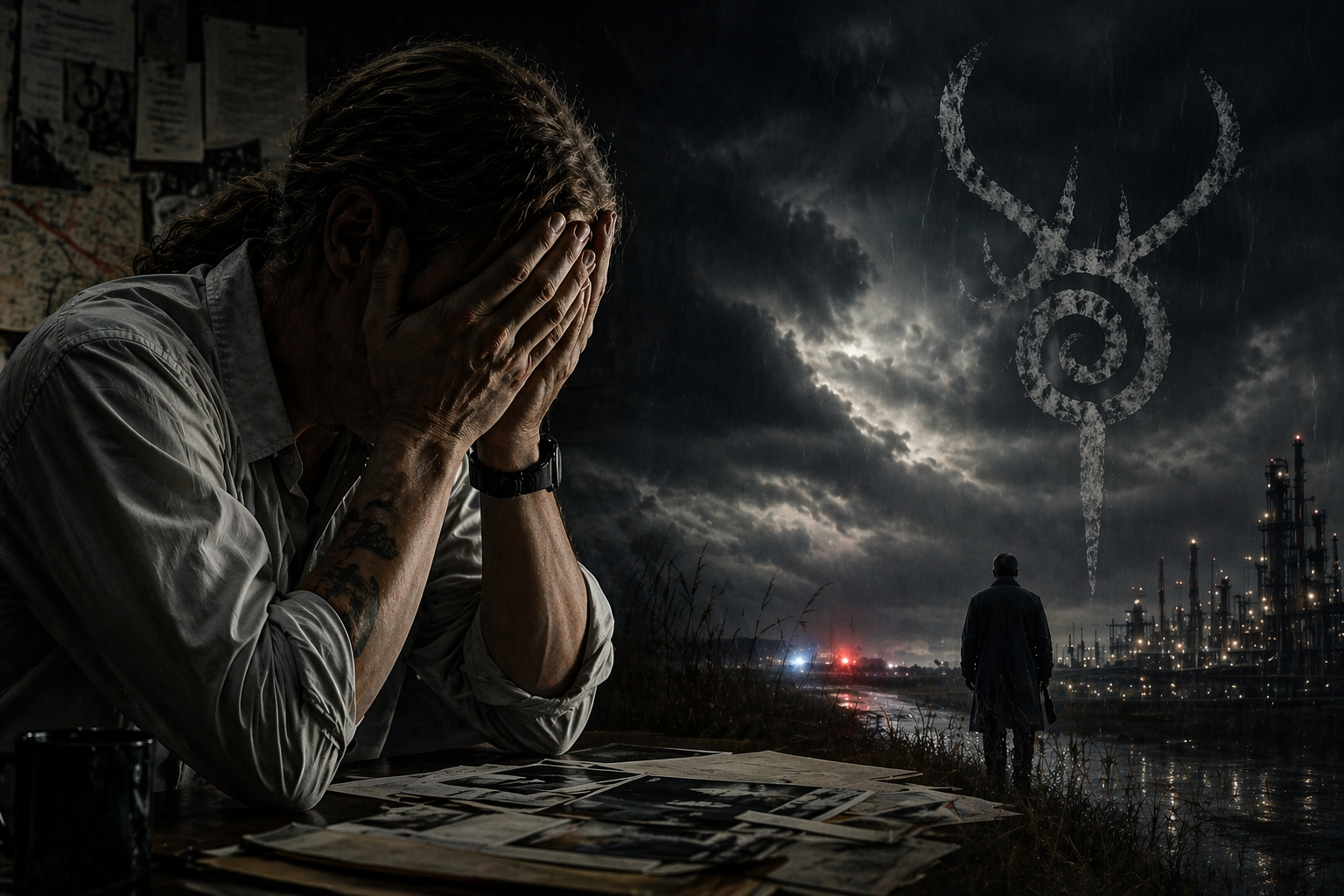
Rust Cohle’s haunted expression during the Dora Lange investigation
The Real Logic of Rust Cohle: Grief, Nihilism and the Hunt for Meaning
The brilliance of Rust Cohle is not that he sounds deep, but that every strange thing he says is really a defense against grief, hypocrisy and a world he no longer trusts
Rust Cohle endures because he does not appear on screen as a conventional great detective. He arrives as a disturbance. Official character material describes him as a Louisiana State Police detective transferred from Texas law enforcement, a cerebral and intense thinker whose negative view of society puts him at odds with Martin Hart and the rest of the force. The scripts turn that description into immediate dramatic pressure: from the start, he feels less like a colleague than like an irritant the room cannot absorb.
That is the first reason he still feels alive more than a decade later. Rust is not designed to flatter the audience. He is not there to say clever things on command and pose moodily in a nicotine haze. He is there to make ordinary consolations sound weak. Family, religion, identity, duty, optimism: he stares at each one as if it were a story people tell themselves to survive. In the pilot script, he openly frames himself as a philosophical pessimist, then drives straight into a worldview in which consciousness itself is an evolutionary mistake and human beings live under illusions of selfhood and meaning.
And yet that is not why the character works. If Rust were only a nihilist with a good vocabulary, he would have become a short-lived cult favorite and then faded into internet wallpaper. He endures because True Detective makes a harder choice. It builds a man whose philosophy is not decorative. It is fused to trauma, work, instinct, and self-punishment. Rust does not monologue because he wants to sound superior. He monologues because he is trying to impose a brutal theory on a life he can barely bear. The show’s power comes from making that theory feel both intelligent and incomplete.
Rust Cohle is not cool in the simple way people think he is
Many characters become iconic because they are aspirational. Rust becomes iconic because he is ruinously un aspirational once you look closely. His apartment is stripped to the bone: a mattress on the floor, books, a crucifix, almost no furnishings. He wakes up looking hollowed out. His life is not stylish minimalism. It is self-erasure. Even his routine carries that feeling. In one script passage, he describes nights of not sleeping, reading manuals, studying, and going over case material until work becomes less a job than an anesthetic.
That matters because Rust’s detachment is often misread as mastery. It is closer to damage. He is frighteningly observant not because he stands above human weakness, but because he has burned away so much of ordinary participation in life. He can read people because he no longer joins them. He can spot self-deception because he has spent years dissecting his own. His philosophy provides him language for that estrangement, but the show is careful to keep showing the cost. The man who sees through everybody is also the man most incapable of inhabiting normal life without wincing.
This moment is where the character gets smarter than his imitators. Fewer shows took the lesson “give the detective a tortured inner monologue.” True Detective understood that the monologue only works if the body, the room, the routine, and the social friction all confirm it. Rust’s words are memorable because the series keeps proving that he lives exactly like someone who believes them.
The grief beneath the philosophy is the real engine of the character
The essential fact about Rust Cohle is not that he is a pessimist. It is that he is bereaved. In the second episode’s script, he tells Marty that he was married, had a baby girl, lost her in a car accident at age two, and saw the marriage collapse under the weight of that loss. Later material makes clear how deeply that catastrophe reordered him. His bleakness is not an abstract intellectual pose floating free of biography. It is a philosophy built over a crater.
Once you see that, everything else sharpens. Rust’s hostility to false comfort is not just intellectual severity. It is grief refusing insult. He cannot tolerate easy talk about God, social order, happy domesticity, or moral certainty because he has already seen how quickly life can annihilate all of it. That is why his pessimism lands with such force. He sounds like a man who has dragged theory into contact with irreversible pain and found most of the available language fraudulent.
Even his most notorious lines change meaning under that light. On the surface, they sound like cosmic pronouncements. Underneath, they often translate grief into systems language. He would rather call consciousness a mistake than admit that the world took his daughter and left him here to keep moving. He would rather talk about programming and extinction than about helpless love. The brilliance of the writing is that it never reduces him to a single wound, but it also never lets you forget that the wound is there.
Why Rust is such a great detective
Rust’s talent is not simply intelligence. It is a specific moral and psychological instrument. A philosophical reading published during the first season argued that Rust is drawn to the ugliest and least palatable forms of thought, expects hypocrisy as the norm, mistrusts discourse built on hope, and is therefore unusually adept at soliciting confessions and seeing behind the masks people wear. That is the essence of his character. Rust is not just clever. He is structurally anti-delusion.
The scripts support reading them again and again. He keeps vast notes. He works obsessively. He searches beyond the obvious frame. He pushes across time, geography, and bureaucratic laziness. Even in early procedural moments, he is the one extending the net, digging into fetish burglaries and older patterns rather than settling for the nearest explanation. He is not more ethical than everyone around him in a clean sense. He is more allergic to the lie that the first convenient answer is good enough.
That is also why Marty needs him, even when Marty hates him. Marty understands people in the social sense: codes, roles, appearances, how things are supposed to look. Rust understands what leaks through those appearances. The contrast is built into the series in the opening framework, where former partners revisit a 1995 serial-killer case from the distance of 2012. Rust is the one who feels, almost from the beginning, that the official story is too neat and therefore false.
What Media Misses
The laziest reading of Rust Cohle is that he is a television nihilist: a man who says darkness is all there is, and the show invites you to admire his cold clarity. That reading misses the central tension of the character. Even commentary from the show’s early run stressed that Rust is not easily reducible to pure nihilism, because compassion complicates him. He is too responsive to suffering, too enraged by abuse, too driven to uncover what powerful men hide. A truly empty man does not care that much. Rust cares ferociously.
That is the real point. Rust does not represent darkness winning. He represents a man trying to live honestly after the collapse of comforting illusions, only to discover that moral seriousness itself can become a kind of tether back to other people. He keeps pushing toward the victims, the buried patterns, the children no one protected. For all his rhetoric about meaninglessness, his actions keep revealing an opposite truth: he cannot stop behaving as though some things matter absolutely.
The extra layer behind the monologues makes the performance even better
One reason Rust feels unusually coherent is that the material was built from real philosophical traditions rather than random pseudo-profundity. In response to plagiarism accusations around Rust’s dialogue, Nic Pizzolatto said the character’s thought drew from a broad pessimistic and anti-natalist tradition, explicitly naming figures such as Schopenhauer, Nietzsche, and Cioran, while earlier commentary around the series connected Rust to works exploring anti-natalism and philosophical pessimism. That does not mean Rust is a walking bibliography. It means the writing gave him real intellectual gravity.
But the performance matters just as much. Matthew McConaughey later said he spent many hours, even days, writing to Pizzolatto asking what the lines meant, why Rust was saying them, and why he was saying them at that moment, until he could make the character his own. That detail is gold because it explains why Rust never feels like an actor reciting prestige-TV philosophy. He feels inhabited. The performance does not merely deliver the words; it makes them sound like the final product of a damaged nervous system.
This is the additional layer that basic character summaries usually miss. Rust is not just well-written and well-acted in parallel. He is the result of writing and performance interrogating each other line by line. That is why even his silence feels authored. The character is precise all the way down.
Why the ending matters more than the quotes
If you want to understand Rust Cohle, you have to care about the ending more than the one-liners. The finale does not suddenly turn him into a sunny believer. It does something better. It lets him reach a form of guarded, unsentimental hope after a near-death experience and after the case forces him to stand inside the full architecture of human evil he has been tracing for years. Contemporary coverage of the finale captured that shift clearly: the story ends not on total victory, but on Rust moving toward optimism and emotional revelation rather than deeper negation.
That shift is what saves the character from becoming a museum piece of beautiful despair. If Rust ended where he began, he would still be memorable, but he would also be smaller. The final movement gives him contour. It reveals that his darkness was never the whole truth of him. Beneath the contempt, beneath the theories, beneath the stare, there was still attachment powerful enough to survive everything he had built to suppress it. His last turn does not erase his worldview. It exposes its limit.
And that is why the final note lands so hard. Rust’s late suggestion that the light is winning is not naive optimism. It is microscopic optimism earned the hard way. Not denial. Not cure. Not clean redemption. Just the admission that darkness may not be the only honest thing left to say. For a character built on suspicion of illusion, that is a far more radical turn than a simple happy ending would have been.
Why Rust Cohle became bigger than the show around him
Rust Cohle became bigger than a single season because the series built one of those rare alignments where character concept, dialogue, performance, atmosphere, and structure all reinforce each other. The Television Academy’s record for the show reflects part of that impact: True Detective received multiple major nominations and won five Emmys, including directing for “Who Goes There.” That kind of recognition does not explain Rust’s hold on viewers by itself, but it does help show that the character emerged from a production working at an unusually high level across writing, acting, and visual execution.
Still, the final reason Rust lasts is simpler. He tells a truth many people feel and do not want to say aloud: that modern life is thick with performance, self-deception, and stories people use to keep from looking directly at pain. But he also tells a second truth by the end, and this is the one that gives the character life beyond meme status. A human being can see horror clearly and still not belong entirely to it. That is the real meaning of Rust Cohle. Not that darkness is deeper. That honesty, grief, and love can survive inside it without becoming soft or stupid.
Summary
Rust Cohle is unforgettable because True Detective refuses to make him only one thing. He is a pessimist but also a mourner. He is abrasive but deeply compassionate toward suffering. He sounds like a philosopher but works like a bloodhound. His genius as a detective comes from his hatred of delusion, while his most famous speeches are really attempts to impose order on catastrophic loss.
The character’s extra depth comes from what sits behind the screen version: a real pessimistic philosophical tradition informing the writing and a performance built through obsessive line-by-line interrogation of meaning. And the reason Rust still matters is the ending. He does not defeat darkness. He simply stops pretending darkness is the only intelligent conclusion. That small movement toward light is what turns him from a great character into a lasting one.
