8 Minutes To Find His Wound: A Dying Student Asked For Help. The Police Did Not Believe Him Until It Was Too Late
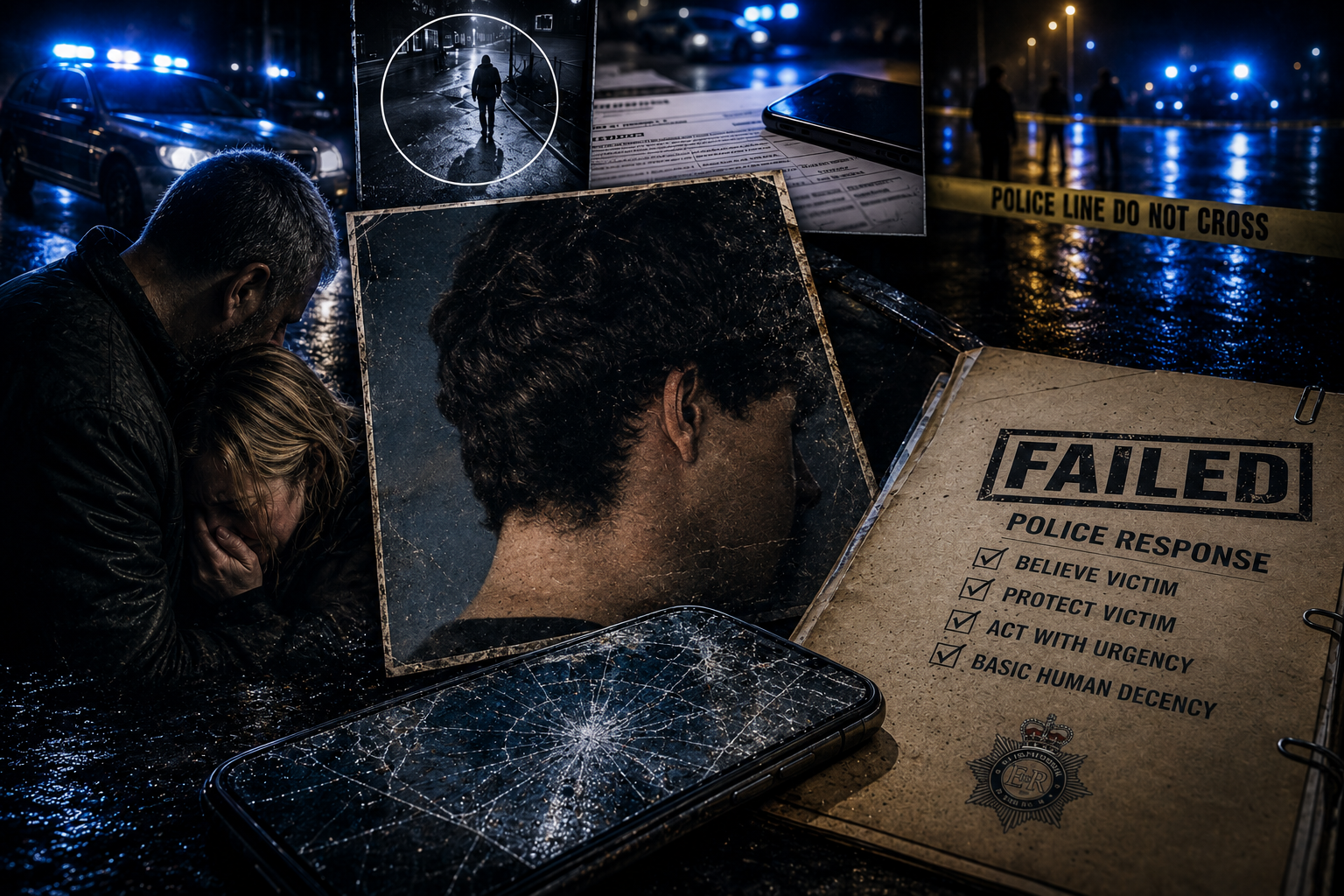
Henry Nowak And The Failure To Listen
Dying Student Was Disbelieved In The Moment He Needed Help Most
Henry Nowak’s Final Minutes Should Haunt British PolicingHenry Nowak was 18 years old, a first-year University of Southampton student, walking back to his accommodation after a night out when he was murdered by Vickrum Digwa in Portswood, Southampton, on 3 December 2025. The sentencing remarks described Henry as “much-loved, kind, hard-working and ambitious”, and made clear that he was alone, unarmed and not drunk when the encounter began.
Digwa stabbed Henry in the chest and inflicted further wounds. The fatal injury cut a vein behind the collar bone, causing heavy internal bleeding into the chest cavity. The court heard that 1,200ml of blood was found there, and that the chest wound was difficult to detect from the outside because of Henry’s clothing and the nature of the injury.
That medical reality explains part of the confusion. It does not excuse the failure. The central outrage is simple: Henry told police he had been stabbed, said he could not breathe, and was still treated, initially, as the suspect rather than the victim. In Parliament, MPs referred to Henry saying he could not breathe nine times and saying he had been stabbed four times; one officer’s response was reported as: “I don’t think you have, mate.”
Why Did It Take So Long To Find The Wound?
The most defensible answer is that several things collided at once: Digwa lied, the scene was chaotic, it was dark, Henry wore a dark top, and the fatal chest wound was not visually obvious. The sentencing remarks say officers had been given a “convincing but wholly false narrative”, that the entry damage to Henry’s clothing would not have been obvious, and that visible blood would not clearly have appeared to be coming from the fatal chest wound.
But that explanation is also the indictment. Because a competent emergency response cannot depend only on whether a wound is visually obvious. If a person on the ground says he has been stabbed and cannot breathe, the default should be immediate medical assumption, not suspicion management.
That is why the delay feels so intolerable. Not because every officer should instantly diagnose a hidden internal bleed. Not because hindsight is easy. But because the victim was giving the most important diagnostic clue available: his own words. He was not saying something vague. He was saying he had been stabbed.
The Handcuffs Were The Symbol Of The Failure
Hampshire Police said Henry was initially handcuffed and told he was under arrest while officers began enquiries into what had happened before their arrival. The force said that within three minutes of officers arriving, the severity of his condition was becoming clear; the handcuffs were removed, an ambulance was called and officers began CPR.
That sequence is still devastating. A dying victim should not have had to deteriorate further before being believed. The problem is not only that Henry was handcuffed; it is what the handcuffs represented. They represented the police accepting the wrong frame of the scene.
Digwa and his brother had claimed that Digwa was the victim of an assault. The court found that Digwa lied repeatedly, including by falsely claiming Henry had used racist language. The judge said Henry had said nothing racist and that Digwa’s claim was completely at odds with Henry’s previous character.
This is where the police response becomes so damaging to public confidence. A false allegation did not merely distract officers. It appears to have shaped their initial understanding of who needed control and who needed care.
The Phone Question Goes To Trust
Henry’s phone matters because the sentencing remarks say Digwa took it and kept it because it contained incriminating recording of him. It was found on Digwa after he had been arrested and taken into police custody.
Claims around police seizure of Henry’s and his father’s phones have circulated widely, but the strongest publicly available official material does not clearly establish the full basis, timing, scope or rationale for any seizure involving the father’s phone. That point needs disciplined handling. It should not be embellished beyond the evidence.
But the public concern is understandable. In a case where Henry was falsely framed at the scene, any later search of devices for material that might retrospectively support an allegation against him would look morally grotesque unless tightly justified, transparently explained and strictly necessary. The family deserved clarity, not a process that appeared to place the dead victim back under suspicion.
A murder investigation obviously may require phones, footage, messages and digital evidence. But there is a world of difference between securing evidence to prove the killer’s guilt and searching for material to soften the image of a dead boy who had already been falsely accused while bleeding on the ground.
The Police Statement Problem Made Everything Worse
One of the most serious complaints is that police appeared to frame Henry as less than fully innocent in the aftermath. The official court record is now clear: Henry was alone, unarmed, not drunk in any meaningful legal sense, and the racist allegation was rejected. Digwa was convicted of murder, and his lies were described by the judge as wicked and obstructive.
That matters because public statements after a tragedy shape memory. If an institution gets the framing wrong early, it can compound the harm. A grieving family is then forced not only to mourn, but to defend the reputation of someone who can no longer defend himself.
The Hampshire Police and Crime Commissioner said Henry was falsely accused of racially aggravated assault while he lay dying, that the incident leading to his arrest and handcuffing was part of Digwa’s attempt to frame himself as the victim, and that the police response raised serious concerns about impartiality, fairness and judgement.
That is the correct institutional language. It does not blame a whole community. It does not turn one murderer into a symbol for a religion. It identifies the actual failure: a victim was misread, a liar was initially believed, and the response fell below what the public expects when a person is dying in front of officers.
The “He Would Have Died Anyway” Line Is Not A Moral Defence
The most inflammatory phrase in this case is the claim that Henry would have died anyway. The precise legal-medical point in the sentencing remarks was that the pathologist said no emergency medical treatment would have permitted access to the bleeding vein, and that Henry would not have survived however quickly he received first aid, CPR or expert medical treatment.
That may be medically important. It is not morally sufficient.
The duty to help does not disappear because survival is unlikely. A dying person is still owed urgency, dignity, comfort and belief. Police officers do not get to treat medical futility as a retrospective shield for poor judgement at the scene.
That is why the phrase lands so badly. To the public, it sounds like an institution saying the outcome was inevitable, so the treatment matters less. But the treatment matters precisely because the outcome was fatal. Henry’s final moments were not a procedural footnote. They were the last human experience of an 18-year-old boy whose family must live with the image forever.
The IOPC Investigation Must Answer The Real Questions
The Independent Office for Police Conduct has confirmed that its investigation covers the contact Hampshire and Isle of Wight officers had with Henry immediately before his death, including the use of handcuffs and first aid provided. The IOPC said the officers involved were being treated as witnesses, though that status is kept under review.
That investigation must not become a narrow technical exercise. The public does not only need to know whether a policy box was ticked. It needs to know why officers weighted the scene the way they did, why Henry’s words did not trigger immediate medical priority, whether training distorted judgement, whether fear of reputational accusation affected decision-making, and whether victim recognition failed.
The IOPC has also warned against speculation while the live investigation continues, saying it must establish the full circumstances and whether misconduct may have occurred. That warning is legally sensible. But restraint cannot mean emotional anaesthesia. The public is entitled to be angry about what is already visible and confirmed.
The Hard Truth Is That Henry Was Failed Twice
Henry Nowak was failed first by the man who murdered him. That must remain the centre of the case. Vickrum Digwa killed him, lied about him, filmed him suffering, kept his phone, and allowed a false story to poison the first response. The court rightly placed responsibility for the murder on him.
But Henry was also failed by the initial police response. Not because officers caused the stab wound. Not because the police are the murderer. But because the institution that arrived with authority, equipment and responsibility did not immediately treat the dying victim as the dying victim.
That distinction matters. It allows the country to reject collective blame, reject religious hatred, reject opportunistic racial agitation, and still demand brutal accountability from the police. Henry’s family themselves asked that his death not be used to create further division, hatred or tension. The Home Secretary repeated that appeal and said this was not a case about Sikhism or racism, but murder.
The correct conclusion is not hatred. It is accountability. Henry Nowak should have been heard the first time he said he had been stabbed. No legal finding, medical explanation or institutional statement can erase the horror of that failure.
