Andy Burnham’s New Information Unit Is Raising A Chilling Question About Who Gets To Define The Truth
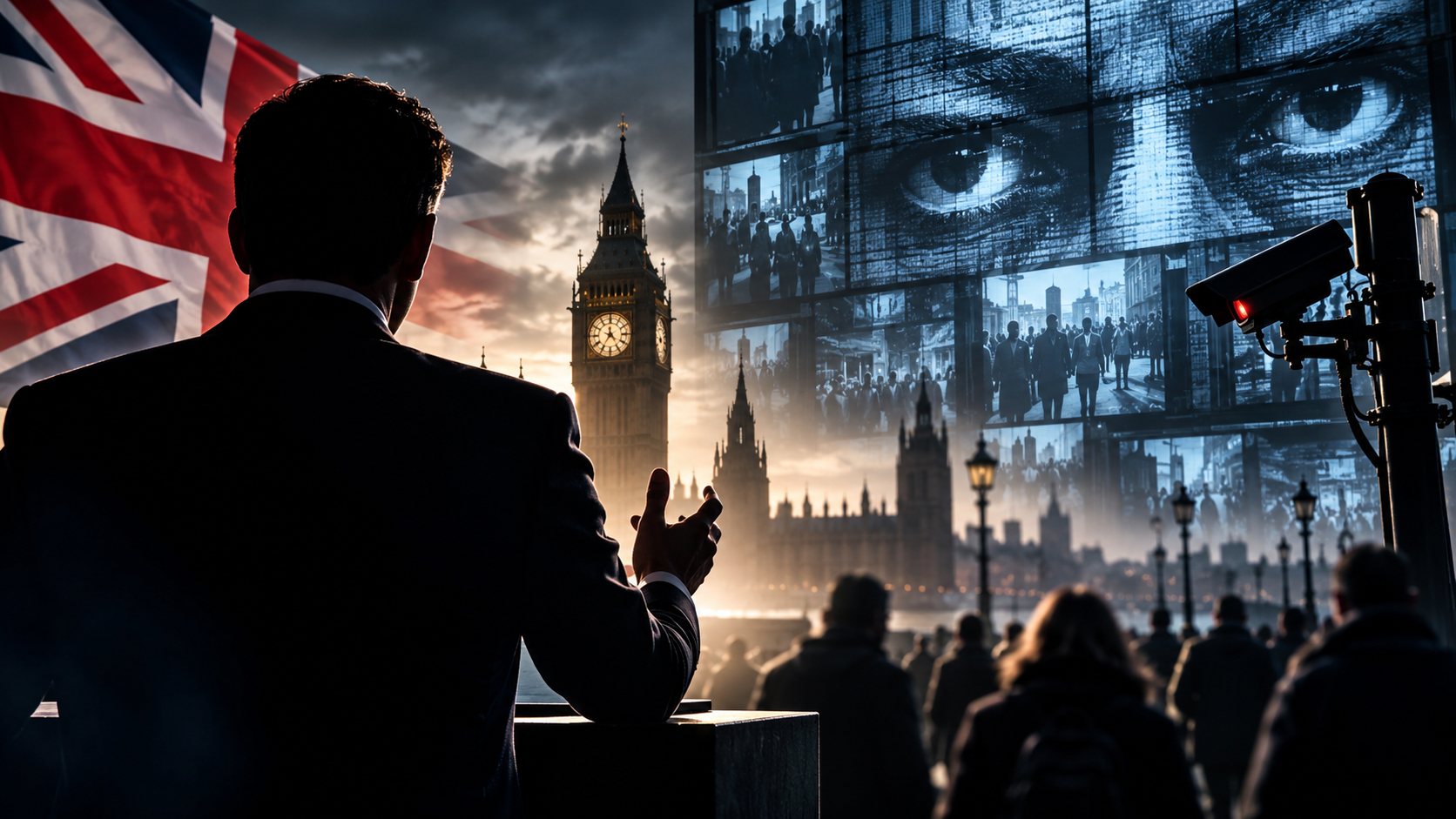
Britain’s Fight Against Disinformation And The Risk To Free Expression
UK Government Disinformation Centre Sparks Civil Liberties Concerns
Andy Burnham has not announced an organisation officially called a “Ministry of Truth”. The name unveiled in his United Nations address on 22 September 2026 was the National Centre for Information Defence, and its stated purpose is to “detect, attribute and disrupt” hostile-state information attacks. Burnham specifically framed the move around foreign interference, Russian disinformation, fabricated material, bots, fake websites and the growing ability of artificial intelligence to accelerate information warfare.
That distinction matters. A democratic government attempting to identify coordinated foreign influence operations is not automatically comparable to the totalitarian state imagined by George Orwell. Countries face genuine campaigns involving impersonation, manipulated media, coordinated fake accounts and attempts to inflame existing social divisions. Parliamentarians from more than one committee have argued that the UK needs a better organised response to hostile foreign disinformation.
But the Orwell comparison is not really triggered by the centre’s name. It is triggered by the fundamental democratic question underneath it: who decides where hostile manipulation ends and legitimate dissent begins?
That is where Burnham’s own words deserve unusually close scrutiny.
The Phrase That Changes The Entire Debate
Burnham told the UN that hostile actors had been creating a “narrative of decline”, stoking division and sowing despair inside Britain. He then went further, saying that over the previous decade Britain had given “too much ground” to people pushing a negative and corrosive narrative about the country which, in his words, “bears no resemblance to reality.”
Those sentences sit immediately before his promise to create the architecture needed to “stem this poisonous tide” and his announcement of the National Centre for Information Defence. The official mission he then gave the centre was narrower: detecting, attributing and disrupting hostile-state information attacks.
That difference is crucial.
Countering a fabricated website secretly operated by a hostile intelligence service is one thing. Countering a “negative narrative” about Britain is something fundamentally different. Decline is not a binary computer variable. People can disagree honestly and intensely about whether living standards, public services, immigration, crime, infrastructure, housing, national identity or political institutions are improving or deteriorating.
A democracy cannot function if pessimism itself starts to look suspicious.
Citizens must remain free to believe Britain is thriving, failing, recovering, declining or changing beyond recognition. They must be free to say the government is wrong. They must be free to exaggerate, make poor arguments, challenge official statistics, distrust institutions and express opinions political leaders consider offensive or absurd, subject to the ordinary limits of law.
The state does not acquire the right to correct an opinion merely because the opinion is bleak.
This Is Where Orwell Becomes More Than A Cheap Reference
George Orwell’s Nineteen Eighty-Four has become so routinely invoked in political arguments that “Orwellian” can sometimes mean little more than “government policy I dislike”. That weakens the comparison.
The deeper warning in Orwell’s Ministry of Truth was more precise.
The fictional ministry controlled information, altered records and continuously reconstructed the past so that reality remained compatible with the Party’s current position. The danger was not simply censorship. It was the concentration of institutional power over what society was permitted to recognise as reality.
Britain in 2026 is obviously not Oceania.
There is no evidence that Burnham has proposed rewriting historical archives, banning criticism of his government or establishing an official political doctrine that citizens must accept. Treating the two systems as equivalent would turn a useful warning into an absurd accusation.
But Orwell remains relevant as a test.
Whenever a government creates machinery concerned with determining, monitoring or disrupting information, democracies should ask who defines the target, what evidence is required, what happens when officials get it wrong and whether lawful political speech can become collateral damage.
That is not paranoia.
It is democratic maintenance.
‘Disinformation’ Is Easy To Condemn And Harder To Define In Practice
The simplest cases cause little controversy. A foreign intelligence service creates fake accounts, impersonates legitimate institutions, fabricates documents and covertly coordinates thousands of posts. Identifying that network does not require the government to decide whether an ordinary citizen’s political opinion is correct.
The harder cases arrive when real people repeat or discuss material connected to those campaigns.
Suppose a hostile foreign operation amplifies criticism of immigration. Does the presence of foreign amplification make the underlying domestic opinion disinformation? Obviously not. Suppose a state-controlled network promotes genuine statistics selectively to damage confidence in Britain. The information might be authentic even if the campaign behind its distribution is manipulative.
This distinction between content and conduct could become one of the most important safeguards around the new centre.
A system designed around identifying covert foreign coordination, impersonation, artificial amplification and state-linked influence networks is far easier to reconcile with free expression than a system that starts classifying ordinary political propositions as acceptable or unacceptable narratives.
The architecture matters because the power to investigate information can become the power to influence which information circulates.
Britain Already Has A History That Makes Scrutiny Necessary
Civil-liberties organisation Big Brother Watch responded to Burnham’s announcement by accepting that action against hostile foreign disinformation can be legitimate while demanding that the new centre be strictly restricted to overseas threats. It also called for clear legal safeguards, parliamentary oversight and an explanation of how the centre will interact with existing counter-disinformation bodies.
Its concern is rooted in its previous investigations of government counter-disinformation operations. The organisation says MPs, journalists, campaigners and members of the public have previously had lawful political speech recorded or flagged by government-linked units, including material critical of government policy. Those are allegations and findings advanced by the civil-liberties group rather than evidence that the newly announced centre has already behaved that way, because the new centre is only being established.
That distinction must be preserved.
There is no basis for claiming Burnham’s new centre has already censored anybody.
But past controversy is precisely why promises about future restraint cannot be the only safeguard.
Institutions should be designed on the assumption that one day they will be controlled by politicians you distrust.
That principle cuts across party lines.
The Most Important Word May Be ‘Disrupt’
Detecting a hostile information operation is relatively easy to understand. Attribution means establishing who is responsible.
“Disrupt” is much broader.
What does disruption mean?
The government has not yet publicly defined the full operational boundaries of the centre. It could involve exposing foreign networks, working with security agencies, pursuing sanctions, disrupting infrastructure, identifying fake domains or coordinating action against covert hostile-state campaigns. But without detailed rules, the term naturally invites questions about whether government bodies could request content removal, pressure platforms, reduce distribution or otherwise intervene in the information environment. Current descriptions leave important operational questions unresolved.
Those questions do not prove an authoritarian intention.
They demonstrate why precision is needed before powers become routine.
The safest defence against accusations of a Ministry of Truth would therefore be surprisingly straightforward: make the centre’s remit narrow, public and enforceable.
Target hostile foreign operations.
Require evidence of foreign coordination.
Create independent scrutiny.
Publish meaningful transparency reports where national security permits.
Establish clear procedures when British citizens are incidentally caught inside investigations.
And draw an unmistakable legal boundary around lawful domestic political argument.
Free Speech Means Protecting Speech The Government Thinks Is Wrong
Freedom of expression is easiest to defend when everyone agrees with the speaker.
Its real test comes when speech is irritating, pessimistic, provocative or hostile to the political establishment.
Someone saying Britain is in irreversible decline may be wrong.
Someone saying immigration has transformed the country negatively may be wrong.
Someone saying government institutions systematically mislead the public may be wrong.
Someone saying all three may also be sincere.
The government can challenge those arguments. Ministers can publish evidence, dispute claims, expose manipulation and make a better political case. Journalists, researchers, citizens and opposing campaigners can do the same.
But democratic legitimacy depends on maintaining a difference between winning an argument and administering the argument.
That difference is the heart of the free-speech concern surrounding Burnham’s proposal.
Taylor Tailored has previously examined the same tension around Britain’s broader online regulation: measures introduced to confront genuine illegal harms can still create legitimate concerns about over-removal, institutional pressure and the chilling of lawful speech when boundaries become too broad.
There Is Also A Strong Case For The Centre
Ignoring the opposing argument would miss the scale of the problem Burnham is trying to solve.
Foreign states do conduct influence operations.
Synthetic media is becoming more convincing.
Artificial intelligence makes it dramatically cheaper to manufacture text, voices, video, personas and entire networks of apparently independent accounts.
A democratic country that refuses to develop the capability to trace coordinated hostile activity could become easier to manipulate precisely because it values an open information environment.
Parliament’s Foreign Affairs Committee welcomed the creation of a central body, arguing that the previous government response to foreign disinformation had been fragmented. The Science, Innovation and Technology Committee chair likewise welcomed a single organisation aimed at state-backed threats.
The serious choice is therefore not between absolute government silence and unlimited government information control.
It is about institutional design.
Britain can defend itself from foreign information warfare without giving officials a general mandate to decide whether domestic political narratives are true.
Whether the new centre maintains that boundary will determine much of the controversy surrounding it.
The Best Defence Against A ‘Ministry Of Truth’ Is Radical Transparency
The uncomfortable part of Burnham’s announcement is not the recognition that Britain faces information warfare.
It does.
The uncomfortable part is the proximity between language about hostile foreign operations and language suggesting that negative descriptions of Britain can “bear no resemblance to reality”.
Governments should be extremely careful when those two categories begin appearing in the same political argument.
The strongest version of the National Centre for Information Defence would expose manipulation rather than manage opinion. It would reveal who is secretly manufacturing information rather than tell citizens what conclusions they should draw from it. It would defend the marketplace of ideas rather than attempt to referee every argument taking place inside it.
That is the line separating legitimate national security from something much more troubling.
Britain does not currently have George Orwell’s Ministry of Truth.
The challenge for Burnham is making sure it never needs to be asked whether it does.
