

Belfast Crisis Escalates Into National Online-Safety Battle As Government Turns Attention To Social Media Giants
Belfast Unrest Sparks Major Clash Over Online Speech And Platform Power
From Belfast Streets To Westminster: How A Knife Attack Triggered Britain’s Next Digital Free-Speech Fight
The immediate trigger was a violent knife attack in Belfast that left a local man seriously injured. Authorities charged a Sudanese national with attempted murder, while police confirmed the investigation was continuing and that the incident was not being treated as terrorism.
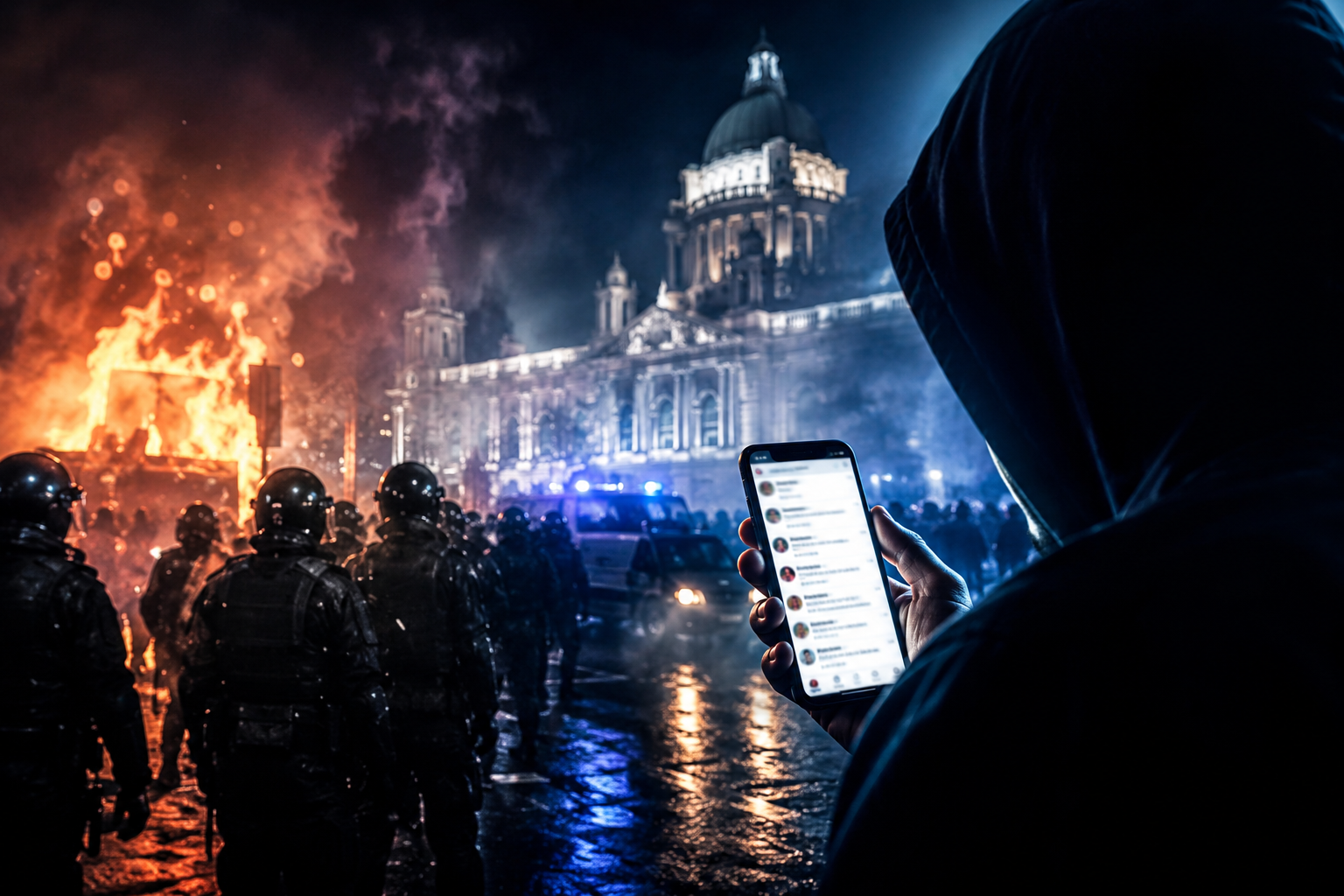
What followed was an explosion of anger across social media. Videos of the attack spread rapidly online, generating outrage, debate and calls for demonstrations. Within hours, protests emerged across Belfast, some remaining peaceful while others descended into serious disorder involving arson, attacks on property and clashes with police.
The story was already politically explosive. Immigration, asylum policy, public safety and border control had all been pulled into the conversation before authorities had fully established the facts surrounding the attack. The speed of the reaction revealed how fragile and emotionally charged these issues have become across the United Kingdom.
The Real Battle Shifted Online
As the unrest spread, attention quickly turned away from the attacker and towards the digital ecosystem surrounding the story.
Government ministers, regulators and political leaders increasingly focused on the role played by social media platforms. Officials argued that online content was helping intensify public anger and potentially contributing to real-world disorder. The debate moved from criminal justice to digital responsibility almost overnight.
The UK's Online Safety Act suddenly became central to the discussion. Ofcom publicly warned platforms about their obligations to tackle content that could incite violence or hatred, while ministers signalled that enforcement could become more aggressive during periods of civil unrest.
That shift matters. Once governments move from discussing individual posts to discussing platform responsibility, the conversation changes fundamentally. The question becomes whether social media companies are neutral communication tools or active participants in shaping public behaviour.
Elon Musk Has Been Dragged Into The Storm
No individual has become more closely associated with the online dimension of the crisis than Elon Musk.
Political figures accused Musk of amplifying content linked to demonstrations and anti-immigration anger. Critics argued that individuals with enormous online reach carry special responsibilities during moments of public tension. Musk and his supporters rejected those claims, arguing that the underlying issue was immigration policy rather than social media activity.
The significance extends far beyond one man. Musk has increasingly become a symbolic figure in a wider struggle between those who prioritise maximum online speech and those who believe stronger moderation is necessary to maintain public order.
That makes Belfast more than a Northern Ireland story. It has become another chapter in a global argument already being fought across Europe, the United States and many other democracies.
The Victim’s Family Changed The Narrative
One of the most striking developments came from the family of the victim.
While public anger intensified and political arguments escalated, the family publicly appealed for calm. They condemned the violence that followed the attack and argued that migrants make valuable contributions to society. They explicitly warned against allowing the tragedy to be used as a vehicle for wider hostility.
Their intervention created an uncomfortable complication for every side of the debate.
For those focused on immigration failures, the attack remained a legitimate public concern. For those focused on racism and disorder, the riots reinforced fears about collective blame. The family's statement highlighted the difficulty of separating public concern about immigration policy from anger directed towards entire communities.
That tension now sits at the centre of the national conversation.
Why The Government Is Nervous
The government's concern extends beyond Belfast itself.
Officials understand that modern unrest often follows a familiar pattern. A shocking incident occurs. Video spreads online. Competing narratives emerge instantly. Public anger escalates before official information becomes available. Political actors enter the debate. Demonstrations follow. The online and offline worlds begin feeding each other in a continuous cycle.
That cycle appears to have unfolded again in Belfast. Regulators have already warned platforms that they must respond rapidly when online content risks contributing to violence or criminal behaviour.
The challenge for ministers is obvious. Move too aggressively and accusations of censorship emerge. Move too slowly and critics argue that dangerous content has been allowed to spread unchecked.
Neither option is politically comfortable.
Belfast May Be Remembered As A Turning Point
The most important question is not what happened in Belfast this week.
The more important question is what happens next.
The unrest has accelerated a debate that was already gathering momentum across Britain. Politicians are now discussing platform accountability, algorithmic influence, online mobilisation and the boundaries of free speech with renewed urgency. Regulators appear increasingly willing to test the powers granted under the Online Safety Act.
What began as a violent criminal incident has evolved into a national confrontation over information, influence and power. The streets of Belfast may have been the location of the crisis, but the real battleground has shifted into the digital world.
That is why this story matters far beyond Northern Ireland.
The attack created outrage.
The riots created fear.
But the argument that follows could reshape how Britain governs the internet itself.
