Britain Gives Energy Watchdog New Powers—But the Real Cost May Land on You
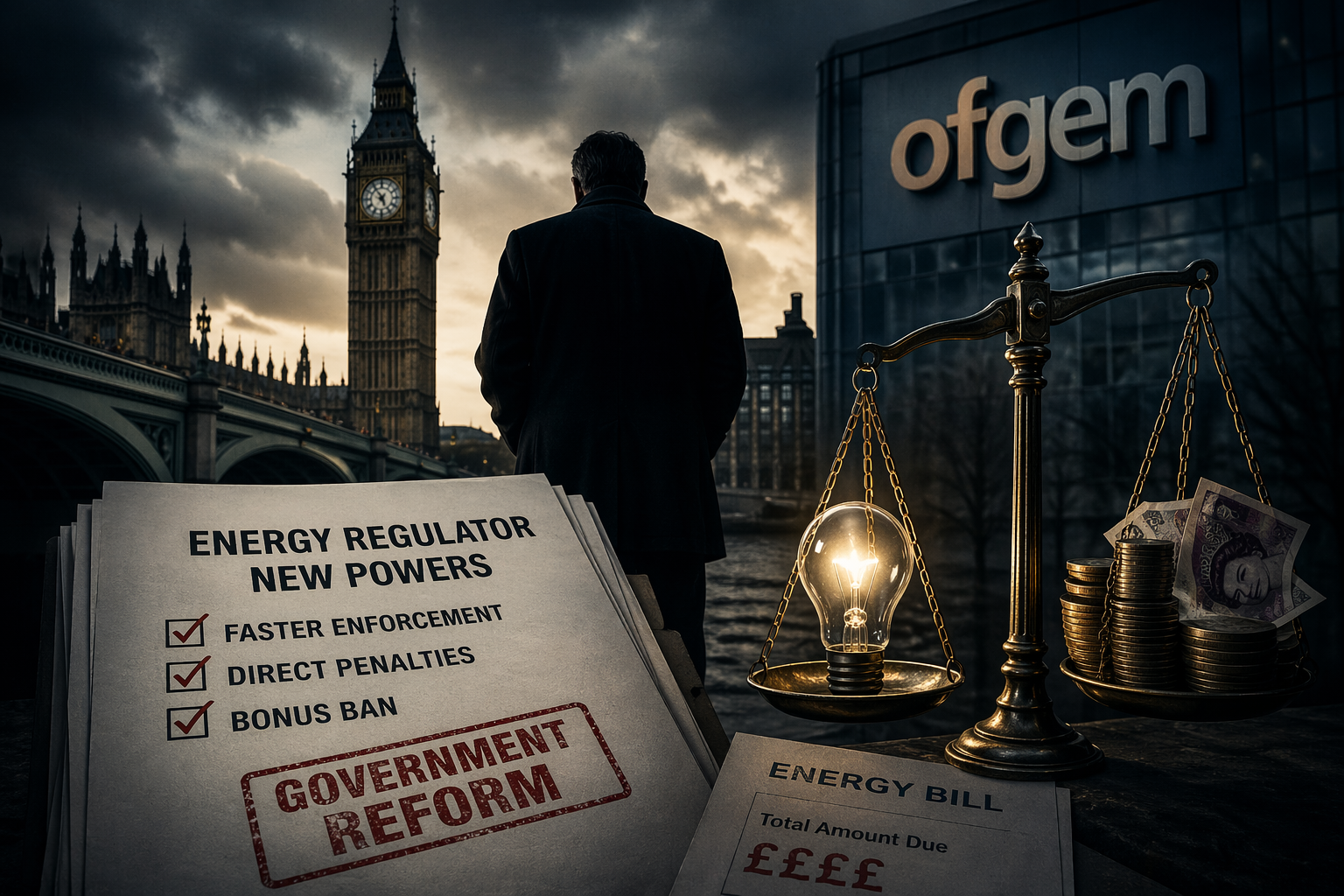
Energy Reform Promises Justice—But Who Pays the Price?
The UK’s Energy Clampdown: Protection or Overreach?
New powers promise faster justice and tougher accountability—but risk expanding state control in ways that could ripple back to consumers.
The UK is poised to grant its energy regulator unprecedented power, which initially appears to be a victory for households.
Under sweeping reforms, the regulator will be able to punish companies directly, bypass courts, and even strip executives of their bonuses if customers are treated unfairly.
It is quick, visible, and politically potent.
But beneath that surface is a more complicated reality: when regulation becomes more aggressive, the consequences rarely stop at the boardroom.
What’s actually changing
The reforms are significant.
They fundamentally change how the system works:
The regulator can enforce consumer law directly, without going through lengthy legal processes
Executives can lose bonuses if their companies breach rules and harm customers
The regulator is being refocused purely on enforcement, with other responsibilities moved elsewhere
The intention is clear: move faster, punish harder, and make accountability personal.
Why the government is doing this
There is a real justification.
Energy markets have been chaotic. Prices surged. Suppliers collapsed. Consumers faced poor service and slow redress.
The regulator was widely criticized for being too slow and too procedural.
The government's response is to eliminate friction, particularly the requirement for court involvement, and to empower the watchdog with more authority.
On paper, it is a correction.
Where this starts to look like overreach
The risk is not the goal. It is the method.
When a regulator can
act without court oversight
directly punish companies
and financially target individuals
…it stops being just a referee and starts becoming an active enforcer with broad discretion.
That matters.
Speed and power often come at the expense of checks and balances.
A system designed to move quickly can also move wrongly—and when it does, the consequences hit an entire market, not just one undesirable actor.
The part most people miss: costs don’t disappear
Here is the uncomfortable truth.
Companies do not absorb regulatory pressure quietly.
They respond by:
increasing compliance costs
building larger legal and risk teams
pricing in regulatory uncertainty
becoming more cautious in investment
Those costs do not vanish.
They are passed through the system—and ultimately, to consumers.
We have seen this pattern before. Even infrastructure decisions by the regulator can push bills up over time, with upgrades expected to add costs to households despite efficiency gains.
More power for the regulator does not automatically mean lower bills.
Incentives change—and not always how you expect
Targeting bonuses sounds simple: punish undesirable behavior.
But incentives are rarely that clean.
When executives face personal financial risk:
decision-making becomes more defensive
innovation slows
risk-taking drops
That might reduce extreme failures.
But it can also lead to a more rigid, slower-moving energy sector—exactly the opposite of what is needed in a system already under strain from transition, infrastructure demands, and geopolitical shocks.
What this means for ordinary people
There are clear upsides:
Faster compensation when things go wrong
More pressure on companies to treat customers properly
Stronger visible accountability
But there are also second-order effects:
Higher operational costs built into bills
Reduced competition if smaller firms struggle with compliance
Slower innovation in pricing, tariffs, and energy solutions
And the biggest one:
A system that becomes more controlled—and potentially less flexible—at exactly the moment it needs to adapt quickly.
What happens next
Three potential paths are currently being explored:
Most likely:
Companies adapt, behavior improves, and the regulator becomes more assertive without destabilizing the market.
Most dangerous:
Heavy-handed enforcement creates uncertainty, pushing up costs and discouraging investment.
Most underestimated:
The psychological shift—executives prioritizing regulatory safety over customer innovation—quietly reshapes the entire sector.
The bottom line
This is being sold as a crackdown on energy companies.
And in part, it is.
But it is also something else: a significant expansion of state power into how companies operate, how executives are paid, and how quickly decisions can be imposed.
That kind of shift never stays contained.
Because in the end, energy systems are simple in one brutal way:
Every cost, every risk, every inefficiency—
eventually—
finds its way onto the bill.
