

Britain Has Burned Through Prime Ministers Because Westminster Is No Longer Holding
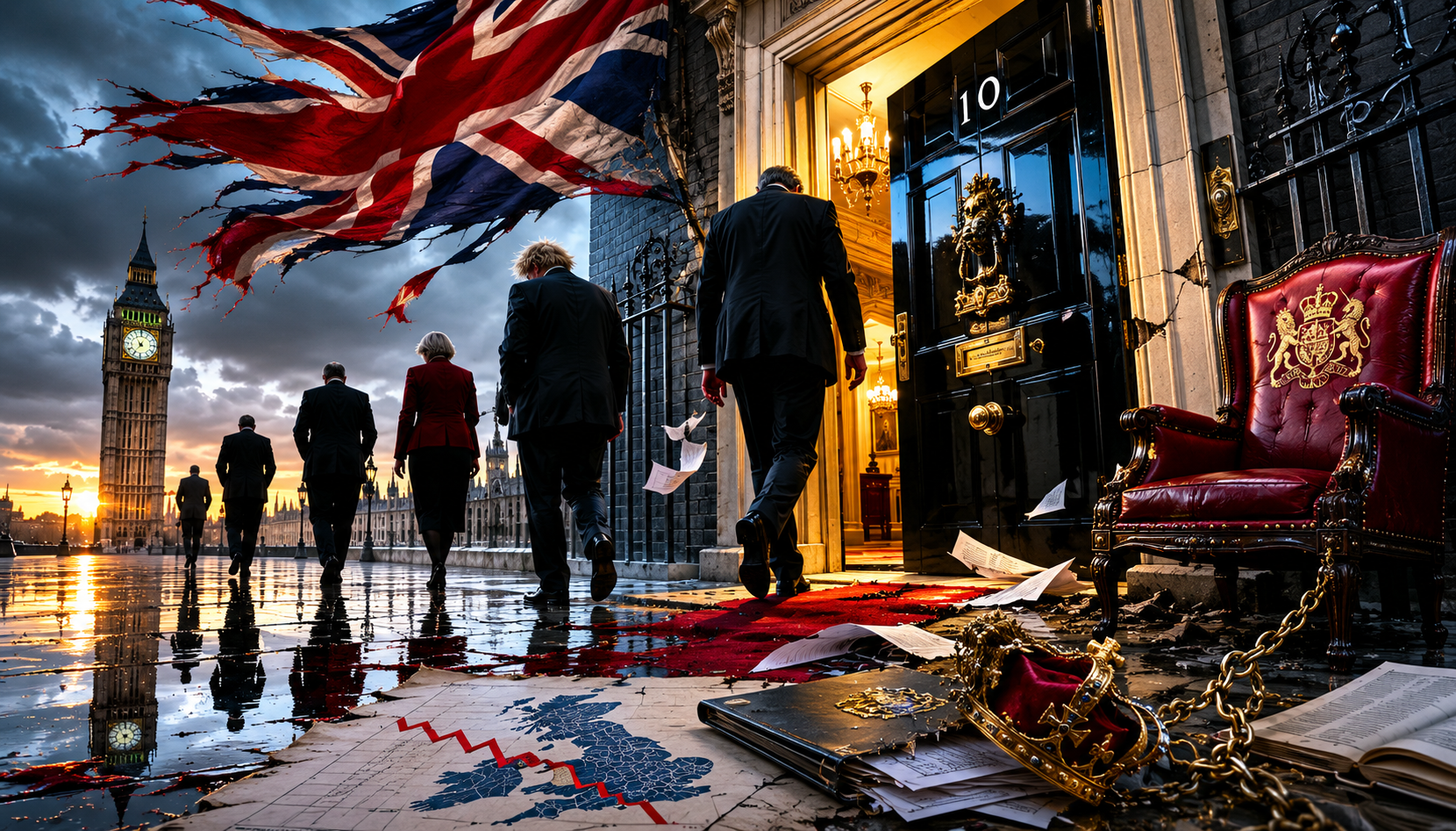
The Prime Minister Is Now The Most Disposable Job In British Politics
The Revolving Door At Number 10 Is Now A Warning Siren For Britain
The Number Is Brutal
Keir Starmer’s resignation does not just end another premiership. It changes the meaning of the entire post-David Cameron era. Britain is no longer looking at a few unlucky leaders, a few bad scandals, or one party’s internal chaos. It is looking at a political system that keeps producing Prime Ministers it cannot sustain.
Since David Cameron left office in 2016, Britain has now moved through Theresa May, Boris Johnson, Liz Truss, Rishi Sunak, and Keir Starmer. That means five Prime Ministers after Cameron, and six if Cameron is included as the starting point. For a country that sells itself as stable, sober, parliamentary, and institutionally mature, that is a brutal modern record.
The most uncomfortable part is not just the number. It is how many of these leaders actually arrived with a fresh public mandate. Boris Johnson did in 2019. Keir Starmer did in 2024. David Cameron did before the cycle began. But Theresa May, Liz Truss, and Rishi Sunak all entered Number 10 through internal party processes first, not direct general election victories as party leaders.
That is constitutionally legal. It is also politically corrosive when it happens too often.
Britain Does Not Directly Vote For Prime Ministers
The first thing to understand is that Britain does not have a presidential system. Voters do not directly elect a Prime Minister. They elect MPs. The Prime Minister is the person who can command confidence in the House of Commons, usually because they lead the largest party or a governing coalition.
That is the technical answer. It is the answer constitutional lawyers give, and it is correct. But politics does not run on technical answers alone. It runs on public consent, emotional legitimacy, and the feeling that the people governing the country were put there through a process the public recognises as fair.
That is where the Westminster machine now looks exposed. When a party changes leader once during a Parliament, the public may accept it as continuity. When it happens repeatedly, it starts to feel like the country voted for one thing and received something else.
Starmer’s resignation sharpens this because he did have a general election mandate. Labour won power in 2024. He entered Downing Street as the leader who had ended fourteen years of Conservative-led government. Yet less than two years later, he has been forced into resignation after mounting political pressure and a collapse in authority.
That is the most alarming version of the problem. If even a landslide cannot protect a Prime Minister for a full term, the issue is no longer just mandate. It is durability.
Cameron Fell Because He Gambled The Country
David Cameron’s downfall came from the Brexit referendum. He promised the vote, campaigned for Remain, lost, and resigned. His exit was not caused by a normal election defeat. It was caused by a constitutional gamble that detonated his own premiership.
Cameron had won the 2015 general election with a Conservative majority. In normal terms, that should have given him power, authority, and time. But Brexit became bigger than the government that had offered it. Once the public rejected his central argument on Europe, Cameron could not credibly stay and deliver the opposite of what he believed.
His resignation began the modern churn. From that moment, Britain entered a period where the Prime Minister was no longer just the leader of the government. The Prime Minister became the shock absorber for unresolved national contradictions.
Europe, sovereignty, immigration, living standards, institutional trust, party rebellion, economic weakness, and public anger all started flowing through Number 10. No leader after Cameron inherited a clean machine. They inherited a pressure chamber.
May Fell Because Brexit Ate Her Authority
Theresa May entered office without first winning a general election as party leader. She inherited Brexit and tried to turn the referendum result into a workable governing programme. Then she called the 2017 general election to strengthen her hand.
Instead, she lost the Conservative majority.
That was the fatal wound. May needed authority to negotiate Brexit, control her party, and stare down Parliament. The election gave her the opposite. She remained Prime Minister, but her power had been visibly reduced in front of the country.
Her premiership became a long struggle between public instruction and parliamentary reality. The country had voted to leave the European Union, but there was no settled agreement on what that meant in practice. Hard Brexit, soft Brexit, customs arrangements, Irish border questions, parliamentary sovereignty, business disruption, and party discipline all collided inside her government.
May’s downfall showed that a Prime Minister can remain legally in office while politically bleeding out. She had the title, the lectern, the red boxes, and the machinery of state. But once her Brexit deal repeatedly failed to command enough support, the end became unavoidable.
Johnson Fell Because Victory Was Not Enough
Boris Johnson looked like the exception. He won a decisive general election victory in 2019 with a simple message: get Brexit done. He secured the kind of parliamentary majority that should have made him one of the most secure Prime Ministers in modern British politics.
But Johnson’s fall proved that even a strong mandate has limits. His premiership collapsed under the weight of scandal, standards questions, ministerial resignations, and the eventual conclusion among Conservative MPs that he had become a liability. The majority that once gave him power became the instrument that removed him.
This is the brutal logic of Westminster. Voters can deliver a leader into office, but MPs can decide when that leader has become too expensive to keep. Loyalty in Parliament is rarely sentimental. It lasts while the leader looks useful, survivable, or electorally necessary.
Johnson’s great strength was that he understood political theatre. His weakness was that theatre could not indefinitely outrun trust. Once enough of his own party decided the show was damaging the brand, the premiership became disposable.
His fall remains one of the clearest signs that Westminster can remove even a victorious leader when the internal cost of keeping them becomes too high.
Truss Fell Because The Markets Moved Faster Than Democracy
Liz Truss entered Number 10 through a Conservative Party leadership contest. She did not arrive through a public general election mandate. Then her government attempted a radical economic shift that immediately collided with market confidence, borrowing costs, institutional credibility, and parliamentary panic.
Her premiership collapsed with extraordinary speed.
Truss matters because her fall revealed a different kind of power. It was not voters who removed her. It was not even a normal parliamentary defeat. It was the combined pressure of markets, MPs, polling, public alarm, and party survival instinct. She had legal authority, but she lost practical authority almost overnight.
That is why her premiership still hangs over the whole conversation. It showed how dangerous the gap can become between the method of arrival and the scale of the programme. A leader chosen by a small selectorate inside a governing party tried to move the country sharply without fresh national consent.
The system allowed her to become Prime Minister. Reality removed her.
Sunak Fell Because He Inherited The Collapse
Rishi Sunak became Prime Minister after Truss. His role was stabilisation. He was not chosen by the public in a general election as leader. He was installed because the Conservative Party needed someone who looked calmer, safer, and more competent after a period of visible breakdown.
Sunak did restore some order. But he inherited a party that was already exhausted. Brexit had divided it. Covid had scarred it. Johnson had damaged trust. Truss had damaged economic credibility. Years of public frustration had hardened into a desire for change.
His downfall came at the 2024 general election, when Labour replaced the Conservatives after fourteen years of Conservative-led government. Sunak’s personal qualities were no longer the central issue. The country was passing judgment on an entire governing era.
That is another lesson from the post-Cameron period. Prime Ministers are not judged only on themselves. They inherit accumulated anger. They carry decisions made before they arrived. They become the human face of a machine that may already be losing legitimacy.
Sunak was not simply beaten by Starmer. He was beaten by fatigue.
Starmer Fell Because A Landslide Was Not The Same As Loyalty
Keir Starmer’s resignation is different because he did not inherit power through an internal party switch. He won a general election. He carried Labour into office. He had a parliamentary majority and a clear opportunity to reshape British politics after years of Conservative turmoil.
Yet his premiership has now ended in resignation less than two years after that victory.
That makes his fall more dangerous for the system’s reputation. It suggests a general election majority can now be wide but shallow. Powerful in seats, but weak in emotional loyalty. Strong enough to govern on paper, but not strong enough to protect the leader when public disappointment, internal fear, and political drift converge.
Starmer’s problem was not simply that opponents disliked him. Opponents always dislike Prime Ministers. The deeper problem was that his leadership struggled to generate a durable sense of direction. When a leader wins because the public wants the previous government gone, they still have to create a positive reason to be kept.
That appears to be where Starmer failed. A landslide can remove the old order. It cannot automatically build love, trust, momentum, or belief.
The Starmer Resignation Makes Britain Look Unstable
The UK used to look politically stable even when it was frustrated. Governments came and went, but the office of Prime Minister carried weight. The rhythm of political change felt slower, more deliberate, and more anchored.
That has changed. Cameron fell after Brexit. May fell after failing to deliver Brexit. Johnson fell after scandals and loss of party confidence. Truss fell after market panic. Sunak fell after electoral defeat. Starmer has now fallen after losing political authority inside his own governing environment.
The pattern is not identical in every case, but the outcome is. Number 10 keeps changing hands.
That matters because leadership turnover has consequences. Departments lose direction. Civil servants adjust to new priorities. International partners wait to see who survives. Investors question policy stability. Parties become more focused on internal positioning than national delivery.
Above all, voters begin to suspect that the person at the top is temporary. Once that feeling sets in, the authority of the office weakens before any individual even enters it.
Westminster Is Working Technically And Failing Psychologically
The British system is not broken in the sense that the rules have stopped functioning. The system has mechanisms for resignation, succession, confidence, leadership contests, and elections. When a Prime Minister loses authority, there is a path to replacement.
The problem is psychological legitimacy.
A system can be constitutional and still feel wrong. It can be legal and still feel evasive. It can follow convention and still leave the public with the sense that something important has happened without them being asked.
That is the danger of repeated mid-cycle leadership change. The public understands that they do not directly elect Prime Ministers in a technical sense. But emotionally, most voters know exactly who is asking for power when they vote at a general election. The party leader is on the posters, in the debates, in the broadcasts, and at the centre of the campaign.
So when the leader changes, the public may accept the legal explanation while still feeling that the political bargain has shifted.
Starmer’s resignation intensifies that because he was the bargain in 2024. He was the face of Labour’s offer. If Labour now replaces him without a general election, the constitutional answer may be straightforward, but the democratic discomfort will be real.
The Real Problem Is The Mandate Gap
The mandate gap is the space between what the public voted for and what Westminster later delivers. It does not appear every time a Prime Minister changes. Some successions are necessary. Some are stabilising. Some are unavoidable.
But the more frequent the turnover becomes, the harder it is to pretend nothing has changed.
A new Prime Minister can bring new priorities, new advisers, new economic instincts, new foreign policy emphasis, new Cabinet appointments, new political enemies, and new electoral strategy. Even if the party remains the same, the government may no longer feel like the one voters chose.
That was obvious with Truss. It may now become the question for Labour after Starmer. If the next Prime Minister is Andy Burnham, Wes Streeting, or another Labour figure, they may command a majority in the Commons. But they will also face the same legitimacy question that now haunts Westminster: when does a change of leader become a change of government in all but name?
That is the constitutional grey zone Britain can no longer ignore.
What Could Change To Stop The Churn
The first reform should be an automatic Commons confidence vote after any mid-Parliament change of Prime Minister. This would not force a general election. It would simply make visible what the system already claims to require: that the new Prime Minister can command the House of Commons.
The second reform should be a stronger convention around manifesto continuity. If a new Prime Minister takes office without a general election, they should be expected to govern broadly within the mandate their party won. If they want to make a major break from that mandate, they should seek explicit parliamentary approval or call an election.
The third reform should be internal party process reform. Governing parties should not be able to make the selection of a national Prime Minister feel smaller than the office itself. MPs, members, and party institutions all matter, but the process must produce a leader who looks capable of commanding Parliament and the country, not just surviving a factional contest.
The fourth reform is harder but more fundamental: Britain may need to revisit whether first-past-the-post is producing huge parliamentary majorities without matching levels of popular consent. A government can be legally powerful while socially fragile. That gap is where instability grows.
None of these reforms would eliminate political failure. Bad Prime Ministers would still fail. Parties would still panic. Voters would still change their minds. But reform could make leadership replacement feel less like an internal Westminster manoeuvre and more like a visible democratic reset.
Britain Needs A Mandate Lock
The strongest solution is a mandate lock. Not a presidential system. Not a direct election for Prime Minister. Not a written constitution overnight. A simpler rule: if the Prime Minister changes between general elections, the successor must publicly renew authority through Parliament and remain tied to the mandate already given by voters.
That would preserve flexibility while restoring seriousness. It would stop governing parties treating Number 10 like an internal vacancy. It would make leadership change possible, but not casual.
The Starmer resignation is the moment the pattern becomes impossible to dismiss. Britain has now watched Conservative Prime Ministers fall through referendum shock, Brexit deadlock, scandal, market crisis, and electoral wipeout. It has now watched a Labour Prime Minister with a fresh majority resign before completing even half a term.
That is not normal churn. It is a warning.
The British constitution survives because it bends. But since David Cameron, it has bent again and again under the weight of leaders who could not hold authority. The danger is not that Westminster cannot replace Prime Ministers. The danger is that it has become too comfortable replacing them while leaving the deeper machine untouched.
