

Britain’s Voters Are About To Deliver A Brutal Verdict On Keir Starmer
The Local Election Bloodbath That Could Leave Starmer Fighting For Survival
The Election Night That Could Break Keir Starmer
The 2026 Local Elections Are Not Just A Council Vote — They Are A Public Trial Of Keir Starmer’s Authority
Keir Starmer is not on the ballot in every ward, borough and council chamber. But politically, he is everywhere. The 2026 UK local elections have become the first major test of his premiership: a sprawling, brutal, multi-front challenge to see whether Labour’s landslide government has already lost the country’s patience.
The scale alone makes the situation dangerous. Voters are choosing thousands of councillors across England, with contests also unfolding for the Scottish Parliament and Welsh Senedd on the same day. In England, the local elections cover 136 councils, all 32 London boroughs and six directly elected mayoralties, with more than 5,000 candidates fighting for council seats. That makes the stakes far more than a routine midterm grumble. It is the biggest electoral stress test since Labour’s 2024 general election victory.
For Starmer, the nightmare is not simply that Labour loses seats. Governments usually suffer in local elections. The danger is that these results could expose something deeper: Labour may have won power in 2024 without building emotional loyalty, ideological excitement or a durable coalition. If voters use these elections to punish Labour from the right, left, nationalist, and local independent movements all at once, the message to Westminster will be savage.
Starmer’s government may discover that a majority can look enormous on paper while feeling frighteningly thin in the country.
Labour Is Defending A Political World That No Longer Exists
The most punishing feature of these elections is the baseline. Many of the English council seats being contested were last fought in 2022, when Boris Johnson’s Conservatives were drowning in Partygate anger and Labour was polling far more strongly than it is now. PollCheck notes that Labour won many northern metropolitan wards with 45–55% of the vote in 2022, when the Conservatives were collapsing and Starmer’s ratings were positive. Those same seats are now being defended in a radically different atmosphere.
That is why Labour’s danger is structural, not cosmetic. The party is not merely trying to hold marginal ground. It is trying to defend a high-water mark against an electorate that has fragmented since the general election. The left are leaking to the Greens. Reform UK is targeting disaffected working-class voters. Local independents are threatening Labour in places where community identity, Gaza, public services and distrust of Westminster intersect. The Liberal Democrats remain dangerous in parts of the south and the commuter belt.
This is the trap: Labour is fighting 2026 with a 2022 map and a 2024 mandate, but the public mood has moved on.
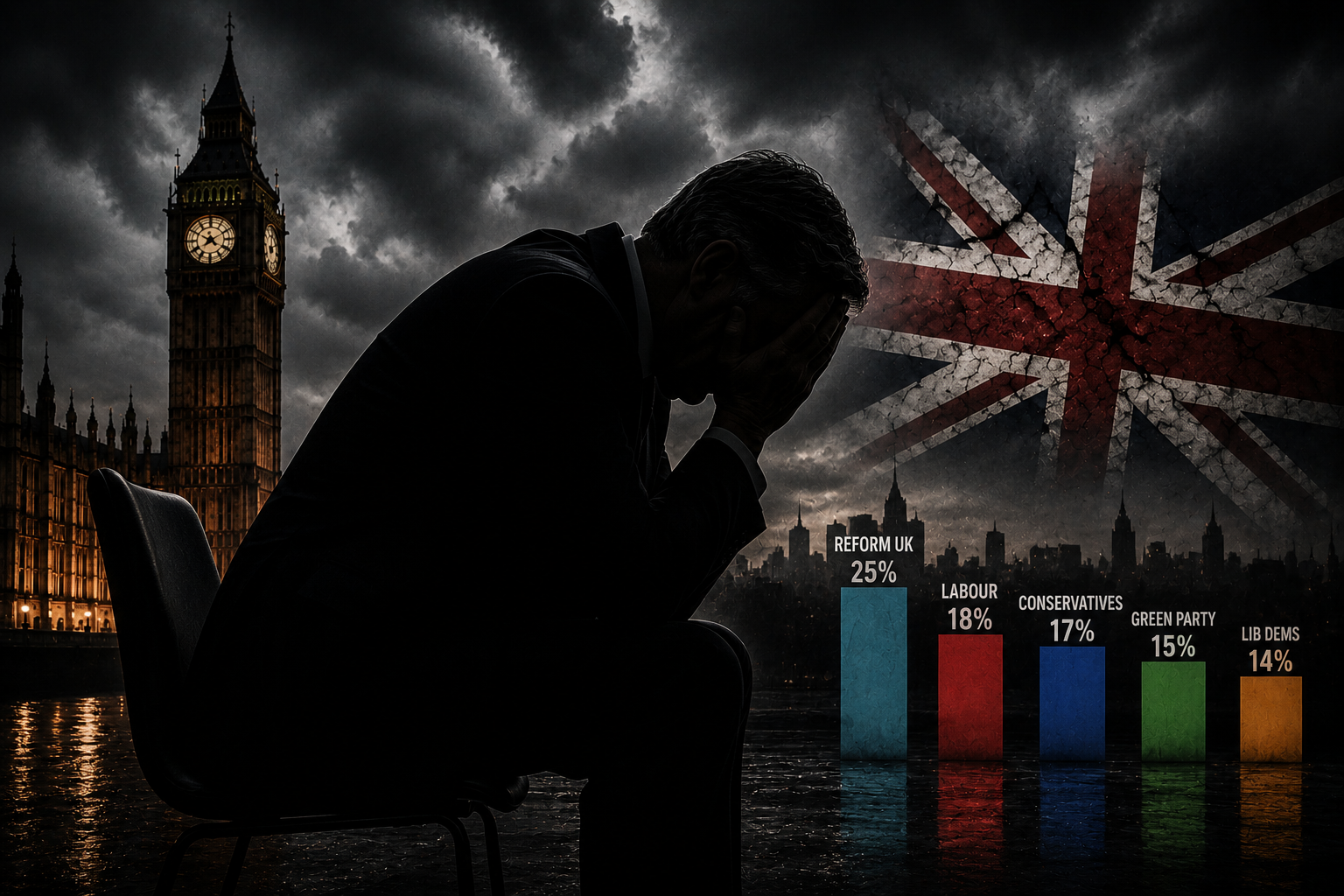
The most recent YouGov Westminster voting-intention figures before polling day put Reform UK ahead nationally on 25%, with Labour on 18%, the Conservatives on 17%, the Greens on 15% and the Liberal Democrats on 14%. That is not a normal governing-party wobble. That is a five-party knife fight.
Reform UK Could Turn Protest Into Power
The single most explosive question is whether Reform UK can convert national anger into actual local control. Protest votes are one thing. Councils are another. Reform has to prove it can win seats, build groups, control authorities and survive the immediate test of competence.
The opportunity is enormous. PollCheck’s local-election guide says Reform has been polling consistently around 25–30% since mid-2025 and has been gaining council seats in by-elections at a striking rate. Its model highlights Essex, Norfolk and Suffolk as major tests, projecting Reform to take control of all three. If that happens, it would mark one of the most dramatic county-level realignments in modern English local politics.
That matters because Reform’s rise threatens both major parties in different ways. For the Conservatives, it raises an existential question: are they still the natural opposition in England, or have they become a damaged brand being carved up by Reform on the right and the Liberal Democrats in the south? For Labour, it is even more psychologically dangerous. If Reform breaks through in working-class areas that once treated Labour as the default vehicle for anger, Starmer’s electoral machine starts to look hollow.
Farage does not need to win every target to hurt Starmer. He only needs enough victories to make the story unavoidable: Labour’s opponents can say the country is turning against the prime minister less than two years after his landslide.
The Greens Are Becoming Labour’s Other Nightmare
Reform is not Labour’s only problem. In London, university cities and progressive urban areas, the Greens are turning Labour’s left flank into a live battlefield.
YouGov’s London MRP, published in April, projected major gains for the Greens and Reform UK in the capital, with Labour on course for historic losses in some boroughs it has held for decades. The same model placed Labour ahead on the highest vote share in 15 councils, down from 21 in 2022, while the Greens led in four and Reform in three. YouGov also found many London boroughs were extremely close, with 10 where the second-placed party was within two points of first place.
This is politically toxic for Starmer because London is supposed to be Labour’s fortress. If Labour looks vulnerable there, especially to the Greens, the story becomes bigger than local dissatisfaction. It becomes a verdict on Starmer’s relationship with progressive voters.
The Green threat is different from the Reform threat. Reform attacks Labour as weak, remote and out of touch. The Greens attack Labour as too cautious, too managerial, too compromised and insufficiently bold on climate, public services, Gaza, inequality and political values. That is a more intimate wound because it comes from voters. Labour believes it should naturally own.
If Labour loses ground to Reform in the north and the Greens in London, Starmer will not be facing one rebellion. He will be facing a coalition of disappointments.
Wales And Scotland Could Make The Damage Feel National
The elections in Wales and Scotland add another layer of danger. The 2026 Welsh Senedd election is being held under a new proportional system, with 96 members elected across 16 constituencies. That change alone makes the result more volatile. YouGov’s final Senedd MRP projected Plaid Cymru as the largest party on 43 seats, with Reform UK second on 34 in the median estimate.
For Labour, that is devastating territory. Wales has long been central to Labour’s political identity. If Labour is pushed out of dominance there, the symbolic damage is severe. It suggests the party’s old institutional heartlands are no longer safe, even under a Labour government at Westminster.
In Scotland, YouGov’s final Holyrood MRP projected the SNP on course for a fifth term but short of a majority, with a central projection of 62 seats against the 65 needed for outright control. That still leaves Labour struggling to turn UK government power into Scottish revival.
The combined danger is that Starmer wakes up after election night facing humiliation in England, disappointment in Scotland and a historic blow in Wales. That would not look like a local protest. It would look like national rejection.
The Ramifications Could Be Brutal
The first consequence will be narrative. If Labour loses heavily, the story will not be “local factors". It will be “Starmer in crisis". Every defeated councillor, every lost borough, every Reform breakthrough, every Green surge and every Welsh reversal will be fed into one central Westminster question: has Labour already lost the country?
The second consequence will be internal pressure. AP reported that a rout could trigger moves by Labour MPs to oust Starmer, or at least intensify pressure for him to set out a timetable for departure. The same report noted that analysts have questioned whether he will lead Labour into the next general election, which must be held by 2029.
That does not mean Starmer automatically falls. Prime ministers can survive ugly midterm results. But survival is not the same as authority. A leader who survives because his party fears chaos is still weakened. Every policy announcement becomes a test. Every poll becomes a referendum. Every potential successor becomes a shadow campaign.
The third consequence is policy panic. Labour may try to move right on immigration and crime to blunt reform. It may try to sound more radical on public services, housing and inequality to stop the Greens. It may try to reassure markets while promising growth, investment and relief from cost-of-living pressure. The problem is that these audiences want different things. A party fighting on four fronts can end up satisfying none of them.
The fourth consequence is local government reality. If Reform, the Greens, the Liberal Democrats and independents gain large numbers of seats, Britain’s councils become more fragmented and harder to control. That means more no-overall-control authorities, more local deals, more unstable administrations and more public arguments over bins, housing, planning, social care, transport and council tax. National politics then bleeds into local delivery.
What Most People Will Miss
The obvious story is that Labour may lose badly. The deeper story is that Britain may be moving into a new electoral era faster than Westminster can process.
For decades, local elections were usually interpreted through a two-party lens: government punished, opposition rewarded, and Liberal Democrats picking up protest votes. That model now looks broken. Reform, the Greens, the Liberal Democrats, nationalists and independents are all capable of hurting Labour in different places for different reasons.
The Elections Centre warned that these elections are unusually hard to forecast because the five mainstream parties appear together on ballots in nearly 80% of wards, voters have extensive choice, and small changes in turnout or support could produce wildly different outcomes. That is the new Britain: fragmented, volatile, less tribal and much harder to control.
Starmer’s central problem is that his political style was designed for stability. He offered competence after chaos, seriousness after scandal, and discipline after spectacle. That worked when voters wanted the Conservatives removed. But governing requires more than being the alternative to yesterday’s failure. Voters now want proof that Labour can make life feel better.
If they do not feel that, they have somewhere else to go.
The Verdict Before The Results
No responsible prediction should pretend the count is already over. Local elections are messy. Turnout matters. Candidate quality matters. Ward boundaries, incumbency, independents and local controversies can all distort the national picture.
But the available data points in one direction: Labour is in serious trouble, the Conservatives are still badly wounded, Reform is trying to turn anger into machinery, the Greens are becoming a real threat on Labour’s left, and the Liberal Democrats remain dangerous wherever local organisation matters.
For Keir Starmer, that is a nightmare formation. He is not being challenged by one clean opponent. He is being surrounded by multiple forms of rejection.
If Labour performs better than expected, Starmer buys time. If Labour suffers a heavy defeat, the question changes immediately. It will no longer be whether voters are disappointed with the government. It will be whether Labour MPs believe Starmer can recover before the next general election.
That is why this election matters. Not because every council result predicts Westminster perfectly. Not because local votes are identical to general elections. But because politics is driven by momentum, fear and belief — and election nights can change all three at once.
The 2026 local elections could become the moment Britain stopped treating Starmer’s government as new and started treating it as vulnerable.
