Grooming Gangs Inquiry Hits a Wall as Court Records Are Ordered Erased
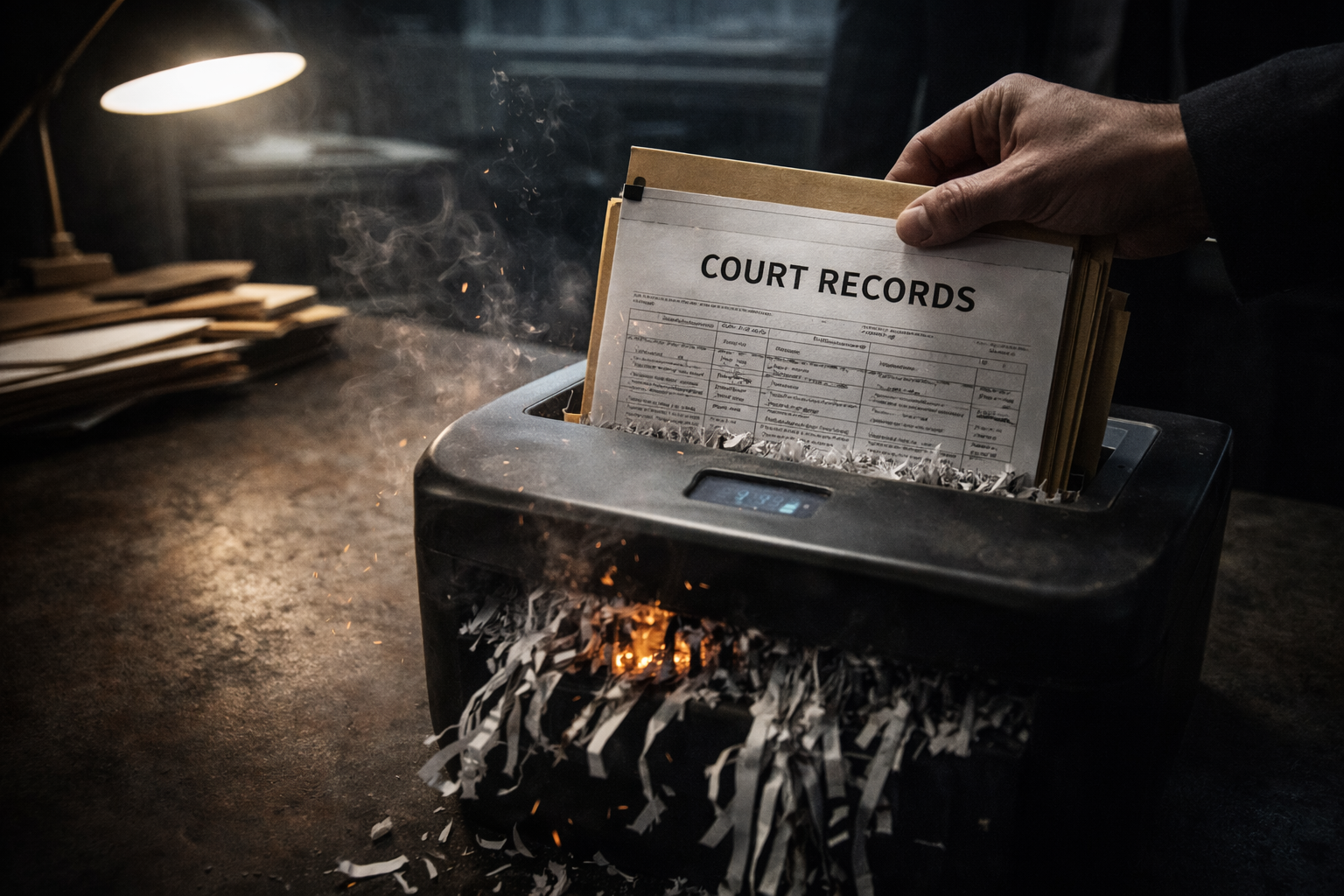
When the Records Go Dark: Grooming Gangs Inquiry Meets a Deletion Order
As Grooming Gangs Testimony Grows, the Paper Trail Starts Vanishing
Two stories that rarely meet have crashed into each other: an independent, crowdfunded “grooming gangs” inquiry led by MP Rupert Lowe, and a government order requiring Courtsdesk to delete a large archive of court records used by journalists to track criminal cases. The timing has inflamed suspicion because both revolve around the same thing: what the public can see, and what it can prove, about how the justice system works in practice.
Officials frame the Courtsdesk decision as data protection compliance. Critics frame it as a sudden retreat from transparency, arriving just as survivor testimony and whistleblower claims are being amplified in a politically charged national debate. The question is not only whether the archive should exist. It is whether the state will preserve an auditable trail of how cases are listed, heard, and reported—or leave the public arguing over anecdotes in the dark.
There is a quieter hinge here: deleting records does not merely limit access. It can erase the baseline needed to test competing claims about court visibility, “missing” hearings, and systemic failure.
The story turns on whether the government replaces what it is destroying with something equally searchable, independently verifiable, and legally durable.
Key Points
Courtsdesk, a platform used by journalists to monitor criminal court listings and registers, has been ordered to delete its archive; the government cites data protection concerns, while critics argue it harms open justice.
Courtsdesk says its analysis exposed major gaps in court transparency, including large numbers of hearings proceeding without advance notice to the press and widespread listing inaccuracies.
Rupert Lowe’s crowdfunded inquiry has gathered testimony and allegations around grooming gangs and institutional failings; Lowe and sympathetic MPs argue the deletion order lands at the worst possible moment for public scrutiny.
The dispute sits on a real legal tension: open justice depends on publishable court information, but personal data rules constrain how long and how widely certain records can be retained and shared.
A practical outcome matters more than the politics: if the archive goes, what replaces it—and will that replacement allow independent verification, not just official reassurance?
Background
Courtsdesk was designed to help reporters and editors see what was coming through the magistrates’ courts and track outcomes—an attempt to make court reporting more systematic in an era where staffing cuts and fragmented listings can mean important hearings proceed with little or no media presence. Court clerks and supportive journalists argue this matters because open justice is not an abstract principle; it is the mechanism by which the public learns what the courts are doing.
The Ministry of Justice and HM Courts & Tribunals Service (HMCTS) have been presented—by supporters of the deletion order—as acting to safeguard personal data. The argument is straightforward: a database that retains, aggregates, or republishes court records at scale risks breaching data protection rules, particularly if it includes personal identifiers and is kept beyond what is necessary.
The counterargument is also straightforward: the archive is not simply a convenience. It is an accountability tool, especially where court listings are inaccurate or where the press is not notified in time to attend. Courtsdesk has said it documented widespread failures in the way hearings were listed and communicated, and that its work helped journalists identify problems such as hearings proceeding without advance notice.
Running alongside this, Lowe’s inquiry—funded by public donations—has positioned itself as a response to perceived institutional reluctance to deliver a comprehensive, nationally trusted accounting of grooming gang cases and related failures. Lowe has described a broader “network” framing; supporters say the inquiry gives survivors a platform, while critics question its method, governance, and political incentives. Regardless of where a reader lands, the inquiry increases demand for primary records: court listings, outcomes, and transcripts that can corroborate or challenge claims.
Analysis
Why Courtsdesk Became a Flashpoint for Open Justice
Open justice works best when information is easy to find, consistent across jurisdictions, and preserved long enough for scrutiny to mean something. Criminal courts generate huge volumes of proceedings. If access depends on being physically present, already “in the know,” or tipped off by chance, then public oversight becomes patchy by design.
Courtsdesk’s value proposition was simple: searchable, trackable court information that could reduce the “needle in a haystack” problem for overstretched newsrooms. Where that model alarms officials is equally simple: aggregation changes the risk profile. Data that may be lawful to disclose in a one-off context can become far more sensitive when stored, indexed, and combined at scale.
So the argument is not merely “open justice vs. privacy.” It is “open justice vs the mass-retention and mass-searchability of court data,” which can feel like a different category of exposure.
The Data Protection Rationale and the Policy Choice Beneath It
The government’s data protection position effectively says: even if courts are public, the long-term retention and broad redistribution of certain records can still be unlawful or inappropriate. This is plausible on its face—privacy rules do not disappear at the courthouse door.
But a key policy choice sits underneath: when a transparency tool runs into a legal constraint, the state can either (1) shut it down or (2) build an official alternative that meets the legal standard while keeping the accountability benefit. Shutting down without replacement creates an information vacuum. Replacing it preserves confidence.
That is why “delete the archive” is politically explosive. It does not just remove a service. It risks removing an independent record of how the system behaved across time.
Why the Timing Intersects With Lowe’s Inquiry
The grooming gangs debate is already charged: it involves serious crimes, survivors’ trauma, historical failures, and intense political blame. In that context, any move that appears to limit transparency will be interpreted through the harshest lens available, regardless of the technical merits.
For Lowe’s inquiry in particular, the point of collecting testimony is to translate human accounts into something that can drive action—investigations, prosecutions, and institutional reform. That translation is easier when primary documentation is retrievable and comparable: were hearings properly listed, were outcomes recorded, were reporting restrictions applied, and did proceedings occur without notice?
If those questions cannot be answered with durable records, then public debate shifts from verifiable patterns to competing narratives. That is not just a political problem. It is a practical barrier to reform, because institutions can always say, "Show us the proof.”
Plausible Scenarios and What Would Signal Each One
Scenario 1: The deletion proceeds, and an official replacement is announced quickly.
Signposts: a new HMCTS/MoJ system that offers equivalent searchability for accredited media, clear retention rules, a published governance framework, and an oversight mechanism.
Scenario 2: The deletion proceeds with no meaningful replacement, and scrutiny migrates to Parliament and the courts.
Signposts: urgent parliamentary questions, select committee interest, threats of judicial review, or a formal complaint pathway involving the Information Commissioner.
Scenario 3: A compromise solution emerges—the archive is preserved, but access is tightened.
Signposts: a “freeze” on deletion; transfer to a controlled environment; restricted access for journalists under clearer rules; partial deletion or anonymization.
Scenario 4: The issue becomes a proxy battle in the grooming gangs’ political fight.
Signposts: campaign-led framing dominates headlines; petitions surge; the technical legal debate is submerged by claims about motive and cover-up.
What Most Coverage Misses
The hinge is that deleting a court-record archive is not only about transparency today; it is about whether tomorrow’s disputes can be settled with evidence.
The mechanism is simple: when independent datasets vanish, accountability becomes dependent on official summaries and selective disclosure, because third parties can no longer replicate analyses or challenge assumptions. That shifts incentives. Institutions become less exposed to audit, while campaigners become more reliant on testimony and inference—fuel for polarization rather than resolution.
Two signposts will confirm whether this hinge is real in the coming days and weeks: first, whether the government offers a retention-and-access model that preserves comparability over time; and second, whether any independent body or controlled repository is allowed to preserve the archive (even if public access is limited) so that disputes can be tested later.
What Changes Now
In the short term, this is a trust shock. If journalists and campaigners believe court visibility tools can be switched off and erased, they will assume other forms of scrutiny are fragile too—because deletion is final in a way that “access restricted” is not.
In the medium term, the key effect is on verification. Survivor testimony, whistleblowing claims, and political arguments are most useful when they can be checked against records and patterns. If those patterns become harder to reconstruct, pressure will rise for alternative transparency measures—especially around listings, hearing notifications, and transcript availability—because the public will look for other ways to see inside the system.
The main consequence is not partisan. It is operational: confidence drops when the evidence trail becomes thinner because the public cannot easily tell whether officials are fixing problems or merely describing them.
Real-World Impact
A local reporter planning court coverage loses the ability to set reliable alerts and cross-check listings; fewer hearings are attended, and fewer outcomes are independently observed.
A charity supporting victims faces higher costs and longer timelines to corroborate case details, because basic verification becomes manual and inconsistent across regions.
A defense lawyer worries about reputational spillover: cases become “trial by rumor” when records are hard to access, and public debate fills gaps with assumptions.
A policymaker trying to reform court transparency lacks a shared dataset; debates over “how bad it is” become endless, slowing decisions on funding and digital infrastructure.
The Fork in the Road for Court Transparency
This moment forces a decision about what “open justice” means in the digital age. If openness is defined as theoretical access—someone can attend a hearing in person—then the deletion order can be defended as a privacy safeguard. If openness is defined as practical accountability—journalists can reliably know what is happening, at scale, over time—then deletion without a durable replacement looks like institutional regression.
The next signposts are concrete: whether the archive is preserved in any controlled form, whether an official system is built that matches the utility of what is being removed, and whether Parliament treats this as a technical compliance matter or a constitutional transparency problem. How the state answers will shape what can be proven about the justice system when the next scandal hits.
SEO PRIMARY (Title Tag)
