HS2 Delays, Costs And Chaos: How Britain’s Biggest Rail Dream Went Wrong
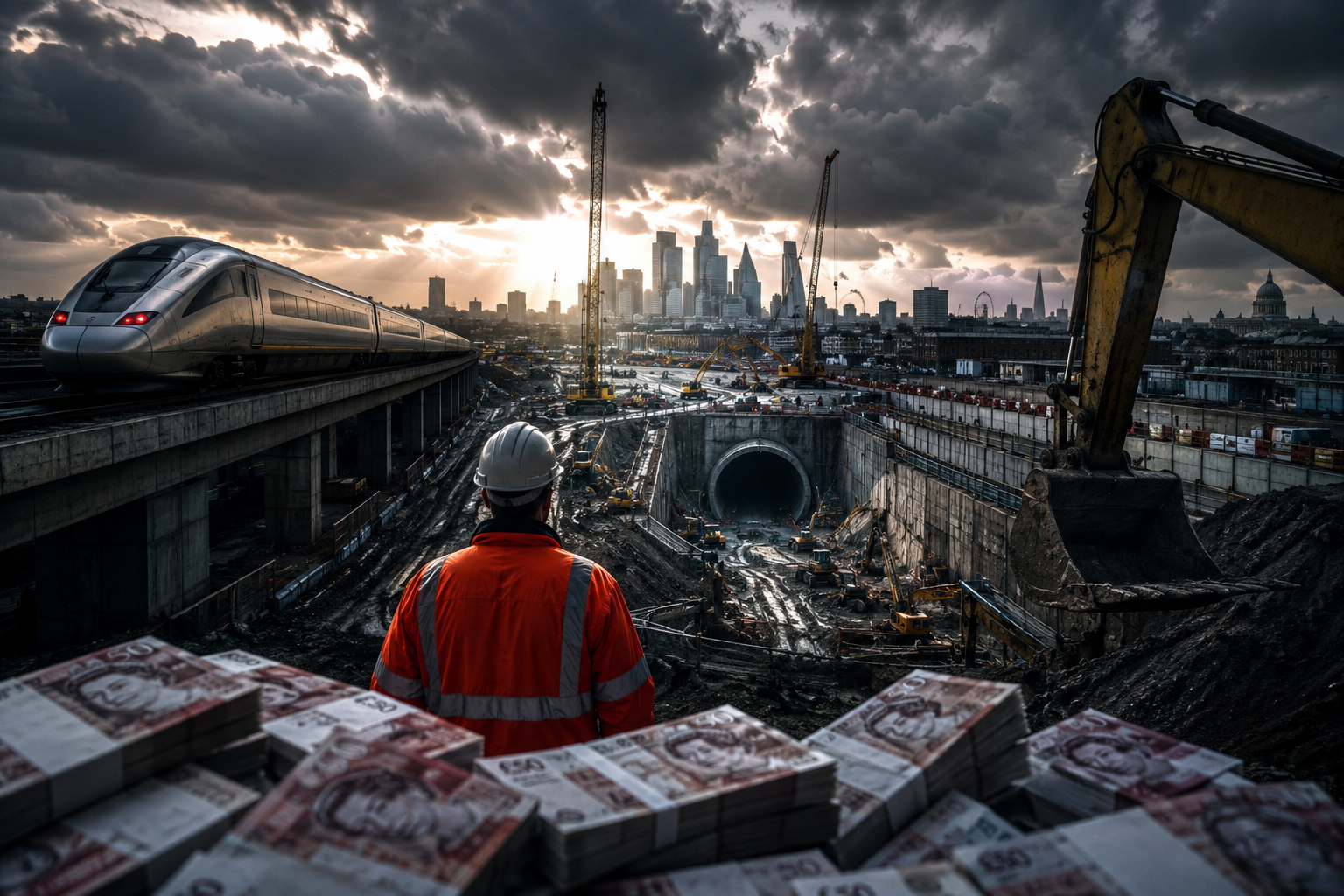
HS2 Is Now Britain’s £100bn Infrastructure Warning Sign
The £100bn Number That Changed The Story
HS2 was sold as a symbol of national ambition: faster journeys, more capacity, stronger regional links, and a modern railway fit for the decades ahead. The project was meant to show that Britain could still think at scale. Instead, it has become the clearest possible example of a country that can approve a giant project, spend staggering sums on it, cut it back, delay it, and still struggle to explain when the public will finally get the thing it paid for.
The latest official position is brutal. The government now says HS2 is expected to cost between £87.7bn and £102.7bn, excluding future inflation on remaining work. In indicative cash terms, including projected inflation, the range rises to £94.3bn to £112.4bn. By the end of March 2026, £44.2bn had already been spent on the HS2 programme, with an overall total of £46.8bn, including former Phase 2 spending.
The dates are just as damaging. The opening stage, between Old Oak Common in west London and Birmingham Curzon Street, is now expected between May 2036 and October 2039. The full scheme, including Euston and the connection to the West Coast Main Line at Handsacre Junction, is estimated to be between May 2040 and December 2043. That means a project once associated with a 2026 opening has drifted toward a timeline where some passengers may not see the full intended route until the 2040s.
That is why HS2 has become bigger than rail. It is now part of the same national anxiety captured in debates about Britain’s scientific decline, weak delivery, slow regulation, rising costs, and institutional drag. The question is no longer simply whether HS2 is a beneficial idea. The sharper question is why Britain seems so bad at turning expensive ideas into finished infrastructure.cause just as much damage
How A Northern Rail Dream Became A Smaller, Slower Reality
HS2 was originally conceived as a much larger high-speed network. The plan was not just a London-to-Birmingham line. It was supposed to form a broader Y-shaped system linking London with the West Midlands, Manchester, and Leeds, creating faster north-south travel and relieving pressure on existing routes.
That vision has been repeatedly cut. According to the House of Commons Library, only Phase 1 — London to the West Midlands — is now going ahead, after the cancellation of HS2 north of the West Midlands. The original line was planned in phases: Phase 1 from London to the West Midlands, Phase 2a from the West Midlands to Crewe, and Phase 2b toward Manchester and Leeds. The strategic promise was national. The remaining project is far narrower.
This is the central political wound. HS2 was justified partly on national rebalancing, capacity, and regional transformation. Yet the project that remains is heavily concentrated around London, Birmingham, Old Oak Common, Euston, and the West Midlands. That does not make it useless. But it does make it easier for critics to ask why the final version is so expensive when so much of the original geography has been stripped away.
The government and HS2 still argue that the line matters because it will link London and Birmingham in around 49 minutes, add capacity, free space on the existing network, support freight, connect with the West Coast Main Line, and stimulate regeneration around major stations. HS2 says around 30,000 construction workers and more than 3,500 UK businesses are currently involved.
But the public hears a different rhythm: fewer places, later trains, higher costs. That is a dangerous combination for any project funded by taxpayers.
Why The Cost Spiralled So Badly
The official explanation is not just inflation. That matters, but it is not the whole story. The government says around two thirds of the expected cost increase comes from missed scope in the original project plan, underestimation, and inefficient delivery. The remaining third is linked to inflation. That is politically explosive because it means much of the escalation was not some unavoidable external shock. It was embedded in how the project was scoped, priced, governed, and delivered.
The House of Commons Library previously identified drivers including inflation, scope changes, worse ground conditions than expected, and optimism bias. It also listed causes of delay, including project complexity, lack of a detailed schedule, time spent revising cost and schedule estimates, detailed technical design, ground settlement after excavation, and revised contingency after updated risk assessments.
That is the phrase that should haunt British infrastructure: optimism bias. It sounds technical, almost harmless. In practice, it means the country keeps telling itself a project will be cheaper, faster, simpler, and more controllable than reality allows. Politicians get the headline. Officials get approval. Contractors get mobilised. The public gets the bill years later.
There is also a deeper pattern familiar from Britain’s biggest fiscal moments: the political system often rewards announcement over execution. Launching a grand plan produces immediate prestige. Finishing it quietly, within budget, over many years, requires discipline that rarely attracts the same attention.
The Contractor Question Nobody Can Ignore
One of the angriest public questions around HS2 is simple: who is getting paid while the project keeps slipping? The answer is not one neat category. HS2 Ltd is an executive non-departmental public body sponsored by the Department for Transport, but delivery depends heavily on a vast supply chain of construction firms, engineering specialists, consultants, contractors, subcontractors, station teams, systems suppliers, and professional services.
That means many people working on HS2 are not traditional civil servants. They sit across from HS2 Ltd, major contractors, joint ventures, consultancies, design teams, land and property functions, and construction supply chains. The visible workforce figure — around 30,000 to 31,000 people — is therefore best understood as a blended project ecosystem rather than a single payroll of permanent public employees.
At the top, the numbers attract obvious scrutiny. HS2’s 2024–25 annual report states that chief executive Mark Wild joined in December 2024 with a full-year equivalent salary of £600,000, plus a payment in lieu of pension with a full-year equivalent of £60,000 and eligibility for a performance-related payment. The government’s senior organogram also lists his salary band as £600,000 to £604,999.
That does not prove wrongdoing. Big infrastructure leadership is expensive, and Britain needs serious project delivery talent if it wants projects of this scale to work. But politically, the optics are harsh. When the public sees missed deadlines, huge bills, repeated resets, and senior pay at that level, trust erodes quickly. The problem is not merely that people are well paid. The problem is that delivery has not matched the price tag.
Will HS2 Actually Make a Difference?
The strongest case for HS2 is capacity, not glamour. The current West Coast Main Line is congested. Faster intercity services, local trains, freight, and regional movements compete for limited space. A new high-speed line can remove some long-distance services from the existing route, opening capacity for more reliable local and freight services.
The government argues that journey times from London to Birmingham will still be around 30 minutes faster than the current service even after the planned operating speed is reduced to 320 kph. HS2’s official site says the line will connect London and Birmingham in 49 minutes when fully operational, while freeing up seats and capacity across the wider network.
So yes, HS2 can make a difference. The uncomfortable issue is whether the difference still feels proportionate to the cost, delay, disruption, and reduced scope. A full high-speed network to northern cities would have been easier to defend as a national transformation. A delayed, scaled-back, extremely expensive line focused on London to Birmingham is much more vulnerable to the charge that Britain paid for a national revolution and received a narrower capacity upgrade.
There is also a timing problem. Infrastructure benefits compound over decades, but political patience collapses much sooner. If the first major service does not begin until the late 2030s, many people paying for HS2 today will have spent nearly a generation hearing promises before seeing benefits. That gap is poisonous for public consent.
How Much Will Tickets Cost?
Nobody can honestly give a final HS2 ticket price yet. The official early fare document said the exact level and structure of HS2 fares would be determined closer to opening and would depend on regulation, franchise structures, competition, and wider funding decisions. It also said the assessment assumed HS2 fares would be the same on average as other trains, with a similar fare structure, and that the business case did not depend on charging higher fares.
That is the official assumption, not a guarantee. By the time HS2 opens, Britain’s rail system, inflation environment, commuter patterns, public ownership model, and ticketing rules may all look different. If the government wants high passenger numbers, fares cannot be absurdly premium. If it wants to recover more money from users, fares could become politically painful.
The likely answer is that HS2 tickets will sit inside the broader intercity rail pricing system: peak tickets will be expensive, advance tickets cheaper, off-peak fares regulated or politically sensitive, and business travel more expensive. But the project’s giant capital cost creates a permanent tension. Either taxpayers absorb the bulk of the financial burden, or passengers face high prices, or the system tries to balance both and satisfies nobody.
That matters because HS2’s social legitimacy depends on us. A high-speed line that ordinary travellers perceive as too expensive becomes a symbol of elite infrastructure. A line priced to fill seats may deliver more public value, but it will not magically repay a £100bn-scale capital bill.
China Built At Speed. Britain Built A Warning Sign.
The comparison with China is brutal but not simple. China has built the world’s largest high-speed rail network, with official Chinese state information saying operating high-speed rail reached 45,000 km by the end of 2023. By contrast, HS2’s remaining UK route is roughly 140 miles of track between London, Birmingham, and the Handsacre connection.
China can build quickly because it has different land systems, state capacity, financing structures, industrial scale, standardisation, planning powers, labour dynamics, and political constraints. Britain operates with heavier consultation, legal challenge, environmental process, property rights, fragmented delivery structures, and a more adversarial planning culture. Some of those constraints protect people and places. Others slow the country to a crawl.
The point is not that Britain should copy China’s political model. It should not. The point is that the comparison exposes the cost of British indecision. China can overbuild and create debt problems. Britain often manages the opposite failure: it debates, delays, redesigns, litigates, descopes, rebaselines, and still spends staggering sums.
That is why HS2 belongs in the wider story of whether Britain can still act like a serious infrastructure state. The same question sits underneath debates about energy, housing, science, defence, transport, and industrial strategy. A country that cannot build quickly becomes a country that pays more for less. A country that pays more for less eventually loses confidence in its own future.
Why Britain Failed So Badly
Britain failed on HS2 because too many weaknesses converged at once. The project was politically oversold, technically undercosted, repeatedly redesigned, exposed to inflation, damaged by optimism bias, and weakened by a delivery structure that did not keep cost, scope, and schedule under tight enough control. Then, after years of spending, the route was cut back, reducing the clarity of the original national mission.
The government now says better governance, stronger commercial controls, a reset, new leadership, and a lower 320 kph speed specification should bring the programme under firmer control. The planned speed reduction could save between £1bn and £2.5bn over the delivery programme, with minimal expected impact on the full scheme benefit-cost ratio.
But that is repair, not victory. HS2’s deeper warning is that Britain has allowed infrastructure to become a maze of ambition without command. The country can still produce world-class engineering, skilled workers, major contractors, and serious technical talent. What it struggles to produce is ruthless alignment between political promise, design maturity, budget control, delivery accountability, and public communication.
That is why the final question is not only whether HS2 will eventually run. It probably will, because cancellation may now cost heavily while leaving little lasting benefit. The harder question is whether Britain learns from it. If HS2 becomes a one-off disaster, it may still leave behind capacity, regeneration, and faster journeys. If it becomes the template for how Britain builds, the real cost will be far larger than £100bn.
