London Firebomb Scare Escalates: Counter-Terror Police Step In After Jewish-Area Arson Attack
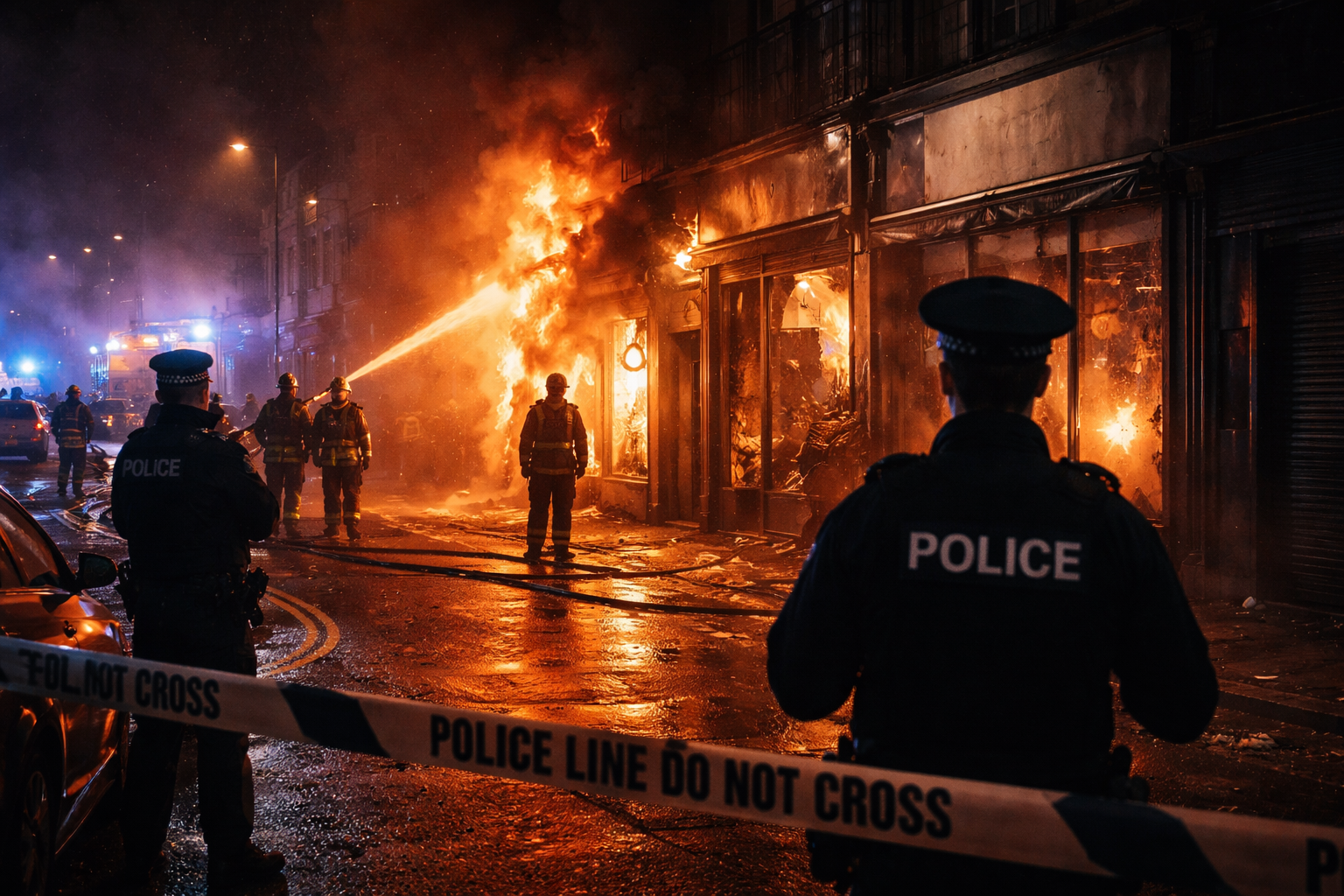
Pattern Emerging: London Arson Incidents Draw Counter-Terror Focus
Fire Attack in Jewish Area Deepens Security Concerns Across London
An arson attack in north-west London has triggered a counter-terror investigation, as a pattern of targeted incidents raises deeper questions about motive, coordination, and what comes next.
A Fire, A Pattern, And A Rapid Escalation
A man approached a row of shops in north-west London late Friday night carrying a plastic bag filled with bottles of fluid. Minutes later, flames erupted.
By the time emergency services arrived, the suspect had already fled.
No major injuries were reported. Damage was limited.
But the response was not routine.
Counter-terrorism police are now leading the investigation.
Although the attack has not been formally classified as terrorism, it fits a pattern that is becoming harder to ignore.
Why Counter-Terror Police Are Involved
The decision to bring in Counter Terrorism Policing (CTP) is not about headlines. It is about context.
This case is now one of multiple arson incidents across north-west London in recent weeks:
Jewish community ambulances set on fire in Golders Green
An attempted firebombing at a synagogue in Finchley
An arson attack on a Persian-language media organisation
And now, a fire attack targeting shops in a Jewish-area neighbourhood
Each incident, on its own, could be explained away.
Together, they form a pattern.
Police have made multiple arrests across these cases and are actively exploring whether the incidents are linked—even if they remain officially “separate investigations.”
The Line Between Crime And Terror
Here is the crucial distinction:
This event is not currently being treated as terrorism.
But it is being treated with counter-terrorism resources.
That gap matters.
Authorities are considering a range of motives, including:
Hate crime
Coordinated targeting
Possible foreign influence
Opportunistic copycat behaviour
This is not speculation—it reflects a broader operational reality.
UK counter-terror officials have already warned of a rise in “hostile activity on UK soil,” some potentially linked to foreign states.
What Media Misses
The headline question is not whether this is terrorism.
The real question is why it is being treated like it could become one.
Counter-terror policing is not deployed lightly. It is used when:
Patterns emerge across incidents
Targets suggest ideological or symbolic meaning
There is risk of escalation
Or there are potential links beyond local crime
The issue is about trajectory, not just classification.
The authorities are not reacting to one fire.
They are reacting to a series.
A Community Under Pressure
The location matters.
Several of the recent incidents have involved Jewish-linked sites or areas with strong Jewish community presence.
Previous attacks include:
The destruction of volunteer ambulances used for emergency response
An attempted firebombing of a synagogue during the night
Targeted arson affecting community infrastructure
These are not random targets.
They are symbolic.
This alters the stakes.
Even when no one is injured, the psychological impact is immediate—and cumulative.
What Happens Next
Three timelines now matter:
1. The Immediate Investigation
Police will focus on identifying and locating the suspect who fled the shop fire scene while continuing arrests linked to earlier incidents.
2. The Link Analysis
Authorities will assess the potential connection between these attacks.
Same individuals
Same network
Or simply the same idea spreading
3. The Escalation Risk
The most important—and most uncertain—question:
Does this stop here?
Or is this the beginning of something larger?
Counter-terror involvement suggests police are planning for the second possibility.
The Real Meaning Of This Moment
This incident is not yet a terrorism story.
But it is no longer just a crime story.
It sits in the uncomfortable space between the two—where patterns start to form, signals begin to align, and authorities act before labels catch up.
That is why counter-terror police are involved.
Because the real danger is not what has already happened.
This is what might happen next.
