London Flooded by Anti–Far Right Protests in Historic Showdown
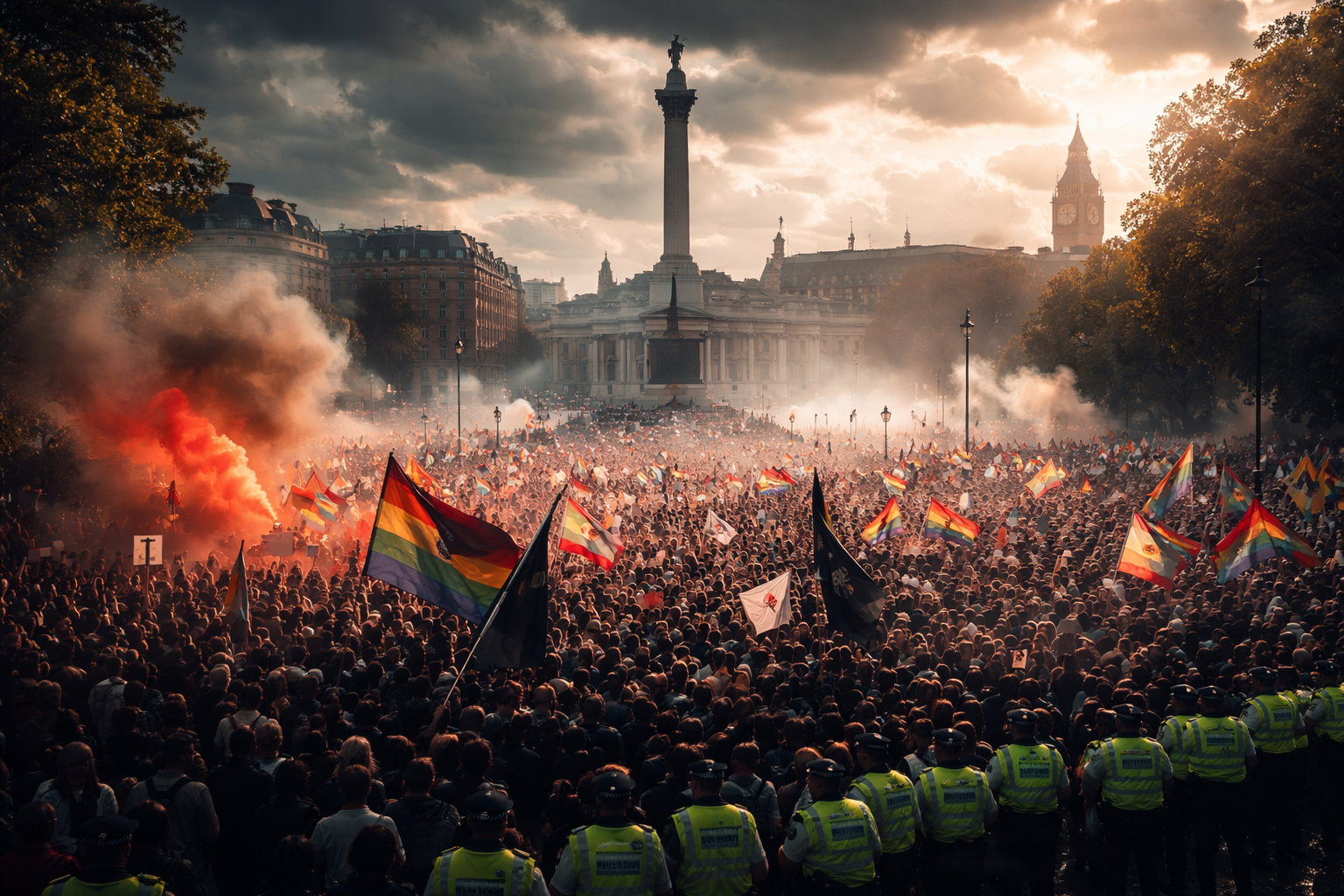
Half a Million March as UK Political Tensions Explode
Anti-Far-Right Mass Protests Erupt in London—A Political Turning Point Is Unfolding
T—andens of thousands — and possibly hundreds of thousands — of people flooded central London in what organizers call the largest anti–far-right protest in British history.
The demonstration, branded the “March to Stop the Far Right,” signals a sharp escalation in public resistance to the rise of right-wing populist movements in the UK—particularly as Reform UK gains traction in national polling.
But the real story isn’t just the scale of the protest. It’s what it reveals about a deeper political shift: Britain is no longer just debating the far right—it is now mobilizing against it at a mass scale.
The story turns on whether this surge of street-level opposition translates into real political power—or fades as a symbolic moment.
Key Points
Tens of thousands marched in central London, with organizer estimates as high as 500,000 attendees, though police suggest lower figures.
The protest targeted the growing influence of Reform UK and broader right-wing narratives around immigration and nationalism.
More than 100–500 organizations, including unions, activist groups, and public figures, participated in the demonstration.
The march remained largely peaceful, with limited arrests tied to related protests and public order incidents.
The event comes amid rising support for right-wing parties and increasing political fragmentation in the UK.
The scale and diversity of the protest suggest a coordinated attempt to counter what participants see as the normalization of far-right ideas.
Where This Story Really Begins
This protest did not emerge in isolation.
Over the past year, the UK has seen a steady rise in right-wing political energy — from mass anti-immigration rallies to the emergence of new parties pushing harder-line policies. Groups and movements advocating stricter immigration controls, national identity politics, and institutional rollback have gained visibility and support.
At the center of the current moment is Reform UK, led by Nigel Farage, which has surged in opinion polls— in some cases overtaking mainstream parties.
Alongside these developments, newer formations like Restore Britain have pushed even further right, advocating policies such as mass deportations and expanded state powers.
The protest is a direct response to this trajectory—not just to individual parties, but to what many see as a broader shift in political tone.
The Day London Filled the Streets
On March 28, crowds gathered across central London, moving from Park Lane toward Trafalgar Square and Whitehall.
The coalition behind the march — the Together Alliance — brought together trade unions, anti-racism groups, environmental activists, and cultural figures.
The messaging was wide-ranging but unified around a central theme: opposition to division, nationalism, and exclusionary politics.
Protesters carried signs supporting refugees, opposing racism, and criticizing the direction of UK politics.
The crowd composition itself was notable — a deliberately broad coalition spanning political, ethnic, and generational lines.
This was not a niche activist gathering. It was designed to look—and feel—like a majority.
Why This Is Happening Now
Timing is everything.
The protest comes at a moment when:
Right-wing parties are gaining polling momentum
Economic pressures are intensifying voter frustration
Immigration remains a central political flashpoint
Global political trends—including US and European shifts—are reinforcing nationalist narratives
A clear feedback loop is evident: the more visible right-wing mobilization becomes, the more it triggers counter-mobilization.
Recent large-scale far-right demonstrations in the UK — including those led by figures like Tommy Robinson — set a precedent for mass street politics.
This march is, in many ways, a direct counterweight.
The Power Shift Beneath the Surface
At first glance, the event looks like a protest.
In reality, it’s a test of political legitimacy.
Mass protests do three things:
Signal perceived majority sentiment
Influence media framing
Pressure political actors ahead of elections
The scale matters because it reframes the narrative.
If hundreds of thousands are willing to mobilize publicly, it challenges the idea that right-wing momentum represents the dominant public mood.
But the inverse is also true.
The existence of such a large protest is itself evidence that the far right is now seen as a credible political force—not a fringe concern.
Real-World Stakes: Beyond the Streets
For the average person, the issue is not abstract politics.
The outcome of this ideological clash will shape:
Immigration policy
Civil liberties and protest laws
Social cohesion and community tensions
Electoral outcomes at local and national levels
There are already signs of strain.
Recent protests in the UK — including pro-Palestinian demonstrations and counter-protests — have led to arrests, bans, and heightened policing concerns.
Authorities are increasingly balancing two competing pressures: maintaining public order and protecting the right to protest.
That balance is becoming harder to sustain.
What Most Coverage Misses
Most reporting focuses on the size of the crowd or the political messaging.
The more important factor is coordination.
This protest was not spontaneous. It was highly organized across hundreds of groups, sectors, and networks.
That level of coordination signals something deeper: institutional opposition to the far right is consolidating.
Trade unions, environmental groups, cultural figures, and political actors are aligning — not just reacting.
This matters because fragmented opposition rarely translates into political outcomes. Coordinated opposition can.
The second overlooked hinge is narrative framing.
The protest is attempting to redefine the political center—positioning anti–far-right sentiment not as activism, but as mainstream.
If successful, that changes how voters interpret political risk — and how parties position themselves ahead of elections.
What Happens Next
The immediate impact of the protest will be symbolic.
The real impact will depend on what follows.
Three paths are now visible:
Momentum converts into votes
Anti–far-right sentiment shapes upcoming elections and pressures mainstream parties to shift tone or policyPolarization intensifies
Both sides escalate, leading to more frequent and larger demonstrations — and potentially more confrontationsDissipation
The protest becomes a moment rather than a movement, with limited long-term political impact
The key signals to watch:
Polling shifts in the next 2–4 weeks
Political responses from major parties
Whether similar protests emerge in other UK cities
Changes in media framing of right-wing movements
This is no longer just a protest story.
It is a stress test of British politics — and a preview of how the next phase of the country’s political conflict will be fought.
