What Did the State Know About the Risks It Exposed Its Servicemen To?
For more than 70 years, men who watched Britain's atomic and hydrogen bombs explode over Australia and the Pacific have asked the same question: what did the state know about the risks it exposed them to, and what did it record? On Tuesday, a sitting prime minister promised them an answer.
Andy Burnham, who became Prime Minister in July after succeeding Sir Keir Starmer, hosted veterans and their families in Downing Street and confirmed an independent panel into the legacy of the UK's nuclear weapons testing programme. It will be chaired by Bishop James Jones, the former Bishop of Liverpool who led the Hillsborough Independent Panel. Burnham told campaigners they would get "the full truth".
The announcement matters because it takes the issue away from the Ministry of Defence, which veterans accuse of withholding their medical records, and into a process modelled on Hillsborough.
What Was Announced on Tuesday
According to the government's announcement, published on 24 November 2026, the Independent Panel on nuclear weapons testing will assess the potential impact of the testing exercises on veterans and their families. Its key features are:
- Chair: Bishop James Jones, who also chairs the Hillsborough and Gosport independent panels.
- Status: a non-statutory inquiry operating independently of government, following the Hillsborough panel model, which the government says is faster and more collaborative.
- Remit: terms of reference are "to be set out shortly", and the government says those most affected will help shape them. The BBC reports the panel will examine health effects on veterans and their descendants, including alleged hereditary illnesses and fertility problems.
- Timescale: the government says it is targeting an interim report for the 75th anniversary of the first UK nuclear weapons test, which falls in October 2027. Some coverage, including the BBC's, describes this simply as a report due by October 2027; the official text specifies an interim report, and no final deadline has been published.
- Sponsorship: the panel is sponsored by the Office for the Prime Minister and Cabinet, with First Secretary of State Louise Haigh as sponsor minister.
- Candour: once the Public Office (Accountability) Bill, the so-called Hillsborough Law, is passed, its duty of candour will apply to the panel. Burnham has told government departments to act in the spirit of that duty immediately.
In the official statement, Burnham said veterans "have waited too long for the truth" and that "the government must act on the recommendations of the panel." Speaking to campaigners, he was more candid about the uncertainty: "Obviously, I do not know what the full truth will be, but we will get it," he said, as reported by the BBC.
The Ministry of Defence steps back
Defence Secretary Wes Streeting told the BBC that the MoD will not be involved in setting up the panel or defining its remit, an acknowledgement of how little trust many veterans have in the department. "It's taken too long to get here," he said. Streeting added that he would not prejudge the findings but expected them to be "uncomfortable", and that if compensation were recommended the government would "have to take that on the chin."
The MoD has long denied any cover-up. According to the BBC, it points to four studies, along with a 2022 Brunel University study, that it says found no increased health risks among test participants. Campaigners dispute those conclusions.
Who Is Andy Burnham in This Story?
The headline promise carries particular weight because of who is making it. Burnham returned to the Commons by winning the Makerfield by-election in June 2026, was elected Labour leader unopposed on 17 July after Starmer announced he would stand down, and was appointed Prime Minister on 20 July.
He is closely associated with the Hillsborough families' campaign. Before entering Downing Street, the BBC reports, he described the treatment of nuclear test veterans as a "criminal cover-up on an industrial scale" and backed calls for an investigation.
Background: Britain's Nuclear Tests and the People Who Were There
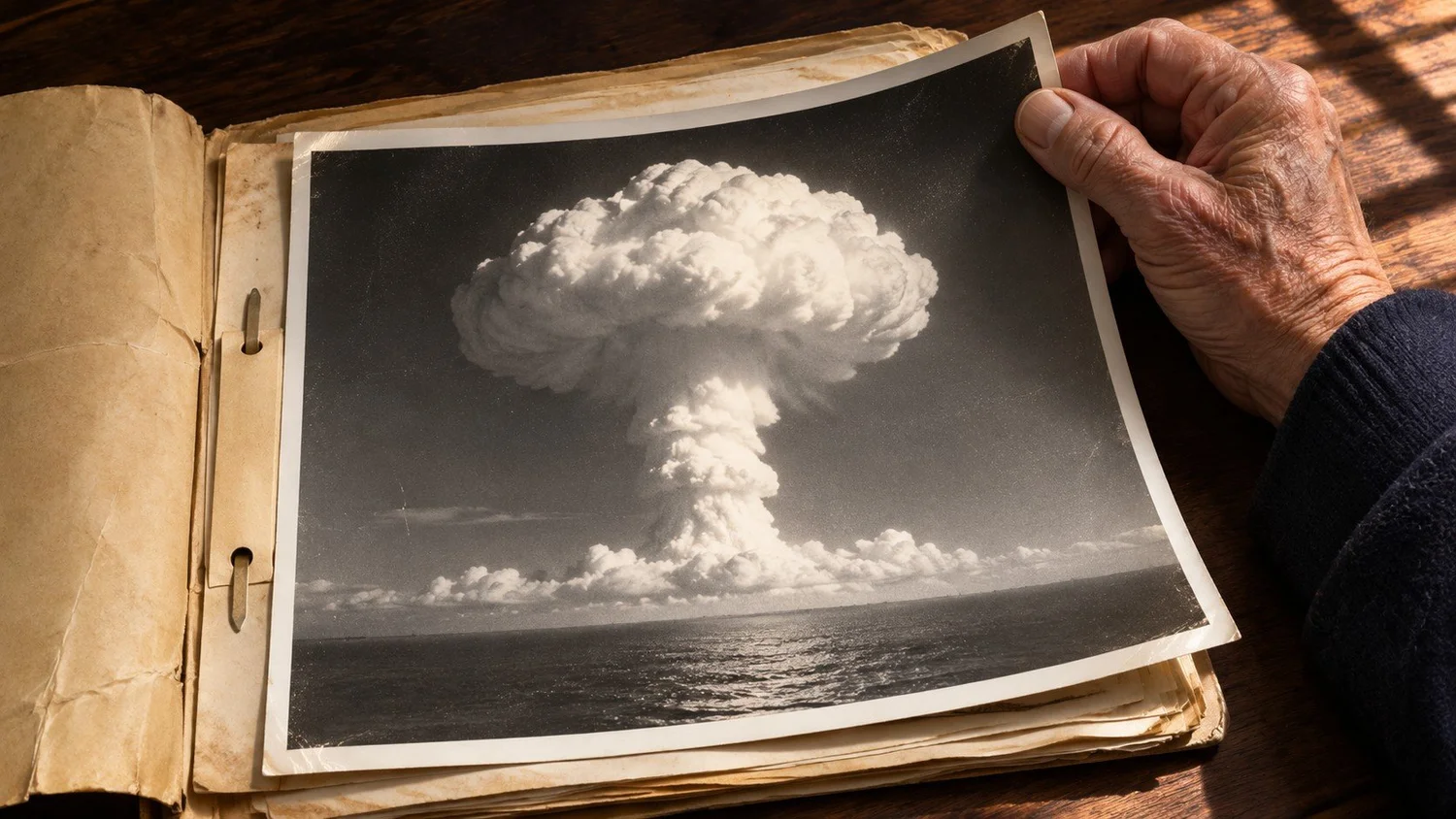
Britain became the world's third nuclear-armed state on 3 October 1952, when Operation Hurricane detonated a plutonium device aboard a Royal Navy ship in the Montebello Islands off Western Australia. Further tests followed at Emu Field and Maralinga in South Australia and, in the hydrogen bomb trials of the late 1950s, at Christmas Island and Malden Island in the Pacific. The wider testing programme, including American tests in which UK personnel took part, ran until 1967.
More than 20,000 military personnel were present at UK nuclear weapons tests, according to the MoD. Veterans' groups put the figure at about 22,000, many of them young national servicemen, alongside scientists, civilians and personnel from Australia, New Zealand, Fiji and Kiribati.
Veterans describe flying through radioactive clouds and living on contaminated ground. Barbara Quick, whose father served with the RAF Police on Christmas Island, told the BBC he was told to "turn his collar up, turn his back and cover his eyes," while higher-ranking personnel had protective equipment.
The medal and the courts
Recognition came slowly. In November 2022, marking the 70th anniversary of Operation Hurricane, then Prime Minister Rishi Sunak announced the Nuclear Test Medal, open to around 22,000 eligible service personnel and civilians, including posthumous awards. Campaigners welcomed it but said it was not enough; Alan Owen, founder of the campaign group LABRATS, said at the time that "we want more."
Legal routes have largely failed. In 2012, the Supreme Court ruled against 1,011 veterans seeking compensation. Veterans can apply for no-fault compensation through the War Pensions Scheme, but campaigners say missing records have made radiation-related claims extremely difficult.
The Blood and Urine Records Controversy
At the centre of the dispute are the blood and urine tests that veterans say were taken before, during and after deployment. Campaigners argue those results could show whether exposure harmed them. In March 2024, veterans and next of kin, represented by McCue Jury & Partners, served a letter before action on the MoD alleging that records had been unlawfully withheld. The MoD said at the time that "no information is withheld from veterans" and that medical records were held in individual service files.
The same year, the Minister for Veterans and People commissioned a records discovery exercise covering testing policy between 1952 and 1967, what was recorded and what happened to those records. Its findings, compiled by the single-service historical branches and AWE Nuclear Security Technologies, were published on GOV.UK on 15 July 2026.
According to figures from those reports, as summarised by LABRATS, only about 43 per cent of roughly 2,362 Army veterans who should have had pre-deployment blood counts have evidence of them; 31 of 65 sampled RAF files from high-risk units had no blood count record; and at least 47 sampled Royal Navy records were confirmed destroyed, some as recently as 2025. The BBC reports the MoD has acknowledged that some records may have been inadvertently destroyed in 2023, and has described the medical records as "complex and inconsistent" because no central database was kept. A moratorium on destroying service and medical records was ordered in November 2025, according to the same campaign summary.
Campaigners call these gaps evidence of a cover-up; the MoD denies concealment. That disagreement is what the panel must test.
Veterans' Reactions
Those at Downing Street welcomed the announcement while making clear they would judge it by what it uncovers. John Morris, who was sent to Christmas Island at 18 and later developed cancer, told the BBC he sincerely hoped "we will get justice." He links his illness, and the death of his four-month-old son, to radiation exposure.
Brian Unthank, who witnessed three hydrogen bomb tests and has since developed multiple skin cancers, wants a prime minister to apologise in Parliament. "Let's get it done today," he said. Steve Purse, the son of a veteran, who was born with complex disabilities that have never been fully diagnosed, called the announcement "huge" but insisted the panel must have full disclosure. "No-one has listened to us like this before," he told the BBC.
These accounts reflect what veterans and families believe. Whether exposure caused such conditions, particularly hereditary effects, remains disputed and is a question for the panel, not its starting point.
Analysis: Why the Hillsborough Model Matters
This section is editorial analysis.
The Hillsborough Independent Panel did not reach legal verdicts. Its power lay in gathering every relevant document, publishing it and explaining what it showed. That disclosure-first approach suits the nuclear tests well, because the core grievance is less about a single disputed event than about what was recorded, by whom, and where it went.
The model has limits. A non-statutory panel cannot compel witnesses, and most 1950s decision-makers are dead. Its success depends on cooperation from the MoD and AWE, which still hold much of the material, and on how quickly the duty of candour becomes law.
Science is the other constraint. The panel will meet existing studies that found no increased health risk, alongside personal testimony and incomplete records. If the original blood and urine data no longer exist, it may be impossible to establish individual exposure. A credible outcome may therefore be a clear account of what was known and what was lost, rather than a definitive answer on causation.
What Happens Next
- The government is due to publish draft terms of reference "shortly", developed with veterans and families.
- Further panel members will be appointed to sit alongside Bishop Jones.
- The Public Office (Accountability) Bill must complete its passage for the statutory duty of candour to apply.
- An interim report is targeted for October 2027, the 75th anniversary of Operation Hurricane.
- Veterans will continue to press for a formal apology in Parliament and for full access to their records.
Conclusion
For a dwindling group of elderly veterans, time is the cruellest factor. Many have died without seeing their records or hearing an apology, and Tuesday's announcement guarantees neither. What it does offer is a process independent of the department they distrust, led by a chair with a record of uncovering uncomfortable truths, and a prime minister who has publicly bound the government to act on what it finds. The test now is whether the documents still exist to tell the story.
For background on how he reached Downing Street, read Andy Burnham Becomes Prime Minister.
Sources
- GOV.UK: "Nuclear test veterans and their families have waited too long for the truth" – PM announces independent panel (24 November 2026)
- BBC News: Nuclear test veterans will get full truth, says Burnham, as he confirms independent panel (24 November 2026)
- Brit Brief: Hillsborough-style panel announced for nuclear test veterans, chaired by Bishop James Jones (24 November 2026)
- GOV.UK: UK nuclear testing programme blood and urine testing policy (15 July 2026)
- LABRATS: Inside the MoD's nuclear test records disaster (16 July 2026)
- Irish News (PA): Nuclear veterans seek tribunal to resolve legal claims over 'withheld' records (19 March 2024)
- GOV.UK: Nuclear test veterans to receive medal as event remembers their service 70 years on (21 November 2022)
- Al Jazeera: UK recognises veterans of nuclear weapons tests with medals (21 November 2022)
- Wikipedia: Andy Burnham (accessed 25 November 2026)
