PMQs Exposed Keir Starmer’s Weak Point—and His Leadership Is Now in Play
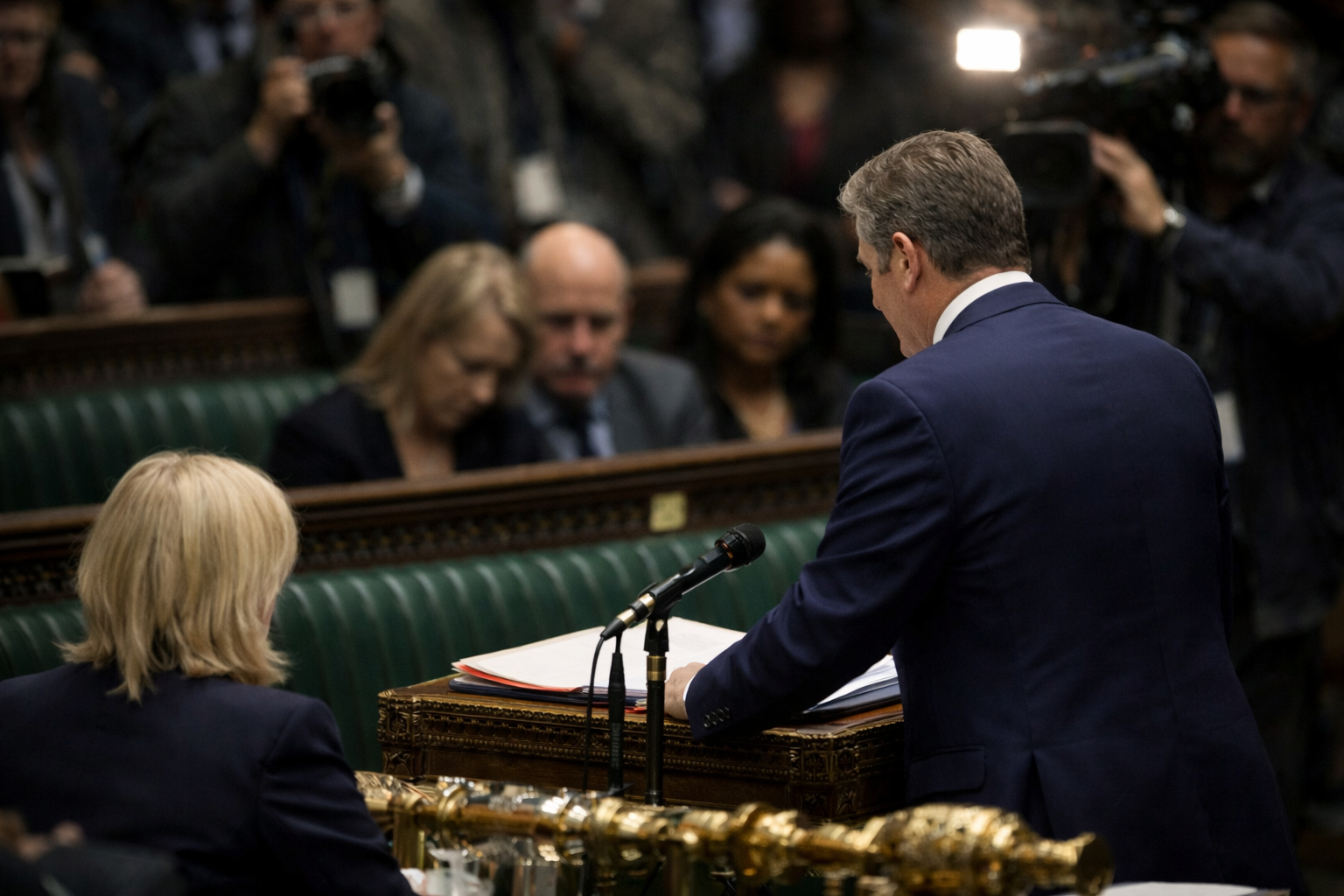
PMQs Today: Is Keir Starmer’s Leadership Under Threat?
Keir Starmer’s PMQs Reckoning
Prime Minister’s Questions intensified the political pressure on Keir Starmer over the Peter Mandelson–Jeffrey Epstein fallout—because Starmer confirmed he knew Mandelson maintained contact with Epstein after Epstein’s prison term, yet still appointed him to a major post.
The attack line in the chamber was judgment: not only what Mandelson did, but what Starmer knew and when. Starmer attempted to resolve the issue by characterizing Mandelson's actions as a betrayal, asserting that Mandelson had "repeatedly lied" during the appointment process, and citing ongoing sanctions and investigations.
But the more dangerous story has shifted. It is no longer just about outrage. It is about durability: whether this investigation becomes a weeks-long drip of documents and contradictions that weakens Starmer’s authority inside his own party—especially if colleagues decide the scandal is starting to define the government.
A key point often missed in the first wave is that leadership threats rarely begin as open coups. They begin as withdrawn cover: fewer people willing to defend you on air, fewer allies prepared to vouch for your judgment privately, and more MPs calculating that survival is safer on the other side.
The story turns on whether Starmer can demonstrate credible transparency without losing control of the paper trail.
Key Points
Starmer faced direct pressure at PMQs after confirming he was aware Mandelson kept ties to Epstein after prison, raising the question of why the appointment proceeded.
Starmer’s defense leaned on two claims: Mandelson misrepresented key facts, and the government has now imposed consequences.
Documents such as vetting notes, briefings, internal warnings, and decisions about disclosure are likely to shape the next phase of the scandal.
If internal frustration extends beyond Mandelson to those who pushed the appointment, particularly senior advisers, it could pose a greater threat to Starmer's position.
Leadership challenges in Labour are not triggered by vibes; they are triggered by numbers—and the numbers move when MPs fear elections, donor confidence, and media oxygen are turning against them.
Potential challengers exist across the party’s right, center, and soft left, but any move depends on whether a credible coalition forms around one alternative.
Background
PMQs is usually a weekly collision of messaging and theater. Today it became a referendum on judgment.
Confirmed political facts anchor the crisis. The crisis stems from Mandelson's connections to Epstein, their ongoing communication following Epstein's prison sentence, and the government's choice to elevate Mandelson to a prominent position. Starmer publicly expressed regret and anger and framed Mandelson as having lied during the appointment process. He also pointed to institutional steps being taken—actions designed to show that the issue was not being brushed aside.
At the same time, the story now sits alongside active law enforcement scrutiny. That matters politically because it creates a credibility bind: leaders cannot say everything, yet the public expects maximal disclosure when disgust is this high.
Inside Labour, the most sensitive element is not only Mandelson’s conduct. It is the question of who advocated for him, how strongly, and what warnings were raised.
Analysis
Is Starmer’s Position Under Threat?
Yes—his position is under meaningful political threat, but not in the Hollywood sense of an imminent vote tomorrow. The real threat is that the scandal becomes a leadership-weakening event: the kind that doesn’t immediately end a tenure but changes how colleagues behave, how the media frames every future stumble, and how quickly internal doubts harden into organized action.
In practical terms, Starmer is most exposed if any of these conditions take hold:
There is a persistent discrepancy between the current statements from Downing Street and the subsequent documents.
A sense among MPs that the government’s response is overly lawyered—heavy on limits and redactions—making it look like containment rather than accountability.
A sharp drop in political confidence was triggered by upcoming electoral tests, where MPs fear this controversy is now the headline voters associate with the government.
Are His Allies Dwindling?
This is the quieter danger: allies do not always “rebel” publicly. They simply stop spending political capital.
In a crisis like this, coalition support erodes in three stages.
Stage one is selective silence: ministers and senior MPs avoid defending the original decision and only defend the response.
Stage two is redirected blame: internal voices begin focusing on the appointment’s architects—often advisers or gatekeepers—because it is safer to criticize staff than the leader.
Stage three is conditional loyalty: MPs privately signal they will stay with the leader only if polling stabilizes, disclosure is clean, and elections do not go badly.
Today’s PMQs pushed the scandal further down that track because Starmer acknowledged prior awareness of post-prison contact. That fact tightens the space for sympathetic interpretations. It makes “misled” harder to sell unless the government can show what exactly was misrepresented and why the misrepresentation was decisive.
The Procedural Reality: How a Challenge Actually Happens
Leadership pressure becomes lethal when it turns into an enforceable mechanism.
A challenge requires a credible internal pathway: a nomination threshold among MPs to start a contest, a timetable, and a candidate capable of uniting factions. Recent Labour contests have used a nomination threshold around a fifth of the parliamentary party, which means a challenge is not trivial—but it is also not impossible if fear spreads.
This is why “allies dwindling” matters more than “one rival.” A leader falls when dozens of MPs conclude that the safest move is to stop protecting the leadership from internal accountability.
The Candidates: Who Could Challenge Him?
Any list of potential challengers is necessarily contingent because challengers only become real when a coalition forms. But the credible names fall into a few buckets:
Continuity-and-competence challengers (center/right of the party): figures who would argue the scandal shows a failure of leadership judgment and process and promise tighter governance and political discipline.
Security-and-state-capacity challengers: senior ministers with reputations for seriousness who could argue that the government needs a leader who can restore trust fast.
Soft-left or “values-first” challengers: figures who would argue that the Epstein connection has damaged the party’s moral authority and that only a reset can restore it.
Based on current public speculation and internal chatter, the most plausibly positioned names include:
Wes Streeting is often seen as a potential standard-bearer for a modernizing wing and a capable media performer.
Rachel Reeves is a candidate archetype if the party wants a “safe hands” economic credibility reset—though any challenge would instantly become a referendum on economic direction.
Yvette Cooper, a plausible unity figure if the party wants to project institutional gravitas and competence.
Lucy Powell, as deputy leader, if the party’s instinct is to keep continuity while changing the face at the top—though deputy leaders do not automatically become challengers.
Angela Rayner and Andy Burnham appear in member preference conversations, but their viability depends on parliamentary positioning and timing, and recent reporting has contained conflicting signals around Burnham’s route back to Westminster.
What matters more than the names is the logic: challengers are viable when they can persuade MPs they will improve three things fast—polling, discipline, and media oxygen.
What Most Coverage Misses
The hinge is this: Starmer’s survival will be decided less by today’s exchanges and more by whether his internal coalition believes the disclosure phase will protect them—or sink them.
The mechanism is fear management. MPs will tolerate a scandal if they believe it is containable and time-limited. They move against a leader when they think the story is entering a “slow leak” phase—documents, redactions, reversals, and new revelations. That phase is politically fatal because it keeps the party trapped in moral disgust and procedural wrangling instead of governing.
Two signposts will confirm which direction this is going in the next days and weeks: whether the government sets a clear disclosure timetable with principled redaction rules, and whether any documentation emerges that undermines Starmer’s claim that Mandelson’s lies were decisive to the appointment.
What Happens Next
Over the next 24–72 hours, Starmer needs to do three things at once: hold a consistent narrative across ministers, show visible consequences, and define what transparency looks like while investigations are live.
Over the next weeks, the threat becomes internal. If MPs see the scandal hurting local campaigning, drowning out other announcements, or placing them in indefensible media positions, the nomination math starts to shift.
The immediate decision points to watch are whether Parliament forces further disclosures, whether Downing Street publishes a clear framework for what will be released, and whether senior figures close to the decision—advisers as well as ministers—become the focus of internal blame.
The main consequence is political authority: Starmer’s leverage over his party weakens if MPs conclude he is now leading under permanent reputational drag, because leadership authority in Westminster is ultimately a confidence contract, not a job title.
Real-World Impact
A mid-level civil servant working on sensitive briefs will experience tighter clearance and slower sign-off, because nobody wants to be associated with material that could later be disclosed.
A local Labour candidate will face doorstep questions that are not about policy but about judgment and trust, because the Epstein connection triggers moral revulsion that overrides normal partisan filters.
A business leader watching the government will factor in distraction risk, because prolonged scandals absorb time, attention, and political capital.
A voter who rarely follows politics will reduce the story to a simple heuristic—“they knew and did it anyway”—unless the government can show the decision process was meaningfully constrained by deception.
After Today’s PMQs, the Leadership Fight Becomes a Numbers Game
PMQs raised pressure, but it did not finish the story. The next stage is institutional: what gets released, what is withheld, who is blamed, and whether the party believes this can be closed down.
If Starmer stabilizes the narrative and the documents do not contradict him, the threat fades into background anger. If the paper trail turns messy—or elections punish Labour while this dominates headlines—the leadership question will stop being gossip and start being arithmetic.
Watch for two concrete signals: more senior Labour figures refusing to defend the original appointment and any movement toward nomination gathering behind a single alternative. If either happens, today will be remembered not as a bruising PMQs but as the moment the internal coalition began to fracture.
