

UK free speech under pressure: when tweets, texts and posts cross the line
In the UK this week, a familiar tension has flared again. A former Premier League footballer has been handed a suspended jail sentence for “grossly offensive” social media posts. A few days earlier, a 61-year-old man was jailed for weeks after sending hundreds of antisemitic messages to a member of Parliament. At Westminster, MPs have just debated whether penalties for non-violent social media offenses are now out of step with punishments for physical crime.
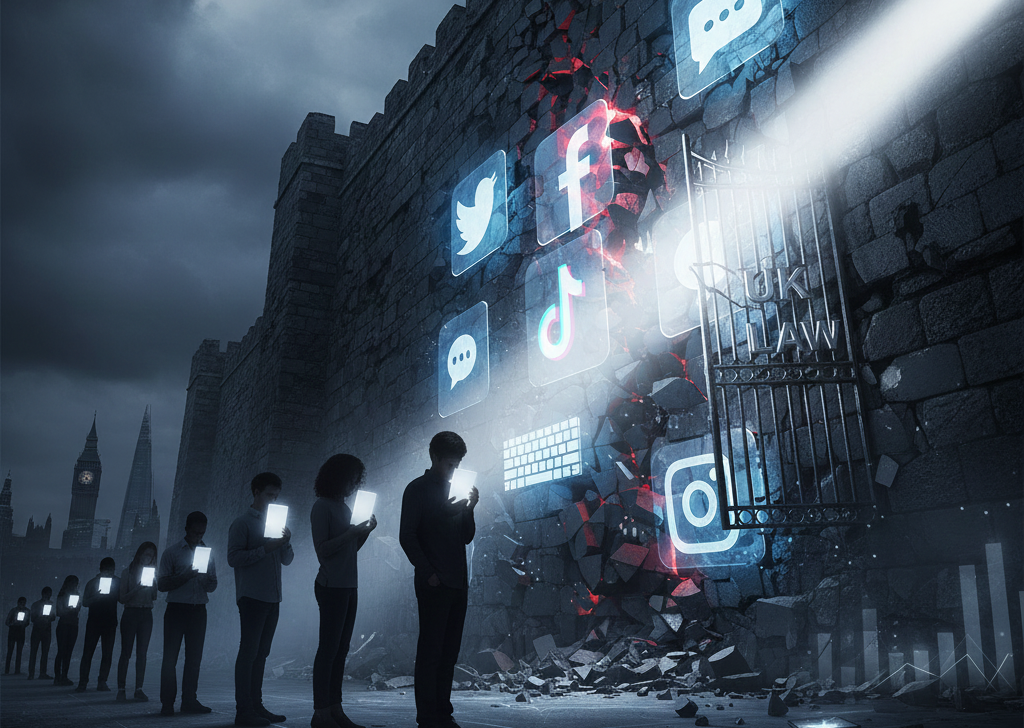
At the same time, Elon Musk’s platform X is locked in a public fight with the UK government over the Online Safety Act. X argues that Britain is edging toward state-mandated censorship in the name of child protection and anti-terror rules. Ministers insist the law protects both safety and speech.
All of this raises a blunt question: does the UK actually have free speech in any meaningful sense, or just a qualified right that can be clipped whenever politics demands it?
This piece looks at how UK free speech law works in practice, why recent cases are being framed as “free speech hypocrisy,” and how sentences for tweets and texts now compare with those for violent or financial crime. It also ranks the main flashpoints that critics say show the system is starting to lose its balance.
The story turns on whether a democracy can criminalize hurtful speech without criminalizing dissent.
Key Points
The UK does have legal protection for free expression, but it is a qualified right, not an absolute shield like the US First Amendment.
Courts have recently handed down both a suspended prison sentence for a high-profile ex-footballer’s posts and an immediate jail term for antisemitic abuse sent to a Jewish MP.
A Westminster Hall debate highlighted public concern that people face harsh penalties for non-violent social media offenses while some violent offenders still avoid prison.
X, owned by Elon Musk, has warned that the UK’s Online Safety Act risks turning Britain into a test case for democratic internet censorship.
Older cases, such as the prosecution of a man for an offensive tweet about Captain Sir Tom Moore, still shape today’s debate about where “grossly offensive” ends and criminality begins.
Civil liberties groups fear a growing “chilling effect,” while victims’ groups argue that without firm enforcement, online abuse and hate will escalate unchecked.
Background
Free expression in the UK is anchored in Article 10 of the European Convention on Human Rights. The right covers holding opinions and sharing information and ideas without interference by public authorities, but it is explicitly qualified. That means Parliament can restrict speech when doing so protects national security, public safety, or the rights of others.
For online content, several overlapping laws operate at once. Section 127 of the Communications Act 2003 makes it an offense to send a message over a public network that is “grossly offensive,” “indecent,” “obscene,” or “menacing.” Other laws, including the Malicious Communications Act and various public order provisions, are frequently used against threatening or abusive posts.
In recent years, critics have focused on the sharp rise in charges linked to “offensive” online messages. Campaigners say police are making dozens of arrests a day for posts that may be insulting or upsetting but not truly dangerous, and that this clashes with the UK’s stated commitment to open debate.
The new Online Safety Act adds another layer. It requires platforms to remove illegal content quickly, police harmful content for minors, and comply with heavy reporting and monitoring duties. Civil liberties groups and X warn that broad definitions and powerful regulators could push platforms into over-removing lawful but contentious content.
Analysis
Political and Geopolitical Dimensions
The UK often portrays itself as a global advocate for free speech, yet at home it now faces accusations that it runs one of the strictest criminal regimes for online expression in Europe.
Three flashpoints stand out.
First, the Online Safety Act. X argues that enforcement could force platforms to build intrusive scanning systems or suppress lawful political debate to avoid penalties. Ministers counter that the Act includes explicit free expression protections, but the gap between theory and practice is becoming a diplomatic issue.
Second, the recent parliamentary debate on sentencing for social media offenses. Triggered by public frustration, MPs noted that people can receive suspended or even custodial sentences for offensive posts while some violent offenders avoid prison through sentencing reforms. Even across party lines, there is growing concern that the balance may be wrong.
Third, Britain’s system is now a live test case in a global struggle over platform governance. The US protects far more speech; the EU regulates platforms heavily. The UK’s hybrid approach—broad criminal speech laws plus strict duties on platforms—places it squarely in the spotlight for tech companies like X.
Economic and Market Impact
Free speech rules shape investment decisions. If the UK imposes expensive compliance burdens and legal risk, platforms may limit features, shrink operations, or deprioritize the market.
For start-ups, uncertain speech boundaries can force heavy spending on moderation tools instead of growth. On the other hand, unchecked online abuse creates its own economic costs: burnout, reputational damage, and security burdens for public-facing workers.
If Britain is perceived as more punitive than comparable democracies, it may harm the appeal of its media sector and its reputation as a global hub for political debate.
Social and Cultural Fallout
This debate is most emotional when it touches real lives.
Victims of sustained harassment and hate crimes argue that tough laws are essential. The man jailed for sending repeated antisemitic messages to a Jewish MP showed how speech can morph into stalking and intimidation. Many feel that failing to prosecute such behavior would leave them unprotected.
But other cases push the opposite way. The conviction of Joseph Kelly in Scotland for an offensive tweet about Captain Sir Tom Moore—visible for roughly twenty minutes and containing no threat—remains an emblem of alleged overreach.
Recent cases involving public figures sit in the middle. Joey Barton’s abusive online posts resulted in a suspended prison sentence and strict restraining orders. Supporters call this a vital deterrent. Critics say it shows how close Britain is to punishing harsh opinion as if it were violence.
Comparisons with sentencing for physical crime fuel the charge of hypocrisy. People have walked away from serious assaults with suspended sentences, while others face prosecution for a crude tweet.
Technological and Security Implications
The Online Safety Act effectively outsources public speech policing to private companies. Automated systems will now scan huge volumes of content, but algorithms are blunt instruments. They are more likely to remove marginal or politically sensitive speech than to miss truly dangerous content.
Police incentives may also be skewed. Arresting someone for an offensive post is fast and measurable. Preventing violent crime or dismantling organised networks is far harder. Rising prosecutions for communications offenses contrast with persistent backlogs in serious crime cases, reinforcing public suspicion that the system prioritises the wrong harms.
What Most Coverage Misses
Two deeper structural issues rarely get attention.
The first is the fragmented legal framework. Instead of one clear statute, Britain relies on a patchwork of overlapping, sometimes vague laws. Words like “grossly offensive” or “causing needless anxiety” leave wide discretion to police and prosecutors. Inconsistent outcomes fuel the sense of unfairness.
The second is long-term trust. When people fear that a tweet can lead to criminal investigation, they self-censor, especially on sensitive topics like religion, gender, race, or foreign policy. Others retreat to fringe platforms, where debate becomes more extreme. Both trends weaken the shared civic space democracies depend on.
Why This Matters
Three groups are most exposed.
Public figures face high stakes: a late-night post can now lead to criminal conviction, restraining orders, or suspended jail time. That may curb targeted abuse, but it can also deter honest political speech.
Everyday users need predictable rules. If it’s unclear when a heated opinion crosses into criminality, people either stay quiet or take risky chances.
Platforms view the UK as a bellwether. If Britain’s blend of speech restrictions and platform duties becomes a global model, firms built on wider free-expression principles may scale back, block content, or redesign their services.
Key indicators to watch include: early enforcement decisions by Ofcom, any parliamentary moves to revise sentencing for online communications, and future court rulings that either narrow or expand what counts as “grossly offensive” speech.
Real-World Impact
A nurse in London vents online about hospital management. The post is blunt but harmless. Under cautious moderation policies, it might be restricted or removed, leaving her feeling even more powerless in a stressful workplace.
A small Midlands exporter faces a smear campaign from an angry customer who spreads insinuations of fraud. Criminal communications laws offer a route for protection, but the process can be slow and costly, and platforms may hesitate without a clear ruling.
A university student in Manchester debates foreign policy online. Fear of misinterpretation leads him to soften his language—or avoid the topic entirely.
An MP bombarded with violent hate messages depends on criminal sanctions to deter obsessive abusers. Without them, there may be no effective way to stop repeat harassment.
Road Ahead
The UK does have free speech—but it is conditional, limited, and increasingly shaped by both criminal law and platform governance.
The central tension is not abstract. It is about which harms the legal system chooses to prioritise. Critics point to cases where speech receives harsher treatment than violence. Victims of online hate point to cases where punishment is the only way to make abuse stop.
One direction leads toward greater criminalisation of harmful or offensive speech. The other calls for tighter definitions, focusing on genuine threats rather than crude opinions.
The future will hinge on Parliament, regulators, courts—and the decisions of platforms like X. If Elon Musk or other major players decide the UK’s rules make true free speech platforms unviable, that alone will be a landmark verdict on where Britain has drawn the line.
