Starmer’s Final U-Turn: Former PM Quits Parliament and Leaves Labour Facing a Dangerous London By-Election
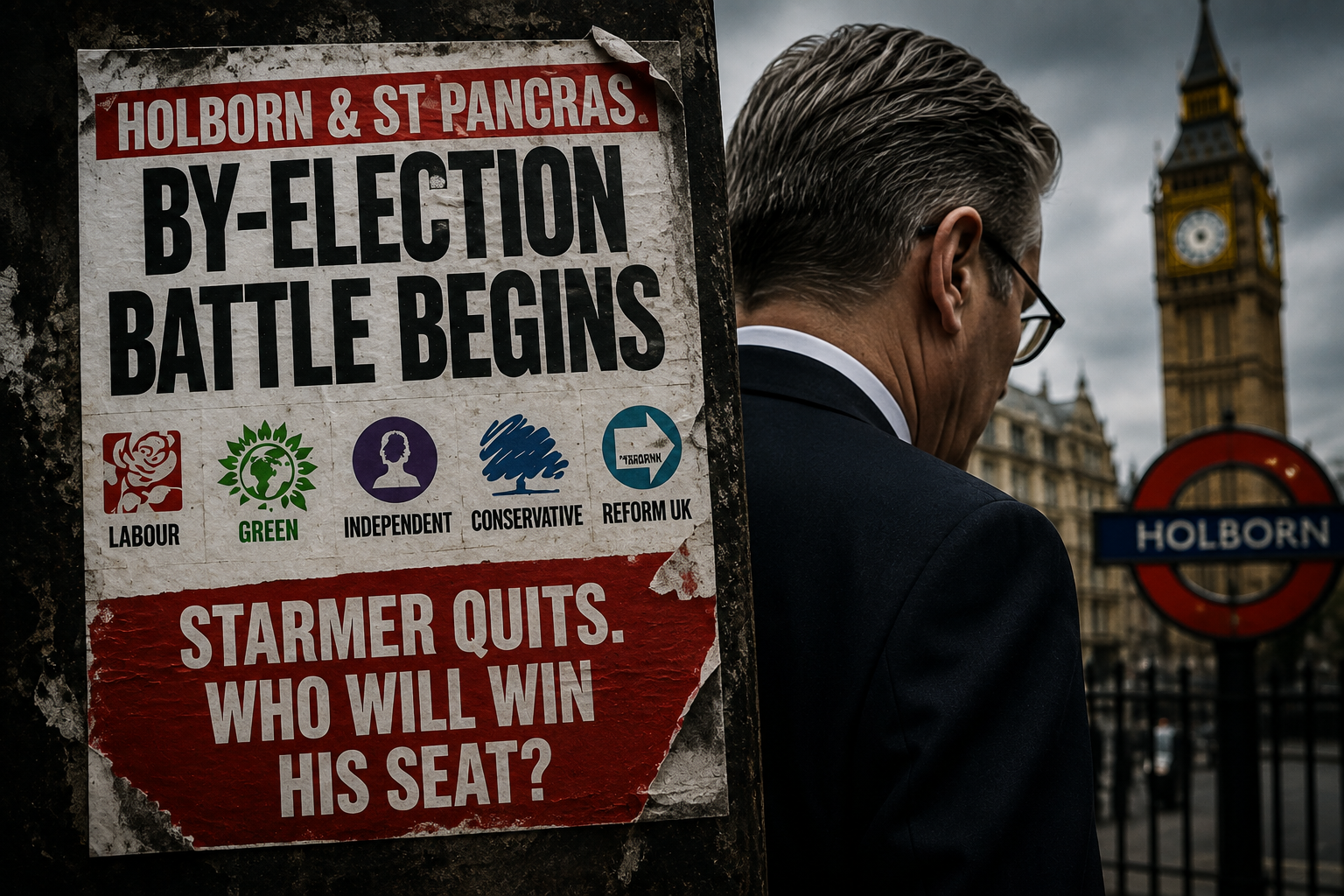
Starmer Quits as MP After Promising to Stay
Starmer Walks Away: Labour Faces Fight to Keep His London Seat
Sir Keir Starmer is walking away from Parliament, bringing his 11-year career as MP for Holborn and St Pancras to an abrupt end and forcing Labour into an awkward by-election in the former prime minister’s own backyard. The resignation comes only weeks after Starmer left Downing Street — and after he had previously indicated that he intended to remain an MP until the next general election.
It is an extraordinary final reversal for a politician who entered Downing Street with one of the largest parliamentary majorities in modern British history barely two years ago. Starmer says he now wants to concentrate on international affairs, including defence, security, trade and technology, but politically the immediate consequence falls on his successor Andy Burnham: Labour must defend a seat where its support has already shown signs of serious erosion.
Another Starmer U-Turn
When Starmer left Downing Street, he said he expected to continue representing Holborn and St Pancras until the next general election. That plan has lasted barely a matter of weeks.
Starmer said on Tuesday that he had spent the summer considering his future and had decided the time had come to “pass the baton” to a successor. His parliamentary career, which began when he replaced Labour veteran Frank Dobson in 2015, is therefore coming to an end considerably earlier than he had previously suggested.
For his critics, it provides an obvious final attack line. Starmer has gone from winning a huge national majority in July 2024, to losing the premiership, to abandoning his Commons seat little more than two years later.
The Conservatives have already attacked the reversal and the cost of staging another election. More importantly for Labour, however, the argument about Starmer himself will soon become secondary. Voters in Holborn and St Pancras will now be given an opportunity to pass judgement on the governing party without Starmer's personal incumbency standing between Labour and its challengers.
Labour Starts as Favourite — But This Is No Longer an Automatic Hold
On paper, Labour should win.
Starmer took 18,884 votes, or 48.9 per cent, at the 2024 general election. Independent Andrew Feinstein finished a distant second on 7,312 votes, or 18.9 per cent, while the Greens received 4,030 votes, or 10.4 per cent. Starmer's majority was 11,572.
Those numbers would ordinarily make a Labour hold look straightforward.
But politics in this part of London has changed considerably since July 2024.
In the May 2026 Camden elections, the Greens won all three council seats in Holborn and Covent Garden, defeating Labour decisively. The leading Green candidate received 1,271 votes against 1,035 for Labour's strongest candidate.
The Greens also swept all three seats in Regent's Park in May before Labour regained a council seat there in a July by-election. Across several other wards contained within the parliamentary constituency, Labour's share was markedly lower than its 2024 general-election performance while Green support had strengthened.
That does not automatically translate into a Westminster defeat. Local elections have lower turnout, different candidates and different voting behaviour.
But it does destroy any sensible assumption that Labour can simply stick a red rosette on somebody and expect Starmer's old majority to reappear.
Zack Polanski Could Turn It Into a Serious Contest
The most consequential decision may now belong to Green Party leader Zack Polanski.
Polanski has not yet been formally confirmed as the candidate, but the Greens have conspicuously refused to rule him out. Even before Starmer's resignation, Polanski was openly discussing Holborn and St Pancras as a possible parliamentary target.
That matters because Polanski would transform what might otherwise be a routine by-election into a national political event.
He is already a London Assembly member, has previously lived in Camden and could attempt to unite progressive voters who believe Labour has moved too far towards the centre. A high-profile Green leader fighting the former prime minister's constituency would also guarantee national attention and campaign resources far beyond those normally available in a single-seat contest.
The Greens have evidence that there is fertile ground. Their local-election breakthrough in Camden demonstrates that the theoretical anti-Labour vote is not merely visible in opinion polling — it has already produced victories inside the constituency.
If Polanski stands, he is likely to be Labour's principal threat.
Andrew Feinstein Could Complicate Everything
Then there is Andrew Feinstein.
Feinstein ran against Starmer as an independent in 2024 and secured 18.9 per cent of the vote — nearly twice the Green share and easily enough to finish second.
His candidacy was built largely around attacking Starmer from the left, particularly over Gaza and foreign policy. A return would create an unusual problem for the Greens.
The combined 2024 vote for Feinstein and the Greens was 29.3 per cent, already much closer to Labour's 48.9 per cent than either challenger managed independently.
If Labour's support has subsequently fallen while Green support has risen, a consolidated challenger could make the arithmetic uncomfortable.
But if Polanski and Feinstein both enter the race, they could instead wreck one another's chances.
A voter opposed to Labour from the progressive left could be offered Polanski, Feinstein and potentially candidates from other left-wing groups. Labour could therefore lose a substantial chunk of Starmer's 2024 vote and still win because its opponents have divided theirs into several competing piles.
For Andy Burnham, that would be the ideal scenario.
Reform and the Conservatives Face a Much Steeper Climb
The Conservatives and Reform UK will almost certainly want candidates on the ballot, but neither begins remotely close to winning territory.
The Conservatives received just 7.2 per cent here in 2024. Reform received 6.1 per cent.
Reform's national advances since then mean its candidate should not be dismissed as irrelevant. A by-election involving the former prime minister's seat also offers Nigel Farage's party an obvious opportunity to attack Labour and attempt to demonstrate that its appeal reaches beyond traditional working-class and post-industrial constituencies.
But Holborn and St Pancras is hardly Reform's ideal demographic battlefield. A respectable increase would itself represent success. Winning would require an electoral earthquake.
For the Conservatives, the position may be even more uncomfortable. They once competed much more seriously across affluent parts of central London, but their 2024 performance here left them below both Feinstein and the Greens.
The real battle is overwhelmingly likely to take place on Labour's left.
Labour Is Favourite — For Now
Labour should therefore still be regarded as the favourite.
An 11,572 majority does not disappear automatically, Labour retains deep organisational roots in Camden, and its opponents risk splitting precisely the electorate required to defeat it. Starmer himself has said he will campaign for his Labour successor.
But the interesting question is no longer whether Labour can hold Holborn and St Pancras. It is whether the party can do so comfortably.
A Labour victory with its majority slashed would provide the Greens with evidence that some of Britain's safest urban Labour territory is becoming competitive.
A Polanski victory would be substantially more serious. The leader of the Green Party would suddenly have a Commons platform, Labour would have lost the former prime minister's own seat, and Burnham's new government would suffer an embarrassing defeat almost immediately after taking power.
That possibility would have seemed extraordinary when Starmer walked into Downing Street after Labour's 2024 landslide.
Two years later, Starmer is leaving Parliament altogether — and Labour is preparing to fight for the seat he once appeared incapable of losing.
