The Manchester Airport Jury Decision Has Ignited A New Two-Tier Justice Firestorm
The Manchester Airport Case Has Become Britain’s Latest Justice System Flashpoint
The Jury Decision That Lit The Fuse
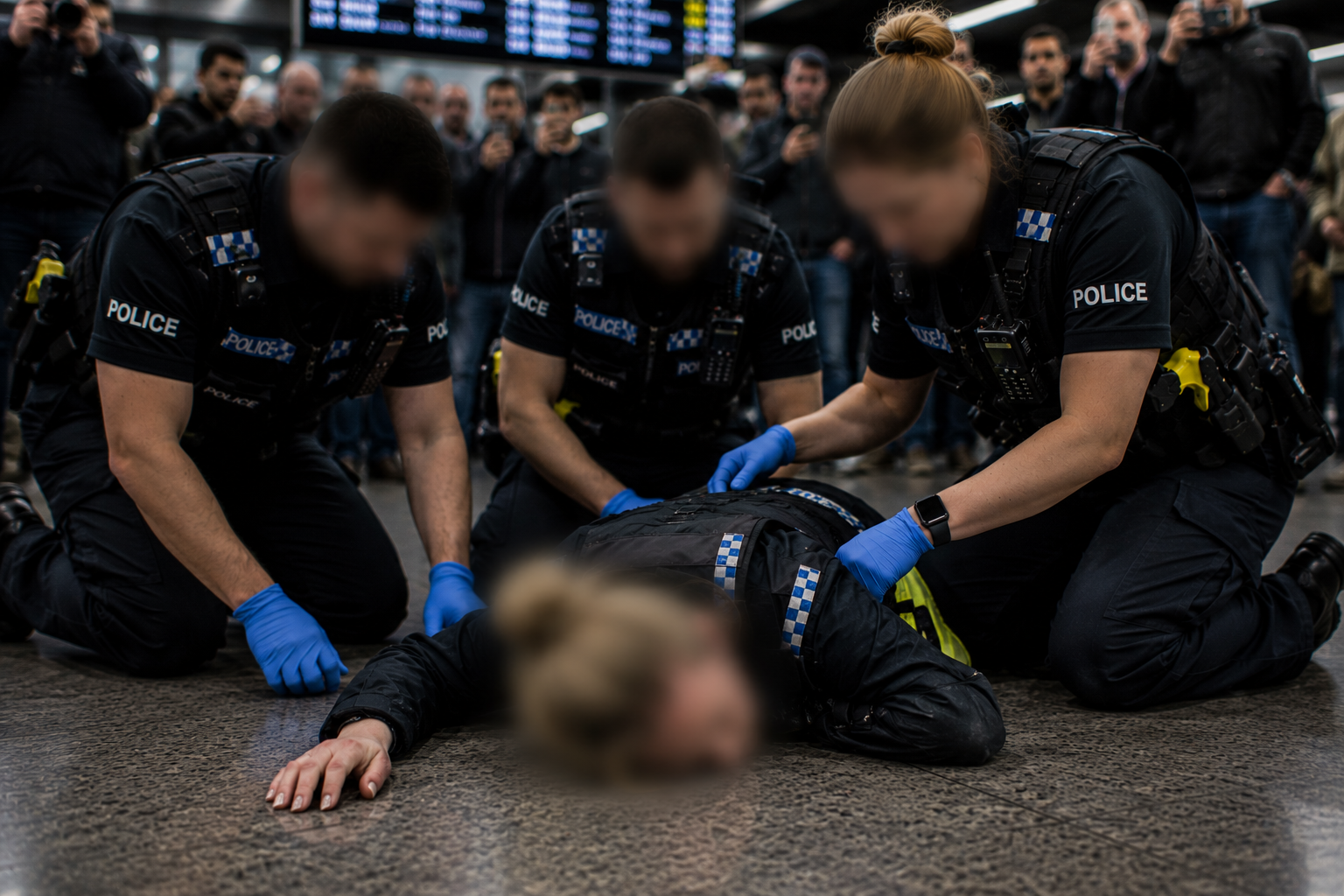
The police assault case at Manchester Airport has become one of the most combustible justice stories in Britain because the public thinks it has already seen enough. The footage was violent, the injuries were real, and the confrontation involved police officers doing their job in one of the country’s busiest transport hubs. To many viewers, the case looked brutally straightforward.
But the courtroom did not deliver the clean ending many expected. Mohammed Fahir Amaaz, from Rochdale, was convicted after a previous trial of common assault and two counts of actual bodily harm after violence involving a member of the public and two female police officers. Yet when the case moved to allegations involving PC Zachary Marsden, juries struggled to reach verdicts. Greater Manchester Police confirmed in 2025 that Amaaz had been convicted over assaults on two female officers and a member of the public, while the jury could not decide on the allegations involving the male officer.
That unresolved part is what has now detonated politically. A later retrial at Liverpool Crown Court also ended without verdicts after the jury failed to agree on allegations that Amaaz and his brother Muhammad Amaad assaulted PC Marsden, causing actual bodily harm. The result does not legally mean innocence. It means the jury could not reach the required decision. But to the public watching the wider footage and hearing about injured officers, that distinction feels painfully thin.
The deeper danger is not simply anger at one jury. It is the feeling that the justice system is becoming unreadable. A system can survive unpopular decisions when the public trusts the process. It becomes far more fragile when people start believing the process itself protects the wrong people, delays the obvious, and moves hardest only when politics is involved.
The Attack That Turned One Clip Into A National Test
The known timeline began with an incident at Manchester Airport on July 23, 2024. The Crown Prosecution Service later charged Mohammed Fahir Amaaz with two counts of actual bodily harm, one charge of assaulting an emergency worker and one charge of common assault. Muhammad Amaad was charged with causing actual bodily harm.
The CPS also confirmed that no police officers would be charged after reviewing video footage, witness statements, expert reports and material relating to police use of force. That final point matters because the original public reaction to the case was shaped by footage appearing to show police force against a man on the ground. That image drove outrage in one direction. Later footage and court evidence sparked outrage in the opposite direction.
Suddenly, some framed a case as police brutality, while others saw it as a brutal example of officers attacking while institutions hesitated.
The confirmed public record is stark enough without embellishment. Amaaz has been convicted over assaults on two female officers and a member of the public. The unresolved trial issue concerns whether the brothers unlawfully assaulted PC Marsden, with the defence arguing self-defence and the jury failing to reach an agreement.
That legal complexity is precisely why the case has become so explosive: the public sees violence, while the court must test charge, intent, lawfulness, force, sequence and reasonable doubt.
The Offender History Question Is Politically Dangerous
The phrase “history of the offenders” needs careful handling because the public record supports only reporting a criminal past that has been officially confirmed. What is confirmed is narrower but still serious.
Amaaz has been convicted in connection with the Manchester Airport incident itself: common assault and two counts of actual bodily harm following a four-week Crown Court trial. The CPS charging record also confirms the original set of charges brought against both brothers.
That distinction matters. Amaaz is now a convicted offender in relation to parts of the airport incident. Amaad remains an accused man in relation to the unresolved allegation concerning PC Marsden unless and until a conviction is secured.
A serious article cannot simply collapse the legal difference between conviction, charge and allegation because doing so would hand critics an easy attack line.
But the public anger does not depend on inventing anything. The confirmed case already contains enough force: an airport confrontation, police officers injured, a member of the public assaulted, video evidence, a conviction on some counts, and repeated jury deadlock on others.
That combination creates the exact sense of institutional failure that drives modern justice outrage.
Online, people have also seized upon the religious identity of the defendants. That is politically real, but legally separate. There is no public evidence that the jury failed to convict because the defendants are Muslim, and any responsible analysis must say that clearly.
The stronger argument is not that a jury protected men because of religion. The stronger argument is that Britain’s justice system now operates inside such a deep trust crisis that identity, politics and suspicion rush into every unresolved case.
Why The “Jail For Tweets” Comparison Will Not Go Away
The comparison with online speech prosecutions is the reason this story has become bigger than one airport case.
In August 2024, the CPS announced that Tyler Kay had been convicted just one day after posting an online message calling for hotels housing asylum seekers to be set alight. The CPS also confirmed that Lucy Connolly was jailed for two years and seven months after admitting inciting racial hatred through a social media post following the Southport killings.
Those cases were not “just tweets” in the harmless sense. They involved incitement, racial hatred and calls for violence during a volatile period. That matters because speech that encourages arson, attacks or mass intimidation can become a real-world public safety issue.
A serious society cannot pretend online incitement is always consequence-free.
Yet the political comparison is still devastating. When people see online speech cases move rapidly while a violent airport case involving injured police officers drags through investigations, trials, retrials and jury deadlock, they do not parse procedural distinctions.
They see priority. They see velocity. They see a state that can move like lightning against a keyboard but like treacle when a police officer is allegedly assaulted.
The argument is no longer only about whether specific speech prosecutions are lawful. It is about whether the justice system appears proportionate.
If words can bring swift punishment but violent cases turn into procedural marathons, the public begins to suspect that someone has inverted the moral order.
The Taxpayer Bill Is The Part Nobody Can Ignore
There is no verified public figure for the full taxpayer cost of this specific Manchester Airport case. Any precise number would be guesswork.
But the public cost chain is obvious: police investigation, bodycam and CCTV review, CPS work, court time, barristers, legal aid where applicable, jury administration, judge time, security, custody, potential retrial preparation, and the opportunity cost of courtrooms that could have been handling other cases.
This lands inside a criminal court system already under extraordinary pressure.
Ministry of Justice figures showed more than 80,000 open Crown Court cases by the end of 2025, the highest level in the modern statistical series and more than double the 2019 level. Jury-trial defendants pleading not guilty were also waiting well over a year on average for cases to conclude.
That is the real taxpayer scandal. It is not only that one case costs money. It is that every unresolved case consumes scarce capacity inside a system already close to overload.
Every day spent retrying disputed allegations is a day the public pays for the machinery of delay.
Every collapsed or deadlocked trial deepens the sense that the taxpayer funds the process without finality.
The cost is also moral. Police officers watch colleagues injured and then see cases stretch on. Victims wait. Defendants wait. Juries are called. Lawyers are paid. Courts fill up.
The public, already battered by tax, inflation and service failure, sees another expensive institutional loop and asks a simple question: what exactly are we buying?
The Bigger Crisis Is Trust, Not One Verdict
A jury’s failure to reach a verdict is not proof of corruption, cowardice or political interference. Juries are allowed to disagree. They are asked to decide specific legal questions beyond reasonable doubt, not deliver emotional satisfaction to the public.
That principle still matters.
But legal correctness does not erase political damage.
The Manchester Airport case has landed in a country already primed to believe in unequal enforcement. Many people think police are too weak when facing real violence, too eager when policing speech, too slow when victims need justice and too fast when institutions feel embarrassed.
Fair or unfair, that perception is now a national problem.
The most dangerous version of this story is not 'two men walked free. 'That is not the full legal picture, because Amaaz has already been convicted of serious parts of the incident.
The more dangerous version is this: Britain now has a justice system that is so slow, expensive and distrusted that even partial convictions cannot stop the public feeling cheated.
That is why this case matters.
It is about injured officers. It is about video evidence. It is about self-defence arguments. It is about jury deadlock. It is about speech prosecutions. It is about court backlogs.
But above all, it is about whether the British state can still convince ordinary people that punishment, process and priority belong to the same moral universe.
