

The UK–Ukraine 100-Year Partnership and the Domestic Backlash It May Invite
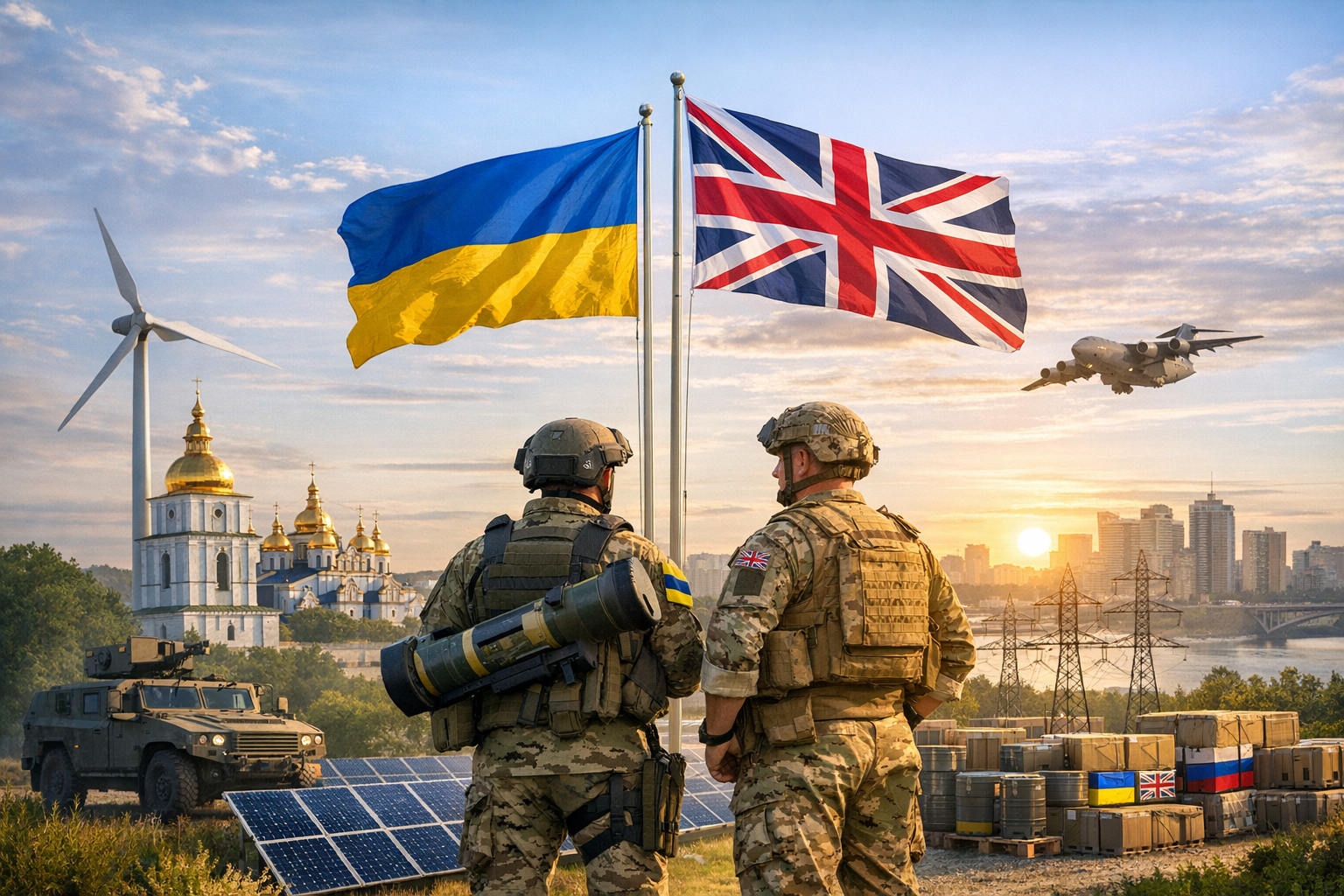
UK marks the 100 Year Partnership anniversary with new funding and initiatives. A capability ledger of what’s truly new—and what it changes.
UK–Ukraine 100-Year Partnership Anniversary: The New Support That Actually Changes 2026
The UK government marked the first anniversary of the UK–Ukraine 100 Year Partnership in Kyiv with a cluster of “published today” updates and a headline funding move: an additional £20 million for emergency energy infrastructure support.
The obvious story is solidarity plus money. The more important story is capacity: the UK is quietly building the plumbing that turns promises into delivery—through trade finance, legal training, and a physical defence-industry presence in Kyiv that targets the bottlenecks that usually kill momentum.
The UK’s announcements span three domains—energy resilience, defence-industrial acceleration, and reconstruction/reform. Each comes with different constraints, different clocks, and different ways it can fail.
The story turns on whether the UK’s new pledges become operational capacity.
Key Points
The UK announced a further £20 million for urgent energy infrastructure repairs and protection in Ukraine on January 16, 2026, framed as emergency support during severe winter conditions.
The UK is expanding the UK–Ukraine school twinning program, with 54,000 pupils expected to benefit and 300 additional schools set to join over the next three years.
A UK-funded Ukraine Business Centre is scheduled to open in Kiev later in 2026 to help smaller UK defence firms overcome security, insurance, and operating barriers and match Ukrainian needs with UK suppliers.
The UK says Octopus interceptor drone production will begin this month, with plans to produce thousands per month—positioned as a lower-cost counter to mass drone attacks.
New “reform and reconstruction” initiatives include specialised training for Ukrainian commercial judges, a UK Export Finance memorandum with Ukraine’s export credit agency, and three UK-led development programs (including school infrastructure upgrades and a net-zero housing initiative).
The 2026 impact depends less on headline amounts and more on execution constraints: physical security, procurement speed, insurance and compliance, supply chains, and Ukraine’s ability to absorb funds into projects fast.
Background
The UK–Ukraine 100 Year Partnership was signed in January 2025 and set out long-term cooperation across security, economy, and societal ties. One year later, the UK chose to mark the anniversary not with a single grand package, but with several specific “delivery enablers” across different departments.
Energy is the immediate pressure point. Russia’s repeated strikes on electricity generation and distribution create a grim loop: repairs restore service, attacks destroy repairs, and winter multiplies the human cost. In parallel, defence support has increasingly shifted toward industrial throughput—how quickly equipment can be produced, adapted, and fielded.
Reconstruction and reform sit on a longer timeline but matter for investment confidence. Businesses and donors care about contract enforcement, dispute resolution, and the credibility of financial backstops. That is why seemingly technical initiatives—commercial judge training and export credit coordination—can matter more than they look.
Analysis
Political and Geopolitical Dimensions
The anniversary package is a signal to three audiences at once: Ukraine, Russia, and allied capitals.
For Ukraine, the message is stamina. The UK is anchoring itself in Kyiv—not just diplomatically, but operationally—by announcing a defence-industry facility intended to shorten delivery cycles and widen the supplier base.
For Russia, the package aims to show that attacks on civilian infrastructure do not create “aid fatigue,” but trigger incremental reinforcement. The risk is escalation logic: emergency repair funding is necessary, yet it can become a predictable rhythm rather than a deterrent.
For allies, this is also coordination theatre. The UK is implicitly advertising a model: blend emergency civilian resilience (energy) with defence-industrial acceleration (hardware) and investment scaffolding (export finance + judicial capacity).
Plausible scenarios:
Scenario A: Sustained winter emergency drives faster allied energy coordination.
Signposts: more rapid disbursements, larger parallel pledges, tighter coordination mechanisms for spare parts and repairs.Scenario B: Support fragments into siloed programs with uneven momentum.
Signposts: announcements without follow-on contracts, slow procurement, sporadic delivery reporting.Scenario C: Political bandwidth shifts to ceasefire architecture and troop-readiness planning.
Signposts: public emphasis on “security guarantees,” readiness funding, and post-conflict stabilization planning.
Economic and Market Impact
The £20 million energy injection alone does not significantly alter the macroeconomic landscape. Its economic value is tactical: it reduces outage hours, protects industrial continuity, and stabilizes basic services that keep cities functioning.
The bigger economic play is the set of measures aimed at “bankability” in reconstruction. Export credit collaboration can de-risk projects by supporting trade finance and payment confidence for UK firms operating in or supplying Ukraine. Commercial court capability matters because investors price legal uncertainty. If disputes become predictable and enforceable, capital is cheaper.
The Kyiv defence-industry centre also has a domestic UK economic angle: it is explicitly framed as opening markets for small and mid-sized firms and supporting jobs. But the constraint is not demand; it is access—security, insurance, compliance, and the difficulty of operating in-country.
Plausible scenarios:
Scenario A: De-risking tools unlock a steady mid-market pipeline for UK suppliers.
Signposts: increased SME participation, repeat contracting, more export credit usage.Scenario B: Activity concentrates among a few prime contractors.
Signposts: SME drop-off, long lead times, contracts clustered in a small supplier set.Scenario C: Higher security and insurance costs choke execution.
Signposts: project delays attributed to underwriting, staff deployment limits, higher risk premiums.
Domestic Political Backlash in the UK
The most immediate risk to delivery in 2026 is not Kyiv’s demand, but Westminster’s bandwidth and Britain’s tolerance for open-ended commitments. Ukraine support has been politically durable, but durability is not the same as elasticity. As budgets tighten and public services remain strained, the marginal pound becomes the argument: not “should the UK support Ukraine,” but “what gets cut, delayed, or deprioritized to keep doing it.”
Backlash is most likely to form along three seams. First, cost-of-living politics: any perception that government is writing checks abroad while households face high bills is combustible, even when the sums involved are small relative to total spending. Second, war-duration fatigue: as the conflict stretches, critics can frame support as “forever spending” without a visible endpoint. Third, security spillovers: if UK support is linked—fairly or not—to heightened risk at home (cyber incidents, disinformation, threats, protests), it can become a domestic law-and-order issue rather than a foreign policy one.
Several plausible pathways could emerge in 2026. One is “soft backlash,” where support remains in place but becomes slower and more conditional; the signposts would be more cautious language about affordability, heavier emphasis on oversight, and a pivot toward smaller, more defensible tranches of funding. A second is “politicized backlash,” where Ukraine policy becomes a wedge issue; the signposts would be rising parliamentary rebellion, louder demands to ring-fence domestic spending, and campaigns that tie Ukraine aid to everyday hardship. A third is “shock-driven backlash,” triggered by a domestic incident—real or perceived—linked to the conflict; the signposts would be sudden calls to pause or audit programs, sharper rhetoric about risk, and pressure to redirect resources toward homeland security.
For the UK’s 2026 capability ledger, this matters because domestic backlash rarely cancels policy overnight. It changes the operating environment: slower approvals, tighter procurement rules, fewer ministerial “wins” available to protect programs, and a greater need for measurable outputs. If the political weather turns, the winners are the initiatives that can prove impact quickly and cheaply, and the losers are the ones that look worthy but vague.
Technological and Security Implications
The defence-announcement stack is about shortening the adaptation loop. Modern battlefield tech evolves in days and weeks, not procurement years. The UK’s planned Kyiv centre is designed to move UK firms closer to Ukrainian requirements and feed them fresher operational data so products can iterate faster.
The Octopus interceptor drone line is presented as a cost-exchange move: cheaper interceptors aimed at mass drone threats, freeing more expensive air defence assets for higher-end targets. If the production targets are met, it could meaningfully alter the “economics of harassment” that drone campaigns rely on.
Energy resilience is also a security-tech problem. Repair funding buys time, but protection—hardening, redundancy, distributed generation, and rapid restoration capacity—determines whether the grid becomes more survivable or just repeatedly patched.
Plausible scenarios:
Scenario A: Drone-interceptor scaling reduces the impact of mass drone raids.
Signposts: deployment volume, measurable reduction in successful strikes on critical nodes.Scenario B: Production meets targets but integration lags.
Signposts: stockpiles without deployment, training bottlenecks, unclear command-and-control fit.Scenario C: Energy infrastructure becomes more distributed and resilient.
Signposts: more redundancy projects, visible hardening programs, faster restoration metrics.
What Most Coverage Misses
The real delta here is not the £20 million. It is the UK’s attempt to attack the delivery bottleneck directly.
Most “support packages” fail in the seam between announcement and execution: security rules prevent site visits, insurance blocks deployment, procurement is too slow for wartime cycles, and SMEs cannot navigate Ukraine’s requirements or contracting channels. The Kyiv defence-industry centre is explicitly a response to those frictions. If it works, it changes 2026 by increasing throughput and widening the supplier base—turning support from episodic packages into a working pipeline.
The same logic applies to reconstruction. Commercial judge training and export credit cooperation look bureaucratic, but they are exactly the kinds of inputs that can convert donor intent into investable projects. In 2026, the UK’s most meaningful move may be that it is investing in the boring machinery that makes follow-through more likely.
Why This Matters
In the short term (days to weeks), emergency energy support matters because winter turns blackouts into a health and safety crisis. Hospitals, schools, and basic heating are the near-term stakes.
In the medium term (months), the defence industry centre and the drone-interceptor scale target a different metric: whether Ukraine and its partners can keep adapting faster than Russia can destroy.
In the long term (years), investment confidence will hinge on reconstruction credibility: predictable courts, credible financial backstops, and a functioning pipeline from UK capability to Ukrainian demand.
Events and decision points to watch in 2026:
The opening timeline and operating model of the Kyiv defense-industry centre (who can use it, what services it provides, and how quickly it matches needs with suppliers)
Evidence of scaled production and field deployment of lower-cost drone interceptors.
Whether energy support shifts from emergency repairs toward hardening, redundancy, and distributed resilience.
Real-World Impact
A hospital administrator in a regional city utilises energy support to ensure the operation of generators, prevent ward closures, and sustain heating during a severe cold spell.
A UK mid-sized defence supplier that could not previously operate in-country uses the Kyiv Centre to understand requirements, validate compliance, and shorten contracting timelines.
A Ukrainian school district uses reconstruction-linked programming to repair buildings, restore safe learning spaces, and reduce disruption that keeps families moving.
A UK engineering firm considers bidding for housing and infrastructure work but bases the decision on whether contracts can be enforced quickly and predictably.
The 2026 Test: From Anniversary Statements to Working Systems
This anniversary package is less a single “big bang” than a portfolio of levers—some immediate, some structural. The emergency energy money buys survival time. The reconstruction tools aim to lower transaction costs. The defence industry centre is designed to convert industrial capabilities into deliveries at wartime speed.
The fork in the road is simple: either these mechanisms create a repeatable pipeline that survives politics and headlines, or they become another set of well-phrased commitments trapped behind procurement drag and operational risk. Watch for the operational proof—open doors, signed contracts, delivered hardware, restored power—because that is where 2026 will be decided, and where this moment will be remembered as either infrastructure for a century or just a slogan for one winter.
