What The “Cover-Up” Narrative Around Keir Starmer Really Reveals About Britain’s Political Breakdown
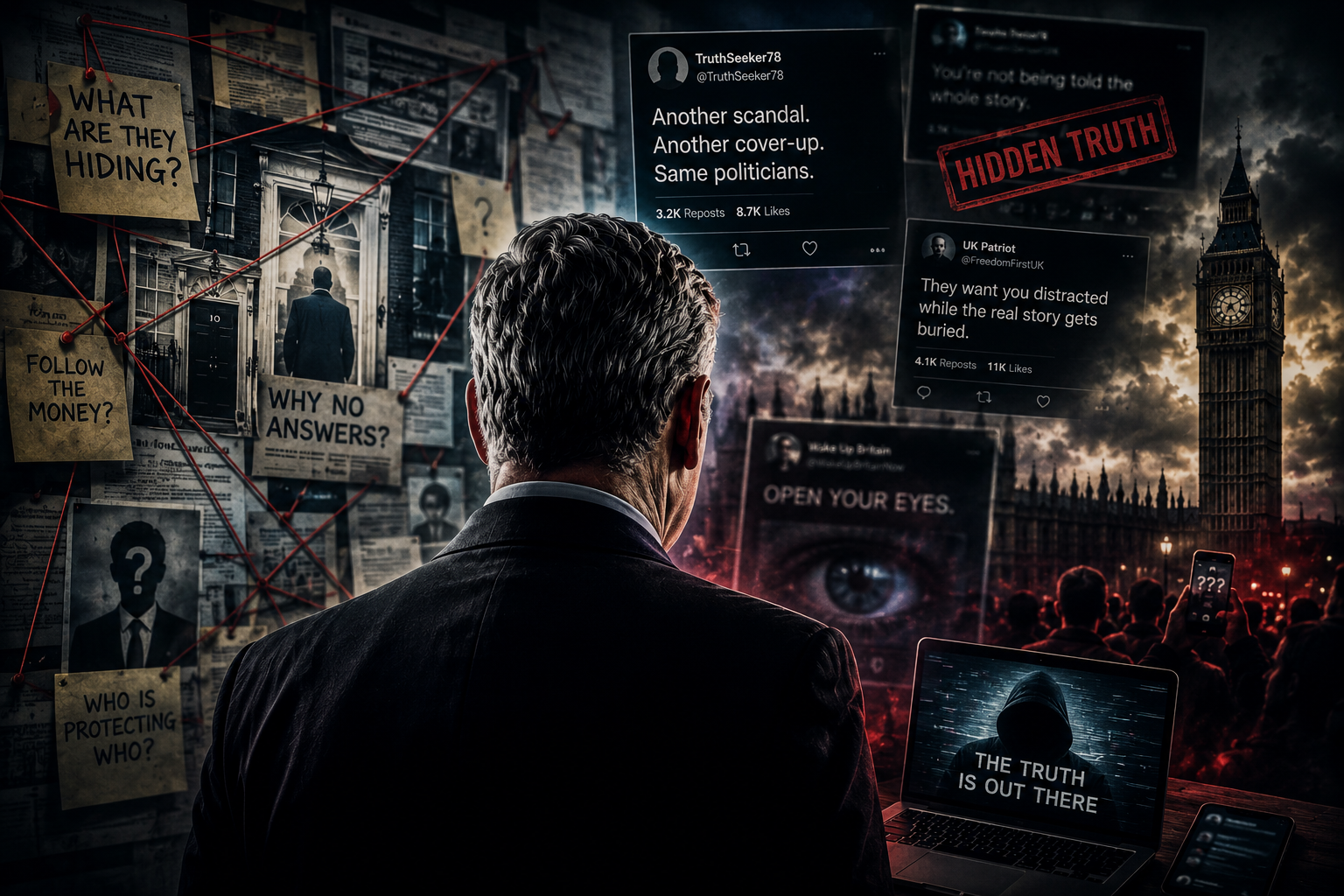
The Online Revolt Around Keir Starmer Is Becoming Something Much Darker
Why The Internet Suddenly Thinks Keir Starmer Is Hiding Something Bigger
The Internet Is No Longer Asking Simple Political Questions
Something changed in British politics this week.
The local election losses were already severe enough to shake Labour internally, with major gains for Reform UK exposing growing voter anger across parts of England and Wales. But the political damage did not stop with the results themselves.
Instead, a far more emotionally charged narrative exploded online afterwards.
Across X, TikTok, YouTube comment sections, political livestreams, and increasingly aggressive online discussion spaces, the language surrounding Prime Minister Keir Starmer has started shifting away from ordinary criticism and toward something much darker: accusations of concealment, managed narratives, institutional protection, and "cover-ups".
That word now appears constantly in online discussion around Labour.
Not always attached to one specific allegation. Not always tied to one identifiable event. But increasingly attached to a broader emotional feeling that something about modern British politics no longer feels transparent.
That is the real story developing underneath the headlines.
And it may become one of the defining political risks facing Labour before the next general election.
The election damage opened a much bigger psychological crack.
The immediate trigger was Labour’s bruising election performance.
The results exposed serious weaknesses in areas once considered politically secure. Reform UK surged in several traditional Labour territories, while voter fragmentation accelerated across multiple regions.
But elections alone do not create “cover-up” narratives.
Distrust does.
And Britain has been moving toward a credibility crisis for years.
The public mood now feels radically different from even a decade ago. Trust in institutions has deteriorated after repeated political shocks: Brexit divisions, lockdown anger, economic stagnation, migration disputes, inflation pressure, public service strain, and a constant sense that political messaging rarely matches lived reality.
The consequence is that every major political controversy now mutates online into something larger.
Not merely incompetence.
Not merely failure.
But suspicion.
That suspicion becomes especially dangerous when attached to leaders who built their public identity around professionalism, competence, and restoring trust.
That was central to Starmer’s original political appeal.
Now critics increasingly frame him as the symbol of a political class they believe says one thing publicly while managing a different reality privately.
The emotional shift is enormous.
Why The Word “Cover-Up” Is Suddenly Everywhere
Part of the problem is that multiple controversies have started blending together online into one larger anti-establishment narrative.
The Mandelson backlash intensified that trend dramatically earlier this year, especially after pressure mounted over appointments, vetting questions, and internal Labour tensions.
Other controversies surrounding lobbying accusations, ethics questions, institutional transparency, immigration pressure, and leadership manoeuvring have all become absorbed into the same broader internet ecosystem.
That matters because modern online political culture rarely treats controversies separately anymore.
Instead, people connect them emotionally into one unified interpretation.
One controversy becomes “evidence” for another.
One political mistake becomes proof of systemic dishonesty.
One communications failure becomes interpreted as deliberate concealment.
This is why the “cover-up” framing is spreading even when different users online are talking about entirely different subjects.
For some, the phrase refers to Labour infighting.
For others, establishment media is distrusted.
For others, immigration.
For others, political donor influence.
For others, elite protection networks.
For others, Westminster itself.
The common thread is psychological, not factual.
A growing number of voters simply no longer trust official framing.
That may be the most politically dangerous development of all.
The Internet Rewards Suspicion More Than Explanation
Modern political communication is structurally bad at handling distrust.
Official statements are slow.
Online narratives are fast.
Institutions communicate cautiously.
Algorithms reward outrage, certainty, and emotional escalation.
And once a political figure becomes trapped inside a distrust cycle, almost every attempt to calm the situation can accidentally intensify it instead.
That is increasingly what appears to be happening around Starmer.
The more Labour figures insist there is “nothing to see", the more some online communities interpret that language as proof of elite coordination.
The dynamic becomes self-reinforcing.
That does not mean every online accusation is true. Many are speculative, exaggerated, or unsupported. Some are openly conspiratorial.
But politically, that distinction is no longer enough on its own.
Perception now moves faster than institutional credibility.
And Britain’s collapsing trust environment has made that extraordinarily dangerous for establishment parties.
The wider backdrop matters too, because Western politics is entering a deeper credibility crisis.
What is happening around Starmer is not isolated.
It fits a broader collapse in public confidence spreading across multiple democracies simultaneously.
Labour’s Bigger Problem Is Emotional, Not Electoral
This is the detail many political strategists still underestimate.
Voters can forgive failure.
They often cannot forgive perceived dishonesty.
And once a leader becomes psychologically associated with concealment, political recovery becomes dramatically harder.
That is why the online language around Starmer matters even if many specific claims remain vague, emotional, or inconsistent.
The narrative itself becomes politically real.
Online distrust ecosystems operate less like traditional journalism and more like emotional pattern recognition.
People collect fragments.
They connect dots.
They search for contradictions.
They assume hidden motives.
And once enough voters begin interpreting politics through that lens, every future controversy becomes amplified automatically.
This is part of the reason Reform UK has benefited so heavily from anti-establishment energy.
The movement is feeding not only on policy dissatisfaction but also on institutional exhaustion itself.
That distinction matters enormously.
Because institutional exhaustion is much harder to reverse than a normal polling slump.
The Political Centre Is Losing Control Of Narrative Power
For decades, traditional politics relied heavily on controlling the pace of public understanding.
Official announcements.
Broadcast interviews.
Managed press cycles.
Structured debate.
That world is disappearing.
Now political meaning forms in real time online through fragmented viral interpretation.
Memes.
Clips.
Threads.
Reaction videos.
Livestream debates.
Algorithmic outrage.
Emotional speculation.
The result is a political environment where “cover-up” narratives spread with extraordinary speed because they match the emotional instincts of distrust already present inside the public.
This is especially true during periods of economic pressure and institutional decline.
The danger grows further when political messaging feels overly scripted or managerial.
That criticism increasingly surrounds Starmer personally.
Even many former Labour supporters now describe him less as inspiring or authentic and more as controlled, distant, cautious, or heavily stage-managed.
Fair or unfair, perception matters more than intent in modern politics.
And perception is now moving against Labour at alarming speed.
The wider consequences could become severe if Britain’s political fragmentation continues accelerating.
The Bigger Fear Beneath The Noise
Most people discussing “cover-ups” online are not conducting formal investigations.
They are expressing something emotional.
A fear that the system itself no longer feels honest.
That fear is becoming one of the defining political emotions of the decade.
It explains why trust collapses faster than governments expect.
Why online narratives spread so aggressively.
Why anti-establishment movements gain traction rapidly.
Why institutional language increasingly fails to persuade voters.
And why Britain’s political environment now feels unstable in a way that would have seemed extraordinary only a few years ago.
The immediate crisis may eventually fade.
Election cycles move quickly.
Political attention shifts constantly.
But the deeper credibility problem underneath this moment looks far more structural.
That is the real danger facing Starmer.
Not simply losing votes.
Losing trust itself.
