

Why Britain’s Most Ridiculous Arrests Now Feel Like A Cost Of Living Insult
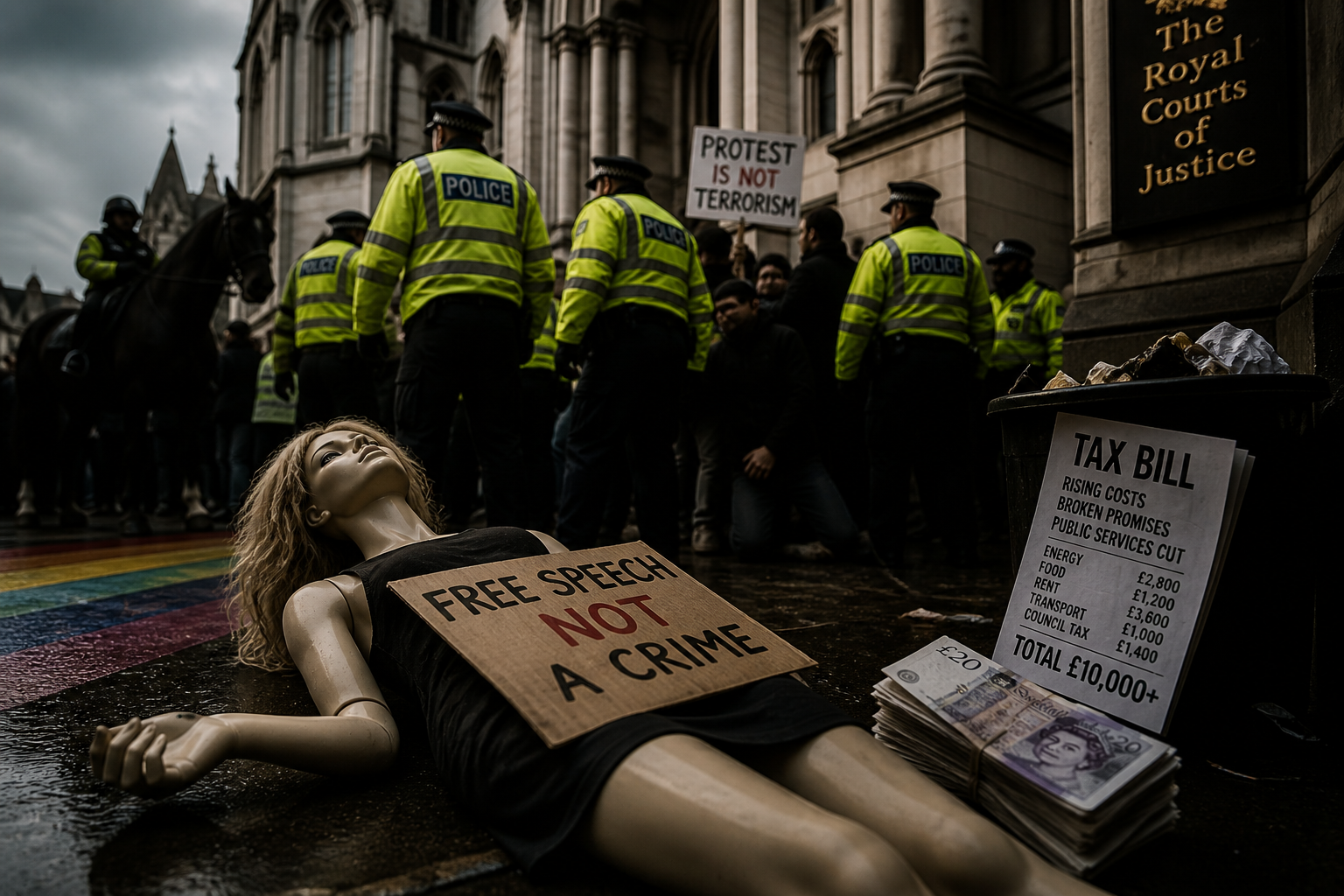
The Hidden Cost Of Britain’s Most Ridiculous Arrests
When Everyday People Are Struggling, Every Absurd Arrest Feels Like An Insult
A mannequin on the pavement. A dog was taught a stupid trick. A tweet sent in anger. A Facebook post writtea moment of strong emotionoment. A rainbow crossing that even police horses reportedly needed training to handle.
Individually, these moments can look trivial. Together, they form something far more serious: a growing public belief that the UK is spending real money policing the wrong things at exactly the wrong time. Not imaginary money. Not abstract departmental money. Taxpayer money, taken from ordinary people through income tax, national insurance, VAT, fuel duty, council tax, insurance tax, and the quiet machinery of everyday life.
That is why the mannequin arrest spread so quickly. Not because it was the most extreme case Britain has ever seen, but because it looked like the purest version of a more profound problem: visible, expensive state power being applied to something that felt symbolic rather than dangerous.
The facts matter. Police did not arrest a mannequin simply because it “hurt feelings.” The arrest was related to protest activity linked to Palestine Action, which had been proscribed under UK anti-terrorism law. Reuters described police outside the Ministry of Justice arresting a protester with a mannequin holding a placard in support of Palestine Action, while Amnesty UK criticized arrests at the protest, including the mannequin incident. That legal context matters. But legality does not automatically equal proportionality. In a cost-of-living crisis, proportionality is everything.
Because when people are struggling with rent, mortgages, food, energy bills, and council tax, every absurd-looking arrest now comes with an obvious question attached: how much did that cost us?
The Dog Case That Turned Bad Taste Into A Police Matter
Long before the mannequin, there was the pug.
In 2016, Scottish YouTuber Mark Meechan, known online as Count Dankula, uploaded a video showing his girlfriend’s pug responding to Nazi phrases. The video was crude, offensive, and deliberately provocative. He said it was a joke intended to annoy his girlfriend by making the dog appear as un-unappealing as possible. Police arrested him. He was prosecuted. In 2018, he was convicted under the Communications Act and fined £800.
That case became a cultural flashpoint because it forced a question most people had never seriously had to answer: Where does offensive behavior end and criminal behavior begin?
For some, the answer was obvious: the content was anti-Semitic, grossly offensive, and deserved prosecution. For others, it was an alarming moment where the state criminalized a joke, however tasteless. But even if someone believes the conviction was legally correct, the public spending point remains. That case required police time, investigation, evidence review, prosecution, court time, legal argument, judicial resources, and administrative processing.
All for a dog video.
That is the part ordinary people remember. Not the exact statutory wording. Not the legal test. Not the procedural detail. They remember that the police, prosecutors, and courts were mobilized because a man taught a pug a grotesque trick on the internet.
And once that becomes possible, the public begins to ask what else the state will spend money on.
The Scale Of Online “Offence Policing” Is Not Small
This is not a fringe issue. It is systemic.
In 2023, police made 12,183 arrests under section 127 of the Communications Act 2003 and section 1 of the Malicious Communications Act 1988, according to figures raised in Parliament. That is roughly 33 arrests per day. The same parliamentary discussion noted that fewer than 10% of the 1,119 people arrested were convicted and sentenced.
That does not mean all of those arrests were silly. Some online communication cases involve serious threats, stalking, harassment, racist abuse, targeted intimidation, or incitement of public disorder. Those are legitimate policing matters. Everyone serious agrees that violent threats should be treated seriously, regardless of whether they were typed or spoken.
The problem is the breadth of the category. “Grossly offensive” and “malicious” communications can drag the police into territory that many people see as speech, stupidity, anger, bad taste, politics, offense, sarcasm, or emotional overreaction. That is where public patience starts to collapse.
Every one of those cases can trigger an expensive chain: complaint handling, officer review, digital evidence capture, arrest planning, travel, custody, interview, disclosure, CPS advice, charging decision, court listing, prosecution, defense, judicial time, and sometimes prison. A single post can activate machinery that was built for crime but increasingly feels like it is being used for offense management.
Even with conservative estimates, the costs can escalate quickly. Police charging guidance for 2025 lists a national constable's full economic cost rate of £87.29 per hour for chargeable policing services. That is not the exact internal cost of every arrest, but it is a useful benchmark because it reflects the wider cost of supplying police labor, not just basic salary.
Apply that benchmark cautiously to online communications arrests. If each of the 12,183 arrests consumed only four officer-hours across complaint review, attendance, arrest, processing, and paperwork, that is about £4.25 million in police labor cost alone. If each consumed eight officer-hours, that becomes about £8.5 million. If more complex cases required 15, 20, or 30 hours across multiple officers, custody, digital evidence, and supervisor review, the figure climbs sharply.
And that is before court.
The Courtroom Bill Makes “Just A Tweet” Much More Expensive
A tweet is free to send. A prosecution is not.
CPS cost guidance lists prosecution cost figures of £85 for an early guilty plea in the magistrates’ court, £400 for a late guilty plea or cracked trial, and £650 for a magistrates’ court trial. Crown Court matters can be far pricier, with listed prosecution cost figures including thousands of pounds depending on the type of hearing and trial length.
Even if you apply only the low magistrates’ court figures to the 1,119 convicted and sentenced online communications cases, the prosecution cost range quickly becomes meaningful. At £85 each, that is about £95,000. At £650 each, that is about £727,000. If a smaller number moves into more complex proceedings, the figure rises again.
But the official prosecution cost figure still does not capture the whole public cost. It does not include all police investigation time. It does not capture the full opportunity cost of courtrooms, custody suites, legal aid, probation, prison capacity, administration, appeals, or the time taken away from other cases. The true cost is not just the number printed on a costs schedule. The true cost is the entire chain of public labor required to turn an online post into a criminal justice event.
This is why people become angry. They are not just asking whether a post was unpleasant. They are asking why a state that cannot always respond quickly to burglary, shoplifting, grooming gangs, antisocial behavior, or fraud appears able to mobilize quickly around speech.
That comparison is politically lethal.
Prison Turns Absurdity Into A Five-Figure Or Six-Figure Bill
The cost becomes even harder to defend when these cases lead to custody.
Ministry of Justice prison performance data covers the direct and overall cost of prison places and prisoner populations. Reporting on the 2024/25 data put the average cost per prisoner in a public-sector prison in England and Wales at £60,018 per year.
That means the rough public cost of custody can be understood like this:
8 weeks in prison: around £9,200
6 months in prison: around £30,000
1 year in prison: around £60,000
2 years in prison: around £120,000
3 years in prison: around £180,000
Those are broad average-cost estimates, not case-by-case invoices. But they show the scale. Once a communications case crosses into imprisonment, the public is no longer paying for a police visit or a court hearing. It is paying for a prison place, prison staff, healthcare, security, food, administration, and system capacity.
That is where the phrase “just a tweet” becomes financially misleading. The tweet might be free. The state response can be enormous.
Again, some online speech cases are serious. Direct threats, incitement to violence, and targeted harassment can ruin lives and escalate into real-world danger. But if the law and police culture do not clearly separate true threats from offenses, then the public starts seeing prison as the end point of hurt feelings, institutional embarrassment, or political discomfort. That perception is poisonous.
The mannequin arrest became a perfect symbol.
The mannequin case hit so severely because it stripped the argument down to an image.
A mannequin cannot commit violence. It cannot run away. It cannot resist arrest. It cannot form criminal intent. It cannot threaten a member of the public. Yet the image of police apparently removing or arresting a mannequin at a protest created exactly the sort of visual that destroys institutional credibility.
The legal issue was not that the plastic body itself had committed a crime. The issue was the placard and the context of support for a proscribed organization. But the public saw a mannequin being treated like an enforcement object, and the internet did what the internet always does: it compressed complexity into ridicule.
That ridicule matters because it exposes a weakness in the state’s own strategy. If the public sees counter-terror law used in absurd ways, support for serious counter-terror powers weakens. If people see police treating symbolic protest like a major threat while they leave everyday crimes unresolved, they do not become more respectful of authority. They become more cynical.
And cynicism is expensive. It makes cooperation harder, reporting weaker, compliance lower, and trust thinner.
The visible two minutes are not the real cost.
When people see 20 or 30 officers around one incident, they naturally do the visible calculation first. Thirty officers standing around for two minutes equals 60 officer-minutes, or one officer-hour. At a simple salary-only estimate, that might look like a small amount. That visible two-minute cluster might cost around £87 at a full economic policing benchmark.
But that is not the real cost. That is just the camera-visible cost.
A single arrest can involve radio control, deployment decisions, travel time, supervisor oversight, risk assessment, officer briefing, arrest itself, transport, custody booking, interview preparation, digital evidence review, statements, charging advice, legal consultation, file building, disclosure, court time, and possible complaints handling. If multiple officers attend, several may write notes, submit statements, or be tied up afterwards.
So the real calculation is not “30 officers for two minutes.” The better calculation is, how many total public-sector hours did the incident generate from first complaint to final disposal?
For a low-complexity arrest, the answer might be several hours. For a contested protest, online speech, or public order case, it could be dozens of hours. For a case that reaches trial, the public cost can spread across police, CPS, courts, legal aid, the judiciary, prisons, probation, and administration.
That is the hidden bill behind a viral clip.
Even the side costs add up.
One of the least discussed parts of policing cost is what happens after enforcement action creates a new administrative burden.
Take seized dogs. Every sensible person agrees police should seize dangerous animals. But the kennel costs show how quickly enforcement creates follow-on spending. Freedom of Information data from the Metropolitan Police showed kennel costs for seized dogs of £1.76 million in 2023/24, £3.7 million in 2024/25, and £3.78 million for a partial 2025 period.
That is not about one dog. It is about system cost. Once the state intervenes, it often owns the consequences: storage, care, legal process, administration, dispute, evidence, and delay.
The same principle applies to low-level speech cases. Once police act, the system must carry the case. What began as an offensive post or stupid stunt can become a multi-agency file. Every file has a cost. Every cost has a taxpayer behind it.
Rainbow Crossings, Police Horses, and Symbolic Spending
Then there are the symbolic costs that make people feel as if public money is being wasted.
Metropolitan Police horses were given special training after being spooked by colorful road markings such as rainbow crossings. The Met said the training was intended to get horses used to the signs before they were ridden out in public and to eliminate risk to the public, motorists, and the horses.
On its own, that sounds operationally reasonable. If police horses are going to encounter unusual road markings, training them not to react is sensible. The problem is what it symbolizes when placed next to the cost of the crossings themselves.
A Richmond Council Freedom of Information response said two rainbow pedestrian crossings cost approximately £8,230 to install. Other London schemes involving colorful crossings have been reported at much higher total project costs once wider works are included.
Supporters view rainbow crossings as symbols of inclusion and civic visibility. Critics see something else: thousands of pounds spent on symbolic markings, followed by operational adaptation when police horses react to them.
That is how public narratives form. The state creates symbolic environments, then trains public assets to cope with those symbolic environments, while ordinary people are choosing between heating, food, petrol, rent, and council tax.
Even when each individual decision has a defense, the combined picture looks absurd.
Police Pay, Benefits, and the Pension Gap
This is where the public frustration becomes sharper.
Police officers do difficult work. They face violence, trauma, night shifts, family disruption, danger, and stress. A serious society should not want a cheap, demoralized police force. But public generosity creates public expectations. If officers are funded through secure salaries, strong pensions, and protected benefits, then the taxpayer has a right to expect serious prioritization.
Police pay can progress strongly. The Police Federation’s 2025 constable pay scale shows top constable pay above £50,000. London officers can receive additional allowances, and the Met advertises benefits including annual leave, pension provision, free and discounted travel, health and wellbeing support, discounts, career development, and policing specialisms.
The Met’s career material also describes 22 days of paid holiday, rising to 30 days with service; special leave; access to one of the strongest public-sector pensions; free and discounted travel perks; and wellbeing support, including physiology, counseling, and specialist support.
The pension is the biggest difference from ordinary working life. The current police pension scheme is a defined-benefit career average scheme. Government guidance explains that the normal pension age is 60, with the option to retire any time after the minimum retirement age, currently 55, and take immediate payment with reductions for early payment. Police Federation guidance states that officers accrue 1/55.3 of their average pensionable pay into the 2015 scheme.
That means a simple illustrative calculation is powerful. An officer earning £50,000 in pensionable pay accrues roughly £904 a year of annual pension for that year alone before revaluation. Over 30 years at an average pensionable salary of £50,000, that would produce around £27,000 a year of career-average pension before considering the exact impact of revaluation, promotions, career breaks, tax, survivor benefits, or early retirement reductions.
Older police schemes could be even more generous. Police Federation guidance on the 1987-style formula explains that for each year up to 20 years, a pension was based on 1/60 of average pensionable pay, and for each year after 20 up to 30, it used 2/60, creating what was known as the double accrual period. A 30-year officer could therefore reach 40/60ths, or two-thirds, of average pensionable pay.
Put that plainly. On £50,000 average pensionable pay, two-thirds is about £33,000 a year in pension before detailed scheme-specific commutation and individual circumstances. That is not a normal private-sector retirement outcome.
The Average Police Pension Compared With Ordinary People
Precise current average police pension data is not easy to pin down centrally, and historical averages should be treated carefully. But older policy analysis estimated the average annual police pension payment at £15,600 and compared it with lower average payments in several other public-sector schemes at the time. That figure is dated, but it remains useful as a historical benchmark because it shows the police pension was already materially stronger than many ordinary retirement outcomes.
Compare that with the state pension. The full new State Pension is £241.30 a week, or about £12,548 a year, depending on a person’s National Insurance record.
So even the older £15,600 average police pension estimate was higher than today’s full new state pension. A modern long-service officer retiring with a defined-benefit police pension can be in a much stronger position than millions of workers who rely mainly on the state pension and whatever defined-contribution pot they managed to build.
That does not mean police pensions are undeserved. It means the public sees a bargain. Officers receive secure public-sector employment, a strong pension structure, earlier pension access than most people, and a package of benefits that many taxpayers do not have. In return, the public expects courage, seriousness, judgment, and value.
If the system looks like it is spending that expensive labor on mannequins, dog jokes, and offensive posts, the bargain starts to feel broken.
Lifetime Tax Is The Comparison That Makes This Explode
This is where the cost-of-living argument becomes explosive.
The TaxPayers’ Alliance estimated that an average UK household will pay around £1.28 million in tax over a lifetime, including roughly £571,740 in income tax, £194,505 in VAT, £179,070 in employee national insurance, and £99,690 in council tax. It is a campaign-group estimate rather than an official government lifetime bill, but it captures the emotional reality: ordinary households spend decades funding the state.
That changes how people see public waste.
A £60,000 annual prison place is not just a line in a Ministry of Justice spreadsheet. It is more than a full year of gross income for many workers. An £8.5 million officer-time estimate for a category of online arrests is not abstract. It is the equivalent of hundreds of years of income tax payments from ordinary households. A £34,000 or £48,000 symbolic road scheme is not pocket change to someone whose mortgage has jumped, whose rent has gone up, or whose food shop now feels like a weekly punishment.
People increasingly see themselves not just as citizens but as forced investors in the state. They cannot opt out. They cannot withhold payment because a public body has poor priorities. They cannot choose a cheaper provider. They pay, and then they watch.
So when they see police time spent on incidents that look pointless, symbolic, or absurd, the reaction is not just ideological. It is personal.
It sounds like this: I worked for that. I paid tax for that. My council tax went up for that. My pension age is rising while they retire earlier for that. My local burglary did not get solved, but this got officers involved.
That is why these stories cut through.
The Public Is Not Anti-Police. It Is Anti-Waste.
This distinction matters.
Most people are not against police catching violent criminals. They are not against police dealing with genuine harassment, stalking, domestic abuse, terror threats, grooming, robbery, burglary, fraud, rape, knife crime, trafficking, or public disorder. In fact, many people want more of that policing, not less.
The anger is aimed at visible misalignment. It is aimed at cases where expensive public machinery appears to move quickly against low-threat behavior while serious everyday crime feels ignored. It is aimed at the suspicion that the police have become too available for symbolic enforcement and not available enough for ordinary victims.
That is why the mannequin, the pug, the tweet, and the rainbow crossing sit together in the public mind. They are not legally identical. They are not morally identical. But they feel like part of the same pattern: the state finding energy for absurdity.
Once that pattern settles, every new clip confirms it.
The Opportunity Cost Is The Real Scandal
The most important cost is not always the direct pound figure. It is the opportunity cost.
Every officer dealing with a low-value symbolic arrest is not somewhere else. Every custody slot used for a speech case is not available for another suspect. Every CPS lawyer reviewing an offensive communications file is not reviewing something else. Every court listing used for a marginal expression case is not being used for a delayed victim. Every prison place used for speech-related offending is a place unavailable in a system already under pressure.
That is the real scandal. It is not just “this cost £500” or “this cost £5,000” or “this cost £50,000.” It is what else that money and time could have done.
It could have funded more visible neighborhood patrols. It could have supported burglary investigations. It could have helped clear backlogs. It could have targeted shoplifting gangs. It could have supported fraud victims. It could have increased domestic abuse response capacity. It could have gone toward rape case progression. It could have been returned to taxpayers, who might have used it on food, heating, childcare, debt, transport, or retirement savings.
Public money is moral because it is taken from people’s lives. Waste is not just inefficient. It is disrespectful.
The Real Risk For Policing
The biggest danger here is not one viral clip. It is cumulative perception.
Each case can be defended separately. The mannequin had a terrorism-law context. The dog case had a grossly offensive communications ruling. Online arrests can involve real threats. Rainbow crossings can be defended as inclusion policy. Police horses needed training for operational safety.
But the public does not experience these stories separately. They stack them.
And when stacked, they create a powerful narrative: too much focus on offense, too many resources for symbolic enforcement, too much expensive process for low-threat conduct, too little visible impact on serious crime, too many protected public-sector benefits attached to questionable priorities, and too much tax taken from people who are already struggling.
That narrative is devastating because policing depends on consent. Once taxpayers begin to see the police as expensive, politicized, and misdirected, trust erodes. And once trust erodes, even good policing becomes harder.
The Bottom Line
The UK can afford strong policing. It cannot afford careless policing.
It can afford officers running toward danger. It can afford serious investigations, counter-terror work, safeguarding, neighborhood patrols, public order protection, and the hard work that keeps people safe. It can afford good pay and decent pensions for officers who do dangerous work with judgment and discipline.
But it cannot afford a policing culture that looks like it has endless energy for symbolic enforcement and endless excuses for failure elsewhere.
It cannot afford officers looking like they are managing optics instead of risk. It cannot afford courtrooms being used for marginal speech cases while serious cases wait. It cannot afford prison capacity being consumed by cases the public sees as avoidable. It cannot afford police labor, backed by strong pensions and public benefits, being deployed in ways that make ordinary taxpayers feel mocked.
Because in a cost-of-living crisis, every pound has meaning.
Every officer-minute has meaning.
Every court hearing has meaning.
Every prison place has meaning.
And every arrest, especially the ones that look ridiculous, is no longer just a legal decision.
It is a financial one.
