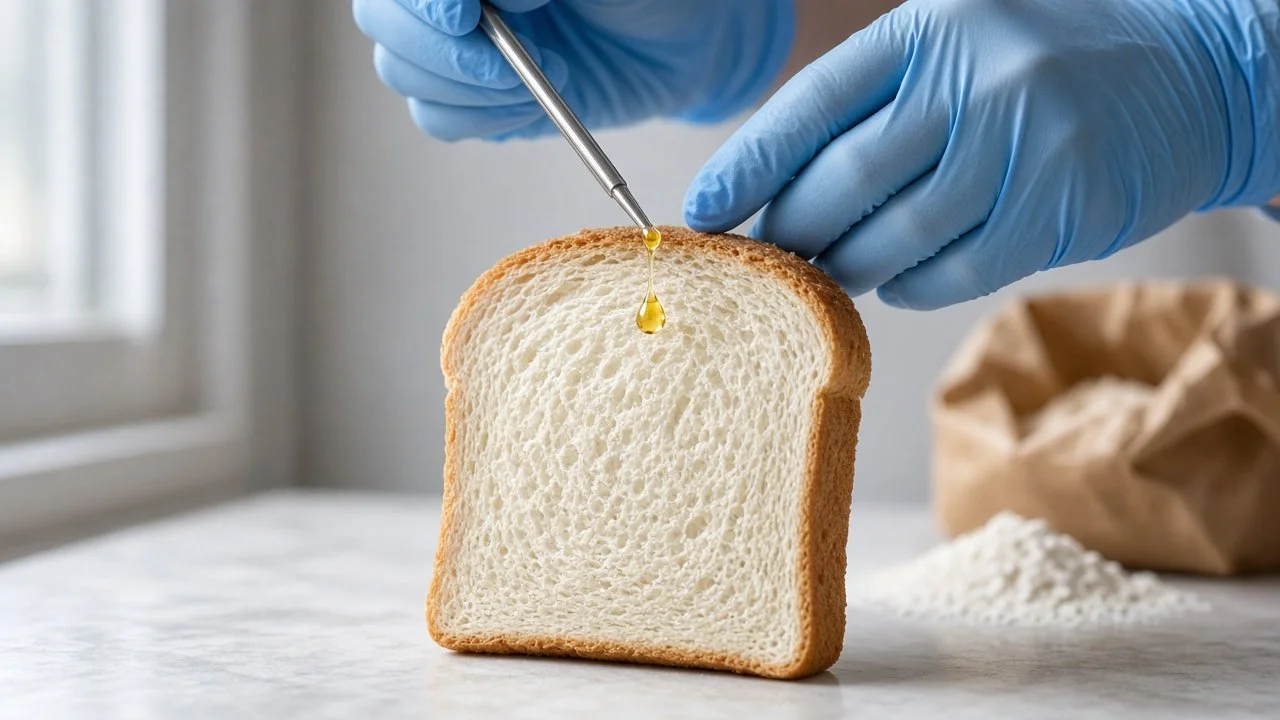
From 13 December 2026, non-wholemeal wheat flour in the UK must contain added folic acid.
Why Will Most White Bread In The UK Contain Folic Acid From 13 December?
From 13 December 2026, every miller and flour producer in the UK must add folic acid to non-wholemeal wheat flour, at 0.25 milligrams per 100 grams. That means most white bread and rolls made in the UK, along with many cakes, biscuits and other foods made with white flour, will contain it. The reason is one specific, preventable harm: babies born with spina bifida and other neural tube defects. Government figures estimate the change will prevent around 200 affected pregnancies a year, roughly a fifth of UK cases.
The policy has taken two decades to arrive and has drawn a late, organised protest. More than 100,000 people have signed a parliamentary petition calling for it to stop, and MPs will debate it the day after it takes effect. Behind that clash sits a quieter question that most coverage skips: how much folic acid is actually involved, and what the official safety ceiling means.
What Exactly Changes on 13 December
Wheat flour in the UK has been fortified by law for decades. Non-wholemeal flour already has to contain added calcium carbonate, iron, niacin and thiamin. The Bread and Flour (Amendment) (England) Regulations 2024 add folic acid to that list, with matching rules in Wales, Scotland and Northern Ireland. The same regulations also raise the minimum levels of iron, niacin and calcium carbonate so they meet the general rules on added vitamins and minerals.
Several types of flour are exempt. Wholemeal flour does not have to be fortified, and neither does flour from small mills producing less than 500 tonnes a year. Flour destined for communion wafers, matzos, or the production of gluten and starch is also excluded. Imported finished foods, such as a ready-made pastry or cake made abroad, are not covered by the requirement.
The change will not happen overnight on the shelves. Flour and bread lawfully labelled or placed on the market before 13 December can continue to be sold until stocks run out. Some manufacturers began using fortified flour early, and the government said it expected some products to contain it from autumn 2025.
Why Flour Was Chosen
The neural tube is the structure in an embryo that becomes the brain and spinal cord. If it does not close properly, the result can be anencephaly, which is fatal, or spina bifida, which brings lifelong disability. Folate, also known as vitamin B9, plays a central role in that early development, and folate deficiency is a known cause of these defects.
Official advice has long told women trying for a baby to take a 400 microgram folic acid supplement daily, one of the few supplements with genuinely strong evidence behind them, ideally from three months before conception until the twelfth week of pregnancy. The difficulty is timing. The government estimates that around half of UK pregnancies are unplanned, so many women only start supplements after the most important window has already begun. Previous campaigns and voluntary fortification by manufacturers had, in the government's words, "limited success".
Flour offers reach that a supplement campaign cannot. Government figures say 99 per cent of households buy bread and 76 per cent of people eat white bread, and around two-thirds of UK flour goes into bread products. Fortifying it raises the baseline folate intake of women who never planned to take a tablet. That logic is why more than 60 countries, including the United States, Canada and Australia, already fortify wheat flour with folic acid, either by law or voluntarily.
The UK's Scientific Advisory Committee on Nutrition first recommended mandatory fortification in 2006 and repeated the advice in 2009. When Food Standards Scotland asked it to look again, the committee's 2017 update concluded that evidence published since then on possible adverse effects "does not provide a substantial basis" for changing that recommendation.
How Much Folic Acid Is Actually in Your Bread?
The legal level is 0.25 milligrams, or 250 micrograms, of folic acid per 100 grams of flour. Two simple comparisons, based on our own arithmetic, put that in context.
First, the standard pregnancy supplement contains 400 micrograms. Matching that from fortified flour alone would take about 160 grams of flour, and because a loaf also contains water, salt and yeast, the equivalent amount of bread would be heavier still. This is why government advice is explicit that fortification is meant to support supplements, not replace them.
Second, UK and European safety bodies use a tolerable upper level of 1 milligram a day of folic acid for adults. The UK's Committee on Toxicity reaffirmed that figure in 2019, and the European Food Safety Authority kept the same adult level in 2023. Each 100 grams of fortified flour carries a quarter of that ceiling. Children have lower upper levels, set by age.
The upper level exists for a specific reason. At high intakes, folic acid can correct the anaemia caused by vitamin B12 deficiency while the nerve damage from that deficiency carries on, making the B12 problem harder to spot. Reviews of the evidence have linked masking mainly to doses of 5 milligrams a day or more, well above that ceiling.
The level of 0.25 milligrams was chosen with that ceiling in mind. In a 2024 parliamentary answer, the government said a higher level would prevent more neural tube defects but would increase the risk of people going over the upper level, and that both its nutrition and toxicity advisers agreed the chosen level was "appropriate". The nutrition committee's own condition was that fortification must come with monitoring of folic acid intakes and blood folate levels across the population. The government says it is still working out how it will evaluate the policy.
How to Tell Whether a Product Contains It
Added vitamins and minerals must appear in the ingredients list, including when fortified flour is just one ingredient in a larger product. In practice, you will see wording such as "Wheat Flour (Wheat Flour, Calcium Carbonate, Niacin, Iron, Folic Acid, Thiamin)". Because nutrients make up a tiny share of the weight, they can be listed at the end in any order.
People who want to avoid fortified flour still have options, and the government has framed this as a deliberate choice. Wholemeal flour, gluten-free products, and flours such as soya or spelt are not subject to mandatory folic acid fortification. Flour from small mills is also exempt.
Folic acid already appears in many foods. Plenty of breakfast cereals and spreads have been fortified voluntarily for years, and the government says mandatory fortification of flour will sit on top of that. Its position, based on the evidence reviewed, is that adding folic acid to flour "is not associated with health concerns". The Food Standards Agency has also reviewed the evidence on allergy and found no reports of hypersensitivity to folic acid in food.
What It Means for Anyone Planning a Pregnancy
Nothing about supplement advice changes. England's Chief Medical Officer, Professor Sir Chris Whitty, said when the law was introduced that women who are pregnant or intending to become pregnant should continue to take folic acid supplements before and during the first 12 weeks of pregnancy. Some women are advised to take a higher dose, for instance after a previous pregnancy affected by a neural tube defect. That is a decision for a midwife, GP or pharmacist, not something fortified bread can cover. Folate is also only one part of the evidence on nutrition in pregnancy, alongside nutrients such as iodine and vitamin D.
For everyone else, the official advice is equally specific. People taking certain medicines may be told to monitor their folic acid intake or avoid supplements because of possible interactions, and the government's guidance says anyone in that position should seek advice from a healthcare professional.
The Petition and the 14 December Debate
The petition, titled "End the mandatory fortification of white flour with folic acid immediately", was created by Dr Clare Craig and published on 8 June 2026. It argues that "Folic acid is a medicine not a food" and that it is unethical to add it to a staple food for everyone without individual consent, in the hope of benefiting a minority. It also points to the NHS website, which lists groups including people with cancer, a coronary stent or low vitamin B12 who may need to avoid folic acid, and notes that some wholemeal and gluten-free products are now adding it voluntarily.
The government responded on 29 June 2026, describing fortification as "an evidenced public health measure, not a medical intervention". It pointed to the long history of fortifying flour with other nutrients, to the exemptions that preserve choice, and to labelling. On the NHS cautions, the relevant NHS medicines page covers folic acid taken as a tablet or liquid. It states that it does not cover folic acid added to food, and that the amount added to food is much lower than in medicines or supplements.
The petition passed 100,000 signatures, and Parliament's Petitions Committee has scheduled a debate for 14 December 2026 at 6pm, the day after the requirement comes into force. The petition closes on 8 December. A petitions debate gives MPs and ministers a public forum, but it does not by itself change the law. Reversing fortification would require changes to the regulations in each of the four nations.
The debate is about two things that are easy to blur. One is a scientific question about safety at this specific dose, where the UK's expert committees have repeatedly concluded the level is appropriate. The other is a values question about consent and choice in public health, which no toxicity study can settle. Supporters of the policy, including the spina bifida charity Shine, campaigned for more than 30 years for it. Critics see a principle at stake, whatever the dose.
What to Watch After 13 December
The real test of the policy comes after the debate. The success measure the government has set is fewer pregnancies affected by neural tube defects, around 200 a year by its estimate. Its safety condition, set by the nutrition committee, is that the share of people going above the upper level must not rise. Both depend on monitoring data that has not yet been published, and the government has not yet confirmed exactly how the evaluation will work.
Until that evidence exists, the honest summary is simple. The dose is small compared with a supplement. It sits well within the safety ceilings used in the UK and Europe. It is aimed at a harm that strikes before many women know they are pregnant. Whether it is acceptable to put it in the nation's bread by default is the part Parliament will argue about on 14 December.
Next Reads
The 10 Supplements That Actually Work — Ranked By Scientific Evidence: where folic acid sits among the supplements with the strongest evidence, and where the evidence runs out.
The Pregnancy Brain-Boosting Methods That Actually Have Scientific Evidence: a wider look at the nutrients and habits in pregnancy that are backed by research.
Paracetamol, Pregnancy, and Autism: What the Evidence Really Shows: how to weigh an alarming pregnancy health claim against what the studies actually measured.
Sources
GOV.UK: Birth Defects Prevented by Fortifying Flour With Folic Acid
Legislation.gov.uk: Explanatory Memorandum to the Bread and Flour (Amendment) (England) Regulations 2024
Scientific Advisory Committee on Nutrition: Update on Folic Acid (2017)
TheyWorkForYou: Written Answer HL1122 on Folic Acid Fortification Levels (2024)
UK Parliament Petitions: End the Mandatory Fortification of White Flour With Folic Acid Immediately
UK Parliament: Decisions of the Petitions Committee, 3 November 2026
