A Christmas Carol Summary
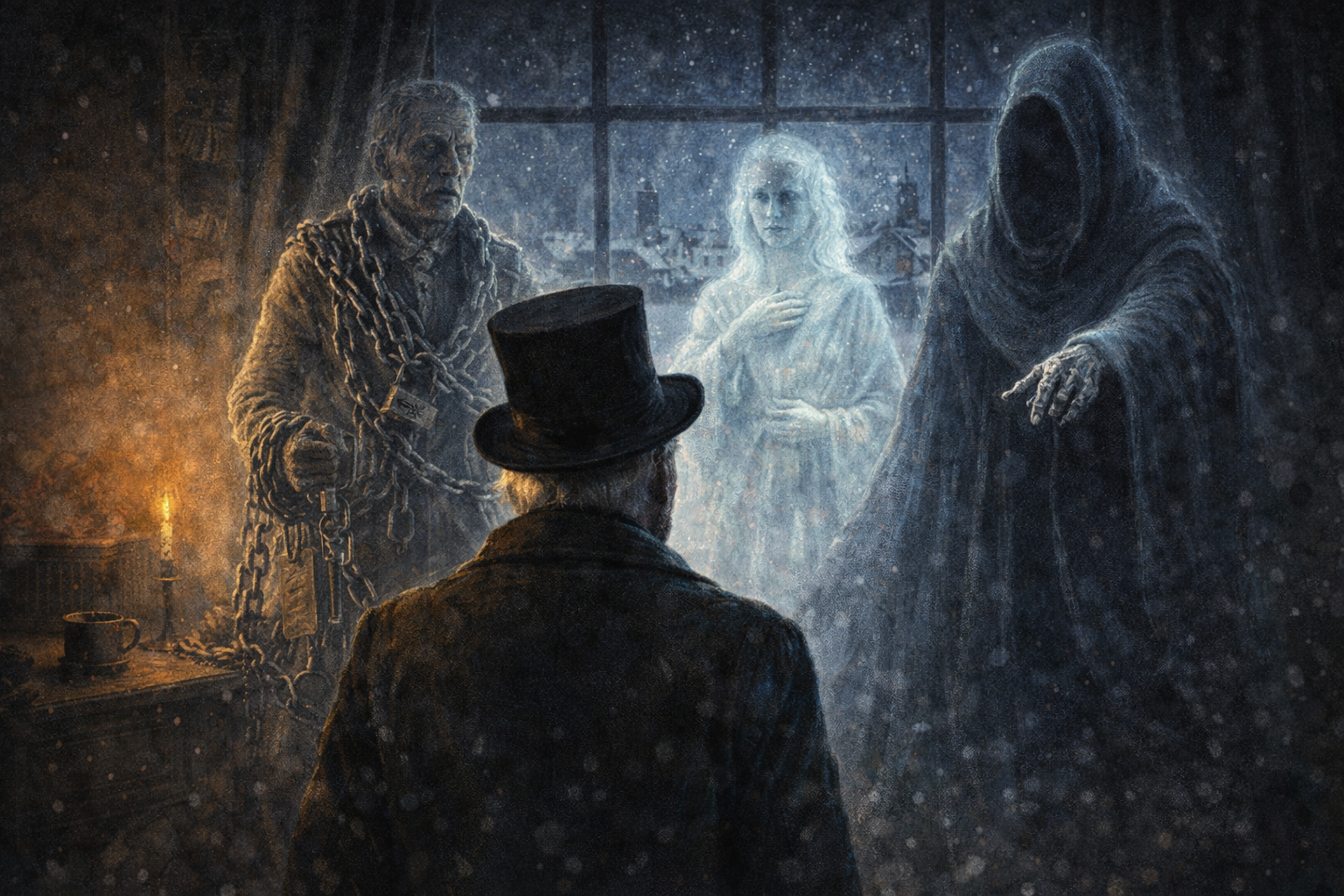
A Christmas Carol: How Ebenezer Scrooge Faces His Life, and Chooses to Live Differently
On Christmas Eve, Ebenezer Scrooge is certain he has cracked the code of survival. Work hard. Spend little. Trust no one. Owe nothing.
But the world keeps testing him anyway. A nephew offers warmth. Strangers ask for help. A clerk tries to keep his hands from going numb beside a dying fire.
Then the pressure point arrives in the dark: the past refuses to stay buried, and the future shows up like a bill you cannot argue down.
This novel turns on whether a man who has made money his only defence can still be reached by human need.
By the end of this episode, you will know exactly how Scrooge gets confronted, step by step, and what each vision forces him to admit.
You will also see why this story still hits: it turns a private attitude into a public cost, then asks what change looks like when it has to happen fast.
Outline
A Christmas Carol is set in a cold, fog-bound London at Christmas time. It follows an ageing businessman known for hoarding, refusing kindness, and treating the season as an irritation.
At the start, he is surrounded by ordinary chances to soften: family invitations, requests for charity, and the quiet loyalty of an underpaid employee.
The visible stakes are simple. If he does not change, he will keep living alone, feared rather than loved, and he will keep feeding a system that punishes the vulnerable.
The book asks a moral question with practical teeth: what happens to a life when it is organised around fear, and what would it take to reorganise it around responsibility?
The Plot
Ebenezer Scrooge runs a counting-house in London. He is wealthy, sharp, and proud of being unmoved by comfort, celebration, or sentiment. Christmas Eve is just another working day to him.
His clerk, Bob Cratchit, works in a cramped little space with barely any heat. Scrooge controls the coal and treats warmth like a luxury that must be earned.
A cheerful nephew arrives with an invitation to Christmas dinner. Scrooge rejects it, not because he is busy, but because he refuses the whole idea of the season. The nephew leaves without malice, still hoping his uncle might one day change.
Two men then visit to collect donations for the poor. They describe hunger, cold, and the strain of winter. Scrooge refuses to give anything, insisting that the existing institutions are enough, and that hardship is not his concern.
As the day ends, Scrooge grudgingly agrees to give Cratchit Christmas Day off, but his tone makes clear it is a concession, not kindness.
Inciting Incident
That night, Scrooge returns to his rooms above the warehouse. The building feels more hollow than usual. Even before anything supernatural happens, he senses that his isolation has a texture. It is not peace. It is absence.
At the door, a familiar object becomes unfamiliar, as if the past is trying to push itself into the present. Scrooge forces himself inside, locking up as though bolts could keep memory out.
Soon, the haunting becomes literal. Jacob Marley, Scrooge’s former business partner, appears as a ghost. Marley’s condition is not vague or poetic. He is weighed down, restrained, and made miserable by what he forged during his life.
Marley explains the logic of his punishment in blunt terms: in life, he focused only on business and ignored the wider “business” of humanity. Now he must wander, seeing suffering he can no longer relieve.
Marley warns Scrooge that the same fate awaits him, and that his own chain is already being made. He offers a single chance: Scrooge will be visited by three spirits on three successive nights. If Scrooge refuses them, he will not escape what Marley has become.
After Marley leaves, Scrooge looks out and sees other restless ghosts, each trapped by what they valued when they were alive. The sight does not inspire abstract fear. It lands as a verdict.
Rising Pressure
The first spirit arrives and takes Scrooge into his own earlier life. The effect is immediate: Scrooge is forced to see himself not as an idea, but as a person shaped by specific moments.
He sees himself as a lonely child left behind during the holiday season, reading for company. The detail matters. It undercuts his belief that he was born hard.
He watches his younger sister, Fan, come to fetch him home. Her affection is direct and uncomplicated, and Scrooge’s reaction reveals that he once accepted love without suspicion. The spirit makes it clear that Fan is no longer alive, and Scrooge has to hold that knowledge alongside the warmth of the memory.
The spirit shows Scrooge as a young apprentice at a lively Christmas gathering hosted by Mr Fezziwig. The scene is not about wealth. It is about atmosphere: music, food, jokes, dancing, and a boss who decides that joy in the workplace is worth paying for. Scrooge sees how little it takes, in material terms, to transform a room.
He then watches his younger self with Belle, the woman he was once engaged to. Their relationship begins in affection and hope, but the balance shifts as Scrooge’s attention tilts towards money and security. Belle does not leave him for drama. She leaves because she can see the direction of travel: the man she loved is being replaced by a man who serves profit like a private religion.
The spirit presses further. Scrooge sees Belle later in life, with a family of her own, surrounded by the noisy, messy life he never allowed himself. The contrast is not framed as moral superiority. It is framed as consequence.
Scrooge tries to shut the visions down. He does not want to feel the weight of what he traded away. But the spirit leaves him with a final push: the past is not a museum. It is evidence.
The second spirit arrives in a different register: abundant, warm, and forcefully alive. It drags Scrooge into the present day and refuses to let him pretend that his choices stop at his own front door.
They begin with the city itself, where people prepare for Christmas with whatever they have. The spirit shows Scrooge that celebration is not a luxury reserved for the rich. It happens in kitchens and back rooms, in small gestures and shared food.
They visit Bob Cratchit’s home. The space is small, the resources are thin, but the family pulls together a meal and makes a ceremony of it. Scrooge sees what his wages actually mean in practice: what can be bought, what cannot, and how close the family lives to the edge.
Tiny Tim, Cratchit’s youngest, appears as fragile, loved, and at risk. The spirit makes the stakes plain: unless the future changes, the child will not survive.
Scrooge’s defences wobble. He wants to argue, to bargain, to treat it like an unfortunate statistic. But the family’s reality refuses to become a spreadsheet. It is grief waiting in the wings.
The spirit then takes Scrooge beyond his usual orbit: to people in isolated and difficult places who still mark the day. Miners gather with families; men in a lighthouse share food and companionship; sailors at sea keep the season in their own way. The point is simple and sharp: Christmas spirit is not a London fashion. It reaches where comfort does not.
They visit Scrooge’s nephew’s Christmas party. Scrooge watches from the edge, unseen. The guests mock him, but not with hatred. The nephew pushes back against cruelty and insists on pity, not revenge. Scrooge, in a rare moment of uncomplicated enjoyment, gets drawn into the games and laughter, even though no one can hear him.
As the night moves on, the spirit changes. It ages, visibly. Plenty is not permanent. Time is not negotiable.
At the end, the spirit reveals two children clinging beneath its robe: Ignorance and Want. They are not symbols in the abstract. They are presented as living consequences, produced by a society that tolerates deprivation and calls it inevitable.
Scrooge reacts with horror and asks what can be done. The spirit answers by throwing Scrooge’s own earlier words back at him, showing him the brutality of his logic when it is spoken in the face of suffering.
The clock strikes midnight. The second spirit vanishes, and the third arrives.
The Midpoint Turn
The last spirit is silent and severe. It does not argue with Scrooge. It does not charm him. It simply points.
They move through the city and into conversations Scrooge would normally treat as background noise: businessmen discussing a death with casual detachment. Their tone is not grief-stricken. It is transactional. The dead man’s value is measured by whether attending his funeral will come with a decent lunch.
Scrooge tries to locate emotion somewhere in the scene. He asks to see someone who feels something real about the death. The spirit offers no comfort and continues pointing.
They enter a grim quarter of the city. People arrive at a filthy shop to sell items they have taken from a dead man’s rooms. The objects are intimate, stripped of dignity, and treated like spoils. The sellers laugh, barter, and justify themselves with the usual human tricks: it is only taking, it is only survival, it is what anyone would do.
Scrooge realises the dead man was alone enough to be looted without shame.
Crisis and Climax
Still searching for a softer angle, Scrooge asks to see a death that brings tenderness instead of opportunism. The spirit takes him to the Cratchit home again, but the atmosphere has changed.
The family moves carefully, as if one wrong word will break the room. Their grief is quiet and heavy. The absence in the household is clear. Tiny Tim is gone.
Bob Cratchit tries to hold himself together for the sake of the others, but the pain keeps slipping through. It is not a grand tragedy in a mansion. It is a poor family losing the child they centred their hope around.
Scrooge is shaken because the link is now undeniable. This is not a random cruelty of the world. It is part of the future his present choices help shape.
The spirit then brings Scrooge to a churchyard. A neglected grave stands with a name Scrooge fears and then recognises as his own. The final humiliation is not death itself. It is the meaninglessness attached to it: a life that ended with indifference, and a body left behind without love.
Scrooge breaks. He begs for time and for the chance to change. He promises that he will not treat these visions as entertainment or warning theatre. He will treat them as instructions.
The spirit’s pointing hand remains steady. The choice is still Scrooge’s.
Resolution
Scrooge wakes in his own bed and realises it is Christmas morning. He is not dead. He has not missed the day. He has been given time.
The change is immediate, not gradual. Scrooge acts before doubt can regroup.
He calls to a boy outside and pays him to buy a large turkey from the poulterer. Scrooge arranges for it to be delivered to the Cratchits, without revealing it came from him. The secrecy matters. He is trying to do good, not buy applause.
He then meets one of the charity collectors he rejected the day before and makes a substantial donation. This time, he does not treat it as a loss. He treats it as overdue.
He goes to his nephew’s house and joins the Christmas gathering he previously scorned. He is awkward, because he is new to warmth. But he stays. He participates. He accepts welcome instead of pushing it away.
The next day, at the counting-house, Scrooge tests whether his old self can still snap into place. Bob Cratchit arrives late, expecting punishment. Scrooge plays the moment for suspense, then overturns it: he raises Cratchit’s salary and commits to helping the family.
The story closes not with a single grand gesture, but with a pattern. Scrooge becomes a different man in public and in private. He keeps Christmas in the only way that counts: by changing what his money and attention do to other people’s lives.
Tiny Tim lives in this altered future. Scrooge, who once defined himself by isolation, becomes a second father in the Cratchit household, and a kinder presence in his wider world.
The Insights
Scrooge’s cruelty is a story he tells himself
Scrooge does not think of himself as evil. He thinks of himself as sensible.
His harshness is wrapped in language about responsibility, deservedness, and how the world works. That is why it is hard to shift. It is not just a mood. It is an identity.
The spirits do not defeat him with argument. They defeat him by showing him what his “sense” looks like when it lands on real bodies, real homes, and a child who will die if nothing changes.
The three spirits are a system, not a lecture
The haunting works because it corners Scrooge from three angles: memory, exposure, and consequence.
The past shows the moment he started choosing safety over closeness. The present shows the human cost he pretends is none of his business. The future removes his last comfort, the fantasy that his life will end with respect because he “worked hard”.
A man can dodge one mirror. Three mirrors, timed perfectly, leave him nowhere to hide.
Tiny Tim is the future made personal
Tiny Tim is not there to “teach a lesson” in the abstract. He turns a social problem into a family problem with a face.
Scrooge can brush off poverty as distance and statistics. He cannot easily brush off the sight of a child carried, cherished, and quietly endangered by forces adults pretend are natural.
The cost is clear: when systems fail, it is never systems that pay first. It is the smallest people in the room.
Modern life has better excuses, not better outcomes
In modern life, Scrooge’s logic is easier to hide behind: targets, metrics, budgets, market forces, and “policy”.
It is simple to say a cut was necessary, a wage was “competitive”, a support request was “out of scope”, a vulnerable person was “not our responsibility”. The language sounds clean. The effect is not.
The story’s warning is not about Christmas cheer. It is about what happens when distance becomes a habit, and habit becomes character.
Key Takeaways
Scrooge changes when he stops treating other people’s suffering as background noise and starts treating it as evidence.
A workplace can be cruel without shouting. It can be cruel through cold rooms, low pay, and the quiet normalisation of deprivation.
The past matters because it shows what was lost before it shows what was done.
Want is not just a personal failing. It is often the predictable result of choices made far away from the person who pays the price.
If you only measure life by what you keep, you will eventually keep nothing that can keep you company.
Modern systems can turn harm into an admin task. The moral question stays the same: who carries the cost when you say no?
Reputation is fragile. If people only show up for your funeral to gain something, the story of your life has already been written.
Change that waits for perfect timing is usually change that never arrives.
A Christmas Carol runs on forced proximity.
Scrooge’s entire strategy is to stay untouched. The spirits break that strategy by putting him inside scenes he cannot control, where his usual defences do not work.
The stakes keep rising because every vision turns his private habits into public outcomes, until the future makes the bill personal.
What This Looks Like in Real Life
A manager runs a team by the numbers. Overtime is “just part of the culture”, pay rises are delayed, and burnout is treated as weakness.
Old approach: squeeze output and call it efficiency.
New approach: treat energy, pay, and time as real constraints, then redesign workload around them.
Consequence: retention improves, and the work stops feeling like quiet punishment.
A landlord uses the law as a shield. Repairs are delayed, heating is unreliable, and tenants are treated like problems.
Old approach: minimise costs and maximise control.
New approach: fix issues early and build trust as part of the business model.
Consequence: fewer crises, fewer conflicts, and a reputation that does not rely on fear.
A successful professional becomes obsessed with optimisation. Every choice is measured, every moment is monetised, every relationship is squeezed for usefulness.
Old approach: treat life as a ledger.
New approach: schedule time for people and meaning the way you schedule work.
Consequence: the “wins” start to feel like a life, not a scoreboard.
A Simple Action Plan
What is the oldest memory that still explains how you handle money, trust, or comfort?
Where do you use “that’s just how it is” to avoid responsibility?
Who benefits from your choices, in ways you rarely picture clearly?
What would it cost you to be generous in a way no one sees?
What does “enough” look like in your life, in plain numbers and plain behaviour?
If your future was a room you had to walk into, what would you dread seeing there?
Who is your Tiny Tim: the person who pays first when the system fails?
What one decision could you make this week that would prove you mean your values?
Conclusion
Scrooge’s transformation is not magic. The magic is only the delivery system. The change is a choice made under pressure, with no room left for excuses.
The story costs Scrooge his pride, his old identity, and the illusion that he can live untouched. In return, it gives him a future where his money becomes help instead of harm, and his days include people who actually want him there.
If you want more plot-led classics and clean modern relevance, follow or subscribe on Spotify.
A life can be rich and still be empty, until someone forces it to look at itself.
Relevance Now
This story fits modern life because it dramatises distance. The ability to say no without seeing who it lands on.
It mirrors workplace performance culture, where harm hides inside KPIs, and responsibility gets passed along a chain until it disappears. It also mirrors cost-of-living pressure, where small decisions upstream become hunger, cold, and fear downstream.
Watch for this: any time your language gets cleaner while the human outcome gets harsher, you are drifting towards Scrooge’s old logic.
The future does not arrive as a surprise. It arrives as the sum of what you practised.
Meta description: A Christmas Carol retold plot-first: Scrooge’s haunting, the three spirits, the future he fears, and the choices that change everything.
