A Midsummer Night’s Dream Summary
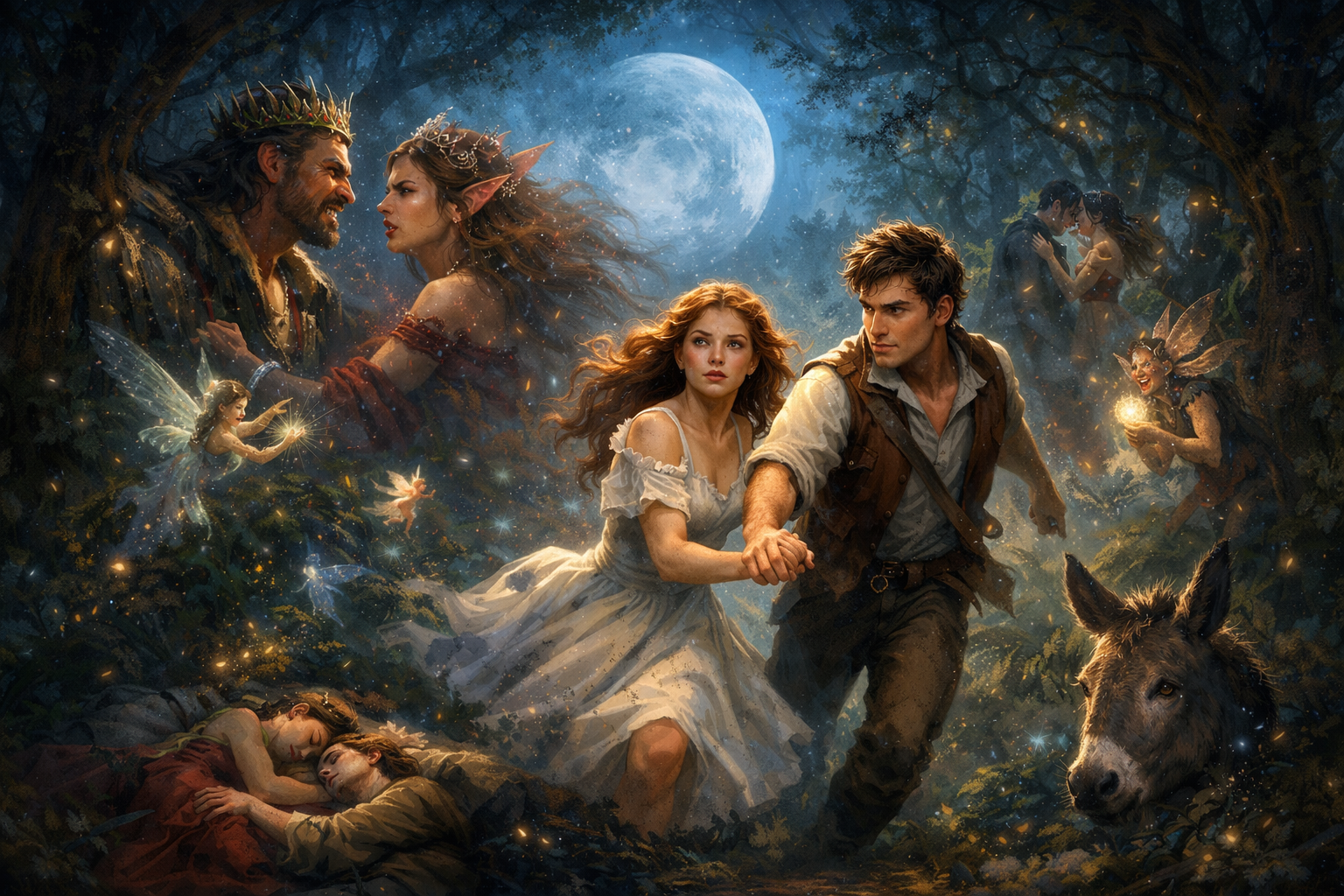
How one night in the woods breaks love into chaos and then stitches it back together
A young woman is told she must marry the man her father chooses. The man she loves is standing right there. The ruler backs the father. The clock is ticking towards a wedding, which will lock the decision in.
So the couple does the only thing they can do quickly. They run.
They pick the worst possible place to hide: a forest where a royal feud is already spilling into the human world and where a single mistake can turn affection into obsession.
This novel turns on whether love is real when the rules of reality can be rewritten.
By the end, you will understand how Shakespeare builds a three-layer collision of court law, young desire, and fairy power, then uses one misapplied “solution” to multiply the problem.
You will also see how the story quietly insists on choice: how easily it can be pushed, misread, borrowed, or stolen, and what it costs to get it back.
Outline
The story begins in Athens, where a duke prepares for his wedding while a family dispute lands at court: a father demands the law force his daughter to marry the man he has chosen.
Outside the city, the woods are not empty. The fairy king and queen find themselves embroiled in a conflict that permeates the night's events.
At the same time, a group of ordinary tradesmen rehearse a play they hope to perform at the wedding celebrations, taking their ambitions into the same forest.
When law, love, and mischief all move into the same space, what happens when everyone starts chasing the wrong person for the right reasons?
The Plot
Theseus, Duke of Athens, prepares to marry Hippolyta, and the city readies itself for public celebration. That official order sets a tone: weddings are not only private feelings; they are civic events with rules.
Egeus brings his daughter Hermia before Theseus and demands the law enforce his choice of husband for her. He wants her to marry Demetrius, and he treats her refusal as disobedience that must be corrected.
Theseus backs the father’s rights under Athenian law and gives Hermia a stark set of outcomes: accept the marriage, face severe punishment, or renounce marriage entirely. The consequence is immediate leverage: Hermia’s personal choice is now a public legal problem with a deadline.
Hermia and Lysander confirm they want each other, not the match Egeus demands. Their response is not negotiation. It is escape. They decide to flee Athens and meet in the woods beyond the city.
Hermia confides the plan to Helena, who is close to her but emotionally tied to the mess. Helena loves Demetrius, and his pursuit of Hermia has already hurt her.
Helena decides to tell Demetrius that Hermia and Lysander will be in the forest. That disclosure changes the geometry of the night: it pulls Demetrius into the woods and forces Helena to follow him, chasing attention that continues to move away from her.
Separately, a group of Athenian workmen led by Peter Quince plan to perform a tragic love story for Theseus’s wedding celebrations. They choose the forest as a rehearsal space, meaning the night now contains a court conflict, a romantic flight, and a theatre troupe heading to the same dark stage.
In the woods, Oberon and Titania, the fairy king and queen, argue over a changeling boy Titania is protecting. Titania refuses to hand him over, and the disagreement escalates into open hostility.
Oberon decides to punish Titania rather than bargain with her. He sends his servant Puck to fetch a magical flower whose juice can make a sleeper fall in love with the first living creature they see on waking. The consequence is a weapon entering the story that does not persuade, it overrides.
Inciting Incident
Puck returns with the flower, and Oberon uses it on Titania while she sleeps. The planned consequence is humiliation: Titania will wake and love something absurd, and Oberon will use that imbalance to get what he wants.
Oberon then sees Helena pleading with Demetrius, who rejects her and continues after Hermia. Oberon responds to what he sees with a second intervention: he tells Puck to use the same magic on the Athenian man so that Helena’s love will be returned.
Puck moves quickly and carelessly in a dark forest where he does not know the humans well enough to identify them reliably. He finds Lysander asleep and, believing he has found the right man, applies the potion to Lysander’s eyes.
Helena arrives and wakes Lysander, hoping to find Demetrius. Lysander wakes under the potion’s effect and immediately transfers devotion to Helena. The consequence is not romance; it is total disorientation: Helena hears declarations she does not trust, and Hermia is left without the ally she ran away with.
Hermia wakes up and realises Lysander has vanished. She follows into the woods, turning escape into pursuit and safety into exposure.
Rising Pressure
Demetrius continues searching for Hermia, while Helena continues chasing him. When Helena encounters Lysander’s sudden devotion, she interprets it as mockery or a cruel game rather than a sincere turn, because nothing in the night has earned her that reversal.
Hermia finds Helena with Lysander and assumes betrayal. The consequence is that the women’s friendship fractures under the pressure of competing narratives, and neither has full information to repair it.
Oberon learns that Puck’s attempt to help Helena has not targeted the intended man. He recognises that his “fix” has created a worse imbalance, and he orders Puck to correct it by enchanting Demetrius instead.
Puck finds Demetrius asleep and applies the potion, aiming to align Oberon’s intention with the right body at last. When Helena later wakes Demetrius, he wakes under the spell and declares love for her.
Now both Lysander and Demetrius pursue Helena, each insisting his feeling is true. The consequence is maximum conflict with minimum clarity: the very outcome Helena once wanted becomes evidence, to her, of humiliation and manipulation.
Helena believes she is being set up, while Hermia believes she is being discarded. Their argument becomes sharper because the men’s behaviour seems coordinated from the outside, even though it is not.
Lysander turns away entirely from Hermia, and Demetrius turns away from her as well. Hermia’s immediate consequence is isolation: she has lost both suitors in the span of a night and cannot convince anyone that she is not the cause.
Puck attempts to manage the situation by leading the men apart and throwing their voices off, creating separation through confusion. The consequence is temporary safety but deeper instability: nobody can be sure who is near, who is speaking, or who is lying.
While the lovers spiral, the workmen rehearse their play in the same woods. Their practical plan is simple: prepare entertainment for the duke’s wedding. The consequence is that ordinary ambition crosses into fairy territory without any of the humans understanding it.
Puck finds the rehearsal and decides to play with it. He transforms Nick Bottom’s head into that of a donkey, turning Bottom into something that will terrify his friends and attract the wrong kind of attention.
Bottom’s fellow actors flee, convinced something supernatural is happening. Bottom is left alone, confused, and trying to make sense of the sudden abandonment.
Titania wakes under Oberon’s spell and sees Bottom first. She immediately falls in love with him and draws him into her fairy world, surrounding him with attendants and attention he did nothing to earn.
Oberon observes Titania’s enchantment working as intended and uses the advantage to take the changeling boy. The consequence is a shift in power: Oberon gets what he wanted, but he has created a spectacle he still needs to clean up.
The lovers continue to clash, and the night keeps producing mismatches. The men’s rivalry sharpens, Helena’s anger rises, and Hermia’s desperation turns into confrontation because she cannot find a stable truth to stand on.
The Midpoint Turn
Oberon, now in possession of the boy, sees that his revenge has gone far enough and that the human situation is dangerously unstable. The midpoint change is not a new prank, it is a decision to restore order before the chaos becomes permanent.
He orders Puck to remove the spell from Lysander so Lysander will return to his original love for Hermia. The consequence is that Oberon chooses one couple to “reset” while leaving the other couple’s spell in place.
Puck applies the antidote so that when Lysander wakes, his devotion returns to Hermia. That sets up a future morning in which one pair will seem “back to normal” while the other remains altered.
Oberon then confronts Titania with the fact of her enchantment and prepares to release her from it. The consequence is a pivot from domination to repair, but repair has to undo a humiliation that has already happened.
Puck removes Bottom’s donkey head so Bottom can return to himself. The consequence is that Bottom’s experience becomes dreamlike and unverifiable, even to him, because the evidence has been stripped away.
Crisis and Climax
Puck engineers a final sleep among the four lovers so the night can be rebalanced without further fighting. The immediate consequence is quiet, but it is the tense quiet of a system being reset, not resolved.
Oberon lifts the spell from Titania, and Titania returns to herself with no desire to remain in the state Oberon forced on her. The consequence is a restored partnership at fairy level, but the story does not pretend the method was clean.
With Titania and Oberon reconciled, the fairy conflict stops feeding the human conflict. The night’s magic does not vanish, but its direction changes from escalation to closure.
Morning arrives, and Theseus comes into the woods, encountering the four young Athenians asleep. The consequence is that private chaos becomes visible to public authority, and the story returns from dream-space to rule-space.
When the lovers wake, Demetrius remains devoted to Helena, while Lysander is again devoted to Hermia. The immediate consequence is a new balance: both women are now matched, but the reasons for the matching are uneven.
Egeus appears and renews his demand that Hermia marry Demetrius. Theseus overrules the earlier legal trajectory and decides the couples will marry according to the pairings now presented. The consequence is rapid legitimisation: the duke turns a night’s confusion into a day’s public settlement.
The weddings proceed, and the city’s celebration becomes a triple marriage. The consequence is that the court absorbs the chaos rather than punishes it, transforming conflict into ceremony.
That evening, the workmen perform their play for Theseus, Hippolyta, and the newly paired lovers. The performance is clumsy, earnest, and comic, and the court watches with a mixture of amusement and patience.
The play-within-the-play reflects the larger story, which includes themes of love, misunderstandings, and the transformation of tragic intentions into comic outcomes. The consequence is a final confirmation that performance can both misfire and still bind a group together.
Resolution
After the festivities, the fairies return to bless the household and the marriages, sealing the night’s disruption into something that will not immediately reopen. The consequence is symbolic order: the supernatural world closes its own loop.
Puck addresses the audience directly at the end, framing what has happened as something like a dream and offering a gentle request for acceptance if anyone feels offended. The consequence is a deliberate blur: the story ends by reminding you that certainty is not always the point, even when the consequences were real for the people inside it.
The Insights
The night proves how fragile “choice” becomes under pressure
When authority sets a deadline and a punishment, people stop choosing freely and start choosing under threat. That changes the moral texture of every decision afterwards, even the ones that look romantic.
Hermia and Lysander flee because the legal frame does not offer them a real path to stay together. Their night is vulnerable to outside interference because their choice is love and survival.
The cost is that once choices are made under force, later “resolution” can look like peace while still carrying the shape of coercion.
Puck represents the original operator error, and the design of the system encourages this mistake.
The magic flower is treated like a tool that can “fix” a relationship without the slow work of understanding. But the tool depends on correct targeting, and the night proves how quickly targeting fails in the dark.
Puck enchants the wrong man and creates a chain reaction that no one person can control. The errors multiply because everyone’s next move is based on what they think they saw, not what actually happened.
The cost is predictable: when a tool changes behaviour faster than people can verify reality, trust collapses first.
Helena shows how validation can feel like a trap
Helena has spent the story chasing a love that will not return. When love finally appears, she cannot accept it as real because the context makes it feel staged.
Her suspicion is not vanity. It is pattern recognition built from repeated rejection. When both men suddenly pursue her, it reads like cruelty because she has no reason to believe the world has genuinely flipped.
The cost is that even “winning” can arrive in a form that hurts, because it comes without the one thing she needed most: believable consent.
The mechanics reveal what communities do when power is elsewhere
The tradesmen are not trying to manipulate love or law. They strive to showcase their skills, gain recognition, and secure a spot in the festivities.
Their rehearsal is constantly interrupted and reshaped by forces they do not understand, yet they still reach the stage, show up, and do the work. Their awkward play becomes a social bridge between the court and the ordinary city.
The cost is that public life often runs on imperfect labour, while the people with power treat that labour as decoration.
Key Takeaways
A deadline backed by punishment turns romance into logistics and logistics into risk.
Attempting to “correct” feelings with a shortcut can create wider damage than the original problem.
Misidentification is a large error in a crowded system. It rewrites outcomes.
Rejection trains people to distrust sudden approval, even when it is genuine.
Humiliation used as leverage may “work”, but it still poisons relationships.
Amateur effort can hold a community together when elite decisions are opaque.
When everyone acts on partial information, conflict becomes self-sustaining.
Modern life has its potions: attention, messaging, and social proof can redirect desire fast.
The story runs on forced choices that meet unreliable perceptions. Law pushes the lovers into motion, magic scrambles what they think they know, and the forest prevents quick verification.
Every attempt to control the outcome creates a new problem that requires further intervention until morning arrives and authority imposes a settlement.
What This Looks Like in Real Life
A junior employee messages sensitive praise meant for one person to the wrong chat, and two colleagues interpret it as a deliberate signal. The “fix” is rushed, the explanation lands badly, and the team spends weeks arguing about intent instead of work.
Two leaders fight over a prized resource in a department, and one uses embarrassment and exclusion to gain leverage rather than negotiate. The resource changes hands, but the working relationship becomes colder and more brittle.
A small project group prepares a presentation for a senior audience, and the stakes feel huge because visibility is scarce. The delivery is messy, but the effort earns goodwill, and the group’s confidence rises because they were allowed to try.
A Simple Action Plan
Where are you confusing pressure with choice?
Who benefits if you misunderstand someone’s signal?
What “tool” do you reach for to shortcut a lengthy conversation?
When did you last verify a story before reacting to it?
Which relationships depend on public approval to feel real?
What would a clean apology look like if you made the wrong call?
Where are you using humour to cover your fear of rejection?
What does a fair resolution require that a fast resolution avoid?
Conclusion
A Midsummer Night’s Dream keeps returning to the same problem in different costumes: love is treated as something that can be ordered, traded, or engineered, and then the night proves it cannot.
The cost is not only confusion. It is the damage done when people’s perceptions are manipulated and their choices are narrowed, even if the morning looks neat and the weddings go ahead.
If you want more plot-led episodes like this, follow or subscribe on Spotify.
Some mornings feel like clarity. Some mornings, it feels like the forest is finally letting you leave.
Relevance Now
This story maps cleanly onto online identity, where attention can flip faster than meaning, and where a single misread signal can cascade into conflict. The lovers’ chaos is a pre-digital version of what happens when visibility rises but certainty does not.
It also speaks to performance culture, where public outcomes matter more than private truth. The court wants weddings and celebrations, and it can absorb almost any mess as long as it ends in an acceptable shape.
Finally, it touches institutional mistrust. When decisions are made over people rather than with them, those people start improvising in the gaps, and improvised plans attract improvised consequences.
Watch for this: when a situation changes overnight, ask what changed the incentives, not just the feelings.
A dream is not harmless just because it ends.
