Much Ado About Nothing Summary
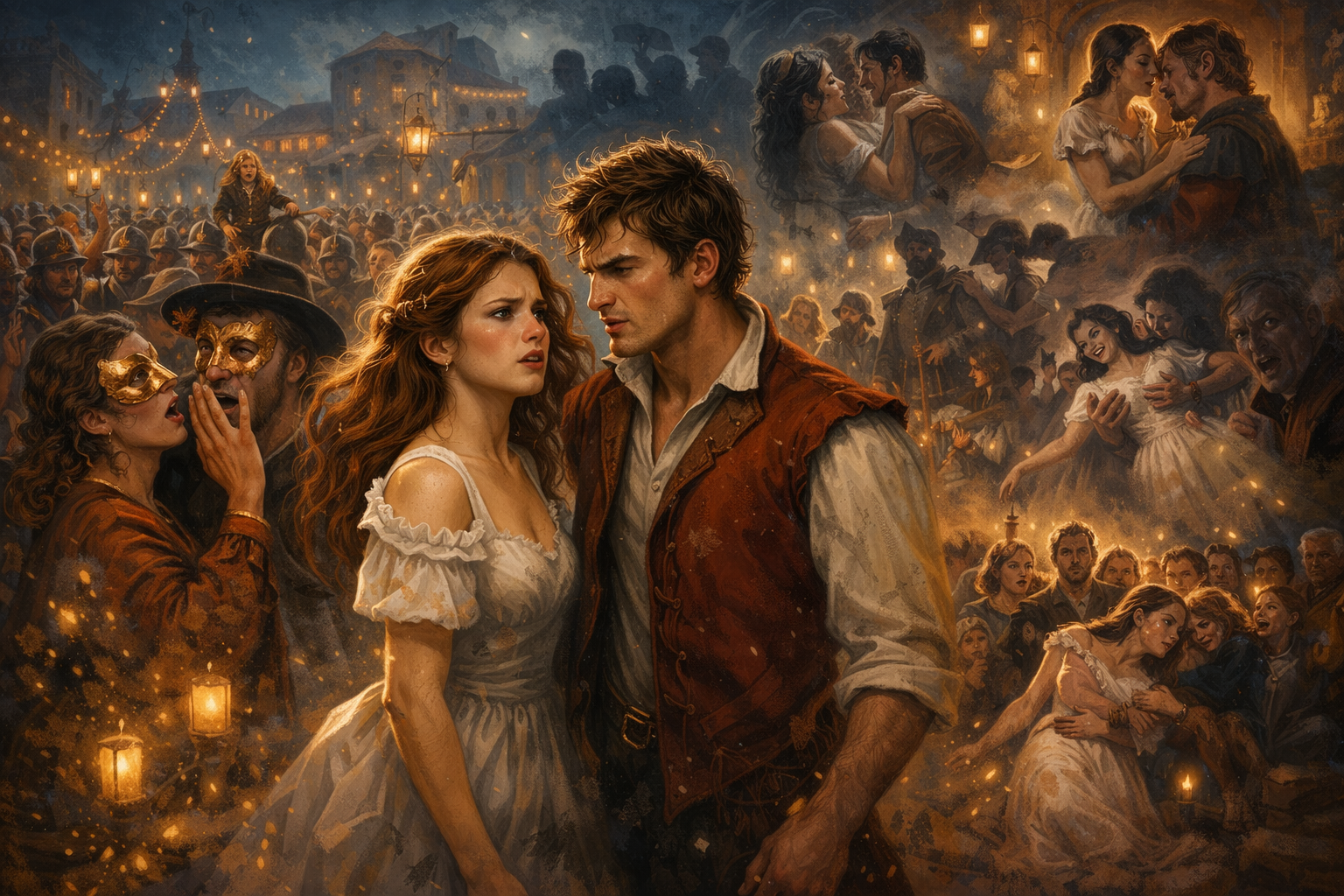
How a Rumour Becomes a Weapon, and Love Has to Survive It
A victory parade arrives in Messina, and the town turns festive overnight. The town is filled with soldiers, music, flirting, masks, and a governor eager to host a month-long celebration.
But underneath the laughter sits a brittle truth: in a small social world, reputation travels faster than proof. One person’s story about you can become everyone’s certainty.
And once a lie is performed convincingly enough, even decent people start acting like it must be true.
This novel turns on whether love can survive when reputation becomes a weapon.
By the end of this episode, you’ll understand how two romances run on opposite fuels. One is swift, conventional, and dangerously dependent on appearances. The other is slow, combative, and built on seeing through pretence.
You’ll also see how the story’s real engine is not villainy alone, but a community that treats gossip like evidence and public humiliation like justice.
In Messina, a powerful prince and his soldiers arrive after a campaign and are welcomed into a household, which quickly becomes the centre of courtship, banter, and social games. Two people fall into an obvious match, while two others insist they are immune to love and use wit as armour.
A resentful outsider watches the celebrations and decides to spoil them, not with force, but with a story that sounds plausible enough to spread. The closer the wedding gets, the more the town’s attention becomes a pressure cooker.
What happens when a community trusts a performance over the person standing in front of them?
The Plot
Don Pedro, a prince, returns to Messina with his companions, including the young Claudio and the sharp-tongued Benedick. Their host is Leonato, governor of the town, whose household includes his daughter Hero and her cousin Beatrice.
Beatrice and Benedick immediately resumed their long-running "merry war" of insults and teasing, both insisting they had no interest in romance and making sure everyone knew it.
Claudio quickly develops feelings for Hero and confides in Don Pedro, who pledges to assist him in winning her. The plan is simple: use the prince’s authority and charm to smooth the path to a marriage.
Alongside them is Don John, Don Pedro’s bitter, illegitimate brother, who sits inside the same social circle but does not belong to it in spirit. He watches the warmth around him as if it is an offence.
Inciting Incident
At a masked celebration, Don Pedro courts Hero on Claudio’s behalf, and the match is set in motion, with a wedding planned soon. The town pivots from welcome to wedding preparations at speed.
Don John seizes the disguise and confusion of the masque to plant suspicion, telling Claudio that Don Pedro is courting Hero for himself. The accusation turns joy into panic in an instant.
When the misunderstanding is cleared and Claudio learns the truth, the romance continues, but the damage is done: Claudio has shown how quickly he can be pushed into jealousy, and Don John has tested how easily a lie can grip the room.
Seeing this, Don John commits to a bigger sabotage and brings his follower Borachio into a scheme designed to “prove” Hero’s unfaithfulness without needing truth at all.
Rising Pressure
While the wedding approaches, Don Pedro and friends decide to occupy the time with another game: they will trick Benedick and Beatrice into admitting they love each other.
They stage conversations for Benedick to overhear, painting Beatrice as secretly in love with him and too proud to confess it. Benedick, flattered and stirred, begins to reframe his own feelings as duty and affection rather than defeat.
They repeat the strategy with Beatrice, arranging for her to overhear that Benedick is quietly devoted to her and suffering in silence. Beatrice, who has built her identity around independence and ridicule of marriage, starts to crack, then soften.
As the “gulling” works, the tone of their sparring changes from sport to intimacy. Each begins to act with more care, even when the words still carry edge.
Don John escalates in parallel. Borachio arranges a staged scene at Hero’s window: he will be seen with Margaret, Hero’s waiting gentlewoman, dressed in Hero’s clothes. The goal is not to convince a court of law, but to trigger a public reaction from Claudio.
Claudio and Don Pedro agree to witness this “evidence” at night. They don't ask Hero for clarification or explore alternative explanations, as the performance aims to satisfy their fears.
After they see the staged encounter, Claudio chooses humiliation as punishment. He decides the wedding will become the stage where he destroys Hero in front of her family and community.
The Midpoint Turn
At the wedding, Claudio publicly denounces Hero, accusing her of infidelity. Don Pedro supports the accusation, turning it from a lover’s complaint into a powerful man’s endorsement.
Hero is overwhelmed and collapses, and Leonato, devastated by public shame, swings from paternal pride to despair and anger. At the moment, the household becomes hostile to its own daughter because honour has been framed as more real than her character.
A friar present at the ceremony studies Hero’s reactions and concludes she is innocent. He proposes a drastic counter-move: they should report Hero as dead, hide her away, and let time and remorse force the truth to surface.
Leonato agrees, turning grief into strategy. The household begins to stage a death in order to undo the damage caused by their earlier display of guilt.
In the aftermath, Benedick and Beatrice finally stop pretending. They confess their love, not as a soft surrender, but as a decision made under pressure.
Beatrice then demands proof that Benedick will stand with her against the social consensus. She asks him to challenge Claudio, forcing Benedick to choose between male friendship and the woman he has decided to believe.
Benedick accepts, and the comedy’s love plot turns into a moral test: can a man defy his circle when the circle has decided a woman is disposable?
Crisis and Climax
As news of Hero's death spreads from Leonato's household, Claudio faces unexpected consequences. His certainty begins to look less like righteousness and more like cruelty.
Benedick challenges Claudio to a duel, and the friend group fractures. Claudio and Don Pedro treat the challenge as absurd at first, but it signals that the accusation has costs beyond the wedding itself.
Meanwhile, the town watch, led by the constable Dogberry and his partner Verges, stumbles into the truth through sheer accident. On patrol, they overhear Borachio and Conrade speaking about the plot and boasting of the deception.
Dogberry’s men arrest them, and despite their clumsy procedures, the confession surfaces. The story begins to flip: Hero was framed, the “evidence” was staged, and Don John used other people’s assumptions as the tool.
Leonato learns the truth and pivots from defensive sorrow to controlled reckoning. He confronts Claudio and demands satisfaction, not through violence first, but through a public act that mirrors Claudio’s public cruelty.
Claudio, believing Hero is dead and recognising his error, submits. He agrees to mourn Hero openly and then marry a substitute chosen by Leonato, accepting a marriage as penance rather than conquest.
This episode creates the final trapdoor of the plot: Claudio thinks he is stepping into a future built on guilt, while the household prepares a reveal built on restoration.
Resolution
At the second wedding, Claudio agrees to marry Leonato’s “niece” without seeing her face. The ceremony is staged as both correction and judgement.
When the bride is revealed to be Hero, alive and vindicated, Claudio’s punishment transforms into reunion. The relationship is restored but now permanently marked by what it took to save it.
Benedick and Beatrice are pushed into public acknowledgement as well. Their friends produce evidence of their mutual affection, and the pair stop hiding behind jokes, choosing marriage in full view of the community they previously mocked.
Don John’s flight is reported, and by the end, he is captured, but the play refuses to let punishment take centre stage over repaired bonds. The town chooses to end on a celebration, while leaving consequences for later.
The story closes with weddings and dancing, but the aftertaste remains: it took a fake death, a public confession, and the accidental competence of fools to undo a lie that spread in one night.
The Insights
Reputation is the real battlefield
The sharpest violence here is not physical. It’s social. A person’s standing is treated like property that can be seized, damaged, and returned with conditions.
Hero is not defeated by evidence. She is defeated by consensus, formed quickly and publicly. Once Claudio performs with certainty in front of powerful witnesses, the room follows.
The cost is brutal: the accused has almost no tools to fight back in the moment, because the accusation is designed to happen where denial looks like desperation.
Benedick and Beatrice are not cynics; they are veterans
Their wit reads like arrogance, but it works like self-defence. They know how quickly words can be twisted and how easily people perform feelings they don’t mean.
The trick that “converts” them is not magic. It simply gives them permission to believe their softer instincts without losing status, because everyone else has already decided it’s respectable.
The consequence is clear: when love is treated like weakness, people learn to mock it until they can safely admit they want it.
Why the lie works: it matches what people already fear
Claudio does not need a detailed story. He needs an image that fits his suspicion: that a woman’s fidelity is fragile and that public shame restores male honour.
Don John’s plot succeeds because it exploits the quickest human shortcut: if something looks like what you’re afraid of, you stop asking what else it could be.
The drawback is that "plausible" takes the place of "true", requiring the truth to exert twice as much effort by the time it emerges.
The modern mirror: performance beats proof when attention is the prize
The key moves are overhearing, staging, and public spectacle. The story is engineered so that the lie is witnessed, repeated, and socially rewarded before anyone thinks to verify it.
That dynamic maps cleanly onto modern life: a screenshot, a clipped video, a confident claim in a group chat. The medium changes, the mechanism stays.
The consequence is the same: once a story becomes a social token, correcting it feels like spoiling the fun, rather than protecting a person.
Key Takeaways
A convincing performance can outpace the truth, especially when it confirms what people already suspect.
Public accusation creates a stampede effect: once a room commits, individuals stop thinking independently.
Love built on appearance is fragile; love built on hard-won trust survives pressure better.
Humour can be armour, but it can also become a prison if it’s the only acceptable way to feel.
Institutions don’t need to be brilliant to matter; they just need to interrupt the lie long enough for facts to surface.
In modern life, attention rewards speed, not accuracy, which makes reputations easier to damage and harder to restore.
Repair after a public harm often requires a public correction, not just private regret.
The engine is staged information. People overhear what they are meant to hear, see what they are meant to see, and then act as if witnessing equals knowing.
Every escalation comes from performance: the masque, the window scene, the wedding denunciation, the reported death, and the second wedding reveal. The plot keeps forcing characters to choose how they will behave in front of others.
What This Looks Like in Real Life
A senior team celebrates a successful project, and a promotion race begins quietly. A rival spreads a neat, believable story about someone’s “unreliability.”. The target is never asked directly, the rumour becomes policy, and the correction arrives only after the damage has shaped decisions.
Student societies thrive on status and internal jokes. A relationship forms, then one staged moment at a party is misread and retold. People pick sides fast because uncertainty feels awkward. The couple survives only when someone produces concrete proof and forces a public climb-down.
An online community thrives on quick takes and moral certainty. A clipped post is shared as “evidence”, and the pile-on becomes entertainment. A fraction of the attention is given to the retraction, leaving the person's reputation permanently "questionable" to strangers.
A Simple Action Plan
Where do you treat “plausible” as “proven” because it feels emotionally tidy?
What would you need to ask directly before believing a damaging story about someone?
When have you joined a consensus because disagreeing felt socially risky?
What is your default response when you feel embarrassed: repair, revenge, or retreat?
Who in your life is treated as a symbol rather than a person when things go wrong?
What does fair public correction look like after public harm?
Where do you use humour to dodge honesty, and what would you change if you stopped?
Conclusion
Ordinary shortcuts power Much Ado About Nothing. It’s powered by ordinary shortcuts: the urge to believe what fits, the comfort of group agreement, and the thrill of a public drama that makes spectators feel righteous.
It costs almost everything to undo what a single staged moment can do. The lovers who survive do so by choosing trust over performance and by refusing to let reputation be the only definition of truth.
If you want more plot-led episodes like this, follow and subscribe on Spotify.
Because in the end, the most dangerous stories are the ones everyone enjoys repeating.
Relevance Now
In an era of algorithmic attention, where the fastest version of events frequently becomes the default version, this story resonates strongly. The play’s “window scene” is basically an early lesson in how a staged clip can become a verdict.
It also speaks to misinformation and social proof: people believe because others believe, and the cost of dissent feels higher than the cost of being wrong. That’s the same dynamic that drives pile-ons, workplace whisper networks, and reputation-by-rumour.
And it hits status anxiety: Claudio’s choice is shaped by what humiliation would mean in public, not by what love would require in private. Watch for this in real life whenever someone chooses spectacle over conversation.
The coda is simple: if the evidence arrives packaged for your emotions, slow down.
