All the Light We Cannot See (Anthony Doerr) Summary
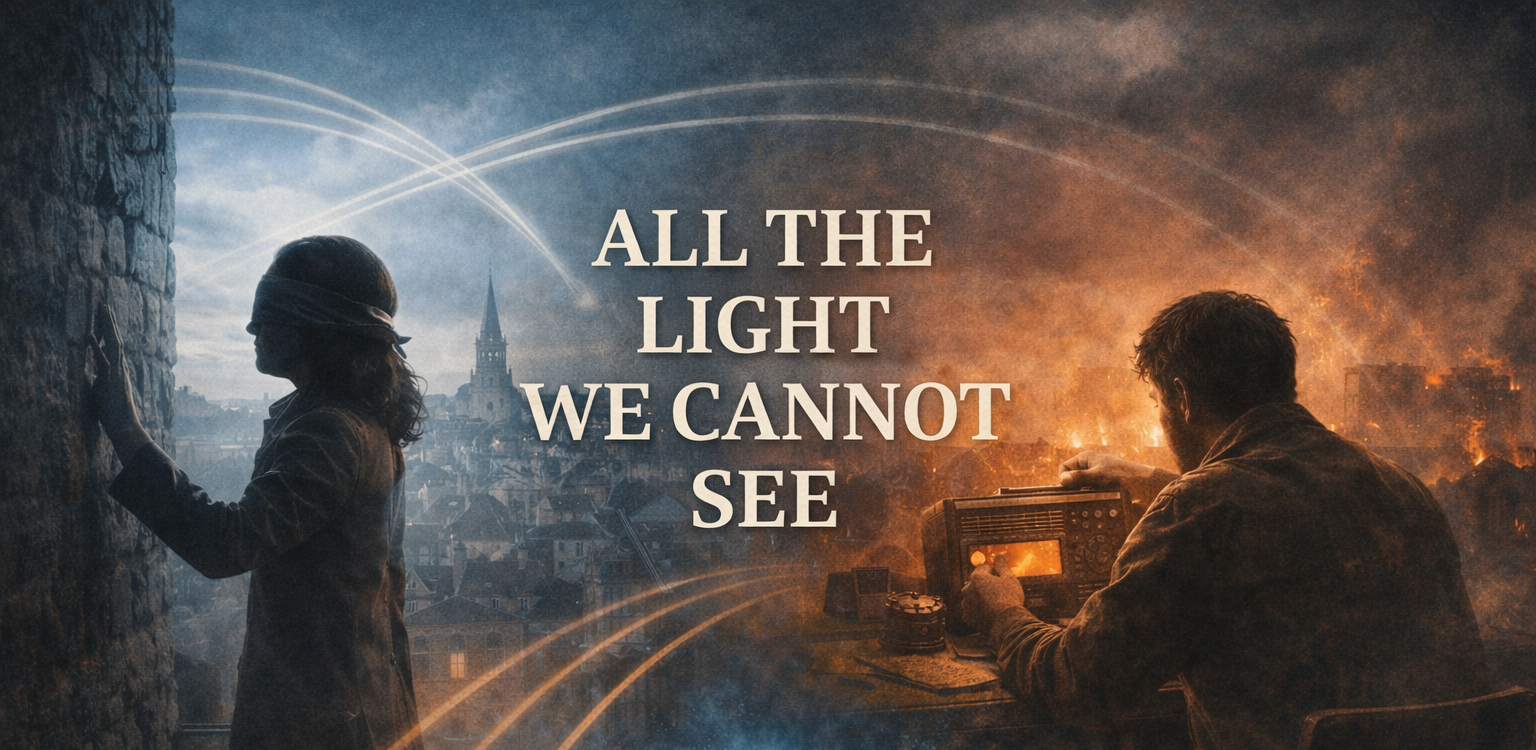
All the Light We Cannot See Summary: Plot, Ending, Themes
Two children grow up on opposite sides of World War II. One is a blind French girl learning to “see” by touch, sound, and memory. The other is a German orphan who can coax music and voices out of broken radios. They never meet as children, yet they’re connected early by something invisible: a science broadcast drifting across borders like contraband light.
Doerr builds the story as a tightening vice. Chapters set during the Allied siege of Saint-Malo in August 1944 keep cutting back to the years that placed each character inside that city’s walls. Each flashback is a fuse being laid. By the time the bombs fall, the plot has already made its choices.
At the centre is a rumour made solid: the Sea of Flames, a legendary diamond said to grant long life while bringing misfortune to everyone nearby—unless it is returned to the sea. Whether you believe in the curse or not, the diamond works like a pressure gauge. It reveals what people will do when they think salvation can be owned.
Key Points
This is a story about invisible connections: radio waves, recorded voices, and the quiet ways one life can shape another across distance and time.
Marie-Laure’s blindness is not a limitation the plot tiptoes around; it becomes a practical survival skill in an occupied city.
Werner’s brilliance is an escape hatch that turns into a trap: his talent saves him from the mines, then binds him to a machine that uses talent for harm.
Resistance here isn’t glamour. It is routine, risk, and patience—messages hidden in ordinary errands and ordinary voices.
The Sea of Flames isn’t “magic” so much as a moral magnet: it draws out greed, sacrifice, and the stories people tell themselves to justify both.
The siege of Saint-Malo compresses everything. Once the city is sealed, choices become irreversible—your next decision isn’t a debate, it’s a door.
The Book’s Plot Engine
The story runs on two parallel engines that are destined to mesh. Marie-Laure is taught to navigate the world through models and careful memory, then forced to apply that training in wartime Saint-Malo, where even small mistakes can be fatal. Werner is taught to hear patterns in noise, then pushed into work that turns “hearing” into hunting.
What keeps the plot moving is a collision between three forces: war, technology, and desire. War shrinks options. Technology amplifies power—sometimes to connect, sometimes to destroy. Desire (for safety, for a future, for immortality) makes people gamble with other people’s lives.
The stakes are intimate and brutal: not “who wins the war”, but who survives the week—and who remains recognisably themselves while doing it.
Key Characters
Marie-Laure LeBlanc: blind French girl; wants independence and safety; grows into quiet courage under occupation.
Daniel LeBlanc: her father, a locksmith at the Museum of Natural History; fiercely protective; carries a secret out of Paris.
Etienne LeBlanc: Marie-Laure’s great-uncle in Saint-Malo; reclusive WWI veteran; custodian of a hidden transmitter and a buried past.
Madame Manec: Etienne’s housekeeper; practical organiser of local resistance; believes ordinary people can matter.
Werner Pfennig: German orphan gifted with radios; wants a life beyond the mines; becomes trapped in the regime’s uses for his talent.
Jutta Pfennig: Werner’s sister; clear-eyed and stubborn; a moral counterweight to her brother’s compromises.
Frederick: Werner’s friend at school; gentle and “unfit” by Nazi standards; pays a terrible price for softness.
Dr. Hauptmann: Werner’s teacher; represents the seductive lie that intelligence and ideology can be cleanly separated.
Reinhold von Rumpel: Nazi gemologist; obsessed with the Sea of Flames; pursues the stone as if it can outwit death.
Frank Volkheimer: Werner’s fellow soldier; intimidating on the surface, surprisingly protective in practice.
Henri LeBlanc: Etienne’s brother and Marie-Laure’s grandfather; dead long before the main action, yet present through a voice that travels.
Synopsis
Marie-Laure grows up in Paris with her father, Daniel, who works as a locksmith at the Museum of Natural History. After she goes blind as a child, Daniel builds intricate models to teach her their neighbourhood—tiny streets and doorways she can learn with her hands—so she can move through the city with confidence rather than fear.
In Germany, Werner and his younger sister Jutta are raised in an orphanage near the mines of Zollverein. Werner’s gift is practical genius: he can rebuild radios from scrap and pull broadcasts out of the air. He becomes obsessed with a French science programme that treats knowledge as wonder, not propaganda.
When the Germans approach Paris in 1940, Marie-Laure and her father flee. They reach Saint-Malo, a walled coastal town, to live with Marie-Laure’s great-uncle Etienne and his housekeeper, Madame Manec. Life there becomes a strange mix of narrow routines and constant threat—queues, rationing, whispers, and the sense that walls protect you until they become a cage.
Werner’s talent wins him entry to an elite Nazi training school. What looks like opportunity quickly reveals itself as indoctrination, brutality, and a steady narrowing of what “choice” even means. Eventually, Werner is sent into military service built around radios: tracking signals, finding people, and turning invisible transmissions into arrests.
Back in Saint-Malo, Madame Manec pulls ordinary townspeople into resistance work, and Etienne’s attic hides more than old records. As the occupation hardens, a separate hunt begins: a Nazi official obsessed with a legendary diamond follows clues towards the LeBlanc household.
By August 1944, Saint-Malo becomes a target. Allied forces begin a siege and bombing campaign against the German-held town. Marie-Laure, Werner, and the hunter are all inside the walls as the city’s options collapse to almost nothing.
Full Plot Summary
This section reveals major plot turns and the ending.
Because Marie-Laure goes blind at six, Daniel refuses to let her world shrink. He builds a tactile model of Paris and trains her to navigate: count steps, feel kerbs, memorise turns, trust sound. That training becomes her independence—and later, her armour.
Because the Museum of Natural History fears looting under occupation, it creates three perfect copies of its legendary diamond, the Sea of Flames, and disperses the stones with staff members. Daniel leaves Paris carrying one of the four—real or copy, he cannot know. The legend around the gem is simple and poisonous: it promises long life to its keeper while harming everyone close to them, and it can only be “made safe” by returning it to the sea.
Because Germany invades France, Marie-Laure and Daniel flee Paris in June 1940 and reach Saint-Malo, where they take refuge in Etienne LeBlanc’s tall house. Daniel immediately begins building a new model—this time of Saint-Malo—so Marie-Laure can learn its streets by touch. While doing so, he hides the diamond inside a tiny replica of Etienne’s house within the model.
Because Daniel is summoned back towards Paris in December 1940, he leaves Saint-Malo—and is arrested on the journey. He is taken to a prison camp in Germany, where he eventually dies. Marie-Laure is left with Etienne and Madame Manec, clinging to routines that now have grief woven into them.
Because Madame Manec believes occupation can’t be met with passive waiting, she organises local resistance. The acts are practical: coded messages, quiet coordination, small disruptions that carry large risks. Etienne hesitates at first—he is traumatised, reclusive, and afraid of the outside world—but the house contains a transmitter hidden in its attic. Before the war, Etienne used it to broadcast science lessons recorded with his brother, Henri (Marie-Laure’s grandfather), keeping Henri’s voice alive across Europe. Under occupation, that same transmitter becomes a weapon: codes and messages sent into the air, invisible but consequential.
Because the resistance work draws attention, the danger escalates. Madame Manec dies in 1942, but Marie-Laure and Etienne continue the work, with Marie-Laure often serving as courier, carrying messages through ordinary errands such as trips to the bakery.
Meanwhile, because Werner and Jutta find a broken radio in 1934, Werner repairs it and discovers a wider world. He listens to music and, most importantly, to the French science broadcasts—Henri’s voice—speaking about curiosity as if it were a kind of freedom. Werner dreams of becoming a scientist, but in Zollverein dreams have an expiry date: the mines are waiting.
Because Werner wants to avoid the mines, his talent becomes his bargain with the state. In 1940 he is accepted to Schulpforta, a Nazi training school. The school’s purpose is not education but shaping. Werner learns that cruelty isn’t a side-effect; it’s part of the method. His friend Frederick, gentle and unsuited to the school’s brutality, is beaten so severely he suffers permanent brain damage and is sent home.
Because Werner tries to leave after two years, Dr. Hauptmann intervenes—falsifying Werner’s age so the boy can be drafted into the military sooner. Werner is placed in a Wehrmacht unit led by Volkheimer, tasked with tracking illegal radio signals across occupied territory. The job’s logic is chillingly clean: trace the transmission, find the people, eliminate the “problem”. Werner’s intelligence keeps the machine efficient, and the machine teaches him what efficiency costs. He becomes increasingly disillusioned, especially after civilians—including children—are killed as a consequence of his work.
Because Germany fortifies Saint-Malo, Werner’s unit is sent there in spring 1944. He begins tracing illegal broadcasts and detects a signal coming from Etienne’s house. Because Werner recognises the voice and music from the childhood science programmes, he does not report the signal. Instead, he watches the house, catches sight of Marie-Laure on her bakery route, and hides the truth from the men around him.
Because the war machine also has a hunger for loot, Reinhold von Rumpel is ordered to seize and catalogue jewels from occupied territories. Because von Rumpel has cancer and believes the Sea of Flames might grant him immortality, he becomes obsessed. Over years he tracks down three of the four stones, but the genuine one continues to elude him. Eventually he traces the diamond to Daniel LeBlanc’s last known residence: Saint-Malo. He visits Marie-Laure and probes for anything Daniel “left”, but she deflects him. Later, she opens the model and finds the Sea of Flames hidden inside.
Because Etienne is framed and arrested on false charges of terrorism, he is taken to Fort National, leaving Marie-Laure increasingly alone in the house—still resisting, still trying to survive, still carrying a secret she never asked for.
Then the story’s timelines snap tight.
Because Allied forces begin the siege and bombing of Saint-Malo in August 1944, the city becomes a sealed environment where every movement is exposed. Marie-Laure takes the Sea of Flames and hides in the cellar as the bombardment shakes the streets. When she surfaces to search for water, she realises she is no longer simply living under occupation—she is inside a burning trap.
Because von Rumpel sees opportunity in chaos, he enters Etienne’s house to search for the diamond. Marie-Laure retreats into the attic with the transmitter and the gem. For days she stays hidden. Because she has no other lever, she turns to what she can control: the signal. She broadcasts pleas for rescue and reads from her braille copy of Jules Verne’s Twenty Thousand Leagues Under the Sea, filling the air with a voice that can travel beyond walls.
Because Werner’s unit is also caught in the bombing, Werner, Volkheimer, and Bernd are trapped beneath rubble when their hotel collapses. Bernd is wounded and dies. Because they may die unseen, Werner repairs a radio to search for help—and hears Marie-Laure’s broadcasts. The voice is both new and hauntingly familiar: the science programme thread has become a lifeline.
Because Volkheimer understands time is running out, he pushes Werner to blast their way free. They escape using a grenade, and Werner runs towards the source of the broadcast.
Because von Rumpel confronts Werner inside the house and mistakes him for a rival thief, the situation turns into a standoff. Werner shoots and kills von Rumpel. He finds Marie-Laure and, because he has finally chosen a human life over obedience, helps her escape the house and the city.
Because the Sea of Flames has been framed as both salvation and curse, Marie-Laure refuses to let it keep pulling bodies towards it. As they flee Saint-Malo, she places the diamond inside a gated grotto flooded with seawater—effectively returning it to the ocean—and gives the key to Werner. They part. Marie-Laure later reunites with Etienne after his release.
Because Werner is captured and sent to a US prisoner-of-war camp, the war does not end cleanly for him. He becomes gravely ill. One night, delirious, he wanders away from the medical tent and accidentally steps on a German landmine, dying instantly.
Decades pass.
Because Volkheimer carries what remains of Werner’s story, he later finds Jutta—now an adult with her own life—and gives her Werner’s possessions, including the model house that once hid the Sea of Flames. Volkheimer tells her Werner was last seen in France and may have been in love.
Because the objects are a trail, Jutta follows it. She travels to France with her son, Max, and meets Marie-Laure in Paris. Marie-Laure is now working at the Museum of Natural History as a marine biologist. When she opens the model, she finds the key to the grotto—one last small piece of the past returning to her hand.
In 2014, Marie-Laure—eighty-six—walks through Paris with her grandson Michel. The world is loud with modern signals, but the novel insists the older, quieter ones are still there if you know how to listen.
The Domino Chain (explicit)
Because Marie-Laure goes blind, therefore Daniel trains her with models until navigation becomes instinct.
Because the museum fears occupation, therefore it creates copies of the Sea of Flames and disperses the stones.
Because Daniel carries a stone out of Paris, therefore the diamond’s danger moves with his family.
Because Daniel hides the stone inside the Saint-Malo model, therefore the truth sits inside a child’s “toy”.
Because Daniel is arrested, therefore Marie-Laure is forced into premature independence and risk.
Because Etienne has a hidden transmitter, therefore resistance can speak invisibly from inside his house.
Because Henri’s recorded science voice is broadcast, therefore Werner grows up longing for knowledge rather than conquest.
Because Werner wants to escape the mines, therefore he accepts Schulpforta and becomes exposed to Nazi brutality.
Because Dr. Hauptmann falsifies Werner’s age, therefore Werner is sent into signal-hunting military work.
Because Werner’s unit hunts illegal broadcasts, therefore radios become instruments of death as well as wonder.
Because Werner traces Etienne’s signal in Saint-Malo, therefore the two storylines are finally within reach of each other.
Because Werner recognises the voice and conceals the signal, therefore Marie-Laure’s broadcast survives long enough to matter.
Because the siege begins, therefore Marie-Laure is trapped and must broadcast for rescue.
Because Werner hears her transmissions, therefore he chooses action instead of obedience.
Because Werner confronts von Rumpel, therefore Marie-Laure escapes and the diamond can be returned to the sea.
Because Werner is captured and falls ill, therefore his life ends not in battle but in an accidental step.
Because Volkheimer delivers Werner’s belongings, therefore Jutta finds the trail to Marie-Laure decades later.
The Point of No Return
The outcome becomes inevitable the moment Werner traces the illegal broadcast in Saint-Malo and chooses not to report it. From there, he is no longer merely “caught in history”. He has made a private rebellion inside a system that punishes private rebellions. When the siege seals the city, that hidden decision forces a final choice: either let the signal be silenced—or follow it, whatever the cost.
The “8 Key Ideas” Module
Invisible Threads, Real Consequences
The point: What you send into the world can outlast you—and reach people you will never meet.
How it works: Doerr treats radio like “invisible light”: connection without contact. A recorded voice becomes a moral influence, then a literal lifeline. The same technology that carries wonder can also carry orders and targets.
Example: Werner grows up listening to Henri’s science lessons and dreaming of becoming a scientist. Years later, trapped under rubble, Werner repairs a radio and hears Marie-Laure broadcasting—voice travelling through wreckage when bodies cannot.
Do this:
If something you do can be replicated or replayed (work, teaching, publishing), build it as if a stranger might one day need it.
If a tool can connect and harm, decide in advance what lines you won’t cross with it.
Retrieval cue: If it travels through the air, treat it as permanent.
The Model City Advantage
The point: Preparation looks small until the day it becomes survival.
How it works: Daniel’s models turn the unknown into something Marie-Laure can “hold”. Repetition becomes confidence; confidence becomes speed; speed becomes safety.
Example: As a child, Marie-Laure learns Paris through a tactile model and step-counting. In Saint-Malo, that same skill set lets her move through a dangerous environment where sighted people can panic and misjudge.
Do this:
Build “mini versions” of hard environments before you enter them (routes, routines, checklists, rehearsals).
Practise until the basics are automatic; save your brain for surprises.
Retrieval cue: If you can’t control the city, build the model.
The Escape Hatch That Becomes a Trap
The point: The deal that saves you can also own you.
How it works: Werner’s talent buys him a future beyond the mines, but the price is proximity to power. Once the system invests in you, it expects repayment—often in the currency of obedience.
Example: Schulpforta looks like opportunity. It becomes a pipeline that turns Werner’s ability with radios into a weaponised job: tracing signals so people can be punished.
Do this:
When offered a “way out”, ask: what does this path train me to tolerate?
Keep a private definition of success that is not granted by the institution using you.
Retrieval cue: If it’s an escape hatch, check who holds the handle.
Softness as a Threat
The point: Brutal systems don’t just punish weakness; they punish kindness.
How it works: Frederick is targeted because he won’t harden into the shape the school demands. His suffering teaches Werner what the regime considers dangerous: empathy, hesitation, decency.
Example: Frederick is beaten so severely he suffers permanent brain damage. The message to everyone else is clear: become like us, or be broken.
Do this:
In hostile environments, protect “soft” people actively; silence is collaboration.
Treat casual cruelty as a forecast, not a one-off.
Retrieval cue: If kindness is mocked, danger is already normal.
Resistance as Routine
The point: Heroism often looks like consistency, not drama.
How it works: Madame Manec organises a network built on small acts—messages, codes, errands—that only work when repeated and trusted. It’s less about one bold gesture and more about many quiet ones.
Example: Marie-Laure carries resistance messages via everyday routes like the bakery run. Etienne uses the transmitter not for speeches but for coded communication—small packets of sabotage in the air.
Do this:
Build resistance into routine: one habit that makes you harder to control.
Make your courage repeatable, not theatrical.
Retrieval cue: If it can be done daily, it can matter.
Greed Makes Its Own Logic
The point: Obsession turns people into predictable machines.
How it works: Von Rumpel believes the Sea of Flames can outwit death. That belief narrows his behaviour until he becomes trackable: he follows clues, corners the vulnerable, and mistakes possession for salvation.
Example: He tracks the stones across years, then arrives in Saint-Malo and invades Etienne’s house during the siege, convinced the diamond must be there.
Do this:
When someone is obsessed, map the obsession; it will tell you their next move.
Don’t argue with the story they’re telling themselves—use the predictability it creates.
Retrieval cue: Obsession is a timetable.
Redemption Is an Act, Not a Mood
The point: Feeling guilty changes nothing; choosing differently does.
How it works: Werner’s disillusionment matters only when it turns into behaviour that carries risk. The novel doesn’t erase what he has enabled, but it does insist that one real choice can still be real.
Example: Werner hides the broadcast’s location, then later follows the transmissions and acts to save Marie-Laure during the siege—placing his life against the logic he has served.
Do this:
Identify the next decision where you can stop being useful to harm.
Choose the action that costs you something; cheap remorse is just self-care.
Retrieval cue: If it doesn’t cost, it isn’t change.
What Survives Is the Signal
The point: Objects and recordings carry stories forward when people can’t.
How it works: The novel is full of “containers” of memory: models, keys, records, a transmitter, a small box of belongings. They become the bridge between decades, making the past retrievable rather than merely tragic.
Example: Volkheimer delivers Werner’s belongings to Jutta. Jutta follows the model’s trail to Marie-Laure decades later. The key returns. The story doesn’t resurrect the dead, but it does reconnect the living.
Do this:
Keep one artefact of what matters and curate it deliberately; memory needs containers.
If you want your work to outlast you, make it easy to pass on.
Retrieval cue: If you want it remembered, give it a vessel.
Themes
Invisible light, invisible lives: radio waves connect Werner to Henri’s voice; Marie-Laure broadcasts from the attic during the siege; connection becomes both plot mechanism and metaphor.
War as a machine that eats choices: Werner’s path from Schulpforta to signal-hunting shows how “opportunity” becomes coercion; Marie-Laure’s routines become risky simply because war changes the rules around them.
Technology as wonder and weapon: the same radios that deliver science and music are used to hunt resistance transmissions; the transmitter can preserve a dead voice or expose living bodies.
Greed versus sacrifice: von Rumpel’s obsession with the Sea of Flames escalates danger; Daniel’s decision to carry the stone is protective; Marie-Laure’s decision to return it to the sea rejects the fantasy that salvation can be possessed.
Legacy and transmission: Henri’s recordings, the model house, the key, and the later meeting between Jutta and Marie-Laure show how the past persists through objects, not just memories.
Close
If you only remember one thing… this novel argues that the most powerful forces are often the ones you can’t see: signals, routines, small mercies, and the private choices that become public consequences.
