The Power Summary
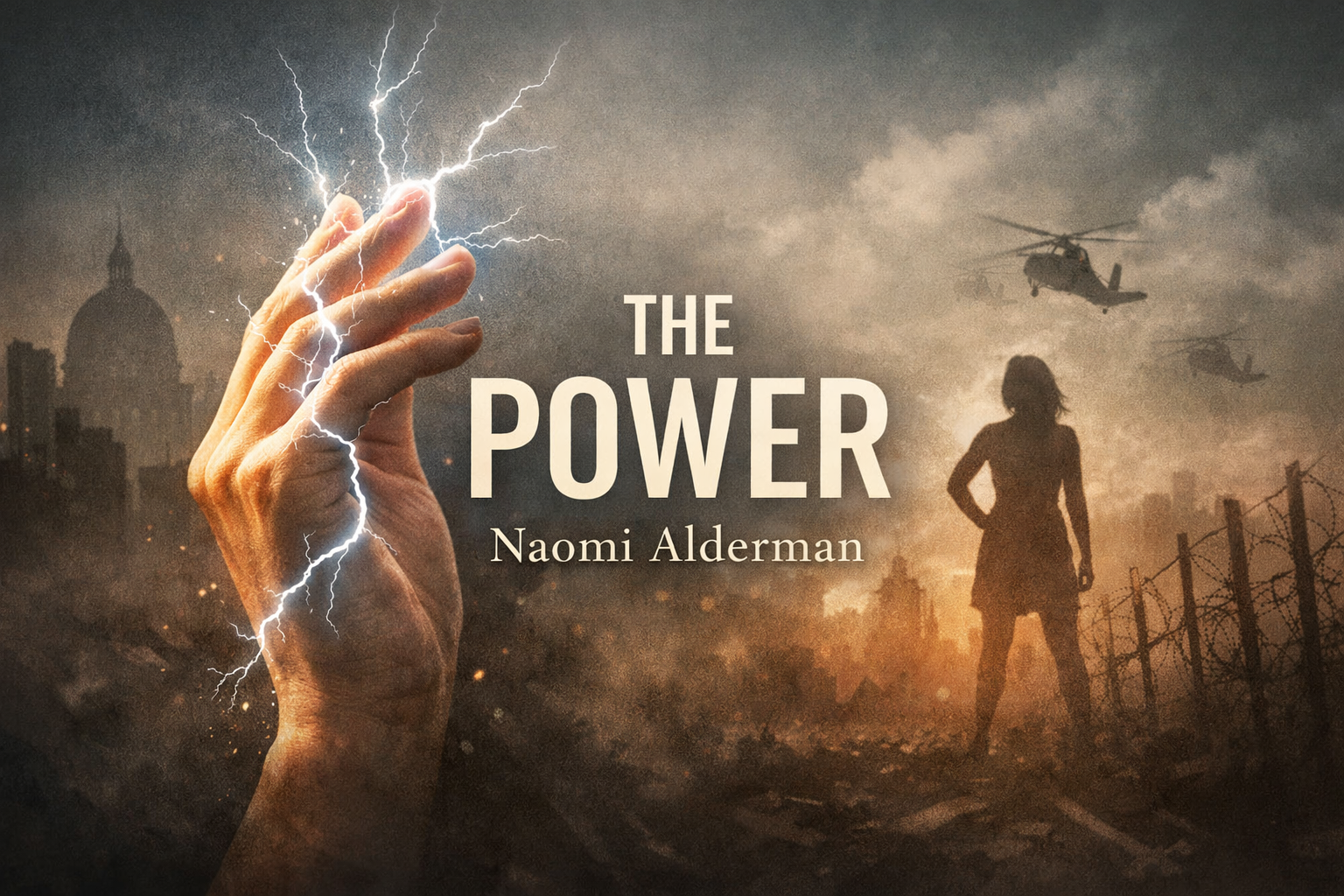
The Power summary: plot, themes, ending explained
Naomi Alderman’s 2016 Novel Explained
Naomi Alderman’s The Power (2016) is a speculative thriller that asks a simple question and refuses to let it stay simple. In this The Power summary, the world changes when teenage girls develop the ability to deliver electrical shocks—and that advantage spreads, organizes, and hardens into a new order.
The book follows multiple lives across countries and classes as the “power” rewires everyday fear, sex, politics, and faith. It is not a superhero story. It is a story about what happens when violence becomes thinkable for the people who used to be told to endure it.
Alderman also frames the novel as a “history” told far in the future, which makes every event feel like a fossil being brushed clean. The frame turns the book into a trap: you think you are reading about gender, then you realize you are reading about power.
“The story turns on whether a sudden advantage creates justice or just a new excuse to dominate.”
Key Points
The Power flips the physical balance between men and women by giving girls a lethal biological ability.
The novel tracks four main viewpoints as society reacts: fear, backlash, organization, and exploitation.
Power spreads from private moments of self-defense to public systems: policing, politics, war, and religion.
The “skein” becomes both a biological fact and a social myth, changing how people explain order.
The book shows how quickly violence can be moralized when it serves the winners.
Its frame narrative turns the story into a lesson about who gets to write history.
The warning is not “women are worse” or “men are worse,” but that systems reward cruelty when it works.
Quick Facts
Title: The Power
Author/Director: Naomi Alderman
Year: 2016
Format: Book (novel)
Genre: Speculative fiction, dystopian thriller
Primary setting: Global, with major threads in the UK, the US, and parts of Africa and Eastern Europe
One-sentence premise (snippet-ready): When girls develop the ability to electrocute at will, the gender order flips—and the new world is not kinder.
Names and Terms
Allie (later “Mother Eve”) — a runaway foster girl who turns her power into a religious movement.
Roxy Monke — a London gangster’s daughter whose grief and rage pull her into the power economy.
Margot Cleary — a US politician who builds policy and institutions around the new reality.
Jocelyn — Margot’s daughter, whose power shapes Margot’s choices and blind spots.
Tunde Edo — a young journalist who documents the upheaval as it spreads and mutates.
Skein — the biological organ linked to the ability to generate electric shocks.
Glitter — an illicit enhancer that boosts women’s electrical ability and fuels conflict.
Bessapara — a new political experiment that becomes a proving ground for the future.
Tatiana — a rising leader whose rule in Bessapara slides toward paranoia and brutality.
Cataclysm — the looming worldwide collapse that the narrative counts down toward.
Full Plot
Spoilers start here.
The novel follows the emergence of the power through several intertwining lives, while a far-future frame treats these events like ancient history. That frame matters because it shapes what the book is really doing: it is showing how a new normal gets built, justified, and remembered.
Act I: Setup and Inciting Incident
Roxy Monke is a tough teenage girl in London, raised close to violence through her gangster father. Her world collapses when men break into her home and her mother is killed. In the chaos, Roxy discovers she can shock with her hands. The power arrives for her not as a gift, but as a reflex in a moment of terror.
Across the world, Tunde Edo is a young man in Nigeria trying to find a way into journalism. When he captures early evidence of women using the power, the footage spreads fast. He realizes he is watching the birth of a new kind of story: not one scandal, but a shift in the rules of life. His access becomes valuable because he can move between spaces others cannot.
In the United States, Margot Cleary is a local politician with ambition and sharp instincts. When her daughter Jocelyn begins to show signs of the power, Margot understands immediately that this is not just a cultural panic. It is a political event, and politics will decide how it gets handled. She starts positioning herself as someone who can manage the fear.
Allie, a foster girl trapped in an abusive home, discovers her power and uses it to escape. She is drawn to a convent, where she finds a kind of shelter and a language of purpose. She also carries something else: a voice that feels like guidance, pressure, or revelation. Allie learns to narrate her own life as a mission, not just survival.
As reports multiply, the power becomes impossible to deny. Scientists identify the “skein,” a biological organ connected to the ability to generate electrical shocks, and older women learn the power can be “awakened” in them, too. The story’s scale widens quickly: what starts in teenage bodies becomes a social fact.
What changes here is that fear stops being private and becomes structural.
Act II: Escalation and Midpoint Shift
Once the power is widespread, people begin to organize around it. Some men respond with denial or violence. Some women respond with exhilaration. Many respond with calculation. The old scripts—who is safe, who needs protection, who gets believed—begin to flip, and the flip is messy.
Margot uses the crisis to build political capital. She supports training programs for girls, publicly framing them as safety and responsibility. But the camps also function as a new infrastructure of force: discipline, hierarchy, and readiness. Margot’s career rises as she becomes associated with “control” in a moment when everyone wants someone to promise control.
Roxy’s path bends toward the underground economy of the power. Grief makes her reckless, and her family’s criminal connections give her tools. She becomes involved with “glitter,” an illicit substance that enhances a woman’s electrical output. Glitter turns the power into a commodity. It also turns women’s bodies into strategic resources, because amplified power can win fights, intimidate rivals, and reshape territory.
Allie reinvents herself as “Mother Eve,” using religion as a channel for authority. She presents the power as divine intention and reframes familiar traditions to center women. Her charisma and claimed ability to heal attract followers. The movement offers something potent: permission. It tells women that domination is not only possible, but morally correct.
Tunde travels and reports as the upheaval becomes global. He sees revolts and crackdowns, and he learns that the power does not end violence—it relocates it. His perspective becomes increasingly dangerous because he is witnessing the new abuses as they form. As a man, he is also exposed to the vulnerability women have long been trained to accept, and the book forces him into experiences that reveal how quickly “normal” can become predation.
At the midpoint, the story’s energy shifts from chaos to consolidation. The power is no longer just a phenomenon; it is becoming governance. A new state project emerges in Eastern Europe: Bessapara. Under rising leadership and shifting alliances, Bessapara becomes a laboratory for a female-led order backed by force. The country’s conflict attracts mercenaries, opportunists, and true believers. It is both a refuge and a warning.
Roxy’s personal world also fractures from within. Trust inside her circle breaks, and betrayal turns her into prey inside the very system she helped build. The logic of power tightens: the more valuable the skein becomes, the more people will treat it like property.
What changes here is that the revolution stops being a reaction and becomes a plan.
Act III: Climax and Resolution
Bessapara becomes the staging ground for the final escalation. Tatiana’s rule grows harsher, with men’s rights curtailed and violence justified as protection or necessary correction. The state begins to sound like every state that has ever needed an enemy to stay coherent. The rhetoric changes first. The policies follow.
Tunde tries to preserve evidence of what he is seeing, but his position becomes increasingly precarious. Information is power, and power does not like uncontrolled records. He is forced into decisions about risk, loyalty, and survival, and he discovers how easy it is for a system to erase a person by changing the paperwork around them.
Roxy is ambushed and loses control of her own body’s source of power when her skein is taken from her. The theft is not just physical. It is symbolic: the new world is willing to mutilate and redistribute power by force, the same way the old world did with different tools. Roxy survives, but she is stripped of the one thing that made her untouchable.
Mother Eve rises further inside Bessapara’s inner circle, becoming a spiritual authority with political reach. When Tatiana’s instability threatens the project, Eve removes her and takes control. The transfer is brutal in its simplicity: a leader is replaced not through debate or consent, but through force and narrative. Once Eve is in power, she chooses continuation over restraint.
Margot’s story reaches its most devastating cost through Jocelyn. Jocelyn’s involvement in the conflict and the surrounding economy of power draws her into danger she cannot fully predict. When she is gravely injured, Margot’s political instincts fuse with personal grief. Her decisions become less about stability and more about ensuring the world tilts toward the side her daughter represents, even if the tilt requires catastrophe.
The book drives toward the Cataclysm: a worldwide collapse linked to escalating conflict and the strategic use of the power. The ending does not offer a clean aftermath inside the main timeline. It offers a sense of inevitability, as if the system has crossed a threshold and cannot reverse without breaking.
Then the frame narrative closes the trap. In the far future, the “historical novel” is presented as a manuscript written by a man, sent to a woman for feedback. Their letters reveal a society where women’s dominance is treated as natural, and the idea that men once dominated is treated as implausible or even laughable. The past becomes a story problem: what sounds believable depends on what the present already assumes.
The novel ends on an emotional note that is colder than tragedy and sharper than satire: the world changes, and then the world explains itself as if it had always been this way.
Analysis and Themes
Theme 1: Power is not virtue
Claim: Power does not purify the person who holds it; it tests what they can justify.
Evidence: The power begins as self-defense and ends as institutional violence. The new order builds training camps, borders, and punishments with the same confidence the old order used. Characters who begin by resisting abuse later participate in systems that produce it.
So what: The book refuses the comforting fantasy that the “right” people will be gentle once they get the tools. It argues that systems reward what works, and what works often looks like cruelty wearing a uniform.
Theme 2: The body becomes policy
Claim: When the body is a weapon, biology turns into law.
Evidence: The skein changes who is feared in public spaces and who gets believed in private spaces. Once older women can be awakened into power, age hierarchies shift. Glitter turns the body into a market, and the market turns the body into strategy.
So what: The Power shows how quickly physical reality becomes ideology. People do not just adapt behavior; they rewrite stories about what is “natural,” then use those stories to justify control.
Theme 3: Religion is a technology of legitimacy
Claim: Faith becomes most dangerous when it offers moral permission for domination.
Evidence: Mother Eve’s movement reframes old traditions to center women and to sanctify violence as destiny. The power becomes proof of divine intent, and the narrative of correction replaces the narrative of equality. The religious story does not reduce conflict; it organizes it.
So what: The novel treats religion as a force multiplier; it can turn fear into meaning and meaning into obedience. It warns that the question is not whether people believe, but what belief allows them to do without shame.
Theme 4: Media makes the revolution real
Claim: Visibility accelerates change, but it also shapes what change becomes.
Evidence: Tunde’s videos help the power spread as a public fact, not a rumor. The story shows how quickly attention turns violence into spectacle and then into policy. The person who controls the record controls what the future thinks happened.
So what: The book anticipates a world where the first draft of reality is a clip, and the second draft is propaganda. It suggests that revolutions do not just need leaders; they need narratives that scale.
Theme 5: Protection is a mask for control
Claim: Institutions often justify force as safety, even when safety becomes domination.
Evidence: Training camps begin as a responsibility and become recruitment. Borders and crackdowns are framed as preventing chaos. In Bessapara, rights are removed in the name of stability, and stability becomes indistinguishable from fear.
So what: The novel highlights a familiar pattern: once violence is normalized as “necessary,” the list of necessities expands. People accept it because they are told the alternative is worse.
Character Arcs
Protagonist: Allie/Mother Eve begins as a traumatized girl who wants safety and meaning, and she ends as an architect of a new order who treats catastrophe as acceptable collateral. The turning points are her escape, her reinvention through faith, and her decision to seize power rather than restrain it.
Roxy begins as a grieving daughter using power to survive and ends as a figure haunted by the fact that power can be stolen, traded, and taken. Her arc forces the reader to see that “strength” does not prevent exploitation; it can attract it.
Margot begins as a pragmatic politician protecting her family and ends as someone whose ambition and grief fuse into decisions that feed global escalation. Her arc shows how “responsible leadership” can become a story people tell themselves while they cross lines.
Tunde begins as an observer chasing a career and ends as a witness whose body and identity are put at risk by the world he documents. His arc reveals how quickly vulnerability becomes normal when the system decides you are disposable.
Craft and Structure (What makes it work)
Alderman builds momentum through braided viewpoints that each represent a different channel of power: crime, politics, religion, and media. That structure keeps the story from becoming a single argument. The world changes in multiple ways at once, and the reader feels the friction between them.
The countdown toward the Cataclysm creates dread without needing constant twists. Even when a scene is small—a conversation, a decision, a betrayal—it carries the weight of a future that has already been written as history.
The frame narrative is the book’s sharpest blade. By placing the manuscript in a distant matriarchal future, Alderman makes “common sense” feel contingent. The same events that would sound obvious in one era sound implausible in another, and that is the point.
What Most Summaries Miss
Many summaries treat the premise as a gender flip and stop there. The deeper mechanism is how quickly the new order builds the same machinery: training, propaganda, scapegoats, borders, and moral permission. The book is not asking “what would women do?” It is asking “what does power do to whoever holds it?”
The second miss is the role of narrative ownership. Tunde’s struggle is not only physical danger; it is the fragility of evidence. The story shows that documentation can be stolen, reframed, or erased, and that the future will believe whatever matches its current hierarchy.
Finally, the frame letters are not just a clever twist. They are the novel’s verdict. They show that once a hierarchy lasts long enough, it becomes invisible to the people inside it—and the past becomes something you can rewrite as “unlikely.”
Relevance Today
The book lands hard in a world shaped by viral media. A single clip can ignite fear, policy, and backlash before anyone understands what they are seeing.
It also speaks to how quickly institutions rebrand control as protection. Training programs, security measures, and “public safety” rules can expand until they quietly become a new form of domination.
Work culture fits the pattern, too. Power shifts are rarely announced as conquests. They are announced as “efficiency,” “risk management,” or “standards,” even when the result is coercion.
Politically, The Power mirrors the way emergencies justify extraordinary measures. Once a society accepts that violence is necessary for stability, leaders can manufacture instability to keep the permission.
In relationships and identity, the novel shows how fear shapes desire and behavior. When vulnerability flips, courtship, trust, and intimacy do not automatically become healthier—they become renegotiations under new threat.
Finally, the book reads like a warning about inequality that mutates rather than disappears. If you replace one dominant group with another without changing the logic of domination, you still get domination—just with different uniforms.
Ending Explained
The ending means the book is not only predicting a disaster but also explaining how disasters get remembered as destiny.
On the plot level, the story accelerates into the Cataclysm, a collapse driven by escalating conflict and the consolidation of power into state and religious authority. It is the endpoint of choices that treat domination as correction and violence as necessary.
On the structural level, the far-future letters reveal the final irony: in a matriarchal world, the idea of male dominance sounds implausible, even when presented as “history.” That reversal shows how “believability” is not neutral. People find stories believable when they flatter the order they already live under.
What It Leaves You With
The Power is for readers who want dystopian fiction that does not soothe. It moves fast, hits hard, and keeps asking the same question in different rooms: who gets to hurt whom, and who gets to call it normal?
It may frustrate readers looking for a clean moral. The book is not interested in proving that any group is inherently better. It is interested in exposing how quickly cruelty becomes policy when it is rewarded.
The final meaning is not that the world would simply invert. It is that power, once it can be taken and kept, will build a story that makes itself feel inevitable.
