Station Eleven Summary
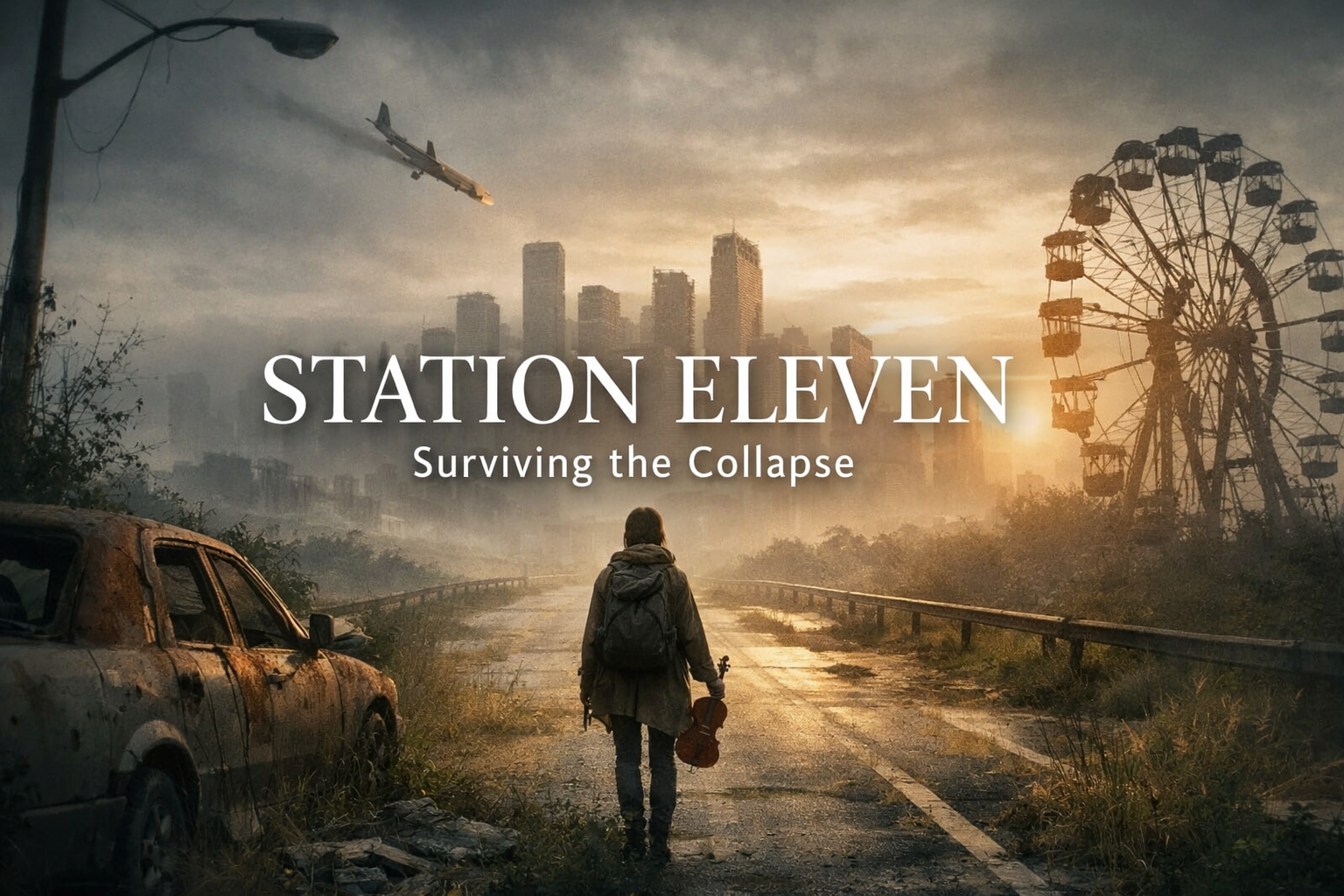
Station Eleven summary: plot, themes, ending explained
A post-pandemic novel about art, memory, and survival
Emily St. John Mandel’s Station Eleven (2014) is a literary post-apocalyptic novel that begins on the last night of the old world and keeps returning to one question: when the systems fall, what still counts as a life?
A deadly flu collapses modern society with terrifying speed. Twenty years later, a small troupe called the Traveling Symphony performs Shakespeare and music across scattered settlements around the Great Lakes. Their work sounds like a luxury, until the story shows how culture becomes shelter, identity, and a kind of moral technology.
The novel is built from intersecting lives: a famous actor who dies just as the pandemic ignites, a child performer who survives into the new world, a paramedic-in-training who tries to do the right thing, and the people who turn memory into either comfort or a weapon.
“The story turns on whether civilization is only infrastructure or also the stories we choose to carry.”
Key Points
Station Eleven follows multiple characters before and after a flu pandemic destroys most of humanity.
The central thread is Kirsten Raymonde, once a child actor, now a performer traveling between fragile settlements.
A two-volume comic book titled Station Eleven becomes a shared artifact that binds key characters and ideas.
The Traveling Symphony’s motto, “Survival is insufficient,” frames the novel’s argument about meaning after catastrophe.
The narrative intercuts “Year Zero” collapse scenes with “Year Twenty” life, showing how trauma reshapes memory.
A dangerous preacher known as the Prophet threatens the Symphony and reveals the dark side of meaning-making.
The book treats art, museums, and performance as practical tools for building continuity, not decoration.
The ending leans toward cautious renewal: connection returns, and lights appear again in the distance.
Quick Facts
Title: Station Eleven
Author/Director: Emily St. John Mandel
Year: 2014
Format: Book
Genre: Post-apocalyptic literary fiction
Primary setting: Great Lakes region (U.S./Canada), with key scenes in Toronto and an airport settlement
One-sentence premise (snippet-ready): After a flu pandemic collapses civilization, a Shakespeare troupe travels between settlements while a shared comic book ties survivors to the world they lost.
Names and Terms
Kirsten Raymonde — a former child actor who grows up in the post-collapse world as part of the Traveling Symphony.
Arthur Leander — a famous actor whose death onstage coincides with the pandemic’s outbreak.
Jeevan Chaudhary — a man in the audience who tries to help on the night the world ends, then fights to survive Year Zero.
Miranda Carroll — Arthur’s first wife and the creator of the Station Eleven comic.
Clark Thompson — Arthur’s friend who helps found an airport community and curates a “Museum of Civilization.”
Tyler Leander / the Prophet — Arthur’s son, later a cult leader whose beliefs endanger others.
Georgia Flu — the fast-moving pandemic that causes “the collapse.”
Traveling Symphony — the troupe of actors and musicians touring settlements with Shakespeare and orchestral music.
Museum of Civilization — a collection of pre-collapse objects that becomes a shrine, a classroom, and a warning.
“Survival is insufficient” — the Symphony’s motto: staying alive is not the same as living.
Full Plot
Spoilers start here.
Act I: Setup and Inciting Incident
On a winter night in Toronto, Arthur Leander performs King Lear at the Elgin Theatre. In the audience sits Jeevan Chaudhary, a man who has drifted through jobs and identities and recently trained for emergency work. During the performance, Arthur collapses. Jeevan rushes to the stage and attempts CPR, but Arthur dies there, under the lights, mid-story.
In the backstage shock that follows, Jeevan briefly comforts Kirsten Raymonde, a child actor in the production. She is eight years old, old enough to register fear, too young to understand that this is the hinge point of her life. Arthur had given Kirsten a gift earlier: two volumes of a comic book called Station Eleven, drawn by his first wife, Miranda Carroll.
Jeevan leaves the theater and gets a warning call: a doctor friend tells him a deadly flu is moving through the city and that normal life is about to end. The advice is blunt—get out, stock up, assume the worst. Jeevan pivots from ordinary indecision to emergency purpose. He buys supplies and goes to his brother Frank’s apartment.
The Georgia Flu hits with extreme speed. In days, hospitals fail. In weeks, the old world is gone. People who gathered to mourn Arthur die soon after, one by one, as if the mourning itself were a last communal ritual before the lights go out.
In Frank’s apartment, Jeevan tries to build rules: ration food, stay inside, think ahead. Frank, paraplegic and sharp-minded, watches the news collapse into static and then silence. Their bond becomes a survival unit—uneven, loving, and tense. Outside, the city becomes dangerous, then empty.
What changes here is that survival stops being an abstract fear and becomes the only job left.
Act II: Escalation and Midpoint Shift
The novel moves forward about twenty years. Civilization has not returned as a nation-state or a grid. It has returned as routes, rumors, and small clusters of people who remember different pieces of the past. Kirsten is now an adult and part of the Traveling Symphony, a group of actors and musicians moving along a two-year circuit around the Great Lakes. They perform Shakespeare and play classical music. They trade art for food and safe sleeping space. They live on the knife-edge between welcome and violence.
Kirsten carries the Station Eleven comics like a relic. She rereads them. She guards them. She also scavenges in abandoned houses for useful objects and for traces of the old world, including tabloid magazines featuring Arthur Leander. Her memory of Year Zero is fragmented, but her connection to Arthur persists as a strange anchor: he died in front of her, and then the world died too. In her mind, those events fuse into one origin story.
The Symphony travels with a motto painted on their caravan: “Survival is insufficient.” It sounds poetic, but it also functions as policy. It gives the group a reason to exist that is not merely hunger avoidance. It is the story they tell themselves so that fear does not shrink their lives into a single dimension.
Their route takes them toward a town where they expect to reunite with friends, only to find the community changed and controlled by a cult leader known as the Prophet. The Prophet claims divine purpose for the collapse and for the violence he commits. He takes young girls as “wives,” and his followers enforce the doctrine with intimidation and brutality. The Symphony senses that this is not a negotiable situation. They leave quickly, but leaving does not guarantee escape.
A girl fleeing the Prophet joins them as a stowaway, terrified of being forced into marriage. The troupe debates what they owe her and what danger she brings. The road becomes a moral test: protect one person at the risk of many, or refuse and become complicit in the world’s new cruelties.
As the Symphony tries to navigate away from the Prophet’s territory, members begin to disappear. Kirsten and her friend August end up separated from the rest. It looks, at first, like the cult has taken everyone. The fear is not just about death. It is about what kind of world this is becoming, and whether art can survive contact with power.
In a parallel Year Zero narrative, the story follows Clark Thompson, Arthur’s old friend, who is traveling with Arthur’s third wife Elizabeth and Elizabeth’s son Tyler. As the flu spreads, their flight is grounded at Severn City Airport. The airport becomes a settlement by accident—people cannot leave, so they build a life inside the terminal. Clark begins collecting objects from the vanished world: phones, passports, laptops, credit cards. He calls it the Museum of Civilization. The museum becomes memory made physical, a way to teach children what “before” meant without turning it into myth.
Tyler, in contrast, grows toward religious certainty. For him, the collapse demands a story of purpose. Over time, he and Elizabeth drift into a more fervent belief system, one that claims the new world is the true world and the old one was a mistake. Eventually, they leave the airport with others who share that worldview.
Back in Year Twenty, Kirsten and August are alone long enough to accept the worst. Then they learn the truth: the Symphony did not vanish. It was diverted and protected by chance and quick decisions on the road. Some were harmed. One was killed. But the group is not erased. The terror, however, has already done its work. Kirsten’s understanding of safety changes. The road is not neutral.
The midpoint pivot arrives when Kirsten realizes the Prophet is not just a regional threat but entangled with her private mythos. He knows words and ideas she thought belonged only to her and her comics. He speaks of the “Undersea,” a key concept from Station Eleven. That means the comic is not only a comfort object. It is also a shared language that can be twisted.
What changes here is that the story stops being about avoiding danger and becomes about confronting the narratives that create it.
Act III: Climax and Resolution
Kirsten and August encounter the Prophet and his men while trying to reach the airport settlement and the Museum of Civilization. The confrontation is tense, close, and intimate in the way violence often is in small societies: there is nowhere to disappear to, and everyone carries the history of every choice.
The Prophet corners Kirsten. He is on the verge of killing her when he reveals his familiarity with Station Eleven—he references the “Undersea,” pulling the comic’s internal world into the real one. Kirsten responds by quoting lines and ideas from the comic, not because she expects mercy, but because she recognizes a crack in his certainty. The comic becomes a weapon of disruption, a reminder that stories can undo as well as build.
A younger follower, shaken and conflicted, shoots and kills the Prophet. The moment is not framed as triumph. It is a collapse of belief, a refusal that arrives too late for the harm already done. The immediate threat ends, but the problem of meaning does not. Even after the Prophet’s death, the question remains: what do survivors do with the stories that explain their pain?
Kirsten and August reach Severn City Airport and reunite with the Traveling Symphony. The airport settlement has held together through routines, quarantine rules, and a sense of continuity. Clark is still there, still curating the Museum of Civilization. He recognizes Kirsten and begins to connect the threads: Arthur’s death, Miranda’s comic, the traveling performers, and the Prophet’s identity.
Clark discovers that the Prophet was Tyler Leander, Arthur’s son, the boy who left the airport years ago with his mother and a new faith. The recognition does not solve anything, but it reframes the tragedy. Tyler did not become a monster from nowhere. He became a monster from a hunger for meaning and a childhood shaped by collapse.
The ending moves upward, literally and emotionally. Clark takes Kirsten to the airport control tower and shows her something beyond the settlement: electric lights in the distance, proof that another town has restored power. It is a small detail with a large implication. It suggests the world is not only enduring but slowly rebuilding connective tissue—systems, trade, perhaps even larger forms of community.
Kirsten leaves the airport with the Symphony. She gives a copy of Station Eleven to the museum, turning her private relic into a public artifact. The story closes on cautious forward motion: the road continues, but now it leads toward light.
Analysis and Themes
Theme 1: Survival is insufficient
Claim: Staying alive is not the same as building a life.
Evidence: The Traveling Symphony keeps performing even when food, safety, and time are scarce, because performance is how they remain human rather than merely durable. Kirsten’s devotion to the comic is not practical, but it stabilizes her identity across a broken timeline. The airport community builds rules and rituals that keep people from turning on one another.
So what: After disaster, people need structure that isn’t only logistics. When societies reduce life to threat management, they often produce new forms of cruelty. The novel argues that meaning is not a bonus feature. It is a survival technology.
Theme 2: Memory as shelter, memory as trap
Claim: The past can protect you, but it can also freeze you.
Evidence: Clark’s Museum of Civilization preserves the old world in objects, not nostalgia alone; it is a way to teach children what was real. Kirsten’s fixation on Arthur and the tabloids shows another side: memory can become obsession, a substitute for belonging. Tyler’s belief that “there is no before” turns memory into an enemy he must destroy.
So what: Communities need a relationship with the past that is honest enough to learn from it and flexible enough to move forward. When memory becomes either worship or denial, it stops being history and becomes ideology.
Theme 3: Art as a shared language
Claim: Art creates connection across time, but it can be interpreted in opposite ways.
Evidence: Miranda’s comic book links characters who never meet, and it becomes a private scripture for Kirsten. The Prophet’s use of the comic’s concepts shows how a text can be repurposed as a tool of power. The Symphony’s Shakespeare performances give strangers a temporary common world—roles, lines, rhythms, and an emotional vocabulary.
So what: Culture is not neutral. Stories can teach empathy, but they can also provide a mask for domination. The novel makes you watch the same artifact do both, which is why it feels so true to life.
Theme 4: Faith, certainty, and permission to harm
Claim: In a shattered world, certainty can become a weapon.
Evidence: The Prophet frames violence as destiny. He uses apocalypse language to justify taking children as property. His followers outsource responsibility to doctrine, which makes cruelty feel clean. Meanwhile, the airport’s rituals and the Symphony’s motto offer meaning without requiring enemies.
So what: People do not only fight over resources. They fight over interpretations. The most dangerous leaders in unstable times are not always the strongest. They are the ones who offer a story that turns fear into permission.
Theme 5: Chosen family and ordinary care
Claim: What rebuilds a world is often unglamorous: care, competence, and small loyalty.
Evidence: Jeevan’s initial instinct is to help on the night Arthur dies, and that impulse carries into the hard weeks of Year Zero. The apartment survival years revolve around routines, not heroics. The Symphony functions as a mobile family with rules, roles, and mutual dependence.
So what: Disaster narratives often worship lone wolves. Station Eleven insists that endurance comes from social skill: sharing, planning, repairing, teaching, and sometimes simply staying with someone when it would be easier to leave.
Theme 6: Fragile systems and the myth of permanence
Claim: Modern life feels permanent until it doesn’t.
Evidence: The Georgia Flu collapses travel, medicine, supply chains, and government response faster than characters can narrate it. The airport becomes a city not because anyone planned it, but because infrastructure can be repurposed when it stops doing its original job. The appearance of electric lights at the end hints that systems can return, but not automatically and not everywhere at once.
So what: The novel trains you to see your world as contingent. That awareness can create panic, or it can create gratitude and responsibility. It also reframes “progress” as something maintained daily, not a force of nature.
Character Arcs
Protagonist: Kirsten Raymonde begins as a survivor who clings to artifacts to stabilize her identity. Her early worldview is shaped by trauma and vigilance, visible in how she watches strangers and how tightly she guards the comic. By the end, she shifts from private preservation to shared continuity. Giving the comic to the museum signals that she is no longer only protecting herself. She is contributing to a culture that can outlast her.
Clark Thompson starts as an observer and social satellite in the old world, orbiting celebrity and proximity. After the collapse, he becomes a builder of meaning through curation and community rules. His arc is a quiet argument that stewardship can be a form of leadership.
Tyler Leander’s arc is a warning. As a child, he experiences collapse and absorbs the idea that stories must explain suffering. As an adult, he uses certainty to control others, turning apocalypse into entitlement. The reveal of his identity is not an excuse. It is an anatomy lesson.
Jeevan Chaudhary’s arc runs from drift to responsibility. He begins as someone who has not yet chosen a life, then becomes someone defined by care and practical action when choice is stripped down to essentials.
Craft and Structure (What makes it work)
The novel’s power comes from its braided timeline. It refuses a straight “before, during, after” march. Instead it shows how memory actually works after trauma: in flashes, loops, and sudden collisions between past and present. This structure also lets Mandel build suspense without relying on violence. You keep reading to understand how the threads connect, not to see who gets shot next.
The recurring objects—the comic books, tabloids, museum artifacts—function like narrative magnets. They pull separate lives into alignment while keeping the world believable. The book also uses Shakespeare not as decoration but as an argument. These plays survive because they are portable, memorable, and built for public performance. In a world without screens, theater makes sense again.
The tone stays controlled. There are horrors, but the prose does not linger on spectacle. That restraint creates credibility, and it makes the moments of tenderness land harder. The ending’s distant electric lights work because the book has earned small hope. It does not promise restoration. It promises possibility.
What Most Summaries Miss
Most summaries treat Station Eleven as a pandemic survival story with a theater gimmick. The deeper engine is the battle over narrative. The world ends quickly, but the real conflict is slower: who gets to say what the collapse means, and what that meaning authorizes.
The Traveling Symphony and the Prophet both build communities around stories. One story says life is more than staying alive. The other says the old world was a lie and violence is purification. The novel forces you to see how close those impulses can sit to each other, especially when people are traumatized and hungry for certainty.
The comic book is the quiet masterstroke. It begins as Miranda’s private grief turned into art. Then it becomes a bridge between strangers, a vocabulary for survival, and finally a contested scripture. That transformation explains why the book resonates: it shows how culture moves through a society like a current, lighting some people up and burning others.
Relevance Today
Pandemic memory and denial: The novel captures how quickly normal life can vanish and how urgently people try to narrate it into something tolerable. That tension still shapes public health debates and personal behavior.
Misinformation and cult dynamics: The Prophet’s power echoes how charismatic certainty spreads in anxious environments, especially when institutions lose trust.
Infrastructure fragility: The collapse of flights, hospitals, and supply chains mirrors modern worries about brittle systems, from medicine shortages to extreme weather disruptions.
Technology as comfort and as illusion: The Museum of Civilization’s artifacts underline how dependent identity has become on devices and networks, and how quickly they become inert without power and maintenance.
Work and meaning: The Symphony embodies a post-crisis question many people ask even without apocalypse: if the job disappears, what remains of the self?
Art as civic glue: The novel argues that culture is part of resilience. That maps cleanly onto real debates about arts funding, public spaces, libraries, and community organizations.
Inequality after shocks: The new world’s settlements show how quickly power consolidates when rules are thin and safety is scarce, and how vulnerable people become bargaining chips.
Ending Explained
The ending resolves the immediate external threat by removing the Prophet, but it refuses the fantasy that one death fixes a world. His followers do not vanish. Trauma does not vanish. The road remains dangerous, and the past remains contested.
“The ending means that rebuilding starts when people share memory instead of hoarding it or weaponizing it.”
Kirsten’s choice to give a copy of the Station Eleven comic to the Museum of Civilization matters because it turns a private lifeline into communal history. It is a small act of trust, and it suggests a shift from survival-as-defense to survival-as-continuity.
The distant electric lights are the final note. They do not promise the return of the old world. They signal that human coordination is possible again. The novel closes in motion, with performers heading toward a future that might reconnect the scattered dots.
Why It Endures
Station Eleven lasts because it refuses to flatten catastrophe into either despair or triumph. It shows the collapse as swift, but it treats the aftermath as complex: new kindness, new cruelty, and the constant struggle to decide what life is for.
It is for readers who like post-apocalyptic fiction that stays literary, character-driven, and idea-rich, without leaning on nonstop action. It may frustrate readers who want a detailed procedural account of the pandemic response or a hard-science rebuilding blueprint.
Its final meaning is simple and hard: you can lose the world and still choose what kind of person you will be, because the stories you live by become the world that follows.
