The Ministry for the Future Summary
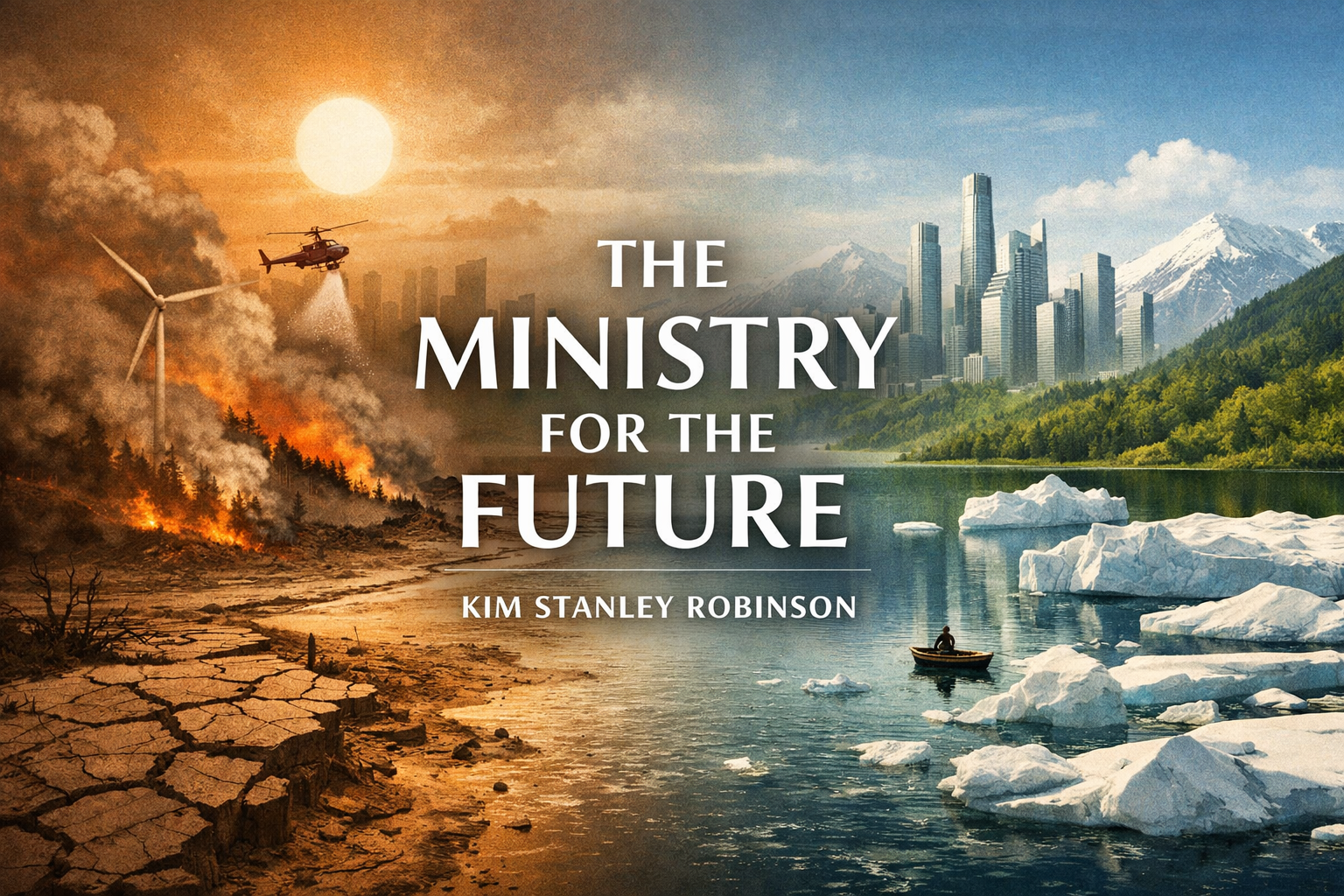
The Ministry for the Future Summary (2020) Explained
The: A Near-Future Climate Thriller About Power, Money, and Survival
Kim Stanley Robinson’s The Ministry for the Future (2020) is a near-future climate novel that reads like a policy thriller and a warning siren at the same time. This The Ministry for the Future summary follows a UN-backed body tasked with representing the rights of future generations, while the world lurches from disaster to disaster and argues about what “realistic” action even looks like.
The central tension is brutally simple: the climate crisis is already killing people, but the systems that could stop it move slowly, protect incumbents, and fear disruption more than catastrophe. Robinson turns that tension into a global story about institutions, economics, law, technology, and the darker forms of political pressure that emerge when patience runs out.
It is also a book about leverage. Who has it. Who lacks it. And what people do when they realize polite persuasion will not keep anyone alive.
“The story turns on whether civilization can change fast enough to stop mass death without becoming something unrecognizable in the process.”
Key Points
A near-future climate narrative that opens with a lethal heat wave in India and expands into a global struggle over survival.
Two core through-lines: Mary Murphy, who leads a UN “Ministry for the Future,” and Frank May, an aid worker traumatized by what he survives.
The novel treats climate change as both a physical threat and a political one: a stress test for law, finance, borders, and legitimacy.
Robinson blends conventional storytelling with reports, dialogues, historical sketches, and “systems” chapters that explain how the world works.
A major idea is a new monetary incentive for decarbonization: a carbon-backed currency that rewards emissions cuts and carbon removal.
Alongside official diplomacy, the story explores radical direct action, intimidation, and sabotage—methods that force change by raising the cost of delay.
The book is grim, but it is not despair literature. Its argument is that coordinated action can bend the trajectory, even after horror begins.
Names and Terms
Mary Murphy — Former Irish politician leading the Ministry; she tries to turn moral urgency into enforceable action.
Frank May — American aid worker and heat-wave survivor; trauma pushes him toward rage, risk, and uneasy purpose.
The Ministry for the Future — A UN-linked institution meant to advocate for future generations as rights-bearing citizens.
Carbon coin / carboni — A proposed complementary currency designed to reward decarbonization and carbon drawdown.
Carbon quantitative easing — Central-bank money creation aimed at paying for emissions cuts and removal, not just rescuing markets.
Children of Kali — A clandestine eco-extremist group that threatens and attacks high-emissions elites and infrastructure.
The “black wing” — The implied shadow side of state action: pressure, covert influence, and deniable enforcement.
Wet-bulb temperature — A heat-and-humidity measure; when it goes high enough, human bodies cannot cool by sweating.
Geoengineering in Antarctica — A cooperative effort to slow ice loss by intervening in glacier dynamics.
COP — Global climate summits where promises collide with power, money, and national interest.
Full Plot
Here is the full plot summary with spoilers.
Act I: Setup and Inciting Incident
The novel begins with an extreme heat wave in India that becomes a mass-casualty event. The heat and humidity rise beyond what the human body can tolerate. Infrastructure fails under load. Power goes out. Water stops offering relief. People die in huge numbers, and the scale of the death shatters any remaining illusion that climate change is a slow-moving problem.
Frank May, an American aid worker in the region, survives by brute luck, frantic improvisation, and the thin margin between consciousness and collapse. Survival does not give him clarity. It gives him a wound. When he eventually leaves, he carries a complicated mix of guilt, fury, and the sense that the world’s moral language is broken.
As the international system absorbs the shock, the Ministry for the Future becomes the novel’s institutional engine. Based in Zurich and linked to the global climate framework, the Ministry is tasked with advocating for future people as if their rights matter now. Mary Murphy leads it with a diplomat’s skill and a reformer’s impatience. She understands the trap: endless conferences can become a substitute for action, and “targets” can become a way to postpone consequences.
Mary’s early work is about pressure. She meets entrenched interests that treat climate risk as an externality, something to be insured, priced, and postponed. She also meets sincere allies who still move inside the constraints of careers, elections, and budgets. The Ministry is loud, but it is not sovereign. It can argue. It can shame. It can coordinate. It cannot directly command.
Frank, meanwhile, drifts through a damaged life. He cannot return to who he was. He looks for meaning that fits the scale of what he witnessed. He is drawn toward people who speak the language of emergency rather than the language of gradual reform.
What changes here is that climate change stops being background and becomes the inciting crime that demands an answer.
Act II: Escalation and Midpoint Shift
After the heat wave, disasters and political stresses multiply. The book widens into a global mosaic: refugees, failing regions, emergency responses, new alliances, and the bitter arithmetic of who caused the problem versus who is dying first. Robinson shows that the climate crisis is not only environmental. It is economic, legal, and psychological. It changes what governments can promise, what insurers can cover, and what citizens will tolerate.
Mary pushes into the domain that quietly governs everything: money. She and her colleagues argue that climate stability is not a “nice-to-have.” It is the substrate of the economy itself. If climate shocks keep accelerating, currency stability, debt markets, and the legitimacy of institutions all become unstable. In other words, central banks cannot pretend this is someone else’s problem.
The Ministry pursues a radical financial mechanism: a complementary currency issued in relation to verified decarbonization. In practice, it functions like a planetary incentive system. If a government, company, or community removes carbon from the air, prevents emissions, restores ecosystems, or changes infrastructure in measurable ways, it gets paid. That payment is not charity. It is monetary policy aimed at survival.
At the same time, a clandestine group emerges on the moral edge of the story: the Children of Kali. They operate as eco-extremists, targeting symbols and agents of high-emissions power. The world’s richest and most protected people begin to feel vulnerable. That vulnerability is the point. The group’s argument is that the existing system values property and status more than human life, so fear must be redistributed.
The novel does not treat this as a clean hero story. It treats it as a political fact that arises when institutions fail to protect the vulnerable. Violence becomes another kind of “policy,” not because it is wise, but because it is effective at changing behavior quickly.
As pressure rises, governments and institutions begin to coordinate on multiple fronts. The Ministry’s work intertwines with projects that range from the pragmatic to the audacious: energy transition, transport changes, carbon farming, altered shipping practices, and geoengineering research. One of the most striking cooperative efforts takes place in Antarctica, where nations work together on interventions intended to slow ice loss and buy time.
Midway through the book’s larger arc, the shift becomes clear: the world is no longer debating whether to act. It is being forced to choose which form of action it can live with—technocratic reform, emergency mobilization, or coercive change driven by fear.
What changes here is that the center of gravity moves from moral argument to enforced incentives, with finance and threat reshaping what “realistic” means.
Act III: Climax and Resolution
The later sections gather the book’s many strands into a rough answer to its central question. The Ministry’s financial strategy gains traction as a practical lever. Once decarbonization is rewarded at scale, behavior changes faster than speeches ever did. Money starts flowing toward the work that reduces risk rather than the work that extracts value while externalizing damage.
The climate struggle remains messy. Progress does not mean peace. Political instability persists, and the moral cost of coercion does not vanish. But the trajectory begins to bend. The book suggests measurable improvement, paired with deep scars: lives lost, places reshaped, and a world forced to admit it waited too long.
Frank’s story converges more directly with Mary’s. After years of turbulence, he has contact with the Ministry’s orbit. He is never a clean symbol. He is what the crisis produces: a survivor whose nervous system never fully returns to normal. His body also becomes a reminder that survival carries a price. He receives a diagnosis that turns his remaining time into a countdown, and his arc closes under the shadow of mortality rather than triumph.
Inside the Ministry, danger arrives in personal form. Tatiana Voznesenskaya, a key legal mind in the institution’s attempt to give standing to future generations and the natural world, is killed. The murder lands as a message: this fight is not abstract. It has enemies who operate with real-world methods.
Mary eventually steps back from leadership. The Ministry does not end, and the work does not end, but leadership changes hands. Badim Bahadur, her strategist and chief of staff, takes over. The succession matters because it signals continuity: the institution is no longer the vision of one person. It is a machine that will keep running.
The ending does not pretend everything is solved. It emphasizes direction rather than victory. The emotional note is hard-earned: a sense that the world can be pushed toward survival, but only through sustained coordination, altered incentives, and the willingness to confront power rather than flatter it.
Analysis and Themes
Theme 1: Emergency and legitimacy
Claim: When a crisis becomes existential, legitimacy depends on results, not rhetoric.
Evidence: The heat wave establishes a moral baseline that makes slow politics feel obscene, and subsequent shocks keep tightening the timeline. Mary’s Ministry is forced to justify its existence not through ideals but through concrete leverage.
So what: Modern institutions often borrow legitimacy from procedure, but emergencies demand protection. The book asks what happens when people stop believing that the system will keep them alive.
Theme 2: Money is moral architecture
Claim: Finance is not neutral; it is a map of what society rewards.
Evidence: Mary focuses on central banks and currency stability because those systems quietly set the rules for everything else. The carbon coin concept reframes decarbonization as paid work, not optional virtue.
So what: People talk about climate like it is a cultural debate. Robinson treats it as a pricing problem with political teeth. Change accelerates when incentives stop rewarding destruction.
Theme 3: Violence as failed communication
Claim: Eco-terror emerges when the vulnerable conclude that peaceful appeal is ignored.
Evidence: The Children of Kali’s actions rise alongside institutional delay and elite insulation. Fear begins to reach people who had previously been protected by money, distance, and bureaucracy.
So what: The novel does not celebrate coercion, but it refuses to treat it as unthinkable. It suggests that when systems refuse peaceful change, they invite darker forces that will impose it.
Theme 4: The planet as a legal subject
Claim: Rights frameworks break when the harmed party is the future.
Evidence: The Ministry’s mission rests on treating future generations as citizens with enforceable rights, not sentimental concerns. Tatiana’s legal work and her death underline how threatening that idea can be to existing power.
So what: Modern law is built around present claimants and present harms. The climate crisis forces a legal imagination shift: representation for people not yet born and for ecosystems without voices.
Theme 5: Utopia as a method, not a destination
Claim: Hope is built through mechanisms, not moods.
Evidence: Robinson stacks practical interventions—policy tools, infrastructure changes, international coordination, and cultural shifts—rather than offering a single miracle solution. Progress comes from accumulation and persistence.
So what: Many climate stories offer despair or fantasy. This book offers a third mode: hard hope grounded in systems engineering, social pressure, and institutional redesign.
Theme 6: Trauma changes the ethics of time
Claim: Survivors experience delay as violence.
Evidence: Frank’s post-heat-wave life shows how trauma compresses the future into urgent, sometimes reckless action. He does not want “targets by 2050.” He wants prevention now.
So what: Policy debates often assume calm rational actors. The book reminds you that mass death produces citizens who no longer accept incrementalism, and that shift reshapes politics.
Character Arcs
Protagonist (Mary Murphy): At the start, Mary believes the system can be pushed—hard—into doing the right thing if you apply the correct leverage. By the end, she still believes in institutions, but she accepts that survival politics will include coercion, deniable pressure, and morally compromised allies. Her shift is from reformer-as-diplomat to reformer-as-strategist, willing to use power rather than simply critique it.
Secondary arc (Frank May): Frank begins as a competent aid worker who believes suffering has a place in the world’s moral ledger. After the heat wave, he stops believing that ledger is real. His arc moves from shock to rage to a kind of grim participation in the world as it becomes, and it ends with mortality that refuses the fantasy of personal closure.
Craft and Structure (What makes it work)
Robinson builds the book like a collage of systems under strain. The shifting forms—narrative chapters, quasi-essays, transcripts, and “voice” pieces—mirror the reality that climate change is not one story. It is many stories happening at once, linked by cause and consequence.
The pacing works by alternation. Intimate trauma chapters pull you into human cost, then a more structural chapter explains how the machine works. That rhythm creates a specific effect: you feel the emergency, then you understand why it is hard to respond, then you feel the emergency again.
The tone is also a craft choice. The book is blunt about death, but it refuses nihilism. It is “anti-dystopian” in the sense that it insists the future is still contested terrain, not a pre-written collapse.
What Most Summaries Miss
Many summaries flatten the novel into “a climate change book with policy ideas.” That misses the real engine: the argument about legitimacy and force. Robinson is not only saying, “Here are tools.” He is asking, “What kind of world uses those tools, and what kinds of worlds refuse them until it’s too late?”
Another commonly missed element is how the book treats central banks as political actors. This is not background detail. It is the point: modern states often cannot act at scale unless money moves first. The Ministry’s strategy is a bet that finance can be repurposed as climate policy, because finance already governs what counts as “realistic.”
Finally, readers often separate Frank’s trauma from Mary’s policy arc. The book wants them together. Frank is the emotional truth that policy must answer. Mary is the institutional reality that emotion alone cannot command.
Relevance Today
Technology and media: The book anticipates a world where information is abundant but attention is scarce, and where “the story” becomes another battleground over whether people accept emergency-level action.
Work and culture: It treats decarbonization as labor that must be paid and scaled, not a lifestyle choice. That maps onto current debates about green jobs, industrial strategy, and just transition.
Politics and power: It shows how national interest and elite insulation slow action until threats become unavoidable, echoing today’s fights over energy security, inflation, and climate commitments.
Relationships and identity: Frank’s trauma illustrates how climate disasters do not just destroy infrastructure; they fracture identity, trust, and the ability to imagine a stable future.
War and violence: The Children of Kali plotline speaks to the risk of political violence in a warming world, especially when people believe lawful channels cannot protect them.
Inequality: The novel keeps returning to who dies first and who is protected longest, mirroring real-world patterns of exposure, resilience, and displacement.
Institutions under strain: The Ministry’s existence reflects a modern question: what new bodies, mandates, and legal concepts are needed when the harmed party is the future.
Ending Explained
The ending resolves the book’s main argument by showing that the trajectory can be bent, but only when incentives and power structures change, not just attitudes. The carbon-based financial mechanism and the broader web of interventions begin to produce measurable improvement, which is Robinson’s version of “hope”: a system that starts to work.
“The ending means that survival requires redesigning the rules of the economy and the boundaries of acceptable action, not simply wishing for better leaders.”
At the same time, the ending refuses clean moral comfort. People are killed, including key figures inside the Ministry’s orbit. Violence and coercion are not treated as glitches; they are treated as part of the political ecosystem that emerges when delay becomes lethal. Mary’s retirement and Badim’s succession emphasize continuity and institutionalization: this is no longer a single heroic push, but a long campaign.
The Last Word
The Ministry for the Future is for readers who want climate fiction that does not soothe them with apocalypse aesthetics or easy villains. It is also for readers who can tolerate a hybrid form: part novel, part field manual, part argument about how the world actually changes.
If you want a tight character drama with a single plotline, this may feel diffuse. If you want a near-future book that treats climate change as a total systems crisis—law, money, violence, technology, morality—this is one of the most ambitious attempts in modern fiction.
It leaves you with a hard question that never really goes away: if the future has rights, who will enforce them, and what will enforcement do to us?
