Carrie Explained: Stephen King’s Ending, the Real Horror and What the Adaptations Change
The Relationship That Changes the Ending
The Horror Inside Carrie’s Home
Carrie White wants something painfully ordinary: to go to a school dance without being treated as a joke. In Stephen King’s Carrie, that wish becomes dangerous because the people around her have already decided what she is allowed to be. At home, her mother treats growing up as a spiritual offence. At school, her classmates turn her isolation into entertainment.
First published in 1974, King’s debut novel places supernatural power inside a girl who has almost no ordinary power over her life. Understanding it means looking beyond the famous image of a blood-soaked prom queen. The ending, the relationship between Carrie and Sue Snell, and the differences between the book and its adaptations reveal a tragedy about humiliation, responsibility and recognition arriving too late.
Carrie’s ending explained: what actually happens
In the novel, Carrie devastates her school and much of Chamberlain after a deliberately cruel prom-night prank. Her mother, Margaret, subsequently stabs her. Carrie kills Margaret by stopping her heart, then kills Chris Hargensen and Billy Nolan after their attempt to run her down. Sue Snell finds Carrie dying and communicates with her telepathically. Carrie finally understands that Sue did not arrange the humiliation.
Carrie dies; Sue survives. The book continues through accounts of the aftermath, then closes with a mother’s letter describing another child’s telekinetic abilities. The immediate catastrophe is over, but Carrie was not necessarily a unique phenomenon. That final distinction separates the novel from a simple revenge story.
The first horror is that nobody explains her own body
Carrie lives in Chamberlain, Maine, with Margaret White, whose religious fanaticism governs their household. Her classmates know her as an outsider. Her clothes, awkwardness and family circumstances make her an easy target in a school culture that has grown accustomed to treating her badly.
The opening crisis occurs when Carrie has her first period in the school showers. She does not understand what is happening and believes she is in danger. Instead of helping, the other girls mock her and throw menstrual products at her.
This scene establishes two kinds of cruelty working together. Margaret has withheld basic knowledge, leaving her daughter unable to interpret an ordinary bodily change. The girls then punish Carrie for the ignorance her upbringing has imposed on her.
Her fear is therefore intelligible even though the crowd treats it as ridiculous. Readers know something Carrie should have been told long before this moment. That gap makes the scene unbearable: an explanation could relieve her terror, but humiliation arrives first.
The gym teacher, Rita Desjardin, eventually recognises the problem and helps. Her intervention matters, yet it cannot erase the experience of discovering that a room full of peers sees distress as an invitation to attack.
King does not need telekinesis to make this frightening. A vulnerable teenager is surrounded by people who possess the information she needs, and their first collective response is contempt. The supernatural element will enlarge the consequences of that failure.
At home, Margaret interprets menstruation through her beliefs about sin and punishes Carrie by confining her in a closet. The place where Carrie might expect reassurance repeats the judgment she has just encountered at school. There is no dependable refuge between the two.
The novel’s recurring blood imagery begins here. Blood becomes something other people use to define Carrie before she can define herself. Her classmates make it evidence of social inferiority; Margaret makes it evidence of spiritual corruption.
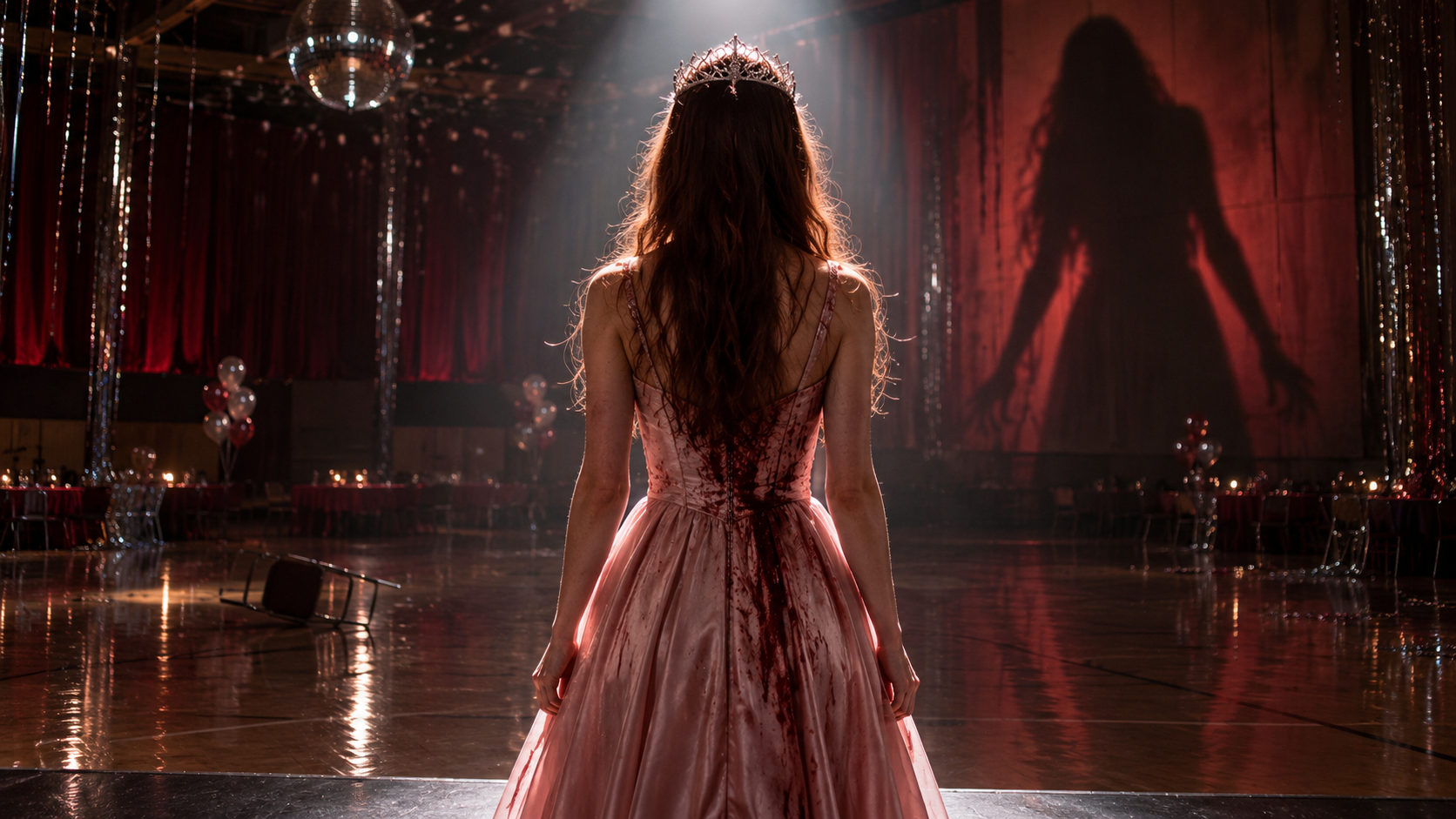
Later, the prom prank deliberately returns Carrie to public exposure through blood. The repetition matters because the second humiliation destroys a newly emerging belief that things might change. She has already endured being terrified and laughed at. This time, she has allowed herself to hope.
Margaret White turns protection into imprisonment
Margaret’s control reaches beyond rules about behaviour. She attempts to control the meaning of Carrie’s body, her desires and her relationships. Growing up becomes a betrayal of the narrow world Margaret has constructed.
A useful way to read their relationship is as a struggle over interpretation. Carrie experiences an ordinary wish to attend a dance. Margaret interprets that wish as danger and corruption. Carrie develops an extraordinary ability. Margaret interprets it through the same language of evil.
Within Margaret’s system, her daughter has no reliable way to demonstrate innocence. Obedience requires surrendering ordinary development; resistance becomes further evidence that punishment is necessary. The rules protect themselves against contradiction.
That helps explain why Carrie’s emerging power initially feels like liberation. Telekinesis allows her to move objects without touching them, and she begins learning to use it deliberately. For the first time, her mother cannot simply enforce every command through physical intimidation.
The book also establishes that unusual events occurred during Carrie’s childhood. Her powers do not suddenly appear from nowhere on prom night. What changes is her awareness of them and her capacity to exercise control.
This distinction matters when interpreting the connection between puberty and power. The story associates adolescence with an intensification of Carrie’s abilities, but it does not reduce the entire phenomenon to her first period. There is an earlier history.
The retrospective documents offer speculative hereditary explanations for telekinesis. These belong to the novel’s fictional world. They give the catastrophe an apparent scientific framework while Margaret insists on a religious one.
Neither framework, by itself, answers the most urgent question in Carrie’s life: who will help her live safely with what she is experiencing? Classification arrives more readily than care.
Margaret’s final violence develops from the same refusal to allow Carrie an independent existence. Her daughter’s increasing strength does not lead her to reconsider her treatment. It confirms, in her mind, the necessity of more extreme action.
The relationship is disturbing because maternal intimacy remains present inside that violence. Carrie can resist Margaret and still long for her. A child’s need for comfort does not disappear merely because the person expected to provide it is dangerous.
Sue’s remorse and Chris’s revenge lead towards the same dance
Sue Snell and Chris Hargensen both participate in the shower-room cruelty, but they respond differently afterwards. Their divergence drives the plot towards the prom.
Sue feels ashamed. She asks her boyfriend, Tommy Ross, to take Carrie to the dance in her place, hoping to give Carrie an experience of inclusion. This is a concrete sacrifice of a night Sue might otherwise have enjoyed herself.
It is also an imperfect attempt at repair. Sue tries to undo humiliation through a conspicuous social gesture, with Tommy acting as the bridge between her remorse and Carrie’s experience. She cannot guarantee how the school will respond.
The value of her decision does not depend on her becoming morally flawless. Sue has participated in the behaviour she now rejects. Her movement towards kindness is meaningful precisely because it requires recognising something ugly in herself.
That makes her more interesting than a secretly innocent friend placed beside an obvious bully. She belongs to the group that has hurt Carrie. The novel asks whether someone can begin to step outside that group’s assumptions.
Chris makes the opposite choice. When the girls face disciplinary consequences, she resists them and loses the right to attend the prom. She directs her anger towards Carrie, transferring responsibility from her own conduct to the person she victimised.
Her boyfriend, Billy Nolan, helps her arrange the pig’s blood. The plan requires preparation and a manipulated prom-royalty result. This is a deliberate operation to manufacture an audience for Carrie’s humiliation.
The contrast between Sue and Chris is therefore more specific than kindness against cruelty. Both encounter the possibility that their behaviour deserves judgment. Sue accepts enough responsibility to attempt change. Chris treats the judgment itself as an injury requiring retaliation.
Tommy occupies a vulnerable position between these decisions. He agrees to Sue’s request and treats Carrie with consideration. His part in the evening should not be confused with Chris and Billy’s deception.
For Carrie, however, distinguishing genuine generosity from a trap is difficult. She has good reasons to distrust sudden attention. Accepting Tommy’s invitation means risking the possibility that her hope will become another joke.
That risk gives the preparation for prom its emotional weight. A dress and a date represent access to an ordinary social world that has repeatedly excluded her. She is trying to participate in a ritual her peers take for granted.
Prom night offers something real before it destroys it
One of the cruellest features of Carrie is that the hopeful part of prom night is not entirely fraudulent. The rigged vote and the hidden blood are real, but so are moments of warmth and enjoyment.
Carrie begins to relax. Tommy’s attention allows her to experience herself differently from the identity imposed on her at school. She is capable of conversation, pleasure and a less defensive way of occupying a room.
This matters because the catastrophe does more than confirm that every person has always hated her. It destroys a mixed situation containing both malice and genuine possibility. Chris’s plot is effective because it can contaminate everything surrounding it.
When Carrie and Tommy are crowned, the blood falls. A bucket strikes Tommy and leaves him unconscious. The novel subsequently places his death in the ensuing fire; the blow and his eventual death should not be compressed into the same instant.
Carrie perceives the room through overwhelming humiliation. Laughter becomes decisive, but the people present do not all possess the same knowledge, motives or reaction. The crowd cannot fairly be treated as a single conspiracy.
That distinction becomes essential to the moral meaning of what follows. Carrie has been targeted by particular people, yet her response spreads far beyond them. The destruction cannot be justified by imagining every victim knowingly helped arrange the prank.
In the novel, she initially flees the gym before turning back towards revenge. That movement gives the escalation a shape: she escapes the immediate spectacle, then decides to act against those inside.
Her power transforms ordinary features of the school into instruments of destruction. Doors become barriers, water and electrical systems become lethal, and a social gathering becomes a trap. The familiar building offers no protection once its basic functions turn against its occupants.
The terror comes partly from the reversal of Carrie’s earlier helplessness. She can now impose conditions on everyone around her. They cannot make her listen, release them or distinguish their intentions.
Yet a reversal of power is not automatically justice. The ability to make others helpless does not restore what Carrie has lost. The dance that promised admission into ordinary life becomes the event that makes such a life impossible.
Why Carrie’s revenge cannot be treated as a victory
The novel’s destruction extends beyond the school into Chamberlain. Fires, damaged utilities and collapsing emergency responses turn an attack at a dance into a community-wide catastrophe.
This scale changes the story. A narrowly targeted revenge narrative might invite readers to identify the guilty and wait for their punishment. King’s novel denies that clean separation. People who did not arrange the prank become victims.
Carrie’s anguish helps explain the escalation, but explanation does not make the victims interchangeable. A stranger caught in the destruction has not inherited Chris’s responsibility simply by living in the same town.
That is the hardest demand the book makes on its readers. Sympathy for Carrie must remain possible after she does terrible things. Recognition of those terrible things must remain possible without pretending her earlier suffering was deserved.
Reducing her to a triumphant avenger loses the innocent dead. Reducing her to an evil creature loses the sustained abuse and exclusion that the novel has made visible. The tragedy depends on holding both parts of the story together.
Her powers intensify this conflict because they remove the usual limits on retaliation. An emotional response can become an environmental disaster. Her private pain acquires public reach without acquiring moral accuracy.
The book therefore becomes more disturbing as Carrie becomes more powerful. Greater control over objects does not provide a trustworthy understanding of people. She can destroy a room while misunderstanding the intentions of someone who invited her into it.
Her treatment of Tommy’s role is particularly tragic in this respect. The evening included real goodwill, but that goodwill cannot protect him once the attack and the response are under way. Chris’s deception destroys relationships as well as bodies.
The expansion into the town also exposes the weakness of treating cruelty as a private matter between individual teenagers. Carrie’s isolation has existed in a social setting. Once disaster arrives, that setting must confront what it previously tolerated.
This does not mean the entire town deserves collective punishment. The difference between shared conditions and individual guilt is exactly what indiscriminate violence erases. The novel’s horror grows where those distinctions collapse.
Margaret’s death and Sue’s final encounter with Carrie
After the destruction, Carrie returns home. Margaret attacks her with a knife, and Carrie uses her powers to slow and stop her mother’s heart. Margaret dies, while Carrie leaves the encounter bleeding from a fatal wound.
The mechanism differs from the famous 1976 film, in which sharp objects pin Margaret in a crucifixion-like pose. In the book, the killing happens inside the body, through control over its most basic rhythm.
That makes the confrontation an especially intimate expression of their struggle. Margaret has tried to govern the conditions of Carrie’s existence. Carrie ends her mother’s life through an inward, invisible act of control.
There is no durable freedom in the result. Carrie can finally stop Margaret from hurting her again, but she cannot reverse the wound she has received. Defeating the source of abuse does not deliver a future beyond it.
Chris and Billy also die. When Billy attempts to run Carrie down, she uses her power against their vehicle. Their punishment occurs within a much larger disaster rather than bringing that disaster into moral balance.
Sue eventually reaches the dying Carrie. Their connection is telepathic, allowing an encounter more direct than the social explanations and suspicions that have governed their relationship.
Carrie initially believes Sue was involved in setting her up. Sue opens her mind, and Carrie discovers that the intended kindness was real. Her understanding changes when there is almost no time left to live with the knowledge.
This is the emotional centre of the ending. The book does not suddenly declare that everything could have been solved by one nice evening. It shows how devastating it is to learn, at the point of death, that a hopeful experience contained something genuine.
Sue cannot rescue Carrie simply by being understood. The truth corrects a belief without repairing the consequences of acting on it. Recognition and survival are separated.
That separation keeps the scene from becoming sentimental. Carrie’s final contact offers an end to one terrible misunderstanding, but the dead remain dead and Sue must continue living with what happened.
The powers that made mass destruction possible also make this moment of understanding possible. Telepathy gives Carrie access to another person’s intention after ordinary communication has failed. Her last important discovery concerns goodness rather than strength.
The final letter leaves a question, not a guaranteed massacre
The novel does not end when Carrie dies. Its documentary aftermath follows the consequences through public accounts and attempts to explain the disaster.
This structure has been present throughout the book. Reports, testimony and retrospective writing interrupt the immediate story, letting readers experience Carrie as both a living girl and a subject other people will analyse.
The effect is unsettling. A person who struggled to receive ordinary attention becomes the focus of extraordinary scrutiny after catastrophe. The world acquires an appetite for understanding Carrie when understanding can no longer help her.
Those documents also prevent the destruction from becoming a single spectacular image. Chamberlain has to live with absence, economic damage and an altered future. The event continues after the most cinematic part is over.
Sue’s account belongs inside that contested record. She has reasons to explain her conduct, but she also carries an understanding of Carrie unavailable to anyone who encountered only the destruction.
The final letter introduces another young girl, Annie, whose mother describes her moving marbles without touching them. The letter brings the supernatural possibility back into an ordinary household after the formal attempts to contain its significance.
What this establishes is recurrence of the ability. It does not establish recurrence of Carrie’s life, Carrie’s choices or Chamberlain’s destruction. Annie is not confirmed as Carrie reincarnated, and her future is not narrated.
A threatening reading is unavoidable: the power that devastated one town exists elsewhere. Any comforting assumption that the danger died with Carrie is inadequate.
There is also a more conditional reading. The letter’s affectionate pride differs from Margaret’s response to her daughter. Another child with extraordinary abilities may encounter a different relationship to those abilities.
The novel provides no guarantee that affection will prevent disaster. Equally, it gives no basis for declaring the new child already condemned to repeat Carrie’s path. The uncertainty concerns what people will do with a recurring possibility.
That is why the ending reaches beyond a final scare. If Carrie were the sole problem, her death could close the case. Another child forces attention back towards upbringing, understanding and the treatment of difference.
What the adaptations change about guilt, survival and the ending
Brian De Palma’s 1976 film, starring Sissy Spacek, concentrates the story into an immediate visual nightmare. The novel’s extensive documentary framework gives way to the experience of watching Carrie move towards the prom.
That change affects how the audience understands knowledge. On the page, readers repeatedly encounter the gap between what people knew at the time and what they claim afterwards. On screen, framing, performance and editing carry much of that pressure.
The film’s final hand emerging from the rubble appears in Sue’s nightmare. It is not straightforward proof that Carrie has physically returned from the dead. The sequence ends with Sue waking in terror.
Where the novel gives Sue and Carrie a final encounter of mutual recognition, the film leaves Sue with a terrifying image of Carrie reaching towards her. The emotional emphasis moves towards the continuing force of trauma.
Both endings extend the event beyond Carrie’s death, but they do so differently. The book gives readers another child and an unresolved social question. The film makes the aftermath erupt inside a survivor’s sleep.
The 2002 television film, starring Angela Bettis and written by Bryan Fuller, makes a more fundamental alteration: Carrie survives. Sue revives her after Margaret’s attempt to drown her, and helps her leave town.
Its use of interviews also brings back something of the novel’s retrospective structure. However, survival changes the basic destination of the story. Carrie has a possible life after the disaster, however haunted that life may be.
This ending invites questions the original closes off. What would responsibility mean for a surviving Carrie? Could she learn to use her powers differently? What kind of relationship could Sue maintain with someone connected to such devastation?
Those are possible consequences of the adaptation’s choice, rather than events established by King’s ending. The novel’s final encounter cannot be read as a hidden escape merely because another version provides one.
Kimberly Peirce’s 2013 film, starring Chloë Grace Moretz, updates the mechanics of humiliation through a recorded shower-room incident. The recording is displayed during the prom attack, bringing the earlier abuse into the later spectacle.
This makes repetition literal. The crowd can watch an earlier moment of vulnerability while participating in a new one. Technology allows humiliation to be preserved, replayed and presented as entertainment.
The film also lets Carrie recognise Sue’s pregnancy and save her from the collapsing house. Its closing grave image belongs to the theatrical film’s ending; the alternate childbirth nightmare should not be confused with that released version.
These changes give the relationship between the two girls a different final action. Carrie can extend protection towards Sue even as her own story ends in destruction. The emphasis is more visibly on a last exercise of mercy.
Mike Flanagan’s 2026 Prime Video series extends the material into eight episodes. It introduces Emaline and allows Carrie to survive and leave with her, opening the story towards a larger supernatural world.
That is a substantial reinterpretation of the novel’s finality. Survival turns the catastrophe into a point from which another story might proceed. King’s book instead leaves others to interpret a girl who can no longer answer them.
The most useful way to compare these versions is to ask what each ending makes possible. Death and recognition, a survivor’s nightmare, escape, mercy and continuing supernatural conflict are different conclusions, even when they share the image of the bloody prom.
The real horror is how thoroughly Carrie becomes a category
Carrie’s abilities are real within the novel. The story does not resolve into an explanation that the supernatural events were merely imagined. Yet those abilities alone do not account for its emotional force.
Before the catastrophe, Carrie is repeatedly reduced to a category: the strange girl, the embarrassing classmate, the sinful daughter. Each category permits someone else to stop asking what she actually understands or needs.
Afterwards, she becomes a case, a public argument and an object of explanation. The change in scale does not automatically produce a more humane understanding. Fascination can preserve distance just as contempt did.
Sue’s final encounter matters because it briefly breaks that pattern. Carrie discovers that Sue is more complicated than the malicious role she has assigned her. Sue encounters Carrie at a depth that neither school gossip nor official inquiry can reproduce.
This does not wipe away responsibility on either side. Understanding is valuable precisely because it does not require pretending the harm never happened. The ending offers recognition without the comfort of restoration.
Carrie remains frightening because the innocent wish at its beginning is so small. She wants to attend a dance, be treated kindly and discover that her mother’s account of the world is incomplete.
For a little while, that possibility exists. The tragedy is that cruelty destroys her trust in it, and her retaliation destroys the people and future through which it might have become real.
Sources
Stephen King — Carrie. Official publication record and premise for the 1974 novel.
Carrie by Stephen King: Plot Summary. Plot chronology, central relationships and the catastrophe, checked alongside the guide’s individual sections.
Carrie: Part 2, Pages 171–196 — Summary & Analysis. Carrie’s experience at the prom and the contrast between genuine acceptance and the planned humiliation.
Carrie: Part 2, Pages 196–215 — Summary & Analysis and Part 2, Pages 215–238. The attack, Tommy’s fate and the escalation of Carrie’s retaliation.
Carrie: Part 2, Pages 238–277 — Summary & Analysis and Carrie: Part 3 — Summary & Analysis. Margaret’s death, the aftermath and the closing letter about Annie.
Anatomy of a Scene: The Many Endings of Carrie. Comparative discussion of Sue’s final connection with Carrie and the screen endings.
Carrie (2002 film) and Carrie (2013 film). Supporting checks on the survival ending, modernised bullying and the distinction between theatrical and alternate endings.
Stephen King — Carrie television series and Here Are All the Big Differences Between the ‘Carrie’ Book and the Prime Video Series. Official series details and the 2026 adaptation’s departures from the novel.
