

Sinners Film Summary: A Blues-Horror Fable About Freedom in 1932 Mississippi
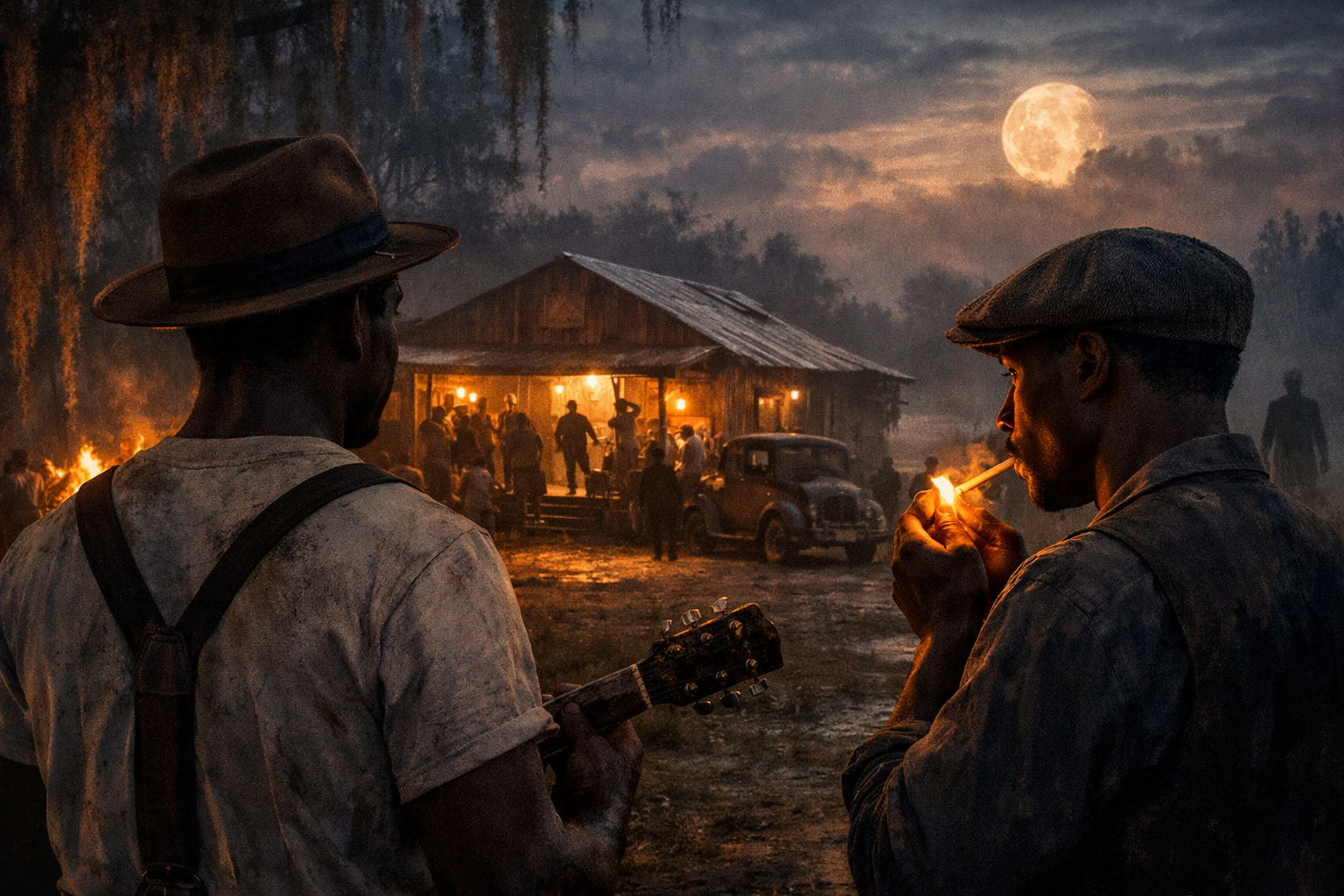
Sinners Plot Summary: Ending Explained and Themes
Sinners (2025): The Night a Blues Juke Joint Became a War for the Soul
Ryan Coogler’s Sinners (2025) is a period horror film that welds Delta blues, Jim Crow economics, and vampire mythology into one tense question: what does it cost to build a safe place in a world designed to take it from you? This Sinners plot summary tracks the story’s cause-and-effect chain from its first hopeful plans to its violent consequences, then pulls out the themes that make it stick.
At the center are identical twin brothers, Elijah “Smoke” Moore and Elias “Stack” Moore, men who have survived war and the underworld and believe they can buy their way into a new life. Their dream is simple: open a juke joint for the local Black community and give people food and music and somewhere to breathe. The problem is that every system around them—money, power, faith, race—has rules. And the supernatural threat in Sinners turns those rules into weapons.
The plot hinges on Smoke and Stack's ability to safeguard their people without giving in to the forces that seek to possess them.
Full Plot
Spoilers start here.
Act One: Setup and Inciting Incident
In 1932, identical twins and World War I veterans Elijah “Smoke” Moore (hard-eyed, strategic, trying to build a safe haven) and Elias “Stack” Moore (charismatic, restless, craving a life that feels like it belongs to him) return to Clarksdale, Mississippi. Smoke and Stack have spent years in Chicago working for the criminal Outfit, and Smoke and Stack arrive with cash, weapons, and a plan that sounds almost innocent: buy a run-down sawmill and turn it into a juke joint for the local Black community.
Smoke and Stack purchase the property from Hogwood (a local landowner, hiding violent power behind a “businessman” smile). Smoke and Stack talk like entrepreneurs, but Smoke and Stack move like men who expect betrayal. Smoke and Stack want one big opening night that proves the place can work, then a steady future that puts distance between them and the violence they came from.
Smoke and Stack include their younger cousin Sammie Moore, a teen guitarist and singer who is eager to gain recognition, in their plan. Sammie’s father, Jedidiah (pastor, terrified that blues music is spiritual danger), warns Sammie that the blues is sin dressed as joy. Sammie hears the warning and walks toward the music anyway. Sammie wants a life larger than the church walls, and Smoke and Stack offer Sammie the first doorway.
To build the night, Smoke and Stack recruit people who can turn an empty building into a living room for the whole town. Smoke and Stack bring in Delta Slim, a talented but worn-out pianist and harmonica player, as the headliner, desiring one more night of dignity. Grace Chow and Bo Chow (Chinese immigrant shopkeepers, practical, protective of their family, and wanting stability) agree to supply food and essentials. Cornbread (field worker, hired muscle, wanting respect and a paycheck) is brought in as the bouncer.
Smoke reconnects with Annie (Smoke’s wife, spiritually rooted, carrying grief like a second skin, wanting Smoke to stop running from pain). Annie believes Annie’s Hoodoo practices protected Smoke and Stack during their years away. Smoke doubts the protection because he and Annie have already lost a child, and he cannot accept a universe that chooses the innocent for payment. Annie still agrees to cook for the opening night, but Annie stresses that love does not erase what grief has done to both of them.
Stack runs into Mary (Stack’s former girlfriend, caught between affection and survival, still wounded by abandonment). Stack once left Mary to shield her from the consequences of being tied to a Black man in a white-dominated town. Mary has been grappling with that decision ever since, and Mary's presence compels Stack to acknowledge that escape invariably leaves someone behind.
While the juke joint comes together, another story is moving in parallel. Remmick (an Irish-immigrant vampire, hunted, yearning for a lost community) is fleeing Choctaw vampire hunters (pursuers, carrying old knowledge, trying to stop a spreading infection). Remmick is desperate for shelter and a reunion that ordinary life can no longer provide. Remmick finds a married Klansmen couple (white supremacists, eager to be chosen by power) and turns them into vampires, creating allies who will gladly wear monstrosity if it comes with dominance.
Opening night arrives with the pressure of a deadline. Smoke and Stack are eager for the juke joint to achieve success promptly. Sammie needs the night to justify choosing music over his father’s path. Annie needs Smoke to finally stop treating love like a negotiation with fate. Stack needs to believe that the past can be cut loose without payment.
The inciting incident comes when Sammie performs. Sammie’s guitar and voice land as more than entertainment. Sammie’s music becomes transcendent, and Sammie unknowingly summons spirits from past and future into the room. The juke joint feels like a place outside time, a pocket of freedom where generations breathe together.
But that same spiritual volume attracts Remmick.
Remmick arrives outside the juke joint with newly made vampires and a smile that reads like politeness. Remmick cannot enter unless invited, so Remmick plays human: Remmick offers money and offers music, framing the request like a fair exchange. Smoke refuses, because he recognizes a predator’s patience. Smoke senses that letting Remmick in would mean losing the only boundary it can enforce.
What changes here is that the juke joint stops being a dream and becomes a siege.
Act Two: Escalation and Midpoint Shift
The pressure escalates through consequences that arrive fast and practically. Smoke and Stack realize the opening night might not even be financially viable because many patrons are trapped in a local economy that pays in company scrip instead of real cash. The system that controls the money can strangle Smoke and Stack even if they manage to build a beautiful room. The realization transforms the juke joint into a symbol: it can serve as a refuge, yet it remains vulnerable to starvation.
Mary tries to help Stack solve the money problem. Mary steps outside to speak privately, to figure out how to bring in outside income and keep the place alive. Mary’s decision is rational, even generous, but the night is no longer governed by rational rules. Remmick seizes the opening. Remmick turns Mary into a vampire.
Mary returns inside the juke joint with a familiar face and an unfamiliar hunger. Mary uses intimacy as a weapon because vampirism turns desire into leverage. Mary seduces Stack, and Mary bites Stack, fatally wounding Stack in a way that makes Stack’s transformation inevitable. Smoke discovers the attack and shoots Mary, but Mary does not die like a human being. Mary escapes, now fully aligned with Remmick’s expanding threat.
Inside, the survivors scramble to understand what is happening. Stack collapses, then Stack revives as a vampire. Stack is still Stack in voice and memory, but Stack’s body has new rules and a new appetite. Annie reacts fast. Annie repels Stack using garlic, forcing Stack to retreat and proving that the threat is stoppable, though unfamiliar.
Smoke, Sammie, Annie, Delta Slim, Grace, Bo, and Pearline (singer, drawn to Sammie, hungry for a bigger life) become a trapped pocket of living people while the crowd outside begins to shift. Vampires turn patrons as they leave. Vampires turn Bo when Bo steps into the wrong moment. Vampires turn Cornbread, who becomes an inside-out version of himself—no longer a bouncer protecting the door, now a predator trying to open it from the other side.
Annie explains the rules as Annie understands them: vampires cannot enter without invitation, garlic can repel, and sunlight destroys. Annie also makes a crucial point that changes the survivors’ strategy. Killing Remmick will not magically restore everyone who has been turned. The infection is not a spell that can be reversed by cutting off the head. The survivors are fighting for containment, not a cure.
Remmick shifts tactics. Remmick stops trying to brute-force the door and starts bargaining. Remmick offers the survivors a deal: join Remmick and gain immortality, freedom from persecution, and a shared mind that promises never to be alone again. Remmick frames vampirism as liberation, especially to people living under Jim Crow terror. Remmick is not only offering survival. Remmick is offering relief from the entire social order.
Then Remmick reveals leverage that is purely human. Hogwood is the local Klan leader, and Hogwood plans to attack the juke joint at dawn. Smoke and the survivors are trapped between two threats: the supernatural predators at night and the organized racial violence waiting for daylight.
Remmick also demands a specific prize: Sammie. Remmick wants Sammie’s music because Sammie’s playing can call spirits, and Remmick wants to use that power to summon the lost community Remmick cannot let go of. Remmick’s hunger is not only for blood. Remmick’s hunger is reunion.
When the survivors refuse, Remmick threatens Grace and Bo’s daughter Lisa (child, innocent, everything the Chows are protecting). The threat detonates Grace’s restraint. Grace cannot gamble Lisa’s life on bravery. Grace invites the vampires into the juke joint.
The invitation changes everything. The door stops being protection and becomes a breach. Vampires flood the room, and the juke joint becomes a battlefield.
A brutal fight follows. Grace and Bo are killed during the struggle, paying the cost of the invitation with their lives. Mary escapes again, slipping out of consequence as if consequence cannot find Mary anymore. Smoke fights with the clarity of someone who has already decided the night ends in blood. Sammie tries to survive without letting his gift become the enemy’s tool.
Stack, fully turned, attacks Annie. Annie is bitten, and Annie knows what comes next. Annie forces Smoke into a promise: if Annie begins to turn, Smoke must kill Annie before vampirism replaces Annie’s mind. Smoke does it. Smoke strikes, not because he lacks love, but because his love has finally become disciplined enough to respect Annie's autonomy.
Delta Slim buys time with sacrifice. Delta Slim maintains the line, allowing Smoke and Sammie to escape the collapsing refuge. Delta Slim’s choice is not romantic; it is practical. Delta Slim understands that if Sammie is taken, the future is taken.
Smoke, Sammie, and Pearline try to flee. Remmick and Stack intercept them. Remmick turns Pearline into a vampire, expanding the loss in a way that makes survival feel like a shrinking island. Smoke fights Stack, and the fight is emotionally illegible in the moment because it is brother against brother, love against necessity, and history against the new rules of the night.
Sammie runs. Remmick catches Sammie.
Remmick tortures Sammie, trying to break Sammie into surrender and trying to force Sammie’s music into Remmick’s possession. Sammie responds with prayer, reciting the Lord’s Prayer as a shield of identity. Sammie’s faith is not the pastor’s certainty. Sammie’s faith is a desperate insistence that the self cannot be bought.
Smoke reaches Sammie in time. Smoke kills Remmick, ending the central vampire threat. With sunrise arriving, the remaining vampires are exposed to daylight and burn. The night’s supernatural siege ends in fire.
Smoke sends Sammie home. Smoke knows Sammie must leave Clarksdale to survive what comes next, because the human threat is still on schedule.
What changes here is that beating the monster does not end the war; it only clears the stage for the men who planned to arrive at dawn.
Act Three: Climax and Resolution
The endgame begins with a cruel clarity: Hogwood and the Ku Klux Klan are coming, and Smoke is the only person positioned to stop them. The vampires were chaotic and hungry. The Klan is organization and intention. The most dangerous constraint is time. Smoke has survived the night, but he is exhausted, wounded, and standing alone in a place built to be destroyed.
Hogwood arrives with Klan men to wreck the juke joint, punish the town for gathering, and erase the idea that Black joy can exist without permission. Smoke fights them anyway. Smoke kills Hogwood, and Smoke kills the men Hogwood brought, turning the final conflict into an answer to the story’s core question. Smoke refuses to bargain with evil. Smoke refuses to invite it in. Smoke chooses confrontation, even if the price is Smoke’s life.
Smoke is fatally shot during the shootout. Smoke’s body gives out after Smoke has already paid everything. As Smoke dies, the film frames his death as a reunion rather than a collapse. Smoke sees Annie again. Smoke sees their dead child again. The vision does not erase the violence, but it offers an emotional equilibrium: Smoke’s love is no longer suspended in doubt. Smoke’s love becomes rest.
Sammie returns to Jedidiah. Jedidiah pleads with Sammie to seek salvation and to abandon the blues. Sammie refuses. Sammie leaves for Chicago, choosing the path that will carry both trauma and purpose. Sammie’s survival is not clean. Sammie carries scars from Remmick’s torture, and Sammie carries the memory of a single day that held more freedom than most lifetimes.
In 1992, decades later, Stack and Mary (still ageless vampires, now dressed for a different era but unchanged by time) visit an elderly Sammie, now a celebrated blues musician living inside the legacy the night created. Stack unveils a pivotal moral revelation: Smoke did not kill Stack when he had the chance. Smoke spared Stack on the condition that Stack never bother Sammie again, allowing Sammie to live in peace.
Stack and Mary offer Sammie immortality. Sammie declines. Sammie plays for Stack and Mary instead, returning to the “real” blues that first lit the fuse. Sammie admits that the night still haunts her, but the hours before the bloodshed were the greatest days of her life. Stack agrees, because that night was the last time Stack saw Smoke, the last time Stack saw the sun, and the only time all of them tasted freedom without a leash.
Analysis and Themes
Theme 1: The price of a safe place
Claim: A refuge is never free; it demands vigilance, sacrifice, and hard boundaries.
Evidence: Smoke and Stack build the juke joint as a sanctuary, but safety depends on the door and the rule of invitation. Smoke refuses Remmick entry because Smoke knows the first compromise becomes the second. The final attack demonstrates that both supernatural predators and organized human violence pose a threat to the refuge.
So what: In real life, "safe spaces" are more than just feelings; they are systems that encompassrules, enforcement, and costs. Communities collapse when boundaries are treated as cruelty instead of survival. Sinners argues that protection is an active practice, not a passive wish.
Theme 2: Music as power and vulnerability
Claim: Art can summon belonging, but it can also attract those who want to exploit it.
Evidence: Sammie’s performance calls spirits across time, making the juke joint feel larger than the living. That same power draws Remmick, who tries to use Sammie’s gift to recover a lost community. Sammie’s music becomes a contested resource, not a private expression.
So what? Cultural power draws attention, and interest is rarely neutral. Viral art, trending scenes, and “breakout voices” are constantly pressured to become products. Sinners treat creativity as sacred and then show how quickly sacred things become targets.
Theme 3: Seduction disguised as liberation
Claim: The most dangerous evil arrives offering freedom.
Evidence: Remmick frames vampirism as immortality and escape from persecution, tailoring the pitch to people crushed by Jim Crow. Remmick uses community language—togetherness, shared mind, never being alone—to mask ownership. The revelation of the Klan threat intensifies the offer, compelling the survivors to choose between two forms of terror.
So what: Power often presents itself as a means of rescue. Predatory systems promise belonging in exchange for obedience, and desperation makes the trade feel reasonable. The film’s vampire lore becomes a metaphor for coercive “unity” that erases the self.
Theme 4: Grief as the hidden engine
Claim: Unprocessed grief shapes choices more than ideology does.
Evidence: Smoke’s conflict with Annie is not about belief versus skepticism; it is about their child’s death and Smoke’s refusal to accept randomness. Annie’s Hoodoo is partly a coping structure, a way to assign meaning to survival. Smoke’s final moments turn grief into reunion, giving Smoke a last emotional coherence.
SoEvidence: So what? People often argue about theology, politics, or “what’s true,” when the real driver is loss. Sinners treat grief as an invisible script that characters keep following until the story forces them to face it directly.
Theme 5: Economics as a trap, not a backdrop
Claim: Money systems can be as violent as monsters.
Evidence: Smoke and Stack understand that the company's scrip makes the juke joint difficult to sustain, as the town's labor already belongs to someone else. The juke joint’s survival depends on resources controlled by people who do not want Black autonomy. Even victory over vampires does not change the local power structure that brings Hogwood back at dawn.
So what: Stories about “starting over” often skip the structural barriers that make reinvention nearly impossible. Sinners keeps the economic trap visible, showing how exploitation survives every genre shift.
Theme 6: Faith under pressure
Claim: Faith becomes real when it is tested by pain, not when it is preached in comfort.
Evidence: Jedidiah frames blues as sin, but Sammie uses prayer to hold onto identity under torture. Annie treats spiritual practice as protection, while Smoke treats it as betrayal after loss. The story refuses easy answers, showing faith as both shield and battlefield.
What's the point? Modern life is rife with moral policing that confuses control for righteousness. The film suggests that belief systems are judged by what they preserve in people, not by how loudly they condemn.
Character Arcs
Protagonist: Smoke begins believing control can outrun fate, and ultimately ends up accepting that love can coexist with loss without demanding a bargain. Key turning points are Smoke refusing Remmick’s invitation even when the Klan threat makes the deal tempting, Smoke honoring Annie’s request to prevent transformation, and Smoke choosing to fight Hogwood at dawn despite the near certainty of death.
Sammie begins wanting music without consequence, and Sammie ends up choosing a life where music carries consequence openly. Sammie’s turning points are Sammie’s transcendent performance, Sammie’s refusal to surrender under torture, and Sammie leaving for Chicago even when family and faith demand submission.
Stack begins wanting escape without responsibility, and Stack ends living with a form of escape that is also a prison. Stack survives as a vampire, but Stack loses the sun, loses Smoke, and loses the chance to be ordinary. Stack’s final visit to Sammie shows Stack’s hunger is not only for blood; Stack’s hunger is for the memory of what freedom felt like for a few hours.
Structure
The film’s impact comes from how it stages a tonal trap. Act I sells a community-building drama with musical electricity, letting the viewer relax into the juke joint as a promised home. Then the genre flips, and the same space becomes a fortress, making every earlier detail—doors, windows, trust, money—feel like setup rather than texture.
The story also uses “invitation” as both a plot mechanism and a moral test. The rule forces characters to choose: protect the boundary or gamble with it. By making the breach a conscious act, the film turns horror from a random attack into a consequence.
The final escalation reveals the daylight threat as the deeper one, delivering a structurally devastating punch. Vampires are extraordinary, but Hogwood is ordinary. The ending insists that even when the supernatural burns away, the world’s built-in violence still walks toward you.
What Most Summaries Miss
Most recaps treat Remmick as the main villain and stop there. The sharper reading is that Remmick is a mirror of the survivors’ hunger: everyone is searching for community, safety, and relief from pain. Remmick offers those needs back as a trap, and the trap works because the needs are real.
Another overlooked element is how the film makes economics part of the horror. Company scrip is not just a line about money. It explains why “safe places” are so fragile: the room can be full, the music can be holy, and the whole thing can still die because the system decides what counts as value.
Finally, the 1992 coda reframes survival as a long sentence, not a triumph. Sammie lives, but Sammie is marked. Stack lives, but Stack is frozen. The film’s emotional ending is not the battle. It is the conversation about what it cost to have one day that felt free.
Relevance Today
The easiest modern parallel is “platform logic.” Sammie’s gift draws attention, and attention invites exploitation. The internet is a microcosm: talent draws fans, predators, and opportunists who want to control the outcome more than support the artist.
The film also depicts the dual pressures exerted on community spaces. People in modern work culture create informal refuges, such as group chats, affinity groups, and mutual aid circles, as formal systems fail to protect them. Bad actors can infiltrate these refuges, but institutions fearing independence can also crush them.
Remmick’s pitch mirrors the language of coercive movements today: “Join us and you’ll never be alone.” That promise shows up in extremist recruitment, cultish influencer ecosystems, and even toxic workplace cultures that confuse loyalty with identity.
The Klan attack at dawn lands as a reminder that the most persistent violence is often bureaucratic and organized. Modern equivalents are not always mobs with torches. They are policies, intimidation campaigns, and systems that punish people for gathering, organizing, or becoming visible.
The film’s economic trap speaks to inequality that is engineered, not accidental. Company scrip becomes a historical cousin of modern debt traps: predatory fees, exploitative gig work, and housing costs that make “starting over” feel like a fantasy reserved for the already-resourced.
In terms of relationships and identity, Sinners shows how love can be weaponized under pressure. Mary’s return to Stack is intimacy turned predation, a chilling echo of how trauma and abandonment can create bonds that feel like destiny even when they are destructive.
And in media, the film’s central set piece argues that culture is memory storage. The spirits Sammie summons are a dramatized version of what art does every day: it keeps the past present. That matters now, when attention cycles shorten and historical amnesia is a profitable product.
Ending Explained
The ending resolves the supernatural conflict by killing Remmick and burning the vampires at sunrise, but the film refuses to treat that as the true victory. The real confrontation is human: Hogwood arrives with the Klan to erase the juke joint, and Smoke chooses to meet that violence head-on rather than bargain for survival through corruption.
The ending means the only lasting freedom is the kind you pay for without handing your soul to the buyer.
Smoke’s death functions as both tragedy and completion. Smoke spends the film trying to control loss through strategy, and he dies after choosing love, sacrifice, and protection without bargaining. Sammie’s choice to leave for Chicago answers the story’s other dilemma: survival requires movement, and art requires refusal.
The 1992 scene adds the final argument. Stack survives, but survival becomes a kind of exile—no sun, no ordinary time, no brother. Sammie refuses immortality because Sammie has seen what “forever” costs when it is built on hunger and ownership. The last performance turns music back into what it should be: a gift freely given, not a tool taken.
Why It Will Endure
Sinners endures because it treats horror as a moral pressure cooker rather than a parade of shocks. The film asks what people will trade for safety, and the film shows how seductive the wrong answer can sound when the right answer hurts.
It is for viewers who like genre stories that still care about character choices, community, and history. It is also for anyone who responds to music as something bigger than entertainment, because the film treats performance as ritual.
It may not work for viewers who want clean catharsis, because the film insists that monsters can burn and the world can remain dangerous. The story turns on whether a refuge can survive without surrendering itself, and it leaves that tension humming after the last note.
