The Man from Earth Summary: The Immortal Story That Breaks Faith and Reason
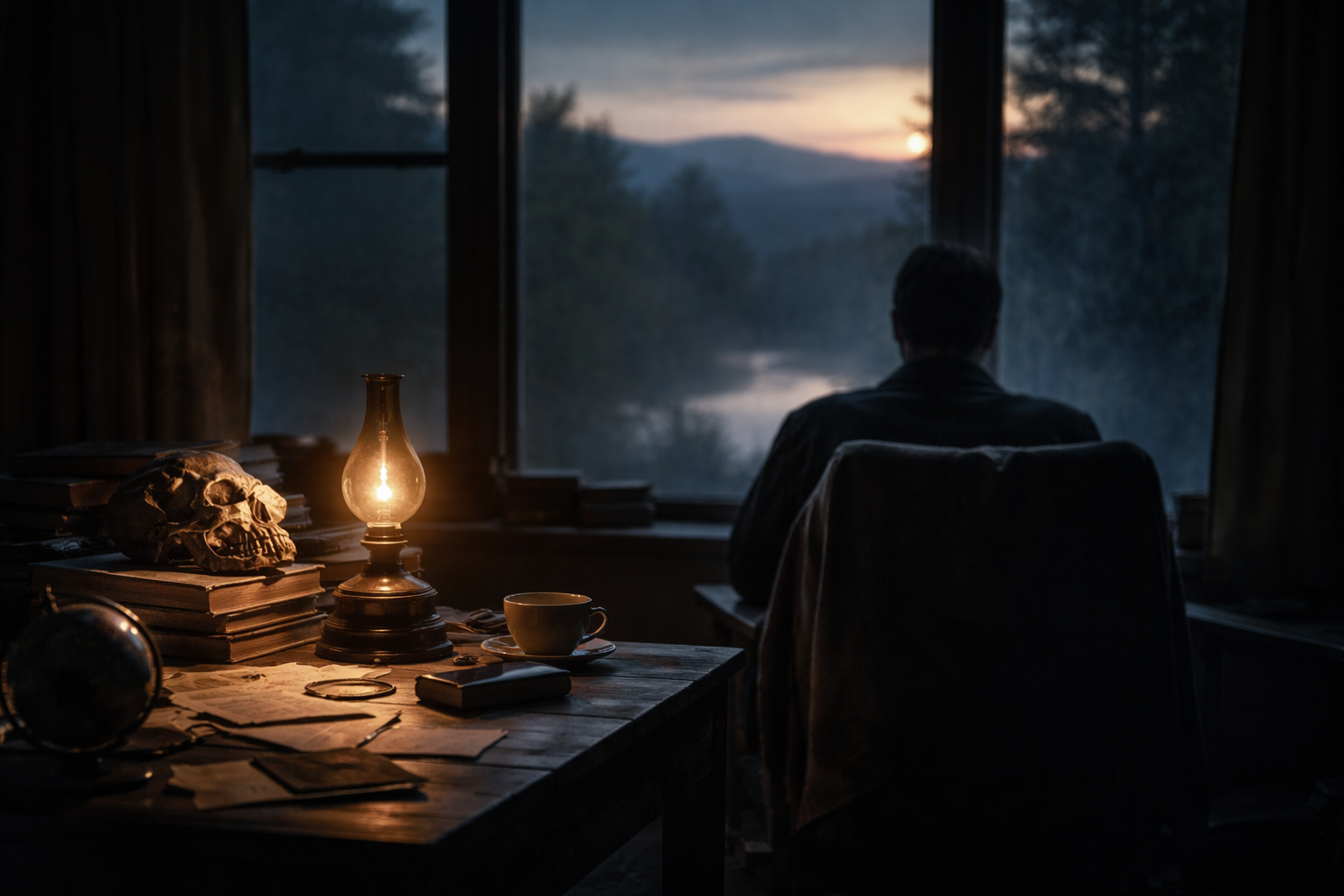
A Farewell Party That Turns Into a Trial of Reality
This The Man from Earth plot summary covers a quiet, dialogue-driven science fiction film that turns one ordinary afternoon into a pressure test for history, identity, and belief. Directed by Richard Schenkman and written by Jerome Bixby (2007), it traps a group of academics in a single room with a single question: what would it actually sound like if someone told the truth about living for fourteen thousand years?
The hook is simple. A respected professor is leaving town abruptly, and the people closest to him refuse to accept a vague goodbye. They keep asking for a reason until the conversation becomes an interrogation.
What makes the film stick is that it does not chase proof. It chases consequences. Each question forces a sharper answer, and each answer forces the group to reveal what they cannot live without: certainty, meaning, control, or love.
“The story turns on whether John can tell an impossible truth without destroying the people who hear it.”
Key Points
The film is set almost entirely during one farewell gathering in and around a professor’s home.
John Oldman claims he does not age and has lived for more than fourteen thousand years.
His friends challenge him using their fields—biology, anthropology, archaeology, history, psychology, and religious belief.
The story escalates through argument, not action: every new claim creates a new demand for consistency.
The tension is not just “Is it true?” but “What does belief do to a person when it lands?”
The group’s reactions expose different needs: skepticism as self-defense, faith as emotional shelter, and curiosity as appetite.
The film treats identity as something performed under pressure, not something possessed in private.
Full Plot
Spoilers start here.
Act One: Setup and Inciting Incident
John Oldman (history professor, wants to leave a scene quietly) is loading boxes into a pickup truck, moving fast, and avoiding lingering goodbyes. Dan (anthropologist, the real reason John is leaving) shows up first and immediately senses that John’s cheerfulness is covering something.
Harry (biologist, wants to test John’s story the way he would test a hypothesis) and Edith (art history professor, wants moral clarity and emotional safety) arrive with food and the energy of friends who feel slightly insulted by how quickly John is disappearing. Sandy (historian, wants John to stay and choose her) arrives with an emotional stake that is not academic. The group’s first move is gentle pressure: jokes, teasing, and small accusations wrapped in familiarity.
Edith’s excitement becomes suspicious when the painting seems too convincing to dismiss as a casual decoration. John brushes it off, but the room remembers the detail: John owns objects that do not fit a normal biography, and John reacts to questions with practiced evasiveness.
Art Jenkins (archaeologist, wants to catch John in a contradiction) arrives with Linda Murphy (student, wants to be part of whatever is happening and understand her teacher as a person). Art brings swagger and certainty. Art also brings the friend group’s most dangerous trait: the need to win. If the night turns into a contest, Art will push it there.
Everyone keeps asking the same question in different forms: why leave now, and why so fast? John offers scotch as a distraction, then realizes it will not work.
John asks the group to pretend he is telling a science fiction story, a thought experiment. The group agrees because the invitation flatters their intelligence. The party becomes a seminar, and the seminar becomes a trial. John’s inciting move is to claim that his “story” is not fictional: John says he was born in the Upper Paleolithic and has lived one continuous life, aging only to about thirty-five.
John makes the claim believable by making it inconvenient. John does not present himself as a superhero. John says he is not omniscient. John admits memory is selective. John admits he has been chased out of groups when people noticed he did not age. John explains that every ten years or so, when people start to notice, he moves on.
Once John commits to the claim, the group cannot go back to casual friendship. unstable or cruel. Either option demands action.
What changes here is that the farewell party becomes an experiment with emotional stakes.
Act Two: Escalation and Midpoint Shift
Harry tries to make the biology work, talking through regeneration and longevity as a theoretical possibility, then presses John for limits. Dan tests John’s prehistory: what the land looked like, what climate shifts felt like, and how nomadic life would shape memory and behavior.
John answers with a mix of humility and detail. to move on as a survival skill. John describes seeing what might have been the British Isles from the French coast before rising seas separated land. John emphasizes that much of what he “knows” about those early centuries is reconstructed through later learning. John is not selling certainty; John is selling coherence.
Art responds by escalating the standard. Art argues that coherence can be faked. Art says John’s answers could come from textbooks. John counters with a quiet constraint that matters: if the story is true, John’s perspective is narrow and flawed because John was only ever one person in one place at a time. The argument stops being about “facts” and becomes about how humans experience time: personally, incompletely, and with gaps.
John’s story moves forward into recorded history. John describes following trade routes as civilizations develop. John describes living as a Sumerian for centuries, then as a Babylonian under Hammurabi. John describes learning how centralized authority makes movement harder and strangers more suspect, forcing John to fake deaths and build new identities.
John claims to have traveled east to India and to have studied with Gautama Buddha, describing him as the most extraordinary man John ever knew. John says the Buddha sensed something different about John, and John never explained it. The point is not name-dropping. The point is that John’s internal life is changing: John moves from surviving to interpreting, from drifting to searching for meaning.
The group becomes unsettled because the story is not escalating like a lie. A lie usually grows flashy. John’s story grows psychologically expensive. John keeps returning to the costs: leaving people behind, watching generations pass, and learning that attachment always ends in grief.
The pressure spikes when Sandy pulls John aside. Sandy says she loves John and asks what love even means if John does not age. John answers without romance. John says he cares, but Sandy would be signing up to age while John stays the same, and John will eventually have to leave. Sandy accepts the unfairness because she sees it as honest. Sandy’s choice makes the room more dangerous: someone in the group is no longer treating the story as entertainment.
Art escalates. Will arrives with a clinician’s gaze and a sense that something is already harmed. Will, delusion, and manipulation. The group’s earlier rule—treat it as a hypothesis—starts to break under the weight of emotion.
Will challenges John with a simulated threat. Will implies a gun, then reveals a pipe, making a point about fear and control. John responds with a line that clarifies John’s own stance: John does not claim invulnerability, only unusual longevity. That response matters because it keeps the story inside the natural world. John is not claiming magic. John is claiming an outlier.
As the discussion continues, the group drifts toward religion because religion is where time, meaning, and authority collide. John says he does not follow a religion. John argues that many sacred narratives are layered with myth, adaptation, and institutional needs. Edith reacts as if she is being physically threatened; the story threatens not only beliefs but also identity and comfort.
The midpoint shift arrives when John stops speaking as a hypothetical storyteller and begins speaking as someone explaining a lived past. John offers a compressed account of trying to bring Buddhist teachings west into the Roman world in a “modern form,” colliding with empire, and being defeated by power. Edith hears what she cannot bear and names it: John is claiming to be Christ.
John does not. John describes being crucified and surviving by using techniques learned in Tibet and India—blocking pain and slowing bodily processes until they were undetectable. John describes followers taking him down, placing him in a cave, and “resurrection” being a physiological recovery misread as a miracle. John says he tried to leave quietly, but witnesses turned departure into ascension.
This is the moment the conversation becomes irreversible. If John is lying, John has crossed from eccentric to cruel. If John is telling the truth, then Edith’s faith is built on a story that mutated into doctrine, and the room has just watched the mutation happen again in real time.
What changes here is that belief becomes the central conflict, not longevity.
Act Three: Climax and Resolution
The endgame begins with collapse. The group is no longer debating for fun. The group is trying to stabilize itself. Harry and Dan argue that religious narratives borrow from older myths and cultural patterns. Edith's theft and desecration. Art demands proof, then demands silence, then demands that John stop because the room is unraveling.
Will pushes for closure the way a clinician pushes for safety. Will demands that John admit it is a hoax. Will threatens consequences: commitment for observation, removal of agency, and a professional label that would permanently define John as ill. Will is not only defending the group; Will is defending the idea that reality is policed by institutions.
John pauses. John looks like someone calculating damage. Then John chooses the least explosive option in the moment: John “confesses” that it was all a story, a prank, a thought experiment pushed too far.
The room reacts like a dam releasing pressure. Edith is relieved and sobs. Art turns angry, feeling manipulated. Dan feels humiliated. Linda looks both impressed and uneasy, noticing even John’s name sounds like a pun that supports the story. Harry tries to hold onto the beauty of the idea while admitting it cannot be verified.
John tries to repair it. John explains how the group gave him the idea: the Van Gogh, the comments about not aging, and Art’s book on early man. John frames the whole night as an intellectual game played by a “perfect audience.” That explanation helps some of them leave without panic, but it also confirms Edith’s fear: John is capable of using minds like instruments.
Sandy refuses the confession. Sandy confronts John privately and says John would not hurt people like that. Sandy asks for John’s real name. John “John” has always been the sound, a small, human detail that avoids mythic language. Sandy chooses to stay with John in the aftermath, not because Sandy has proof, but because Sandy trusts John’s character more than the group trusts certainty.
As the others exit, Dan hesitates. Dan admits something about John feels too consistent to dismiss. Dan does not demand proof. Dan chooses a softer ending for himself: Dan decides to live with uncertainty rather than force a clean answer.
The final confrontation arrives not as a debate, but as a slip. Sandy asks John about other pun names John has used. John lists several, including a name tied to teaching in Boston decades earlier, referencing a period at Harvard. Will overhears and freezes. Will recognizes the name as personal, not abstract.
Will confronts John with rising panic. John tries to soften it, but the truth is now too close. John reveals details only a father would know: Will’s mother’s name, a childhood nickname, a dog’s name, and specific family memories. Will’s anger collapses into grief. Will says his mother claimed John abandoned them. John apologizes and repeats the same brutal necessity John has repeated all night: John had to move on.
Will’s body reacts before Will’s mind can integrate the revelation. Will clutches his chest and collapses. John calls for an ambulance and holds Will as the cost of intimacy becomes literal.
The ending leaves John in motion again, facing the simplest consequence of the premise: even when John tells the truth, the truth hurts people. Sandy remains with John in the immediate aftermath, suggesting that the only thing that can travel with a life like John’s is a person willing to accept uncertainty.
What changes here is that the story stops being philosophical and becomes personal, irreversible, and tragic.
Analysis and Themes
Theme 1: Belief as Self-Defense
Claim: People believe what protects their identity, not what best fits the evidence.
Evidence: Edith resists John’s claims most fiercely when the story touches religion, because the threat is existential rather than factual. Will demands a hoax confession not because Will disproves John, but because Will sees the group breaking and needs a stabilizing answer.
Challenges feel like attacks, even when presented as “just questions.” The film shows why debates rarely change minds: the target is not information; it is safety.
Theme 2: Knowledge Without Power
Claim: Living through history does not grant control over history.
Evidence: John describes learning as the race learns, not staying ahead of it, and admits John cannot keep up with new knowledge even with centuries of time. John says he tried to carry teachings across cultures, but empire and institutions turned them into something else.
So what? Expertise can feel like power, but it is often just perspective.
Theme 3: Identity as an Ongoing Performance
Claim: A stable self is often a role maintained under social pressure.
Evidence: John describes passing as a son, faking deaths, and cycling identities to avoid suspicion. Even at the farewell party, John begins by performing “normal goodbye,” then performs “storyteller,” then performs “liar,” depending on what the room can tolerate.
So what? Modern identity is increasingly managed—online, at work, and in relationships. The film makes that management visible and asks what happens when the performance cracks and the audience refuses to stop watching.
Theme 4: Loneliness as the Hidden Price of Survival
Claim: The core horror of extreme longevity is not boredom, but grief without end.
Evidence: John repeatedly returns to leaving people behind, moving on, and watching lives rise and fall like waves. The climax lands not on an argument, but on a relationship: Will’s recognition that John was family, and John’s recognition that truth can still kill.
It also mirrors ordinary life: people outgrow relationships, relocate, reinvent, and grieve versions of themselves they can never return to.
Theme 5: Institutions Enforce Reality
Claim: Social systems maintain “truth” by rewarding conformity and punishing disruption.
Evidence: Will invokes commitment and professional authority when the conversation becomes destabilizing. Art treats inconsistency like a crime because Art’s status depends on the rules of evidence staying intact. John’s “confession” functions like compliance: it restores order even if it is false.
So what: In workplaces, communities, and media, “truth” is often what keeps the system calm. The film shows how quickly a group will choose an acceptable lie over an intolerable ambiguity.
Theme 6: Mythmaking Is a Human Reflex
Claim: People turn messy events into clean stories to make life livable.
Evidence: John describes how resurrection and ascension could grow from misunderstanding, devotion, and the need for meaning. The room then reenacts the process: they try to label John as a liar, madman, prophet, or prankster because the middle ground is unbearable.
So what? Myths do not begin as lies. They begin as interpretations that spread because they meet psychological needs. The film warns that mythmaking is not ancient history; it is present tense.
Character Arcs
Protagonist: John Oldman begins as a man trying to leave with minimal pain and ends as a man forced to see that truth can be as damaging as deception. John’s belief at the start is that the story can be told safely if framed as a hypothesis. John’s belief at the end is that intimacy makes the truth dangerous and that even careful disclosure can produce catastrophic consequences.
Edith’s arc is the most emotionally visible: Edith moves from friendly concern to existential threat to relief when the hoax confession restores a stable world. Edith’s shift shows how faith can be less about doctrine than about emotional shelter.
Will Gruber’s arc is tragic and compressed: proof that rational order is not protection against personal truth. Will’s need for control collapses when the story stops being “about history” and becomes “about family.”
Structure
The film’s power comes from narrative compression. A life that spans millennia is delivered through conversation, which forces the audience to experience the same constraint as the characters: no flashbacks, no external proof, only language and reaction.
The pacing is built like a courtroom drama. Each academic specialty becomes a line of cross-examination, and each “answer” is judged not just for accuracy but for psychological cost. That design keeps tension rising even when nobody leaves the room.
The tone stays grounded by refusing spectacle. The ordinary setting makes the extraordinary premise feel more dangerous, not less.
What Most Summaries Miss
The deeper story is that the group is not actually equipped to handle proof either way. If John is telling the truth, the group’s lives cannot return to normal because their frameworks for meaning have been cracked.
The film is also quietly about consent. John begins by offering the story as a game, and the group agrees. But as the night escalates, the group loses the ability to opt out without losing face. By the time Will demands a confession, .
Finally, the “confession” is not a twist meant to fool the audience. It is an ethical move inside the story: John choosing social stability over personal truth because the room is breaking. That choice makes the later personal reveal hit harder, because it shows John was not chasing drama—John was trying, and failing, to minimize harm.
Relevance Today
Misinformation and “plausible coherence.” The film shows how a story can feel true through consistency and confidence, even without evidence, which mirrors how modern misinformation spreads through presentation rather than proof.
Identity in the age of reinvention. John’s rotating identities anticipate modern life, where people change cities, careers, online personas, and even names to survive social scrutiny.
Public faith and private doubt. Edith’s reactions resemble contemporary culture wars, where disagreements are treated as moral injuries, not intellectual disputes, and where compromise feels like betrayal.
Authority as a comfort drug. Will’s impulse to medicalize and institutionalize the disruption parallels how organizations often respond to uncertainty: label it, contain it, and restore normal operations.
Longevity science and the meaning problem. As real-world work on aging and lifespan extends the horizon of “how long,” the film asks the more unsettling question: what does a long life do to attachment, purpose, and empathy?
Work culture and “exit narratives.” John’s sudden departure mirrors how people leave jobs and communities with half-truths to avoid conflict, even when the real reasons are personal, painful, or politically risky.
The fragility of shared reality. The room’s breakdown reflects a broader social pattern: when people cannot agree on what is real, relationships become the battleground, and trust becomes the scarce resource.
Ending Explained
The ending pivots from philosophical debate to personal recognition. The group can tolerate an abstract claim about history because abstraction has distance. The moment Will recognizes details that connect John to Will’s own life, the story becomes intimate and therefore destabilizing.
The ending means the film’s real question is not “Can John prove it?” but “What does the truth cost when it lands?” John can survive. The tragedy was through a single careless detail.
What the ending resolves is the emotional logic: extreme longevity turns every close relationship into a countdown. What the ending refuses to resolve is the scientific question of how John’s condition works. The ambiguity is not a tease; it is an argument that belief is shaped more by personal stakes than by data.
Final Take
The Man from Earth endures because it treats the biggest ideas—time, faith, identity, mortality—as things people fight over in living rooms, not lectures. It is less interested in proving an immortal man exists than in proving what an immortal story does to a human group.
This film is for viewers who love dialogue, moral pressure, and the feeling of watching smart people lose control of certainty. It may frustrate viewers who want visual spectacle, hard evidence, or a tidy scientific explanation.
In the end, the most unsettling idea is not that John might be telling the truth—it is that the truth, if spoken plainly, can still break the people you love.
