Crime and Punishment Explained: Raskolnikov’s Theory, His Choices and the Ending
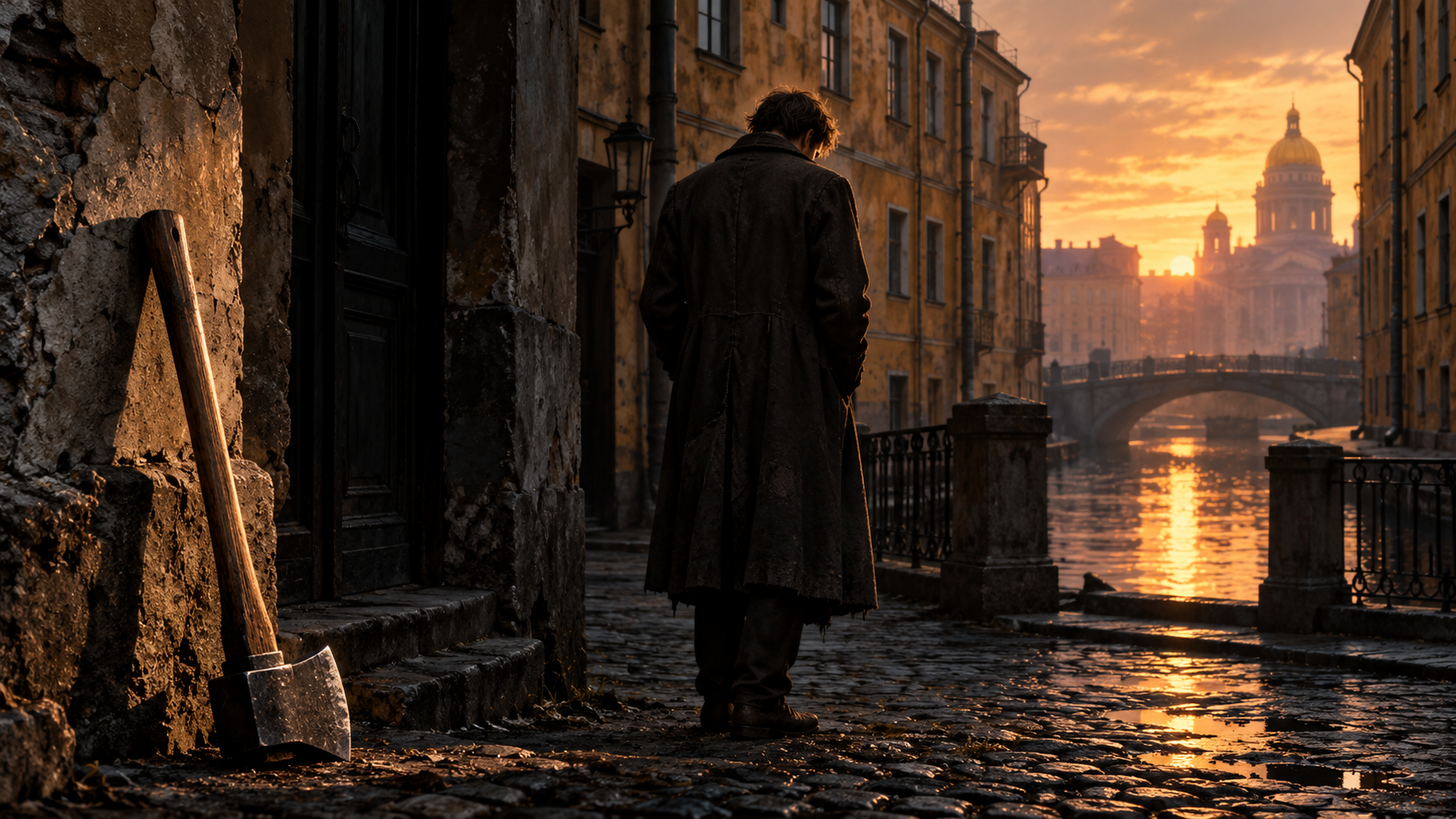
The Story, the Theory and the Ending
What Makes a Person Responsible?
A young man in St Petersburg has begun to think that ordinary morality may be an obstacle to greatness. He is poor, isolated and furious at a world in which vulnerable people sell their freedom to survive. Increasingly, he wonders whether someone exceptional could cross a forbidden line and turn the consequences towards good.
Fyodor Dostoevsky’s Crime and Punishment, first published in 1866, follows Rodion Raskolnikov as that possibility becomes a practical temptation. His intelligence gives him arguments for acting, while his encounters with suffering expose feelings those arguments cannot contain. This summary follows the novel’s central events in order, explaining how his family, a determined investigator and a young woman named Sonya bring pressure to bear on his understanding of himself.
A Room Too Small for Raskolnikov’s Ambitions
Raskolnikov is a former student living in a cramped rented room. He has withdrawn from university and from ordinary social life. Debt, hunger and humiliation occupy his days, but he increasingly turns away from practical opportunities to improve his circumstances. Thinking has become a substitute for living among other people.
He visits Alyona Ivanovna, an elderly pawnbroker, ostensibly to exchange a possession for money. He also studies her apartment and habits. A criminal possibility is taking shape, although he recoils from it as well as returning to it.
Alyona exploits people who need immediate cash, lending against possessions on harsh terms. Her treatment of her younger half-sister, Lizaveta, gives Raskolnikov further grounds for despising her. He begins to imagine that eliminating such a person could release resources for more worthwhile lives.
The reasoning depends on an enormous assumption: that he can assess another person’s entire value and appoint himself to act on that assessment. His poverty supplies urgency, but the imagined authority reaches far beyond financial need.
Meanwhile, a meeting in a tavern brings him into contact with Semyon Marmeladov, a former official whose drinking has devastated his household. Marmeladov describes his wife, Katerina Ivanovna, her children, and his daughter Sonya, who has entered prostitution to support them.
Marmeladov understands the harm he causes. He can describe his shame with painful eloquence, yet that awareness has failed to stop him. His confession introduces a distinction already relevant to Raskolnikov: understanding yourself does not necessarily make you behave differently.
Raskolnikov accompanies him home and sees the family’s misery. He leaves money for them despite having little himself. The gesture complicates any picture of him as uniformly cold. He responds to particular suffering with generosity, even while developing an idea that would allow him to disregard a particular life.
A letter from his mother adds a more personal pressure. His sister Dunya has endured harassment while working for Arkady Svidrigailov and is now engaged to Pyotr Luzhin, a financially established man. Raskolnikov suspects that she is sacrificing herself partly to improve his prospects.
He rejects the bargain angrily. Yet his protectiveness contains its own desire to command: Dunya’s future becomes something he believes he must decide. The family’s distress strengthens his sense that the existing world is intolerable, while making his dependence on other people harder for him to bear.
The Plan Meets the Reality of Violence
Before the crime, Raskolnikov dreams of witnessing a horse being beaten to death during his childhood. In the dream, he is overwhelmed by pity and horror. He wants to protect the helpless animal from the crowd’s cruelty.
The dream gives emotional form to his resistance. The part of him that can imagine a murder as a useful intervention also knows what violence means to a vulnerable creature. For a time, he feels released from his plan.
Then he learns that Lizaveta will be away from the apartment at a particular hour. Alyona will be alone. The information makes an uncertain fantasy seem like an opportunity arranged for him.
Dostoevsky shows the danger in that shift. Raskolnikov starts to experience circumstances as forces carrying him towards action. Yet favourable timing cannot make the act inevitable or transfer responsibility away from him.
He obtains an axe and brings a wrapped object as a supposed pledge. Once inside Alyona’s apartment, he kills her. The intellectual problem he has rehearsed becomes a confused physical event involving blood, keys, locked containers and the fear of interruption.
Lizaveta returns unexpectedly and finds him there. Raskolnikov kills her too.
This second murder destroys the boundaries he has tried to impose on his calculation. Lizaveta is a gentle, exploited person, someone belonging to the very category of people his imagined redistribution might supposedly help. Her death follows from his need to protect himself after the first killing.
The crime therefore reveals how quickly a claimed public benefit can become private self-preservation. Once Raskolnikov permits himself to destroy an obstacle, another person can become an obstacle simply by appearing at the wrong moment.
He takes money and valuables but barely escapes detection when visitors arrive. Survival depends on circumstance and luck as much as planning. Back in his room, he is overwhelmed by exhaustion and fear.
The promised mastery has not arrived. He must now inspect his clothing, conceal evidence and reconstruct every movement. The event he imagined as proof of independence immediately subjects him to new forms of dependence: on strangers’ memories, on unnoticed details and on his own unstable behaviour.
Nor does the violence establish the superiority he hoped action might demonstrate. It leaves him unable to separate what he intended from what he actually did. The plan concerned one supposedly expendable woman. The reality contains two dead people.
Suspicion Turns Everyday Life Into a Threat
A police summons arrives soon afterwards. Raskolnikov assumes that discovery may already be imminent, only to learn that the matter concerns money owed to his landlady.
The relief is temporary. When he hears officers discussing the murders, he faints. An ordinary debt dispute has placed him in a setting where his body produces a reaction he cannot explain away with complete confidence.
He hides the stolen property beneath a stone in a courtyard. He does not use it to rescue his family or establish a new career. He has not even properly examined the money.
That failure to benefit from the robbery matters. Material desperation is part of his situation, but the stolen goods cannot explain the whole crime. Once obtained, they become intolerable evidence rather than the foundation of the better life he has imagined.
Raskolnikov falls into fever and delirium. His friend Razumikhin and the servant Nastasya help care for him, while a doctor examines him. Their attention keeps him alive, but he experiences concern as intrusion because every conversation might reveal what he has said or done while ill.
Razumikhin provides a practical alternative to his withdrawal. He is willing to work, find opportunities and help other people without first solving the organisation of society. His usefulness exposes how much Raskolnikov’s isolation depends on pride as well as poverty.
As his strength returns, Raskolnikov behaves recklessly. He talks provocatively about the murders with the police clerk Zamyotov and revisits the pawnbroker’s apartment. He wants to test what others suspect, but also seems drawn towards the very circumstances he should avoid.
His concealment and his desire to disclose himself coexist. Keeping the secret protects his freedom while making ordinary contact almost impossible. He cannot accept reassurance because the people offering it do not know the thing that matters most.
During this period, Marmeladov is run over by a carriage. Raskolnikov helps bring him home, where he dies. Seeing the family’s immediate need, Raskolnikov gives them money sent by his own mother.
The generosity does not cancel the murders. It establishes something more troubling: tenderness and terrible wrongdoing remain possible within the same person. He can recognise suffering before him even after having created suffering elsewhere.
When his mother and Dunya arrive in St Petersburg, their love brings no simple comfort. They approach him through an understanding of their son and brother that he can no longer inhabit honestly. His secret makes affection feel like another demand he cannot meet.
Porfiry Questions the Right to Be Exceptional
Raskolnikov’s connection to the pawnbroker gives him a reason to approach the investigator Porfiry Petrovich: he has possessions to reclaim. Razumikhin, who knows Porfiry, accompanies him.
Porfiry’s apparently conversational manner makes the meeting difficult to read. He does not begin with a straightforward accusation. Instead, he discusses an article Raskolnikov has written about crime and exceptional individuals.
The article distinguishes ordinary people, who maintain the existing order, from extraordinary people whose new ideas may require them to transgress it. Raskolnikov argues that such figures may permit themselves to cross moral boundaries when their work demands it.
Napoleon provides an important model. History celebrates powerful people whose achievements involve enormous bloodshed, while condemning smaller offenders. Raskolnikov sees an inconsistency and tries to discover whether he belongs among those entitled to act beyond ordinary restrictions.
Porfiry presses the practical weakness in the argument. How can someone know that he is extraordinary? What happens when an ordinary person decides that he qualifies?
Those questions turn an abstract classification into a problem of self-deception. A theory granting exceptional people permission to kill becomes especially dangerous when the would-be killer is also the person deciding who counts as exceptional.
Raskolnikov struggles to determine how much Porfiry knows. He watches every remark for a trap, and his efforts to appear unconcerned make the encounter increasingly charged. The investigation operates through interpretation as much as physical evidence.
Outside that struggle, Dunya must judge Luzhin for herself. He wants a wife whose poverty will make her grateful and dependent. When the family meets him, his demands and resentment reveal the inequality built into his proposed marriage.
Dunya ends the engagement. Her decision gives substance to a kind of freedom Raskolnikov has difficulty recognising: someone can resist exploitation through judgement and refusal without claiming authority over another person’s life.
Svidrigailov also appears in St Petersburg after his wife’s death. He offers money and presents himself as someone capable of helping Dunya, but his earlier harassment makes that attention threatening. His resources give him freedom of movement and access that the poorer characters lack.
Raskolnikov is now surrounded by different uses of power. Luzhin wants dependence disguised as gratitude. Svidrigailov pursues desire through influence and money. Porfiry uses knowledge and uncertainty. None allows Raskolnikov to preserve the idea that power can be understood apart from its effect on others.
Sonya Offers a Different Kind of Understanding
Raskolnikov visits Sonya in her room. He knows the circumstances that have driven her into prostitution, and he is drawn to her position outside respectable society.
He initially tries to establish a resemblance between them. Both, in his account, have crossed a boundary and made ordinary life impossible. That comparison offers him a possible companion in exile from conventional morality.
Yet the similarity has severe limits. Sonya has sacrificed herself under desperate pressure to support others. Raskolnikov has killed others while testing a claim about his own authority. Their suffering does not make their actions morally interchangeable.
He questions her faith and presses her with frightening possibilities for her family. His attention can become cruel. He wants access to the conviction that sustains her, but he also attacks it when it resists his understanding.
During their conversation, he learns that Sonya knew Lizaveta. The woman he killed has a place in someone else’s memories and affections. She can no longer remain merely the unexpected interruption in his account of the crime.
At his request, Sonya reads the Gospel story of Lazarus, whom Jesus raises from the dead. The scene introduces the possibility of restoration to someone whose life appears closed.
Nothing about the reading instantly resolves Raskolnikov’s position. He listens while remaining divided, and Sonya cannot supply an argument that neatly overturns every defence he has constructed. What she offers is a belief that a damaged life can still be addressed by love and responsibility.
Their conversation also has an unseen audience: Svidrigailov listens from an adjoining room. What Raskolnikov seeks as private contact is vulnerable to another person’s use of the information.
At a subsequent meeting with Porfiry, the pressure intensifies. Raskolnikov becomes convinced that the investigator is manipulating him towards an admission. He demands clarity, but the encounter denies him the stable position he wants.
Then Nikolai, a painter who has come under suspicion, unexpectedly confesses to the murders. The interruption creates an apparent escape from immediate danger.
It also complicates any simple equation between confession and truth. Someone can admit a crime he did not commit. Porfiry must judge the confession against what he knows, while Raskolnikov must live with the possibility that another person could bear punishment for his actions.
A False Accusation Makes the Stakes Personal
Luzhin, humiliated by the broken engagement, attempts to discredit Sonya. He arranges for money to be planted on her and then accuses her of theft at the gathering following Marmeladov’s funeral.
The accusation exploits her social vulnerability. A woman already treated as disreputable can be made to appear guilty with little effort, particularly when a wealthy, respectable man controls the story.
Luzhin’s acquaintance Lebezyatnikov exposes the deception because he saw Luzhin secretly place the banknote in Sonya’s pocket. Raskolnikov explains how the scheme serves Luzhin’s hostility towards him and his attempt to regain influence over the family.
The episode places evidence and moral reputation in direct conflict. Sonya’s position makes suspicion easy; Luzhin’s status makes his accusation credible. Establishing the truth requires someone to challenge the story those inequalities encourage.
Afterwards, Raskolnikov goes to Sonya and tells her that he killed Alyona and Lizaveta.
Her response includes horror, grief and pity for him. She does not accept his explanations as justification, but she does not withdraw her concern. The admission places him before someone who knows his guilt and still sees a human being.
As he tries to explain himself, his motives become clearer without becoming simple. He invokes poverty, opportunity and Napoleon, yet acknowledges the personal test beneath them: he wanted to discover whether he dared cross the line.
The crime was bound up with proving what kind of person he was. Helping his family and doing future good could serve as explanations, but they did not contain the central hunger to establish his own exceptional status.
Sonya urges him to acknowledge the crime publicly and accept its consequences. She offers companionship through suffering, rather than a route around responsibility.
Meanwhile, Katerina Ivanovna’s illness and distress become catastrophic. After the funeral gathering and further humiliation, she takes the children into the street, trying to make them perform. She collapses and dies.
Svidrigailov provides money for the children’s care and the funeral arrangements. He also reveals that he has overheard Raskolnikov’s confession.
His help is real, but it gives no assurance about his wider purposes. Raskolnikov’s secret has passed into the hands of someone willing to use other people’s vulnerabilities. The danger now extends beyond the investigation and into Dunya’s life.
The Remaining Choices Narrow
Porfiry later visits Raskolnikov and speaks more directly. He does not believe Nikolai committed the murders. He identifies Raskolnikov as the killer and urges him to confess.
The investigator’s confidence exceeds his immediate ability to prove the case conclusively. He offers time for a voluntary admission and suggests that confession may improve Raskolnikov’s position.
This is both an investigative strategy and a challenge to Raskolnikov’s account of freedom. Porfiry believes that continued concealment will keep drawing him back into the investigation. Physical escape would not necessarily release him from the mental world the crime has created.
Raskolnikov still resists. Accepting defeat would mean relinquishing the identity he tried to establish through murder, and he remains capable of treating his anguish as evidence of weakness rather than proof that his principle was wrong.
Svidrigailov takes a different approach to the secret. He brings Dunya to his rooms, tells her about her brother’s guilt and offers assistance. The supposed rescue becomes a means of pressuring her sexually while preventing her from leaving.
Dunya has a revolver and fires at him, grazing him. She ultimately drops the weapon. When Svidrigailov asks whether she could ever love him, she makes her refusal absolute.
He lets her go.
The release is a real decision to stop coercing her, but it does not erase the coercion that has brought her there. Nor does Dunya’s refusal make her responsible for what he subsequently chooses.
Svidrigailov distributes money, including assistance for Sonya, spends a disturbing night in a hotel and dies by suicide the following morning. His final acts combine generosity, despair and the unresolved consequences of his conduct.
For Raskolnikov, Svidrigailov has represented one possible version of life beyond ordinary restraints. His fate removes any easy suggestion that unrestricted desire leads to a sustainable freedom.
Raskolnikov visits his mother and then speaks with Dunya. He prepares to surrender while continuing to argue against a full moral condemnation of his act. His movement towards confession is therefore uneven. He can recognise that he cannot continue as he is without yet accepting everything Sonya asks him to understand.
The Public Act and Its Consequences
Before going to the police, Raskolnikov visits Sonya. She gives him a cross, placing his intended confession within her understanding of shared suffering and responsibility.
He goes to a public square and kisses the ground, following part of her instruction to acknowledge what he has done before the world. But he does not complete the public confession there. The gesture exposes the distance between an emotional act and a clear admission spoken to other people.
At the police station, he learns that Svidrigailov is dead. Disturbed, he leaves without confessing. Outside, he sees Sonya waiting.
He returns and tells the police that he killed the pawnbroker and her sister with an axe and robbed them.
The statement is direct. The murder that has generated so many arguments, evasions and competing explanations becomes an acknowledged act with identifiable victims and a responsible perpetrator.
In the epilogue, Raskolnikov receives a sentence of eight years’ penal servitude in Siberia. His confession, his circumstances and evidence of earlier generosity contribute to the comparatively lenient punishment.
Sonya follows him and supports herself nearby. Dunya marries Razumikhin, whose plans include eventually building a life closer to Raskolnikov. His mother becomes gravely ill and dies, having remained distressed and confused about his absence.
These outcomes establish that the consequences have spread through the family. The legal process can identify the person responsible and determine a sentence, but it cannot gather all the damage into that sentence.
Nor does imprisonment produce immediate repentance. Raskolnikov remains proud, isolated and resentful. He is ashamed of having failed to sustain his supposed greatness, and he does not initially regard his underlying idea as decisively refuted.
That is the epilogue’s essential difficulty. He has confessed the facts and accepted a legal outcome, yet the moral structure that enabled the crime still survives within him. Punishment has changed his circumstances more quickly than his understanding.
What the Ending Opens Up
In prison, Raskolnikov struggles to connect with the other convicts. Sonya, by contrast, becomes valued through small acts of care, including helping with letters and maintaining contact with prisoners’ families.
She does not need to establish intellectual superiority before becoming useful. Her relationships develop through attention to particular people, precisely the kind of ordinary dependence Raskolnikov has resisted.
During an illness, he dreams of a spreading plague that makes people certain they alone possess the truth. Communities collapse because nobody can recognise authority or judgement beyond their own conviction.
The dream enlarges the danger contained in his exceptional-man theory. A world of individuals who each claim a private entitlement to define good and evil cannot sustain common life. Certainty becomes destructive when it abolishes the possibility of correction.
After his illness, Sonya’s absence troubles him. Learning that she has been unwell makes him anxious for her in a way his earlier coldness has concealed or resisted.
When they meet near the river, he falls at her knees and weeps. Sonya understands that he loves her. The narrative presents this as the opening of a renewed life, with seven years of his sentence still ahead.
The change is significant, but its limits matter. Dostoevsky does not show Raskolnikov completing his punishment, returning to society or demonstrating a fully transformed character across years of action.
He has Sonya’s New Testament beneath his pillow, yet does not open it in the final scene. He wonders whether her convictions might become his. Religious renewal is strongly suggested, while its gradual development remains beyond the story’s ending.
The Lazarus reading now acquires its fullest significance. Raskolnikov’s restoration concerns a return from spiritual isolation into relationship. The imagery offers hope without making the murdered women alive again or removing the need for responsibility.
His love for Sonya is therefore a beginning with obligations. Her care has made another future imaginable, but she cannot undertake his moral work for him. The narrator explicitly leaves that difficult process to a story still to come.
This also explains the relationship between crime and punishment in the title. Psychological suffering begins almost immediately after the murders. Legal punishment arrives later. Ethical renewal follows neither automatically.
Raskolnikov suffers for much of the novel while remaining capable of defending himself. Pain alone does not establish repentance. The decisive opening comes when another person matters beyond her usefulness to his argument or his escape.
The ending offers a qualified hope: a person can become more than the principle that justified his worst act. But that possibility begins with surrendering the right to treat other lives as materials for proving his own importance.
Sources
Crime and Punishment — Fyodor Dostoevsky, translated by Constance Garnett — Public-domain primary text for the narrative, Raskolnikov’s explanations, the confessions and the epilogue.
Crime and Punishment — Penguin Random House Higher Education — Publication background and information about the Pevear and Volokhonsky edition.
Crime and Punishment: Full Book Summary — SparkNotes — Supplementary cross-check of the principal characters and narrative sequence; the original text takes precedence.
