Dracula (Bram Stoker) Sumary
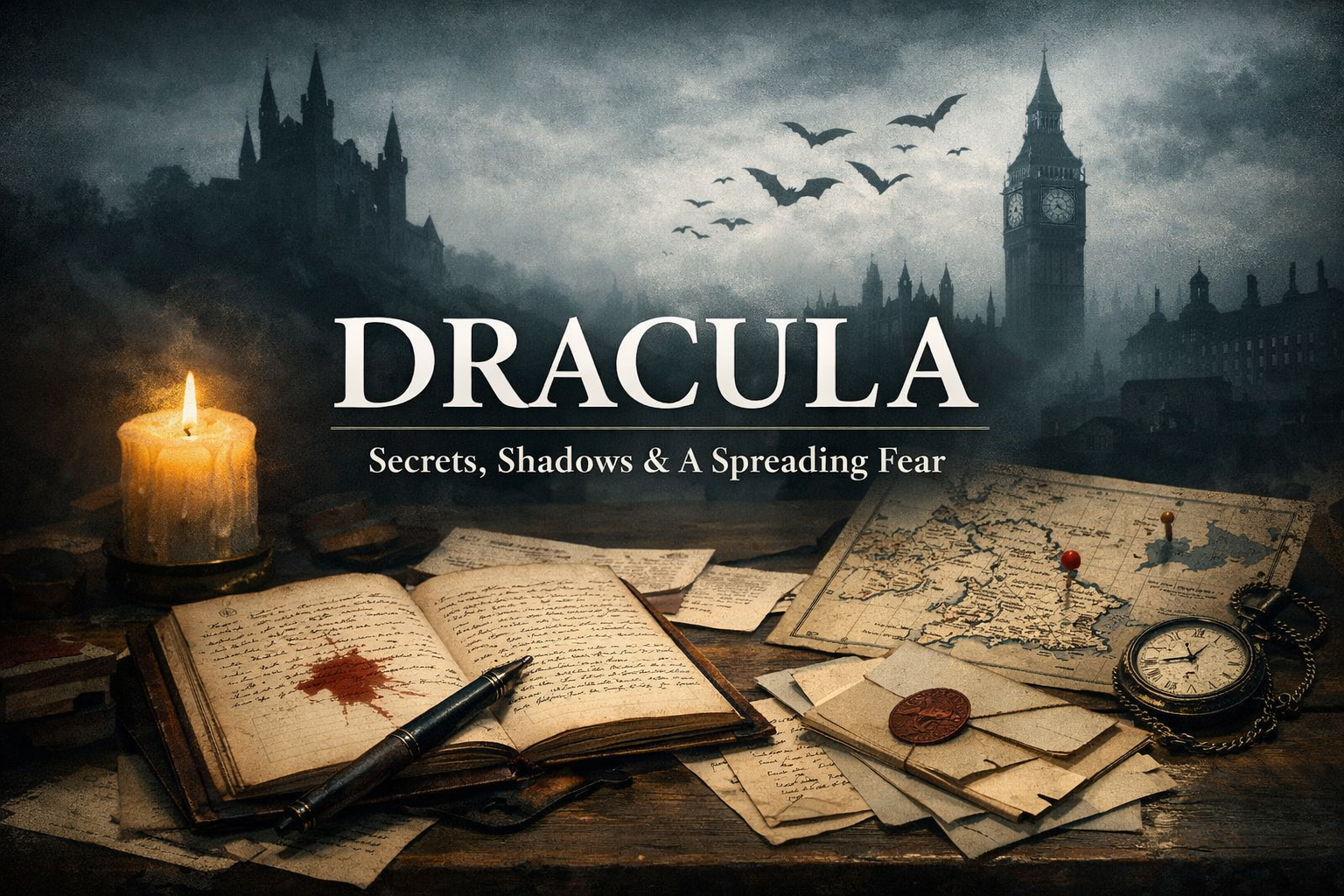
Dracula (Bram Stoker) — Paper Trails, Blood Rituals, and a Foreign Darkness in Victorian England
Paper Trails, Blood Rituals, and a Foreign Darkness in Victorian England
Key Points
The story is told through journals, letters, telegrams, newspaper cuttings, and recorded notes, so the reader pieces events together like evidence in a case file.
Jonathan Harker, a young solicitor, travels to Transylvania for work and realises too late that his host, Count Dracula, is not fully human.
Dracula’s real ambition is expansion: he plans to relocate to England, blend in, and feed freely while building a foothold in London.
In Whitby, Dracula’s arrival spreads like an infection through a close circle of friends, turning private illness into public danger.
Professor Abraham Van Helsing brings a blend of modern medicine and old-world lore, insisting the threat must be faced with both reason and faith.
The novel’s tension comes from limits: daylight windows, thresholds, paperwork, transport routes, and the slow time it takes to move people and cargo.
It’s a story about invasion and contamination, but also about teamwork—an ensemble of ordinary people forced into extraordinary courage.
The dread isn’t only the monster; it’s the fear of not being believed and the fear that “proof” arrives too late.
At heart, it’s a chase narrative: find the lairs, cut off the supply lines, and finish the job before the curse becomes permanent.
The Plot Engine
A man brings home a story nobody wants to believe. Then the story starts happening to other people.
Dracula runs on a simple mechanism: a predator moves into a new hunting ground, and a small group must learn the rules fast enough to stop him. But Stoker makes it feel real by grounding it in routines—train timetables, legal documents, shipping receipts, doctors’ notes, domestic visits, and late-night watches.
The form matters. Because the narrative is assembled from personal records, nobody sees the whole picture at once. The threat grows in gaps: what happens between entries, what someone doesn’t notice, what they’re too polite to say aloud.
What This Book Is About
Jonathan Harker leaves England for Transylvania to finalise a property matter with Count Dracula. The trip turns strange before it even begins. Locals react with fear, press charms into his hands, and warn him not to go on. Jonathan, practical and dutiful, takes it as rural superstition and continues.
At Castle Dracula, the Count appears courteous and oddly intense—curious about England, language, and modern life. Jonathan soon notices things that don’t add up. The castle is isolated. Doors are locked. Servants never appear. Dracula is present at uncanny hours and absent when daylight comes. Jonathan’s sense of being hosted shifts into the dread of being held.
He begins to understand that the Count is preparing a departure. The castle feels less like a home and more like a staging ground. Jonathan finds himself trapped in a place where the normal rules of safety—neighbours, law, daylight, distance—do not apply. His journal becomes his lifeline: a way to stay sane by turning terror into words.
Back in England, Mina Murray—Jonathan’s fiancée—keeps her own careful records while staying with her friend Lucy Westenra in the seaside town of Whitby. Lucy is lively, adored, and newly engaged, with other suitors orbiting her. The atmosphere is bright on the surface, but small disturbances arrive: uneasy dreams, sleepwalking, strange marks, and a sense of something watching.
A violent storm brings a wrecked ship into Whitby’s harbour. The town gossips. Officials investigate. People argue over what they saw in the dark. And Lucy’s health begins to fail in a way that ordinary explanations cannot fully hold.
Doctors become involved. Treatments begin. There are brief improvements, then sudden collapses. The pattern is baffling until an older specialist—Van Helsing—arrives and behaves unlike the others. He watches details nobody else takes seriously. He insists on precautions that feel embarrassing, old-fashioned, and even absurd.
As Mina and Jonathan’s story reconnects with Lucy’s, the separate documents start to point in one direction. The group begins to suspect that the threat is not a metaphor, not a superstition, and not a private tragedy. It is an intelligent enemy with a plan—and England is only the next step.
The Domino Chain
Because Jonathan dismisses the locals’ fear as superstition, he enters Castle Dracula without meaningful defences.
Because Dracula studies Jonathan’s habits and English manners, he learns how to imitate normal life while hiding his true nature.
Because Jonathan records everything in his journal, a private account later becomes a map of the enemy’s methods.
Because Mina values order and documentation, she turns scattered fragments into a coherent record the group can act on.
Because Lucy’s illness comes in waves, the doctors chase symptoms while the real cause keeps feeding in the background.
Because the wrecked ship’s arrival looks like a freak accident, the town treats it as a spectacle instead of the opening move of an invasion.
Because Van Helsing refuses to choose between science and folklore, he creates a practical rulebook the others can follow.
Because Dracula’s strategy depends on hidden resting places, the hunt becomes logistical: identify routes, caches, and patterns.
Because the group realises time is part of the monster’s weapon, their investigation turns into a race.
Why It Works (and What Might Not)
What It Nails
Stoker is brilliant at escalation. The early Transylvania section traps you in a closed world with one polite, unstoppable host. Then the story opens into England, where the threat becomes harder to see because life keeps going—visits, letters, dinners, doctor’s appointments. Horror thrives in normality.
The epistolary format does more than add flavour. It builds suspense through partial knowledge. You often know just enough to dread what the characters don’t yet see, and the switching perspectives makes the menace feel like it is moving through rooms while the narrators are facing the wrong way.
It also nails collaboration. Few novels make teamwork feel this tense. Each person brings a piece: law, medicine, technology, faith, organisation, nerve. The monster is ancient, but the response is modern: share information, coordinate, verify, act.
What Might Not Work for Everyone
The pacing can feel uneven if you prefer a single driving narrator. The “document” approach sometimes repeats events from different angles or pauses for detail that feels procedural.
It’s also unapologetically Victorian in its sensibilities—gender roles, moral language, and the way characters interpret purity, danger, and desire. For some readers, that tension is part of the point; for others, it may create distance.
And if you want Dracula constantly on the page, you may be surprised: the Count often operates offstage, which is exactly how the book generates its dread—but it’s a different flavour from more action-forward modern horror.
Key Characters
Jonathan Harker — A young English solicitor whose business trip becomes a fight to stay human and sane.
Mina Murray — Jonathan’s fiancée; disciplined, perceptive, and the person who turns chaos into usable information.
Count Dracula — A Transylvanian nobleman with a strategic mind and a predatory need.
Lucy Westenra — Mina’s closest friend; warm, admired, and at the centre of the novel’s first English crisis.
Professor Abraham Van Helsing — A doctor and scholar who treats the threat as real and insists on decisive action.
Dr. John Seward — A physician who records his days with clinical care, even as the situation becomes unclassifiable.
Arthur Holmwood — Lucy’s fiancé; loyal, honourable, and tested beyond the limits of polite society.
Quincey Morris — An American adventurer; brave, direct, and essential when the hunt turns physical.
R. M. Renfield — Seward’s patient, whose strange fixations seem connected to a larger pattern.
Themes and Ideas
The book’s core theme is proof. Everyone is writing, recording, collecting, and filing—because the truth is so unbelievable it must be pinned down in ink. The monster isn’t only Dracula; it’s the fear that nobody will accept the evidence until the evidence has teeth marks.
It’s also about modernity colliding with ancient evil. Trains, telegrams, phonographs, typewriting—these aren’t background props. They’re tools in a hunt. The group survives because they use what their era offers, but they also survive because they accept that not everything fits the era’s explanations.
There’s a constant tension between intimacy and violation. Dracula’s attacks are not just physical harm; they are a forced closeness that poisons trust, marriage, friendship, and the sense of safety inside a home. The horror is domestic as much as it is supernatural.
And beneath it all is invasion anxiety: the fear of an outsider who learns the rules, buys property, moves goods quietly, and feeds on the inside of a society that congratulates itself on order.
Full Plot Summary
SPOILER WARNING: The rest of this section reveals the entire plot and ending.
Jonathan Harker travels to Transylvania to meet Count Dracula and complete legal arrangements for property purchases in England. From the start, locals treat Dracula’s castle as a death sentence. Jonathan accepts a crucifix and boards the Count’s carriage through the Borgo Pass, arriving at a castle that seems to contain only Dracula and silence.
Dracula plays the perfect host, but Jonathan quickly notices impossible details. The Count has no reflection. He moves with unnatural strength. He keeps Jonathan locked inside the castle. When Jonathan cuts himself shaving, Dracula lunges towards his throat before restraining himself. Jonathan also discovers that Dracula can crawl down the castle wall like a lizard, defying gravity.
One night, Jonathan is approached by three beautiful women in the castle who attempt to feed on him. Dracula intervenes, furious, claiming Jonathan as his own. Jonathan realises he is prey being kept fresh. He begins to explore forbidden rooms, finds coffins, and understands that Dracula sleeps in the earth. He also learns that the Count is preparing to leave: boxes of soil are being readied, and Dracula is obsessively studying English law and manners.
Jonathan attempts escape and eventually gets out, but he is left weakened, traumatised, and ill. His journal, however, survives—and that record becomes crucial.
In England, Mina Murray stays with Lucy Westenra in Whitby. Lucy receives proposals from Arthur Holmwood, Dr. John Seward, and Quincey Morris, accepting Arthur. Strange events unfold in the town: Lucy sleepwalks, and Mina finds her in the churchyard in a trance-like state, with marks on her throat. Around the same time, a storm drives a ship into Whitby harbour. The crew is missing or dead; the captain is found tied to the wheel. The ship’s cargo includes wooden boxes filled with earth.
Lucy’s health collapses. Dr. Seward cannot explain her blood loss and calls his mentor, Professor Van Helsing. Van Helsing sees the bite marks and immediately suspects vampirism. He orders garlic in Lucy’s room and tries to keep her protected through night watches and strict rules. Lucy improves briefly, then worsens whenever the protections fail—especially when well-meaning people remove the garlic or open windows, undoing the barrier.
Lucy grows weaker until Van Helsing insists on repeated blood transfusions from the men around her, each attempt buying time but not solving the source of the drain. Lucy finally dies. The group mourns, but disturbing reports follow—children found weakened, a “bloofer lady” whispered about at night, and the sense that Lucy’s death did not end her story.
Van Helsing leads the men to Lucy’s tomb. They see an undead Lucy—beautiful and predatory—and Van Helsing forces the others to accept what they are facing. To free Lucy’s soul and end her harm, Arthur stakes her, and they complete the grim rites that destroy the vampire. Lucy is restored to a peaceful death.
Meanwhile, Mina reunites with Jonathan, now married, and becomes the organiser of their collected records. The group gathers in London and begins to treat the situation like a campaign. They identify Dracula’s London base at Carfax and learn that the Count needs his native earth to rest and regain strength. The hunt becomes practical: locate the boxes, sanctify them, and remove his safe places one by one.
They track Dracula through documents, shipping routes, and property records. They break into his hiding places and render his soil unusable by placing holy objects into the boxes. Dracula retaliates. He attacks Mina, breaks her sense of bodily safety, and—most devastatingly—forces her to drink his blood, creating a corrupt bond that threatens to transform her after death.
Mina is marked by this contamination. Van Helsing attempts to protect her, but holy objects now burn her, signalling how close she is to crossing the line. Mina, horrified by what she may become, begs the men to kill her if the change completes. Yet Mina also becomes essential to the hunt: Van Helsing hypnotises her at specific times, using the strange bond to sense Dracula’s movements when he is far away.
Dracula, hunted and cornered, flees England. The group learns he has shipped his final box back towards Transylvania. They split into teams and chase him across Europe by train, carriage, and river routes, racing daylight and distance. Van Helsing and Mina push towards Castle Dracula while the others pursue Dracula’s moving coffin.
Near the Borgo Pass, the pursuers converge on a wagon carrying the last box, guarded by armed men. With the sun sinking, the group attacks. Jonathan and Quincey force the box open. Dracula lies inside, watching the sunset with triumph, believing he will reach safety in time.
They strike before the light fails. Jonathan slashes Dracula’s throat, and Quincey drives his bowie knife into the Count’s heart. Dracula’s body crumbles into dust, and the curse over Mina lifts at once—her scar heals, and the sense of doom releases. But Quincey has been mortally wounded in the fight. He dies moments after seeing that Mina is saved.
In the final note, years later, Jonathan and Mina have a son whose birthday falls on the day Quincey died. They name the boy Quincey, binding their little band together in memory and in the price they paid.
The Point of No Return (Spoilers)
The moment Dracula forces Mina to drink his blood locks the story into its endgame. The hunt stops being about stopping a killer “out there” and becomes a race to save someone “in here.” Mina’s infection turns time into a weapon: either Dracula dies, or Mina’s future is stolen.
The Domino Chain (Cause → Effect)
Because Jonathan goes to Castle Dracula for legal work, Dracula gains the knowledge and paperwork to enter England.
Because Jonathan is imprisoned and writes everything down, the group later has a precise record of Dracula’s abilities and habits.
Because Dracula ships his earth-filled boxes to England, he creates multiple resting places that make him hard to trap.
Because Lucy is attacked repeatedly, her illness becomes the first undeniable evidence that something supernatural is feeding in plain sight.
Because Van Helsing recognises the pattern and uses garlic and sacred symbols, the group gains a rulebook instead of guesswork.
Because Lucy dies and returns as undead, the threat becomes morally urgent and impossible to deny.
Because the group sanctifies Dracula’s boxes, Dracula loses safe ground and must take greater risks.
Because Dracula retaliates by attacking Mina and forcing a blood bond, he accidentally gives the hunters a way to track him.
Because Mina can be hypnotised at key times, Dracula’s attempted control becomes an information leak.
Because Dracula flees England with the last box, the conflict becomes a continental chase with the sunset as a ticking clock.
Because the group intercepts the wagon before Dracula reaches the castle, they force a final confrontation in the open.
Because Jonathan and Quincey strike in time, Dracula is destroyed—yet Quincey’s wound becomes the final cost of victory.
Who Should Read This
If you like gothic atmosphere, creeping dread, and a story that feels like a dossier of escalating proof, this delivers in full. It’s also ideal if you enjoy ensemble narratives where competence, loyalty, and courage matter as much as bravery.
If you want a fast, modern-paced horror novel with minimal repetition and a single viewpoint, this may feel slower and more procedural. And if Victorian moral framing grates for you, you may find yourself wrestling with the era even as the plot grips you.
If You Liked This, Try
Carmilla — Sheridan Le Fanu — A compact, eerie vampire ancestor with a sharper intimacy.
The Strange Case of Dr Jekyll and Mr Hyde — Robert Louis Stevenson — Victorian dread, identity horror, and moral pressure.
Frankenstein — Mary Shelley — A foundational gothic tragedy about creation and consequence.
The Picture of Dorian Gray — Oscar Wilde — Decadence, corruption, and the cost of hidden sin.
The Turn of the Screw — Henry James — Ambiguity, dread, and a tightening psychological noose.
The Woman in White — Wilkie Collins — Document-driven suspense and secrets that ruin lives.
’Salem’s Lot — Stephen King — A modern town’s slow collapse under vampiric pressure.
Interview with the Vampire — Anne Rice — Vampirism as confession, desire, and philosophy.
The Historian — Elizabeth Kostova — A scholarly hunt that treats history like a trail of blood.
Let the Right One In — John Ajvide Lindqvist — A colder, modern vampire story with moral bite.
The Final Word
Dracula endures because it doesn’t treat horror as spectacle. It treats it as an intrusion: a thing that enters homes, reshapes relationships, and forces decent people into grim decisions. Its power comes from the paper trail—the sense that you are reading the last calm notes before the world admits it is not safe.
For more useful insight across news, geopolitics, science and technology, book summaries, and film summaries, visit Taylortailored.co.uk or you can also subscribe to our Spotify channel, Taylor Tailored.
