The Testaments (Margaret Atwood) Summary
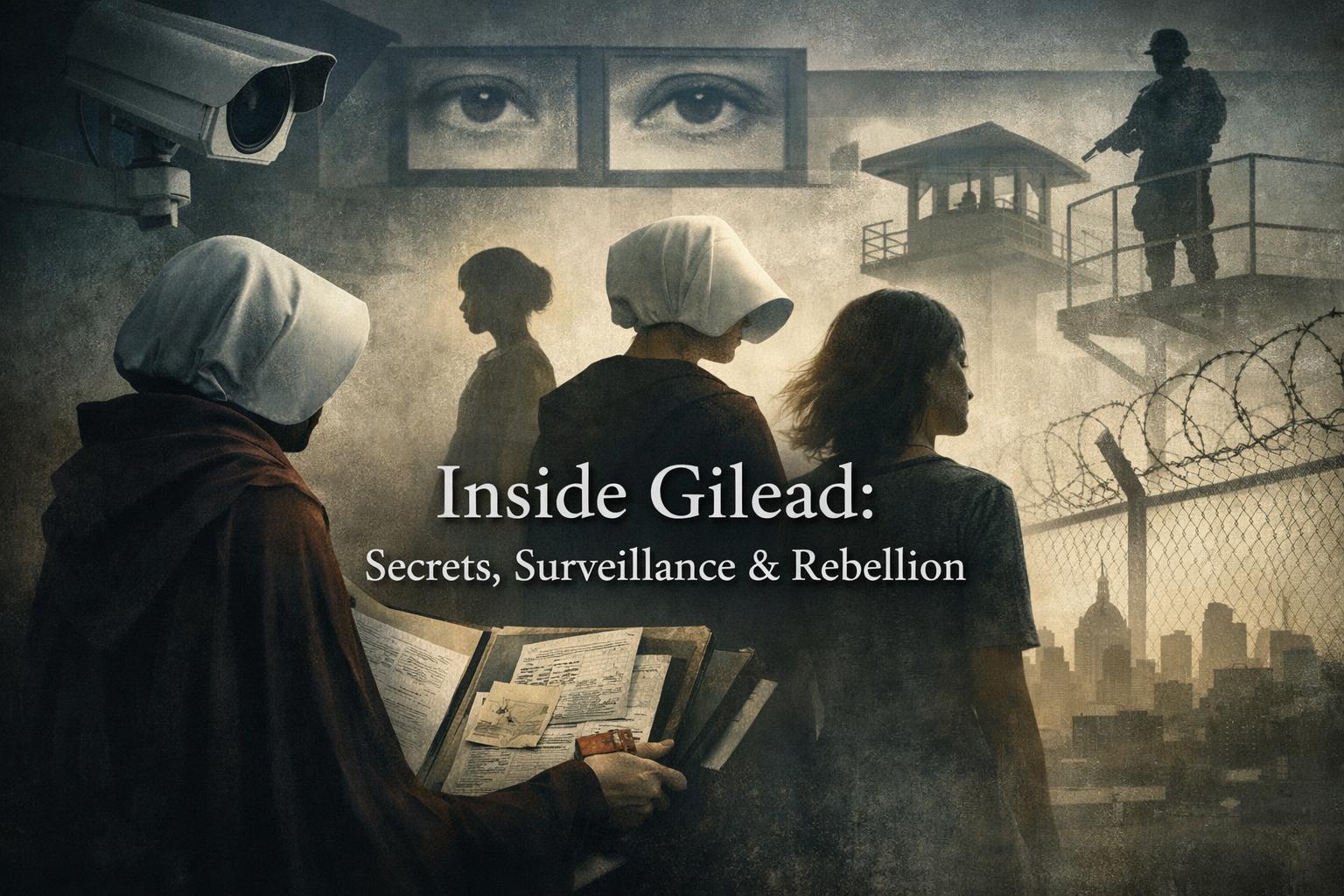
The Testaments by Margaret Atwood: spoiler-free overview, full ending, themes, and why Gilead collapses — a sharp, fast sequel.
Three Witnesses, One Surveillance State, and the Rot Inside Gilead
Key Points
Gilead is back, older and more corrupt — this is late-stage theocracy: hypocrisy, factional rivalry, and rot inside the regime.
Three narrators build a “case file” feeling: a secret manuscript from Ardua Hall alongside two witness accounts.
Aunt Lydia is the story’s engine: access to records becomes access to power.
Agnes shows indoctrination from the inside: raised to become a wife, kept illiterate, trained for compliance.
Daisy shows the “outside” view: Canada as a contested frontier of protest, propaganda, and covert networks.
Surveillance isn’t atmosphere—it’s plot mechanics: secrecy, blackmail, and knowledge-as-contraband drive every turn.
The pacing is more thriller-like than the original: sharper momentum, clearer endgame.
It trades some of The Handmaid’s Tale ambiguity for answers — satisfying for some, less haunting for others.
The novel, published in 2019, takes place fifteen years after the events of The Handmaid's Tale.
The Plot Engine
Gilead runs on two things: women’s bodies and controlled information. The novel turns that into forward motion by following three women positioned at different pressure points of the system — the enforcer-librarian with access to the files, the girl being shaped into a compliant wife, and the teenager outside Gilead who discovers her life is entangled with the regime’s most politically charged symbol.
The tension is ruthless: in a surveillance state, the truth can destroy you — but it can also destroy the state if it escapes intact.
What This Book Is About
Aunt Lydia writes in secret from Ardua Hall, the Aunts’ stronghold. She understands the public face of Gilead — purity, order, scripture — and she also knows what sits underneath: corruption, coercion, factional politics, and the quiet trade in secrets that keeps powerful men safe.
Agnes Jemima grows up inside Gilead as the cherished daughter of an elite household. Her education is narrow by design: domestic skills, piety, and fear. She cannot read. Her childhood security fractures when the adults around her change course and her future narrows towards the path Gilead reserves for girls like her.
In Toronto, Daisy lives an apparently ordinary teenage life, with Gilead close enough to be real: a neighbouring horror that fuels protests, headlines, and arguments in the street. When Daisy brushes against that political edge, consequences hit home. She’s forced into a world of covert networks that reframe who her parents were— and why her identity matters to the people fighting Gilead.
These three strands tighten towards the same place: Ardua Hall, where records are kept, loyalties are tested, and a young woman’s “value” can become the excuse for marriage, capture, or leverage.
The Domino Chain
Because Aunt Lydia has access to forbidden knowledge and records, she can accumulate leverage—which becomes her real power.
Because Agnes is kept illiterate, her world is made smaller — and the system can rewrite reality for her without resistance.
Because Gilead treats marriage as a transaction, “coming of age” becomes a countdown rather than a celebration.
Because household politics shift, Agnes’s safety becomes conditional — and she starts searching for exits inside the rules.
Because Daisy steps into anti-Gilead activism, she becomes visible— and visibility triggers danger.
Because Daisy’s parents are connected to resistance work, their “normal” life is a cover— and covers get blown violently.
Because Gilead exports "missionaries," the regime gains a recruitment tool— and outsiders can exploit that route in return.
Because Ardua Hall catalogues women’s identities, it’s also where identities can be weaponised — or rewritten.
Why It Works
What It Nails
A thriller’s momentum is built on bureaucracy. The book gets speed not from set pieces, but from files changing hands, names becoming dangerous, and who can read what.
The novel delves deeper into the concept of complicity. By shifting focus towards the Aunts, it forces the uncomfortable question: what does survival look like when collaboration is the price of staying alive?
Gilead as a late-stage regime. This isn’t the birth of theocracy. It’s the brittle, factional stage — hypocrisy, deals, and internal paranoia.
What Might Not Work for everyone?
There should be less dread and more plotting. If you loved the claustrophobic menace of The Handmaid’s Tale, this can feel more engineered, more like a political spy story.
Hope changes the flavour. Light leaks into Gilead here in a way the first novel resisted. That’s catharsis for many — and dilution for others.
Key Characters
Aunt Lydia — A dominant, feared Aunt at Ardua Hall; power through records and leverage.
Agnes Jemima—A girl raised inside Gilead’s elite; indoctrination and the marriage pipeline.
Daisy—A Canadian teenager living near Gilead’s shadow; protest, propaganda, and resistance networks.
Becka—Agnes’s friend; vulnerability; and the cost of escape routes.
Commander Judd — A high-ranking Commander; patriarchal power disguised as authority.
Aunt Vidala — A founding Aunt and rival; internal factional warfare.
Themes and Ideas
Gilead’s theology is a mask; the real religion is control. The novel shows virtues performed in public while the machinery underneath runs on coercion, hypocrisy, and private appetite— and it makes Ardua Hall the central vault where that machinery is documented.
It’s also about knowledge as contraband. Agnes’s illiteracy isn’t incidental; it’s the point. When she moves towards reading and record-keeping, it isn’t “education” in a wholesome sense — it’s entry into the regime’s true weapon system.
Underneath the politics sits a personal question: what does a “self” look like when your identity is a state document? Names, parentage, and reputation become assets traded by powerful people, turning young women into targets before they’ve done anything at all.
Full Plot Summary
SPOILER WARNING: The section below reveals the full plot and ending.
Aunt Lydia begins by writing a forbidden manuscript from Ardua Hall. Before Gilead, she was a judge; after the coup, she’s imprisoned, brutalised, and coerced into cooperation. Commander Judd offers her a bargain: serve the new regime or be destroyed by it. Lydia chooses survival — and she immediately starts planning how to outlast the men who think they own her.
Inside Gilead, Lydia rises to become the most politically dangerous Aunt. Ardua Hall gives her rare privileges: literacy, archives, and proximity to the state’s secrets. She weaponises that access by compiling evidence of hypocrisy and crime among the elite, while managing rival Aunts — especially Vidala — who want her removed.
Agnes Jemima grows up in Boston as the adopted daughter of Commander Kyle and his wife, Tabitha. Tabitha is Agnes’s main source of warmth and stability in Gilead’s rigid world. When Tabitha dies, that protection disappears. Commander Kyle remarries Paula, who despises Agnes and treats her as an obstacle to her status.
Paula takes a Handmaid (Ofkyle). The Handmaid becomes pregnant, but the birth turns lethal: doctors cut her open to save the baby, killing her in the process. Agnes is horrified, not only by the death, but by how normalised the Handmaid’s lack of choice is.
As Agnes approaches marriageable age, Paula manoeuvres to marry her off to Commander Judd—a powerful figure with a reputation for marrying young girls and discarding them when they age out of his preferences. Agnes’s fear becomes urgent. Her friend Becka, terrified of marriage and the life awaiting her, attempts suicide; she survives. The act exposes a grim truth: in Gilead, death can feel like the only consent available.
Aunt Lydia offers Becka an alternative: pledge as a Supplicant and train to become an Aunt, which removes marriage from her future. Soon after, with her marriage looming, Agnes takes the same route. She enters Ardua Hall, reunites with Becka, and learns to read and write — powers forbidden to almost all women.
Meanwhile in Toronto, Daisy lives with her parents, Neil and Melanie, who run a second-hand shop called The Clothes Hound. Daisy is increasingly drawn to anti-Gilead activism. After she attends a protest, her visibility alarms her parents. Shortly afterwards—on her sixteenth birthday— a car bomb kills Neil and Melanie.
A woman named Ada extracts Daisy and hides her. Ada reveals the truth: Neil and Melanie were Mayday operatives, and Daisy was never their biological child. Daisy is “Baby ”Nicole”—the child smuggled out of Gilead years earlier and turned into a political symbol. Because Gilead wants Nicole back, she’s now a target.
Mayday needs a courier to retrieve material from an insider in Gilead: evidence strong enough to destabilise the regime. Nicole must go in. She’s trained, renamed “Jade”, and pushed into Gilead by posing as a vulnerable girl recruited via the Pearl Girls — Gilead’s missionary programme designed to lure women across borders.
Jade reaches Ardua Hall and is placed under the supervision of Agnes and Becka, who have become Aunts. Jade struggles to blend in with Gilead’s behavioural scripts while waiting for contact from the insider.
The insider is Aunt Lydia. Lydia reveals Agnes and Nicole are half-sisters — daughters of the same Handmaid mother who escaped to Canada. Lydia implants a microdot containing her compiled evidence into Nicole’s arm, using the concealment of a tattoo as the delivery mechanism.
Lydia’s plan becomes a controlled extraction: Agnes and Nicole will leave Gilead disguised as Pearl Girls; Nicole will pose as Becka, while Becka remains behind to provide cover. Becka agrees, understanding what that sacrifice may cost.
But Gilead tightens its net. Commander Judd closes in on Ardua Hall and intends to claim Nicole for himself through marriage. The danger forces a rushed escape. Becka hides on Ardua Hall’s roof and kills herself in a cistern rather than be captured and interrogated.
Agnes and Nicole flee. They assault Aunt Vidala when she realises what’s happening, buying time. They pass through checkpoints as missionaries, helped by a chain of sympathisers who hate Gilead but cooperate with Mayday. Close calls accumulate as they push towards the border.
They travel along the Penobscot River and reach Canadian waters, then make it to Campobello Island, where Mayday retrieves them. There, Agnes and Nicole reunite with their mother, who has been in hiding.
Once the microdot evidence reaches Canada, dissemination exposes corruption at the top of Gilead. The regime turns inward: purges, panic, and a destabilising power struggle follow, culminating in a coup and the collapse of Gilead, along with the restoration of the United States.
Aunt Lydia, having set the fall in motion and knowing she will be tortured if captured, prepares for suicide by morphine overdose. She closes her manuscript as a final act of control: she will not give Gilead her last secrets by force.
The epilogue jumps to 2197, presented as an academic symposium on Gileadean studies. Professor James Darcy Pieixoto discusses the authenticity and limitations of the documents—Lydia’s manuscript and the witness testimonies— and suggests Agnes and Nicole’s mother may have been Offred, framed as informed speculation rather than confirmed fact.
The Point of No Return
When Commander Judd closes in on Ardua Hall and moves to seize Nicole, the story snaps from covert manoeuvring to flight. From that moment, extraction isn’t a goal — it’s the only way out.
The Domino Chain (Cause → Effect) (Spoilers)
Because Lydia is coerced into founding the Aunts, she survives— and builds a power base inside the regime.
Because Ardua Hall controls records and literacy, Lydia gathers secrets—and those secrets become leverage.
Because Tabitha dies, Agnes loses protection — and Paula can force a marriage plan.
Because Paula targets Judd as Agnes’s husband, Agnes seeks refuge — and becomes a Supplicant.
Because Neil and Melanie are resistance operatives, they’re murdered — and Daisy learns she is Nicole.
Because Mayday needs a courier, Nicole infiltrates via the Pearl Girls— and reaches Ardua Hall.
Because Lydia implants the microdot, Nicole becomes the carrier— and the escape becomes urgent.
Because Judd moves to claim Nicole, the plan collapses into improvisation — and Becka sacrifices herself.
Because the evidence reaches Canada, Gilead fractures — and the regime collapses amid purge and coup.
Because Lydia won’t be interrogated, she chooses suicide— and leaves her testimony behind.
Who Should Read This
If you want dystopian fiction that’s politically sharp but genuinely plot-driven, this is a rare sequel that understands its cultural weight and still turns pages.
If you prefer dystopias that stay unresolved and psychologically tight, you may find this more direct and answer-giving than the first book.
If You Liked This, Try
The Handmaid’s Tale — Margaret Atwood
1984 — George Orwell
Brave New World — Aldous Huxley
The Power — Naomi Alderman
Vox — Christina Dalcher
Red Clocks — Leni Zumas
The Children of Men — P. D. James
The School for Good Mothers — Jessamine Chan
A Clockwork Orange — Anthony Burgess
The Final Word
The Testaments turns Gilead into a late-stage regime: brittle, corrupt, and full of people sharpening knives behind smiles. It’s less a single scream from inside a cage and more a dossier about how cages are built— and how they finally fail.
For more useful insight across news, geopolitics, science and technology, book summaries, and film summaries, visit Taylortailored.co.uk, or you can also subscribe to our Spotify channel, Taylor Tailored.
