Dune Messiah Summary and Ending Explained: Paul Atreides Won—and That Was the Disaster
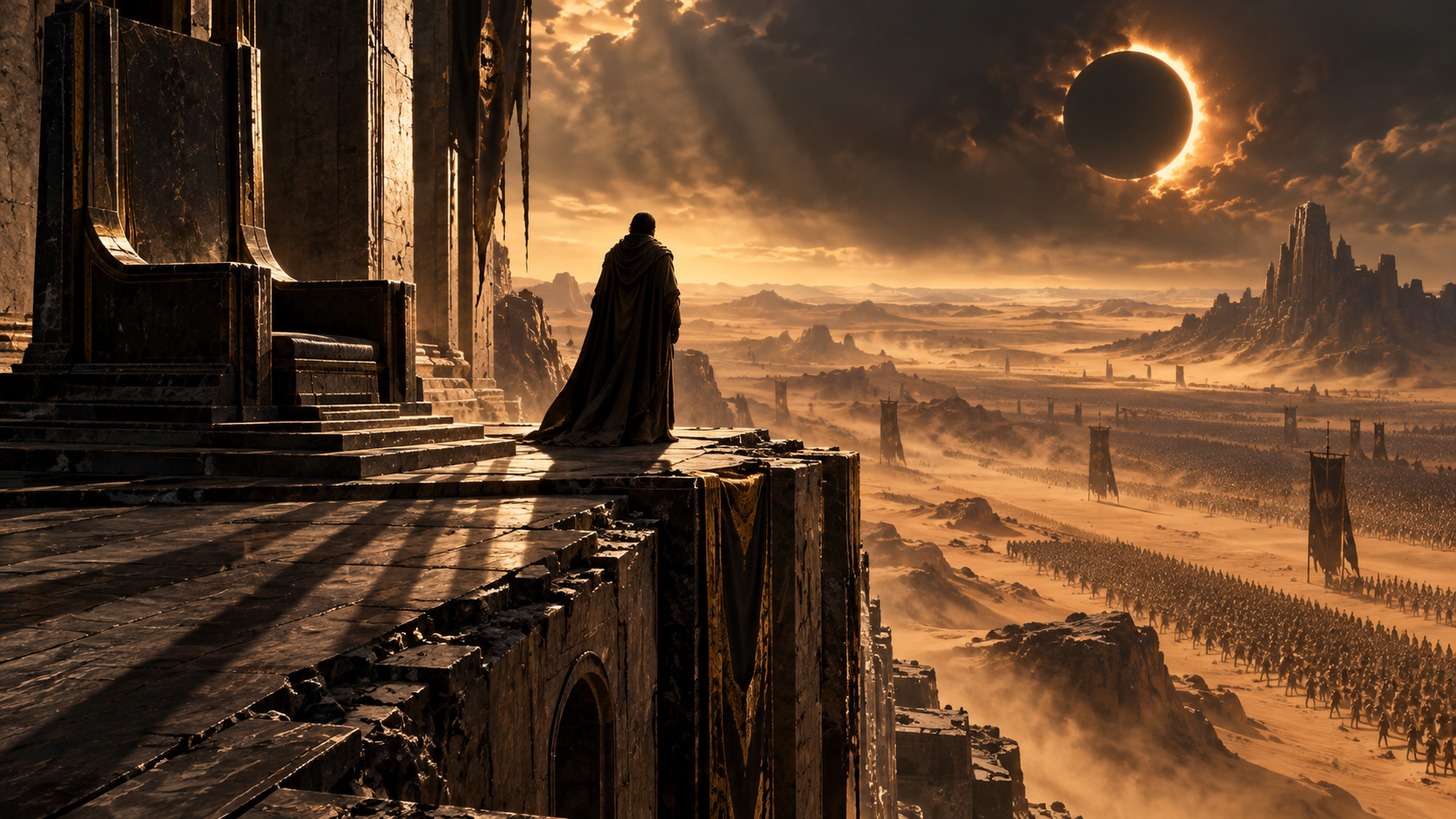
A Throne With No Escape
Knowing the future does not make Paul free; it makes the consequences impossible to ignore.
Paul Atreides has defeated his enemies, taken the throne and become the centre of a religious empire. The victory looks complete until its human cost enters the room.
Dune Messiah is where Frank Herbert makes the reader live with what success has produced. The young man who once seemed capable of changing history now struggles to move inside the history created in his name.
The Big Idea
The first novel asks how Paul acquires power. The sequel asks what happens when power acquires Paul.
Its deeper argument concerns the difference between exceptional ability and legitimate authority. A person may possess extraordinary knowledge while remaining unable to prevent the institutions, loyalties and violence growing around them.
Dune Messiah Summary
The story takes place twelve years after Paul’s rise. His followers have carried a religious war across the universe, killing on an enormous scale. Paul is emperor and messiah, but those roles make him the symbolic centre of consequences he cannot simply reverse.
A conspiracy brings together interests threatened by his rule: the Bene Gesserit, the Spacing Guild and the Tleilaxu. Princess Irulan, his political wife, is involved, while Chani remains his intimate partner. Irulan secretly interferes with Chani’s ability to conceive.
The conspirators give Paul a ghola named Hayt, made from the body of Duncan Idaho. Duncan once died protecting him; Hayt returns as both a painful reminder of loyalty and a potential instrument of manipulation.
That gift is effective because it cannot be treated as merely strategic. Paul’s attachment to Duncan makes the threat emotionally credible. The conspiracy places something he wants inside something designed to endanger him.
A visit connected to the former Fremen fighter Otheym brings Paul into another layer of the plot. The dwarf Bijaz carries hidden conditioning that can activate Hayt against him. Then a stone burner attack blinds Paul physically, although his prescient vision allows him to continue moving as if he can still see.
Chani becomes pregnant and eventually gives birth to twins, Ghanima and Leto II. She dies during childbirth. Paul’s vision has not delivered the secure future he hoped to preserve; it has carried him towards a loss he could anticipate without making emotionally bearable.
Hayt’s conditioning is triggered, but Duncan’s loyalty breaks through it. His recovered identity matters because the conspirators’ weapon becomes evidence that a ghola can regain the person it once was.
Scytale uses that discovery to offer Paul the possibility of restoring Chani in exchange for surrendering power. He also threatens the children. Paul briefly sees through his son’s eyes and kills Scytale, rejecting the bargain rather than allowing grief to hand control to his enemies.
Paul then walks into the desert, following the Fremen custom for the blind. Alia becomes regent, and Irulan turns towards caring for his children.
This ending is not a confirmed account of Paul’s death. It is his departure from the political role that has consumed his life.
Character Arcs: The Emperor, the Lover and the Returned Friend
Paul’s development is a narrowing rather than a conventional ascent. He gains authority but loses room to act as an ordinary person. Every private choice now carries public consequences.
Chani embodies the life he cannot reduce to imperial calculation. Yet the novel gives her less independent interior space than her importance warrants. Her death is both a personal catastrophe and a structural weakness worth recognising.
Duncan’s return moves in the opposite direction to Paul’s trajectory. Where Paul becomes trapped inside imposed significance, Duncan recovers an identity that others tried to instrumentalise.
Irulan also changes. Her movement from political obstruction towards responsibility for the children complicates the idea that a character’s worst action must be their final definition.
The Story Anchor
The unforgettable image is a blind emperor navigating through prescience.
Paul can move because he knows the pattern ahead. That appears to demonstrate control, but it also exposes his captivity: he remains functional by following a future already visible to him.
The ability that seems to remove uncertainty becomes another way of living inside constraint.
The Plot In One Flow
Paul’s victory creates an empire and a religious war, which produce enemies determined to exploit his personal attachments. The return of Duncan, the attack that blinds him and Chani’s pregnancy converge into a crisis where political survival and emotional survival become inseparable.
When Chani dies, the conspirators try to turn the promise of her restoration into leverage. Paul protects his children and refuses the bargain, then leaves the throne’s world for the desert.
If You Only Remember Three Ideas
A successful leader can become a disastrous symbol
Paul’s followers do not merely obey specific instructions. They act through the significance attached to his identity, making him responsible for a movement larger than his immediate control.
Foresight is not the same thing as freedom
Knowing what is coming does not guarantee a painless alternative. Information can clarify the cost of a decision without removing that cost.
Grief makes certain bargains dangerously attractive
The offer to restore Chani targets a desire no political argument could replace. The scene matters because Paul must decide what he will refuse even when refusal hurts.
The Sentence That Explains The Entire Book
A hero becomes dangerous when the world stops distinguishing his greatness from its permission to act.
Why The Ending Matters
Paul’s departure strips away the triumphant shape readers might expect from a sequel. He does not solve the empire by winning one more confrontation.
Emotionally, the desert becomes a place beyond the role of emperor, husband and sacred figure. Philosophically, the ending challenges the assumption that the person at the centre of a system must remain there to give the system meaning.
It also makes the first novel harder to read innocently. The victory that once felt exhilarating now carries a future the reader has witnessed.
Why This Book Still Matters
The novel remains useful wherever charismatic individuals become substitutes for accountable institutions. Its warning extends to politics, business and movements organised around a person’s supposed exceptional insight.
It also challenges a familiar success story: once the breakthrough happens, everything should become easier. Herbert understands that achievement can create obligations and dependencies that the achievement itself cannot resolve.
Where The Book Is Weakest
The political vocabulary and compressed conspiratorial exchanges can make the book harder to enter than its short length suggests. Readers may need to pause over what each faction wants.
Its treatment of women also deserves scrutiny. Chani’s emotional importance exceeds the independence the narrative gives her, while reproduction repeatedly becomes a political instrument.
Those limitations do not cancel the critique of power. They make it necessary to ask whose experience receives the fullest treatment.
Who Should Ignore This Book
Readers looking for a simple extension of the first novel’s adventure may find the change in emphasis frustrating. It is strongest for those interested in consequence, political tragedy and the dismantling of heroic certainty.
Read Dune first. The sequel relies on relationships and institutions already established there.
How This Compares To Alchemised
Both stories distrust official accounts of victory. However, Herbert examines the visible ruler whose public identity becomes a trap, while Alchemised examines people whose private contributions are distorted or erased.
Their endings also differ emotionally. Paul moves away from the centre of power; Helena and Kaine seek a life beyond the public history of the war.
The Common Themes and Hidden Pattern
Power, dependency, grief and manufactured legitimacy run throughout the novel. The hidden pattern is that Paul’s opponents repeatedly turn his attachments into instruments.
The system does not defeat him by discovering that he cares too little. It exploits how much he cares, then makes those feelings operate at imperial scale.
Where These Books Quietly Disagree
Alchemised leaves greater room for private life as an answer to historical violence. Dune Messiah is more suspicious of escape, because the machinery created around Paul continues after his departure.
One asks what can still be saved. The other asks what cannot be undone.
What Most People Misunderstand—and What The Internet Gets Wrong
Calling Paul simply evil flattens the tragedy. Calling him a misunderstood saviour evades the consequences.
The deeper reading holds ability, suffering and responsibility together. Herbert does not need Paul to be a cartoon villain to make his authority dangerous.
Likewise, “Paul can see the future” should not become “Paul controls everything.” The gap between those statements drives the book.
The Taylor Tailored Framework: The Power After Victory Test
After an important success, ask who can still challenge the person responsible for it. Then ask which decisions depend on that person’s approval and what happens if they leave.
Finally, examine who carries the costs that the success story leaves outside the frame. A victory deserves a second evaluation once its consequences become visible.
The Real-Life Test
A founder can rescue a business and later become the bottleneck preventing it from maturing. A manager can be highly competent while creating a team unable to disagree.
The practical issue is not whether the leader deserves admiration. It is whether admiration has replaced a functioning process.
How To Apply The Lesson Without Creating Another Self-Help Fantasy
Choose one decision that currently depends too heavily on one person. Write down who has the authority to question it and what evidence would change the decision.
Build a review point into the process before the next success makes questioning feel disloyal. Accountability works best when it does not require a crisis.
Which Book Should You Read First?
Read Dune for the ascent and Dune Messiah for the consequences. Choose Alchemised afterwards if you want a more intimate exploration of war, loyalty and historical memory.
Five Questions To Test Your Understanding
What does Paul’s victory make harder rather than easier?
Why is Duncan a more effective weapon than an ordinary assassin?
What does prescience fail to provide?
Does leaving power remove responsibility for what power created?
Who can challenge the most admired person in your own organisation?
The Final Lesson
The most frightening leader is not always the one who knows nothing. It can be the person who knows a great deal and becomes impossible to question.
Paul’s tragedy leaves a demand behind: admire ability carefully, build limits around authority, and never let someone’s greatness become your excuse for abandoning judgement.
